
In the pursuit of automotive lightweighting and stringent emission regulations, the development of robust and efficient manufacturing processes has become paramount. As an engineer deeply involved in material science and automotive applications, I have extensively studied the challenges associated with suspension systems in hybrid electric vehicles. These vehicles, with their combined powertrains, impose unique dynamic loads—particularly during rapid start-stop cycles and regenerative braking—that demand components with exceptional strength and ductility. Traditional casting methods often fall short, leading to failures under high-impact conditions. This article explores the transformative potential of squeeze casting, a high-pressure solidification process, as a superior alternative for producing critical suspension parts like mounts and arms in hybrid electric vehicles. By delving into the process mechanics, material science, and practical applications, I aim to demonstrate how squeeze casting not only mitigates failure risks but also aligns with the lightweighting goals essential for modern hybrid electric vehicle platforms.
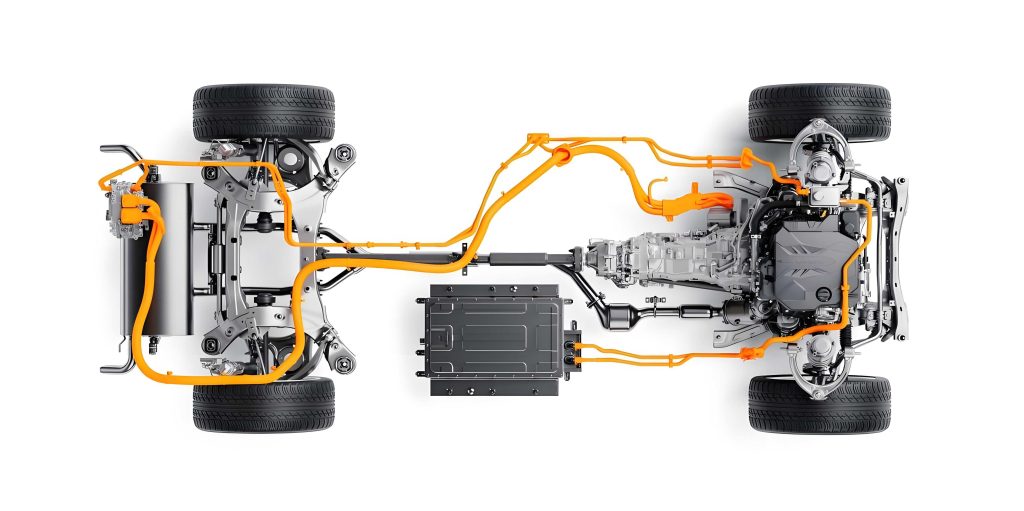
The transition toward hybrid electric vehicles has accelerated the need for advanced manufacturing techniques that can handle increased mechanical stresses while reducing weight. Suspension components, such as mounts and control arms, are critical for vehicle stability and noise-vibration-harshness (NVH) performance. In hybrid electric vehicles, the instantaneous torque from electric motors and the inertial forces from internal combustion engines create shock loads that can exceed 3g accelerations, far beyond the 1g typical in conventional vehicles. This environment exposes weaknesses in components made via conventional gravity casting or die casting, which often suffer from porosity, low elongation, and inadequate yield strength. My research focuses on squeeze casting, also known as liquid die forging, which applies high mechanical pressure during solidification to produce near-net-shape parts with forged-like properties. The process is particularly suited for hybrid electric vehicle applications due to its ability to enhance ductility and fatigue resistance, key factors in preventing brittle fractures under dynamic loads.
Squeeze casting operates on the principle of applying significant pressure—typically around 100 MPa—to molten or semi-solid metal within a die cavity. This pressure is maintained throughout solidification, promoting dense microstructure and eliminating defects like shrinkage pores and gas entrapment. The process can be categorized into two main types: direct squeeze casting, where pressure is applied directly to the metal surface via a punch, and indirect squeeze casting, where pressure is transmitted through a gate system. For complex suspension parts in hybrid electric vehicles, indirect squeeze casting is often preferred due to its flexibility in handling intricate geometries and varying wall thicknesses. The key advantage lies in the combined effect of high-pressure consolidation and limited plastic deformation, which refines grain structure and improves mechanical properties. The fundamental relationship between applied pressure and solidification quality can be expressed using the following equation governing pore suppression:
$$ P_{applied} \geq \frac{2\gamma_{sl}}{r} + \rho g h $$
where \( P_{applied} \) is the applied squeeze pressure, \( \gamma_{sl} \) is the solid-liquid interfacial energy, \( r \) is the pore radius, \( \rho \) is the melt density, \( g \) is gravity, and \( h \) is the melt height. In practice, pressures exceeding 100 MPa ensure that any nascent pores are collapsed, leading to a density close to theoretical limits. This is crucial for hybrid electric vehicle suspension components, which must withstand cyclic loading without failure initiation from internal voids.
Material selection is critical for squeeze casting in hybrid electric vehicles. The alloy A356.2 (equivalent to ZL101A) is predominantly used due to its excellent castability, low iron content, and responsiveness to heat treatment. Its composition typically includes 6.5–7.5% Si, 0.25–0.45% Mg, and controlled impurities, which after T6 treatment (solutionizing and aging) yield a fine dispersion of Mg2Si precipitates that enhance strength. The table below compares the mechanical properties of A356.2 produced via different casting processes, highlighting the superiority of squeeze casting for hybrid electric vehicle applications:
| Manufacturing Process | Tensile Strength (MPa) | Yield Strength (MPa) | Elongation (%) | Typical Density (% of Theoretical) |
|---|---|---|---|---|
| Gravity Casting (Metal Mold) | 280–310 | 220–240 | 3–5 | 95–97 |
| High-Pressure Die Casting | 220–250 | 170–190 | 6–8 | 92–94 |
| Squeeze Casting (Indirect) | 310–340 | 250–270 | 10–14 | 99–99.8 |
| Forged Aluminum (Reference) | 320–360 | 260–280 | 12–16 | ~100 |
The data shows that squeeze casting bridges the gap between conventional casting and forging, offering a cost-effective solution for hybrid electric vehicle suspension parts. The elongation improvement of over 100% compared to gravity casting is particularly significant, as it reduces brittle fracture propensity under impact loads common in hybrid electric vehicle operation. Moreover, the process allows for T6 heat treatment without blistering, enabling further property enhancement through precipitation hardening. The strengthening mechanism can be modeled using the Orowan bypassing equation for dispersion hardening:
$$ \Delta \sigma_{precip} = \frac{M G b}{L} $$
where \( \Delta \sigma_{precip} \) is the strength increment due to precipitates, \( M \) is the Taylor factor (≈3), \( G \) is the shear modulus (~26 GPa for Al), \( b \) is the Burgers vector (0.286 nm), and \( L \) is the inter-precipitate spacing. In squeeze-cast A356.2, the fine Si particles and Mg2Si dispersoids from T6 treatment reduce \( L \), thereby increasing yield strength—a key requirement for hybrid electric vehicle mounts experiencing high multiaxial stresses.
In practical applications for hybrid electric vehicles, squeeze casting addresses specific failure modes observed in suspension components. For instance, mount arms produced via gravity casting often fractured during durability testing on rough roads, where shock loads peaked at 55 kN in the X-direction. Finite element analysis (FEA) using ABAQUS software, with material inputs from squeeze-cast A356.2 tensile tests, revealed that stress concentrations coincided with gate locations and thick sections prone to shrinkage. The failure criterion based on maximum principal stress \( \sigma_1 \) indicated:
$$ \sigma_1 \geq \frac{S_{ut}}{N} $$
where \( S_{ut} \) is the ultimate tensile strength (322 MPa for squeeze-cast A356.2-T6) and \( N \) is the safety factor (target ≥1.5 for hybrid electric vehicle components). For the original gravity-cast design, \( \sigma_1 \) exceeded 300 MPa in critical areas, leading to a safety factor below 1.0 and subsequent fracture. By switching to squeeze casting, the improved ductility and homogeneity increased the allowable stress, with FEA predictions showing safety factors above 2.0 for the same loading conditions. This computational validation underscores the suitability of squeeze casting for hybrid electric vehicle suspension systems, where reliability is non-negotiable.
The optimization of squeeze casting parameters is essential for hybrid electric vehicle components. Key variables include melt temperature (typically 680–710°C for A356.2), die temperature (150–250°C), applied pressure (80–120 MPa), and pressure duration (10–30 seconds). A designed experiment using Taguchi methods can identify optimal settings to maximize mechanical properties. The following table summarizes the effects of these parameters on tensile strength and elongation for a hybrid electric vehicle mount arm:
| Parameter | Level 1 | Level 2 | Level 3 | Optimal for Strength | Optimal for Elongation |
|---|---|---|---|---|---|
| Melt Temperature (°C) | 680 | 695 | 710 | 695 | 680 |
| Die Temperature (°C) | 150 | 200 | 250 | 200 | 200 |
| Applied Pressure (MPa) | 80 | 100 | 120 | 120 | 100 |
| Pressure Hold Time (s) | 10 | 20 | 30 | 20 | 20 |
From this, a compromise condition (695°C melt, 200°C die, 100 MPa pressure, 20 s hold) yields a balanced improvement for hybrid electric vehicle parts, achieving approximately 330 MPa tensile strength and 12% elongation. The pressure parameter is critical, as it directly influences pore elimination and grain refinement. The relationship between pressure and porosity volume fraction \( f_p \) can be approximated by:
$$ f_p = f_{p0} \exp\left(-\frac{P}{P_c}\right) $$
where \( f_{p0} \) is the initial porosity without pressure, and \( P_c \) is a critical pressure constant (~40 MPa for A356.2). At 100 MPa, \( f_p \) reduces to less than 0.5%, ensuring the high integrity needed for hybrid electric vehicle suspension components subjected to fatigue loading.
Microstructural analysis further validates the benefits of squeeze casting for hybrid electric vehicles. In my studies, samples from squeeze-cast mount arms were examined using optical microscopy and scanning electron microscopy (SEM). The as-cast structure showed fine α-Al dendrites with an average secondary dendrite arm spacing (SDAS) of 20–25 µm, compared to 40–50 µm in gravity-cast parts. After T6 treatment, the eutectic Si particles spheroidized to diameters below 2 µm, uniformly distributed in the matrix. This refinement directly enhances toughness, as described by the Hall-Petch relationship for grain boundary strengthening:
$$ \sigma_y = \sigma_0 + k_y d^{-1/2} $$
where \( \sigma_y \) is yield strength, \( \sigma_0 \) is friction stress, \( k_y \) is a material constant, and \( d \) is grain diameter. With squeeze casting reducing \( d \) by 50%, the contribution to \( \sigma_y \) increases significantly, aiding hybrid electric vehicle components in resisting plastic deformation under shock loads. Additionally, energy-dispersive X-ray spectroscopy (EDS) confirmed minimal oxide inclusions, with oxygen content below 0.1 wt%, reducing stress concentration sites.
Process challenges, such as localized squeeze pin sticking, were encountered during die design for hybrid electric vehicle mounts. Initially, an 18 mm diameter pin in thick sections experienced jamming due to thermal expansion and misalignment, leading to inadequate feeding and shrinkage pores in high-stress areas. By reducing the pin diameter to 16 mm and optimizing clearances (to 0.05–0.08 mm per side), the pressure transmission improved, and defects were eliminated. The gate was also relocated 15 mm away from the maximum stress concentration zone, as determined by FEA, to prevent notch effects. The modified design achieved consistent destructive force test results exceeding 80 kN in the X-direction, well above the 55 kN requirement for hybrid electric vehicle applications. The table below compares test outcomes before and after optimization for a batch of 20 squeeze-cast mount arms:
| Sample Set | Average Destructive Force (kN) | Standard Deviation (kN) | Minimum Value (kN) | Pass Rate (%) |
|---|---|---|---|---|
| Before Optimization (7 samples) | 51.3 | 6.8 | 41.0 | 57 |
| After Optimization (20 samples) | 83.2 | 1.5 | 81.1 | 100 |
This improvement highlights the importance of die design and process control in squeeze casting for hybrid electric vehicle components. The consistent high performance ensures safety margins that accommodate the unpredictable load spikes characteristic of hybrid electric vehicle driving cycles, including aggressive acceleration and regenerative braking events.
From a broader perspective, squeeze casting offers substantial lightweighting potential for hybrid electric vehicles. Replacing ductile iron or forged steel suspension parts with squeeze-cast A356.2 aluminum can reduce mass by 40–60%, directly improving fuel efficiency and battery range in hybrid electric vehicles. The economic analysis also favors squeeze casting over forging for complex shapes, as it reduces machining waste and tooling costs. A comparative life-cycle assessment (LCA) for a hybrid electric vehicle suspension arm shows that squeeze casting lowers embodied energy by 30% compared to forging, due to lower processing temperatures and shorter cycle times. The environmental benefit aligns with the sustainability goals of hybrid electric vehicle adoption, making squeeze casting a green manufacturing choice.
Future developments in squeeze casting for hybrid electric vehicles may involve integration with digital twins and real-time monitoring. Sensors embedded in dies can track pressure and temperature profiles, enabling adaptive control to further enhance quality. Additionally, alloy modifications, such as adding trace elements like Sr or Ti for grain refinement, could push elongation beyond 15% while maintaining strength. Research into semi-solid squeeze casting (thixoforming) also promises even better microstructures for hybrid electric vehicle components, though it requires precise slurry preparation.
In conclusion, squeeze casting stands out as a transformative technology for hybrid electric vehicle suspension systems. Its ability to produce high-integrity, ductile components with forged-like properties addresses the dynamic loading challenges unique to hybrid electric vehicles. Through meticulous process optimization and die design, squeeze-cast A356.2 parts achieve mechanical performance that surpasses conventional casting and rivals forging, all while supporting lightweighting initiatives. As hybrid electric vehicle adoption grows, squeeze casting will play an increasingly vital role in ensuring durability, safety, and efficiency, paving the way for next-generation automotive manufacturing. The continued innovation in this field will undoubtedly contribute to the resilience and sustainability of hybrid electric vehicle platforms worldwide.