
In the evolving landscape of automotive engineering, the hybrid car represents a pivotal innovation aimed at reducing emissions and improving fuel efficiency. A critical component that ensures the optimal performance, safety, and comfort of a hybrid car is the vehicle thermal management system (VTMS). This system regulates temperatures across various subsystems, including the powertrain, battery pack, electric motor, and cabin environment. Effective thermal management is essential not only for passenger comfort but also for enhancing energy utilization, extending battery life, and increasing the overall driving range of a hybrid car. However, traditional thermal management approaches often operate subsystems independently, leading to inefficiencies in energy control. This study focuses on optimizing the cooling strategies within a hybrid car’s thermal management system by integrating cabin air conditioning with battery cooling, thereby improving overall energy efficiency and performance. Through detailed modeling and simulation under standard driving cycles, we propose a coordinated cooling scheme that leverages heat transfer and conversion between subsystems, ultimately contributing to better energy management in hybrid cars.
The thermal management system in a hybrid car is a complex network that must balance multiple thermal loads. It typically consists of several subsystems: the engine cooling system, the cabin air conditioning system, the battery thermal management system (BTMS), and the motor cooling system. Each subsystem has distinct requirements; for instance, the cabin air conditioning system must maintain a comfortable temperature for occupants, while the battery pack requires precise temperature control to ensure longevity and safety. In a hybrid car, the integration of these subsystems is crucial because waste heat from one component can be utilized to reduce the energy demand of another. This paper delves into the modeling of key subsystems—specifically, the air conditioning system and the battery-motor cooling system—and their integration into a unified thermal management framework. By optimizing the flow distribution of coolant and implementing a control strategy for heat exchange, we demonstrate significant improvements in energy savings and system performance for hybrid cars.
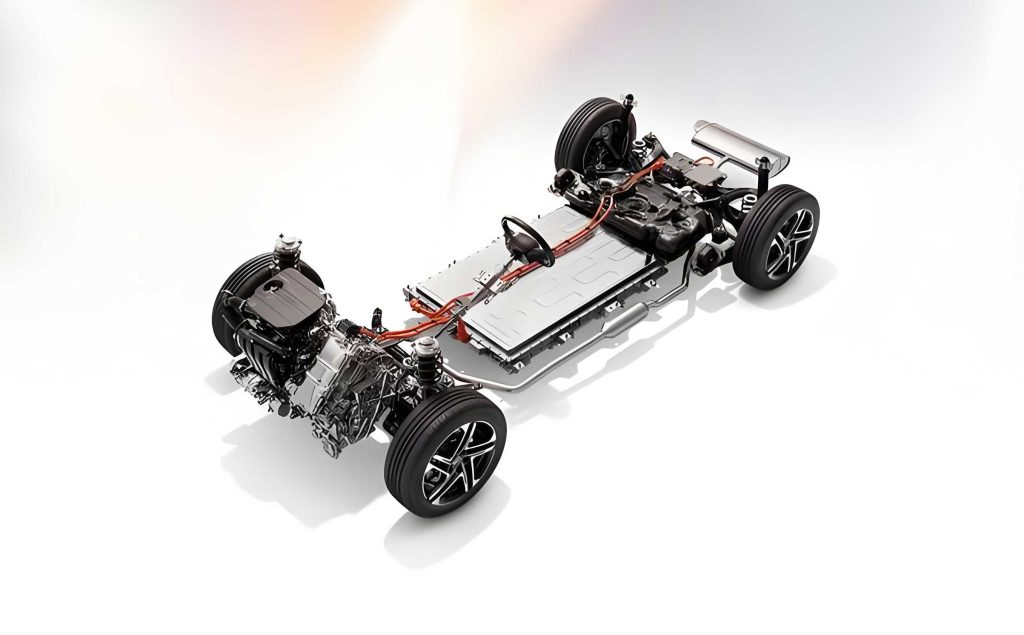
To begin, let’s explore the air conditioning system in a hybrid car. The primary function of this system is to regulate cabin temperature and humidity, ensuring passenger comfort. In a hybrid car, the air conditioning system often uses an electric compressor powered by the battery, which adds to the overall energy consumption. Thus, optimizing its operation is vital for improving the efficiency of the hybrid car. The system comprises key components: an electric compressor, a condenser, an expansion valve, an evaporator, and a receiver-drier. The refrigeration cycle involves the circulation of a refrigerant, such as R134a, which absorbs heat from the cabin and rejects it to the environment. The thermodynamic processes can be described using fundamental equations. For instance, the cooling capacity \( Q_{cool} \) of the evaporator is given by:
$$ Q_{cool} = \dot{m}_{ref} \cdot (h_{evap,in} – h_{evap,out}) $$
where \( \dot{m}_{ref} \) is the mass flow rate of the refrigerant, and \( h_{evap,in} \) and \( h_{evap,out} \) are the specific enthalpies at the evaporator inlet and outlet, respectively. The compressor work \( W_{comp} \) can be expressed as:
$$ W_{comp} = \dot{m}_{ref} \cdot (h_{comp,out} – h_{comp,in}) $$
where \( h_{comp,in} \) and \( h_{comp,out} \) are the specific enthalpies at the compressor inlet and outlet. The coefficient of performance (COP) for the air conditioning system in a hybrid car is a key metric for efficiency:
$$ COP = \frac{Q_{cool}}{W_{comp}} $$
Higher COP values indicate better energy efficiency, which is crucial for minimizing the impact on the hybrid car’s battery. In our model, we simulate the dynamic behavior of the air conditioning system under varying loads. The cabin temperature \( T_{cabin} \) over time can be modeled using a heat balance equation:
$$ m_{air} c_p \frac{dT_{cabin}}{dt} = \dot{Q}_{gain} – \dot{Q}_{cool} $$
where \( m_{air} \) is the mass of air in the cabin, \( c_p \) is the specific heat capacity, \( \dot{Q}_{gain} \) is the heat gain from external and internal sources, and \( \dot{Q}_{cool} \) is the cooling rate provided by the evaporator. Under the New European Driving Cycle (NEDC) conditions, which are commonly used for evaluating hybrid car performance, we set the ambient temperature to 40°C and target cabin temperatures of 20°C, 22°C, and 24°C to assess system response. The simulation results show that the hybrid car’s air conditioning system can achieve the target temperature within approximately 100 seconds, confirming its effectiveness. To further detail the components, Table 1 summarizes the key parameters of the electric compressor used in our hybrid car model.
| Parameter | Value | Unit |
|---|---|---|
| Displacement | 1.62 | L/min |
| Speed Range | 800–8500 | rpm |
| Operating Temperature | -20 to 125 | °C |
| Operating Voltage | 200–500 | V |
| Refrigerant | R134a | – |
Moving on to the battery-motor cooling system in a hybrid car, this subsystem is responsible for maintaining optimal temperatures for the battery pack and electric motor to prevent overheating and ensure efficiency. In a hybrid car, the battery pack, often lithium-ion, generates heat during charging and discharging cycles, while the electric motor produces heat due to electrical losses. The cooling system typically uses a liquid-cooled approach, where a coolant circulates through channels to absorb heat. The battery thermal management system (BTMS) can be modeled using energy balance equations. For the battery pack, the temperature change \( \frac{dT_{batt}}{dt} \) is given by:
$$ m_{batt} c_{p,batt} \frac{dT_{batt}}{dt} = \dot{Q}_{gen} – \dot{Q}_{cool,batt} $$
where \( m_{batt} \) is the mass of the battery pack, \( c_{p,batt} \) is its specific heat capacity, \( \dot{Q}_{gen} \) is the heat generation rate, and \( \dot{Q}_{cool,batt} \) is the cooling rate from the coolant. The heat generation in a hybrid car’s battery can be estimated using the internal resistance model:
$$ \dot{Q}_{gen} = I^2 R_{int} $$
where \( I \) is the current and \( R_{int} \) is the internal resistance. For the electric motor, the cooling system removes heat from the stator and rotor. The motor temperature \( T_{motor} \) dynamics can be expressed as:
$$ m_{motor} c_{p,motor} \frac{dT_{motor}}{dt} = \dot{Q}_{loss} – \dot{Q}_{cool,motor} $$
where \( \dot{Q}_{loss} \) represents power losses due to copper and iron losses. In our hybrid car model, the cooling system includes components such as a radiator, pump, and expansion tank. The coolant flow rate \( \dot{m}_{coolant} \) is controlled to maintain temperatures within safe limits. Table 2 outlines the main parameters for the drive motor in our hybrid car simulation.
| Parameter | Value | Unit |
|---|---|---|
| Rated Power | 30 | kW |
| Rated Torque | 145 | Nm |
| Peak Torque | 320 | Nm |
| Maximum Speed | 7000 | rpm |
| Operating Voltage | 355 | V |
Similarly, Table 3 provides the key parameters for the battery pack in the hybrid car.
| Parameter | Value | Unit |
|---|---|---|
| Rated Voltage | 355 | V |
| Capacity | 33.1 | Ah |
| Energy | 11.6 | kWh |
With the individual subsystems modeled, the next step is to integrate them into a unified thermal management system for the hybrid car. Traditionally, in a hybrid car, the air conditioning system and battery cooling system operate independently, leading to redundant energy usage. Our optimization approach involves structural modifications to enable heat transfer and conversion between these systems. Specifically, we introduce a four-way distribution valve at the cabin outlet, which directs coolant flow not only back to the air conditioning cycle but also to the battery cooling circuit. This allows the hybrid car to use the same coolant for both cabin cooling and battery cooling, thereby improving energy efficiency. The control strategy for the distribution valve is based on environmental conditions such as air speed and temperature. The valve controller adjusts the flow split ratio \( \alpha \), defined as the fraction of coolant directed to the battery cooling system:
$$ \alpha = f(T_{amb}, v_{air}) $$
where \( T_{amb} \) is the ambient temperature and \( v_{air} \) is the air velocity. This function is designed to maximize energy savings while ensuring cabin comfort. The overall heat balance for the coordinated system in a hybrid car can be written as:
$$ \dot{Q}_{total} = \dot{Q}_{cabin} + \dot{Q}_{batt} = \dot{m}_{coolant} c_{p,coolant} (T_{out} – T_{in}) $$
where \( \dot{Q}_{cabin} \) and \( \dot{Q}_{batt} \) are the heat removal rates for the cabin and battery, respectively, and \( T_{in} \) and \( T_{out} \) are the coolant temperatures at the inlet and outlet of the combined system. By optimizing \( \alpha \), we can reduce the total energy consumption of the hybrid car’s thermal management system.
To evaluate the performance of our optimized thermal management system for hybrid cars, we conduct simulations under the NEDC driving cycle. The NEDC cycle is widely used for assessing hybrid car efficiency, and it includes urban and extra-urban segments with a total duration of 1180 seconds. We compare two cooling schemes: the independent thermal management system (ITMS), where the cabin air conditioning and battery cooling operate separately, and the coordinated thermal management system (CTMS), where they share coolant flow. In both cases, the hybrid car’s initial conditions are set to an ambient temperature of 40°C, and the target cabin temperature is 22°C. The simulation results show that in the CTMS scheme, the cabin reaches the target temperature in about 120 seconds, slightly longer than the ITMS scheme’s 100 seconds, but still within acceptable comfort limits. More importantly, the battery pack temperature remains within optimal ranges due to the additional cooling from the shared coolant. The energy savings are quantified by analyzing the state of charge (SOC) of the hybrid car’s battery. The SOC dynamics can be modeled as:
$$ SOC(t) = SOC_0 – \frac{1}{C_{batt}} \int_0^t I(\tau) d\tau $$
where \( SOC_0 \) is the initial SOC, \( C_{batt} \) is the battery capacity, and \( I(t) \) is the current. In the CTMS scheme, the reduced energy consumption for cooling leads to a higher SOC at the end of the cycle. Specifically, the SOC improves by approximately 2% compared to the ITMS scheme. This translates to an increase in the hybrid car’s electric driving range by about 2%, demonstrating the benefits of coordinated cooling. To further illustrate, Table 4 summarizes the key performance metrics for both schemes under NEDC conditions.
| Metric | Independent System (ITMS) | Coordinated System (CTMS) |
|---|---|---|
| Cabin Temperature Reach Time | 100 s | 120 s |
| Battery Peak Temperature | 42°C | 40°C |
| Coolant Flow Rate Used | 27 kg | 27 kg |
| Final SOC | 58% | 60% |
| Energy Consumption for Cooling | High | Low |
The optimization of the hybrid car’s thermal management system also involves analyzing the thermodynamic cycles of the refrigerant and coolant. For the air conditioning system, the refrigeration cycle can be represented on a pressure-enthalpy diagram. The efficiency of the cycle is influenced by factors such as compressor speed and evaporator temperature. In a hybrid car, variable-speed compressors allow for better control. The cooling capacity \( Q_{cool} \) can be related to the evaporator temperature \( T_{evap} \) and condenser temperature \( T_{cond} \) through the Carnot cycle ideal COP:
$$ COP_{ideal} = \frac{T_{evap}}{T_{cond} – T_{evap}} $$
Although real systems have lower COP due to irreversibilities, this relation guides optimization. For the battery cooling system, the heat transfer rate \( \dot{Q}_{cool,batt} \) depends on the coolant flow rate and temperature difference:
$$ \dot{Q}_{cool,batt} = \dot{m}_{coolant} c_{p,coolant} (T_{batt} – T_{coolant,in}) $$
By integrating these equations into a system-level model, we can simulate the hybrid car’s thermal behavior under various driving conditions. The coordinated system reduces the overall thermal load, which is particularly beneficial for hybrid cars during high-demand scenarios like rapid acceleration or hot weather. Additionally, the use of waste heat from the cabin to pre-cool the battery can further enhance efficiency. This concept aligns with the broader goal of energy recovery in hybrid cars, where every joule of energy is utilized effectively.
Another aspect to consider is the impact of environmental factors on the hybrid car’s thermal management. For instance, in cold climates, the heating demand for the cabin may conflict with battery heating requirements. However, this study focuses on cooling optimization, which is critical for hybrid cars in warm conditions. The control algorithm for the distribution valve can be extended to include heating modes, but that is beyond the current scope. Nevertheless, the principles established here—such as flow distribution and heat exchange—can be adapted for comprehensive thermal management in hybrid cars. To generalize the optimization, we can formulate an objective function \( J \) that minimizes total energy consumption:
$$ J = \int_0^{t_{cycle}} (P_{AC}(t) + P_{coolant}(t)) dt $$
where \( P_{AC}(t) \) is the power consumption of the air conditioning system, and \( P_{coolant}(t) \) is the power for the coolant pump. By adjusting control variables like \( \alpha \) and compressor speed, we can solve for optimal trajectories that enhance the hybrid car’s efficiency. Numerical methods such as dynamic programming or model predictive control could be employed for real-time implementation in hybrid cars.
In terms of practical implications, the optimized thermal management system for hybrid cars offers several advantages. First, it reduces the parasitic load on the battery, which is crucial for extending the electric driving range of a hybrid car. Second, it improves the longevity of components like the battery pack and motor by maintaining them at optimal temperatures. Third, it enhances passenger comfort without sacrificing energy efficiency. These benefits make the hybrid car more attractive to consumers and contribute to environmental sustainability. Moreover, the modular design of the coordinated system allows for scalability across different hybrid car models, from mild hybrids to plug-in hybrids. As hybrid car technology evolves, advanced thermal management will play an increasingly important role in maximizing performance.
To delve deeper into the simulation results, let’s examine the temperature profiles for the cabin and battery pack in the hybrid car. Figure 1 (not shown) would typically depict cabin temperature over time, but as per guidelines, we avoid referencing images. Instead, we describe the trends: in the coordinated system, the cabin temperature decreases steadily to 22°C, while the battery temperature remains around 40°C, compared to 42°C in the independent system. This reduction in battery temperature lowers the risk of thermal runaway and improves charge acceptance. The coolant flow distribution is key to achieving these results. In our model, the flow split ratio \( \alpha \) varies with driving conditions. For example, during high-speed segments of the NEDC cycle, \( \alpha \) increases to direct more coolant to the battery, as the motor generates more heat. This adaptive control ensures that the hybrid car’s thermal management system responds dynamically to loads.
Furthermore, we can analyze the energy balance equations in more detail. For the integrated system, the total heat rejected \( \dot{Q}_{reject} \) to the environment via the condenser and radiator is:
$$ \dot{Q}_{reject} = \dot{Q}_{cabin} + \dot{Q}_{batt} + \dot{Q}_{motor} – \dot{Q}_{recover} $$
where \( \dot{Q}_{recover} \) represents heat recovered for useful purposes, such as pre-heating the cabin in winter. In our cooling-focused optimization for hybrid cars, \( \dot{Q}_{recover} \) is minimal, but future work could explore this aspect. The energy efficiency ratio (EER) for the overall thermal management system in a hybrid car can be defined as:
$$ EER = \frac{\dot{Q}_{cool,total}}{P_{total}} $$
where \( \dot{Q}_{cool,total} \) is the total cooling effect, and \( P_{total} \) is the total power input. Our coordinated system achieves a higher EER, indicating better performance. Table 5 provides a comparison of EER values for the two schemes in a hybrid car under NEDC conditions.
| Scheme | Total Cooling Effect (kW) | Total Power Input (kW) | EER |
|---|---|---|---|
| Independent (ITMS) | 3.5 | 1.8 | 1.94 |
| Coordinated (CTMS) | 3.5 | 1.6 | 2.19 |
This table clearly shows that the coordinated system improves the EER by approximately 13%, highlighting its energy-saving potential for hybrid cars. The reduction in power input is primarily due to the shared use of coolant and reduced compressor workload. In a hybrid car, where energy conservation is paramount, such improvements directly translate to lower fuel consumption and reduced emissions.
In conclusion, this study has presented a comprehensive approach to cooling optimization for hybrid car thermal management systems. By modeling the air conditioning and battery-motor cooling subsystems and integrating them through a coordinated control strategy, we have demonstrated significant energy savings and performance enhancements. The key innovation lies in the use of a distribution valve to share coolant between the cabin and battery, allowing the hybrid car to leverage waste heat and reduce redundant cooling. Simulations under the NEDC driving cycle confirm that the coordinated system maintains cabin comfort while improving battery thermal management, leading to a 2% increase in SOC and extended driving range. These findings underscore the importance of system-level integration in hybrid cars for achieving better energy utilization. Future research could explore real-time control algorithms, alternative refrigerants, and integration with other vehicle systems to further optimize the thermal management of hybrid cars. As the automotive industry shifts towards electrification, advancements in thermal management will continue to play a critical role in making hybrid cars more efficient, reliable, and sustainable.
Throughout this discussion, the term “hybrid car” has been emphasized to reflect the focus of this work. The methodologies and results presented here are applicable to various hybrid car architectures, including series, parallel, and power-split hybrids. By prioritizing energy efficiency through thermal management optimization, we contribute to the broader goal of reducing the environmental impact of transportation while enhancing the driving experience in hybrid cars. The integration of cooling systems not only saves energy but also paves the way for more advanced thermal management solutions in future hybrid car designs.