
As fossil energy resources become increasingly scarce and environmental issues grow more prominent, the automotive industry has shifted its focus toward reducing carbon emissions. Hybrid cars, particularly hybrid electric vehicles (HEVs), have emerged as a crucial transitional technology between conventional internal combustion engine vehicles and pure electric vehicles. The development of effective control strategies is central to optimizing the performance of hybrid cars, as these strategies manage power distribution between the engine and motor, ensuring efficient operation under various driving conditions. In this study, we explore the redevelopment of control strategies for parallel hybrid cars using ADVISOR software, aiming to enhance mode-switching rationality, improve battery charge-discharge performance, and extend driving range. This research underscores the importance of advanced control methodologies in advancing hybrid car technology.
Hybrid cars combine an internal combustion engine with an electric motor, offering benefits such as improved fuel economy, reduced emissions, and enhanced power performance. The parallel hybrid configuration allows both power sources to drive the wheels independently or jointly, providing flexibility in energy management. Control strategies for hybrid cars must dynamically allocate torque or power between the engine and motor based on factors like vehicle speed, load demand, and battery state of charge (SOC). ADVISOR (Advanced Vehicle Simulator), a simulation tool built in MATLAB/Simulink, serves as a valuable platform for modeling and testing these strategies. However, default control strategies in ADVISOR may not fully address real-world scenarios, necessitating redevelopment to optimize hybrid car performance.
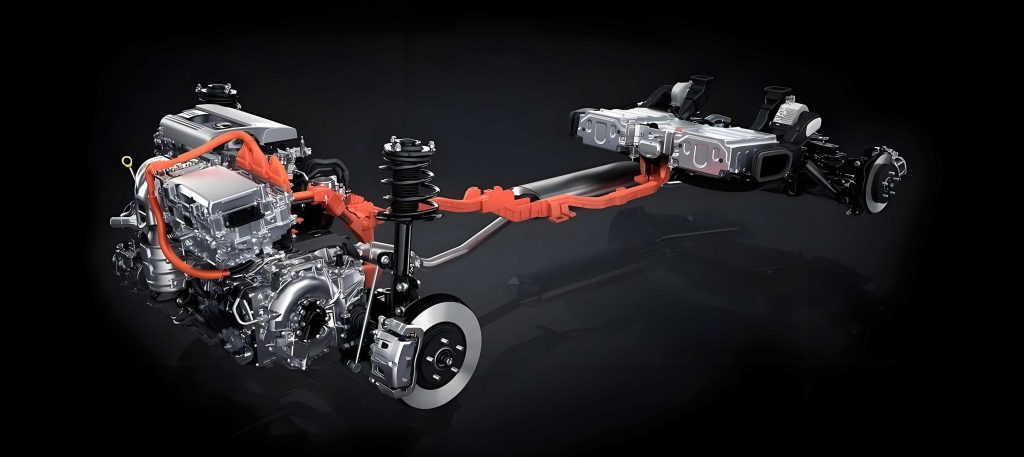
The powertrain layout of a parallel hybrid car typically includes an engine, an electric motor, a torque coupler, a transmission, and a battery pack. In this configuration, the engine and motor can deliver torque to the drivetrain separately or together via the coupler. The motor can also function as a generator to recharge the battery during regenerative braking or when excess engine power is available. The dynamic equations governing the system vary depending on the operating mode. For electric-only driving, with the clutch disengaged, the dynamics are described by:
$$ J_1 = i_0^2 i_{gm}^2 J_m + J_W + 0.5 m r_W^2 $$
$$ J_1 \dot{\omega}_W + B \omega_W = i_{gm} T_m – T_L $$
$$ \omega_m = \omega_W i_{gm} i_0 $$
where \( J_1 \) is the equivalent rotational inertia of the vehicle’s translational mass, \( i_0 \) is the final drive ratio, \( i_{gm} \) is the motor transmission ratio, \( J_m \) is the motor inertia, \( J_W \) is the wheel inertia, \( m \) is the vehicle mass, \( r_W \) is the wheel radius, \( \omega_W \) is the wheel angular velocity, \( T_m \) is the motor torque, \( T_L \) is the load torque, and \( \omega_m \) is the motor angular velocity. During engine-only driving, the engine directly drives the transmission, while in combined mode, with the clutch slipping or engaged, the dynamics become more complex. For clutch slip mode:
$$ J_2 = i_0^2 (i_{ge}^2 J_{cm} + i_{gm}^2 J_m) + J_W + 0.5 m r_W^2 $$
$$ J_2 \dot{\omega}_W + B \omega_W = i_{gm} T_m + i_{ge} T_c – T_L $$
$$ \omega_{mc} = \omega_W i_{ge} i_0 $$
where \( J_2 \) is the equivalent inertia during slip, \( i_{ge} \) is the engine transmission ratio, \( J_{cm} \) is the clutch inertia, \( T_c \) is the clutch torque, and \( \omega_{mc} \) is the angular velocity. For clutch engaged mode:
$$ J_3 = i_0^2 [i_{ge}^2 (J_e + J_{ce} + J_{cm}) + i_{gm}^2 J_m] + J_W + 0.5 m r_W^2 $$
$$ J_3 \dot{\omega}_W + B \omega_W = i_{ge} T_e + i_{gm} T_m – T_L $$
where \( J_3 \) is the equivalent inertia when engaged, \( J_e \) is the engine inertia, \( J_{ce} \) is the clutch cover inertia, and \( T_e \) is the engine torque. These equations highlight the intricate interactions in a parallel hybrid car, necessitating precise control to maintain efficiency.
ADVISOR software provides a default control strategy for parallel hybrid cars, known as the parallel assist control strategy. This strategy prioritizes the engine as the primary power source, with the motor assisting during high-torque demands or low-efficiency engine operations. Key operating modes include: electric-only driving at low speeds, motor assistance when torque exceeds engine capacity, engine shutdown during low-efficiency periods, battery charging when SOC is low, and regenerative braking. The core of this strategy involves maintaining battery SOC around a midpoint value (SOC0) to prevent overcharge or deep discharge. The battery supplemental torque is calculated as:
$$ T_{chg} = K (SOC_0 – SOC) $$
$$ K = \frac{T_{const}}{A_{soc}} = \frac{T_{const}}{(SOC_{hi} – SOC_{lo})/2} $$
where \( T_{chg} \) is the charging torque, \( K \) is a positive constant, \( T_{const} \) is the engine charging torque constant, and \( SOC_{hi} \) and \( SOC_{lo} \) are the high and low SOC limits. In ADVISOR’s default model, this is implemented with a fixed ess_on value of 1, which can lead to battery depletion under high-load conditions like climbing, as the motor continues to discharge the battery despite insufficient engine power. This flaw necessitates redevelopment to protect the battery and improve hybrid car performance.
To address these limitations, we redeveloped the control strategy by modifying the battery supplemental torque calculation module in Simulink. The enhanced model incorporates a battery management system that disconnects the motor when SOC falls below a threshold, preventing excessive discharge, and allows discharge when SOC is high to avoid overcharging. The revised module dynamically adjusts ess_on based on real-time SOC, ensuring balanced operation. This redevelopment aims to optimize the hybrid car’s energy flow, particularly during demanding cycles, by integrating feedback mechanisms that respond to battery state and load conditions. The updated Simulink model was embedded into ADVISOR’s GUI, allowing for seamless simulation with customized vehicle parameters.
To validate the redeveloped control strategy, we performed simulations using ADVISOR on a representative parallel hybrid car. The vehicle parameters are summarized in the tables below, covering整车 and component specifications. These parameters define the hybrid car’s baseline performance for comparison.
| Parameter | Symbol | Value | Unit |
|---|---|---|---|
| Dimensions (L × W × H) | – | 3159 × 1480 × 1520 | mm |
| Curb Mass | m | 1350 | kg |
| Frontal Area | A | 2.0 | m² |
| Drag Coefficient | C_D | 0.3 | – |
| Wheelbase | – | 1850 | mm |
| Rolling Resistance Coefficient | f | 0.019 | – |
| Transmission Efficiency | η_T | 0.85 | – |
| Mass Factor | δ | 1.04 | – |
| Wheel Radius | r_W | 0.282 | m |
| Component | Parameter | Value | Unit |
|---|---|---|---|
| Engine | Max Power (at Speed) | 39 kW (5600 rpm) | kW |
| Max Torque (at Speed) | 79 N·m (3300 rpm) | N·m | |
| Motor | Rated Power | 73 kW | kW |
| Max Speed | 9800 rpm | rpm | |
| Average Efficiency | 0.89 | – | |
| Battery | Standard Discharge Capacity | 25 Ah | Ah |
| Number of Modules | 25 | – |
We selected the CYC_NREL2VAIL driving cycle for simulation, which includes high-load segments such as climbs to test the hybrid car under strenuous conditions. This cycle spans 139.78 km over 5692 seconds, with a maximum speed of 117.87 km/h and multiple stops. Simulations compared the default and redeveloped control strategies, focusing on vehicle speed and battery SOC trends. The results indicate that the modified strategy slightly affects动力性, with minor动力损失 during high loads, but overall performance remains acceptable. More importantly, the battery SOC profile shows significant improvement: under the redeveloped strategy, SOC fluctuates more sustainably, with charging during light loads and controlled discharge during heavy loads, thereby extending the hybrid car’s driving range. For instance, initial SOC drops due to polarization are mitigated, and SOC stabilizes closer to the midpoint, reducing deep discharge risks.
The importance of control strategy redevelopment for hybrid cars cannot be overstated. By refining ADVISOR’s default models, we enhance the hybrid car’s ability to manage energy efficiently, particularly in challenging scenarios. This redevelopment not only improves battery longevity and vehicle续航 but also contributes to the broader adoption of hybrid cars as a sustainable transportation solution. Future work could integrate machine learning algorithms for adaptive control, further optimizing hybrid car performance across diverse environments. In conclusion, this study demonstrates that targeted modifications to control strategies can yield substantial benefits for parallel hybrid cars, paving the way for more intelligent and resilient hybrid systems.
Hybrid cars represent a pivotal innovation in automotive technology, balancing environmental concerns with practical mobility needs. The redevelopment process outlined here underscores the value of simulation tools like ADVISOR in iterating control strategies. As hybrid cars evolve, continuous refinement of these strategies will be essential to maximize efficiency and reliability. This research contributes to that ongoing effort, highlighting how nuanced adjustments can lead to meaningful advancements in hybrid car dynamics and energy management.