
In recent years, the automotive industry has increasingly focused on reducing vehicle energy consumption, with hybrid cars playing a pivotal role due to their ability to combine internal combustion engines and electric motors. One promising approach to enhance fuel economy is eco-driving (ECO), which involves optimizing driving behavior to minimize energy use. This study investigates the impact of driving time on eco-driving strategies for hybrid cars, particularly when traversing ramp roads. By adjusting vehicle speed profiles, we aim to develop strategies that reduce energy demand while considering time constraints, which are crucial for traffic flow and practical driving scenarios. The core of this research lies in formulating an eco-driving strategy model using two-state dynamic programming, with driving distance and speed as states and driving time as a stage variable. We target the sum of driving and braking energy as the objective function, as the fuel economy of hybrid cars on real roads is primarily influenced by vehicle energy demand rather than powertrain efficiency variations. Through simulations on a hybrid car model, we compare fixed-speed driving (FSD) with ECO strategies under different driving times on up-down and down-up ramps, demonstrating significant fuel savings and highlighting the sensitivity of energy consumption to driving time variations.
Hybrid cars, which integrate multiple power sources, offer substantial potential for energy savings through optimized energy management. However, driving behavior, especially on gradients like ramps, can significantly affect overall efficiency. Eco-driving strategies aim to leverage vehicle inertia as an energy buffer, but their effectiveness depends on driving time constraints, which influence traffic dynamics. In this work, we delve into the coupling between driving time and eco-driving strategies for hybrid cars on ramps, exploring how time adjustments can lead to energy reductions without compromising travel needs. We build upon existing research that uses optimal control methods, such as dynamic programming, but extend it by incorporating driving time explicitly into a two-state framework. This approach allows us to generate speed profiles that minimize energy consumption under specific time limits, providing insights into the trade-offs between time and energy for hybrid cars.
The motivation for this study stems from the observation that driving behavior can account for up to 30% of on-road energy consumption, largely due to inefficient management of vehicle kinetic energy. For hybrid cars, this is compounded by the need to coordinate power split between the engine and motor. While prior studies have addressed eco-driving for conventional vehicles and hybrid cars on flat roads, ramp scenarios present unique challenges due to gravitational potential energy changes. We aim to fill this gap by quantitatively analyzing how driving time affects eco-driving strategies on two common ramp types: up-down and down-up slopes. Our methodology involves developing detailed models, including a hybrid car simulation model, a limiting energy consumption assessment model, and the eco-driving strategy model. The results show that ECO strategies can reduce fuel consumption by 17.6% for up-down ramps and 12.2% for down-up ramps compared to FSD, with energy savings being more sensitive to driving time on up-down ramps. This has implications for real-world applications, such as adaptive cruise control systems in hybrid cars.
Model Development for Hybrid Car Eco-Driving
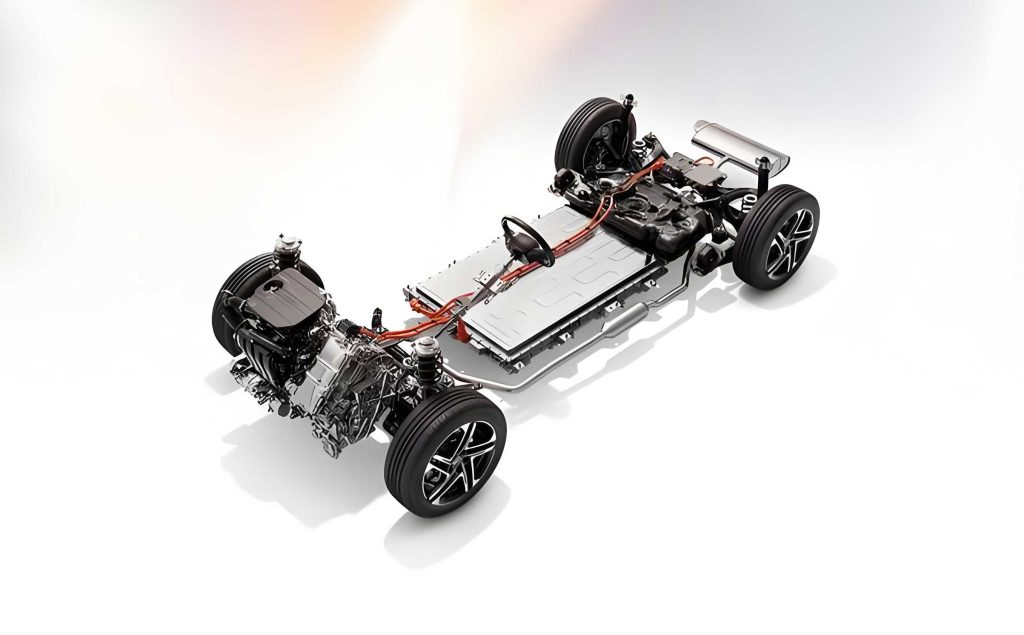
To analyze eco-driving strategies, we first establish a comprehensive modeling framework. This includes a detailed hybrid car model, a limiting energy consumption assessment model, and the core eco-driving strategy model based on two-state dynamic programming. The hybrid car in focus is a parallel hybrid electric vehicle (HEV) with a dual-clutch transmission, featuring an engine, a motor-generator, a 6-speed transmission, and a battery pack. The engine has a rated power of 100 kW and peak torque of 220 Nm, while the motor offers 21 kW and 149 Nm. The battery capacity is 1.49 kWh with a nominal voltage of 240 V. We developed a simulation model for this hybrid car using rule-based energy management strategies, which control the power split between the engine and motor based on vehicle demand and battery state of charge (SOC). This model serves as the basis for evaluating energy consumption under different driving strategies.
The limiting energy consumption assessment model is crucial for understanding the theoretical minimum energy use of the hybrid car. We employ single-state dynamic programming to determine the optimal power split between the engine and motor for a given driving cycle, minimizing fuel consumption while maintaining battery SOC balance. This model outputs the optimal engine and motor power trajectories, along with SOC variations, providing a benchmark for the best possible energy efficiency. It has been validated against real-world data, showing close alignment with measured fuel consumption. For instance, on the Worldwide Harmonized Light Vehicles Test Cycle (WLTC), the limiting model, the simulation model with rule-based strategies, and actual dynamometer tests yielded 100 km fuel consumptions of 7.91 L, 8.13 L, and 8.51 L, respectively, confirming model accuracy. This step is essential because it highlights that hybrid car energy consumption is predominantly driven by vehicle energy demand rather than powertrain efficiency differences, justifying our choice of objective function in the eco-driving strategy model.
The eco-driving strategy model is formulated as an optimal control problem in continuous time. We aim to find the optimal driving force $F(t)$ and speed $v(t)$ sequences over a time interval $[t_0, t_f]$ to cover a distance $[s_0, s_f]$, minimizing the total energy consumption $Q(t)$. The road slope $\alpha(s)$ is known in advance, ranging from $-\pi/2$ to $\pi/2$, as shown in the road gradient schematic. The vehicle speed must be non-negative and within legal limits. Mathematically, this is expressed as:
$$ \min \int_{t_0}^{t_f} Q(t) dt $$
subject to:
$$ \frac{ds}{dt} = v(t) $$
$$ m \frac{dv}{dt} = F(t) – F_{\text{res}}(v, s) $$
$$ v_{\text{min}} \leq v(t) \leq v_{\text{max}} $$
$$ s(t_0) = s_0, \quad s(t_f) = s_f $$
$$ v(t_0) = v_0, \quad v(t_f) = v_f $$
where $m$ is the vehicle mass, and $F_{\text{res}}$ represents resistive forces including aerodynamic drag, rolling resistance, and gravitational force due to slope $\alpha(s)$. For a hybrid car, the energy consumption $Q(t)$ includes both fuel energy from the engine and electrical energy from the battery, but our objective function simplifies to the sum of driving and braking energy at the wheels, as justified by the limiting model analysis. This simplification reduces computational complexity while capturing the primary energy demand for hybrid cars.
To solve this problem, we use two-state dynamic programming with driving time as the stage variable. The state variables are driving distance $x_1 = s(t)$ and vehicle speed $x_2 = v(t)$. The stage index $k$ corresponds to discrete time steps, and the state space is discretized into a grid. The solution involves two phases: backward optimization and forward computation. In the backward phase, we compute the cost-to-go for each feasible state at each stage, considering constraints to reduce computation. The cost function is the cumulative energy, defined as:
$$ J = \sum_{k} \left( E_{\text{drive}, k} + E_{\text{brake}, k} \right) $$
where $E_{\text{drive}, k}$ is the driving energy and $E_{\text{brake}, k}$ is the braking energy at stage $k$. For a hybrid car, braking energy can be partially recovered through regenerative braking, but losses in the motor and battery mean that not all braking energy is converted to usable electrical energy. Thus, minimizing braking energy is beneficial for fuel economy. The dynamic programming algorithm yields optimal control sequences for force and speed, which constitute the eco-driving strategy. Although this method is computationally intensive and not suitable for real-time implementation in current hybrid car controllers, it provides a benchmark for developing approximate real-time strategies using techniques like neural networks.
Energy Consumption Analysis in Hybrid Cars: Key Factors
Understanding the factors influencing energy consumption in hybrid cars is vital for designing effective eco-driving strategies. Our analysis focuses on how driving style and road conditions affect energy demand, using data from real-world driving tests. We collected driving data from a hybrid car on a route comprising urban (25.0 km), suburban (29.5 km), and highway (73.6 km) segments, with three typical driver types: calm, normal, and aggressive. The driver’s aggressiveness is quantified using the aggressiveness index $ID$, defined as:
$$ ID = \frac{p_m}{p_{LH} + p_{HF}} $$
where $p_m$ is the mean power spectral component, $p_{LH}$ is the sum of low-frequency components (below 0.1 Hz), and $p_{HF}$ is the sum of high-frequency components (above 0.1 Hz). Based on literature, drivers are classified as calm if $ID < 0.13$, normal if $0.13 \leq ID < 0.21$, and aggressive if $ID \geq 0.21$. Our data shows distinct $ID$ values across driver types, especially in urban conditions, with convergence in suburban and highway settings due to reduced variability.
We evaluated energy consumption by inputting the speed profiles from these drivers into both the limiting energy consumption assessment model (with optimal energy management) and the simulation model (with rule-based energy management). The results, with SOC balanced, are summarized in Table 1. This comparison reveals that driving style significantly impacts energy consumption, but the primary driver is the vehicle’s energy demand at the wheels, not the powertrain efficiency. The limiting model shows that optimal energy management can reduce consumption, but the variation across driver styles remains consistent, indicating that wheel energy demand is the dominant factor. For hybrid cars, regenerative braking recovery is imperfect, so lower braking energy correlates with better fuel economy. Thus, in our eco-driving strategy model for hybrid cars, we use the sum of driving and braking energy as the objective function, ignoring minor efficiency variations in the powertrain. This simplification is justified by the data and aligns with the goal of reducing overall energy demand for hybrid cars.
| Road Condition | Driver Type | Aggressiveness Index (ID) | Fuel Consumption (L/100 km) – Simulation Model | Fuel Consumption (L/100 km) – Limiting Model | Energy Demand (kWh/100 km) |
|---|---|---|---|---|---|
| Urban | Calm | 0.10 | 8.5 | 8.1 | 25.3 |
| Urban | Normal | 0.18 | 9.2 | 8.8 | 27.1 |
| Urban | Aggressive | 0.25 | 10.1 | 9.6 | 29.5 |
| Suburban | Calm | 0.08 | 6.8 | 6.5 | 20.0 |
| Suburban | Normal | 0.15 | 7.3 | 7.0 | 21.4 |
| Suburban | Aggressive | 0.20 | 7.9 | 7.5 | 22.9 |
| Highway | Calm | 0.05 | 6.2 | 5.9 | 18.2 |
| Highway | Normal | 0.12 | 6.5 | 6.2 | 19.0 |
| Highway | Aggressive | 0.16 | 6.9 | 6.6 | 20.1 |
The data underscores that for hybrid cars, energy consumption is closely tied to the kinetic energy management dictated by driving behavior. By optimizing speed profiles, we can directly influence this demand, leading to substantial fuel savings. This insight forms the basis for our eco-driving strategy model, which targets wheel energy minimization. Additionally, we note that the hybrid car’s ability to recover braking energy, though limited, adds nuance to the strategy; thus, our model explicitly accounts for braking energy to encourage smooth deceleration and maximize regeneration potential in hybrid cars.
Impact of Driving Time on Eco-Driving Strategies for Hybrid Cars on Ramps
We now apply our eco-driving strategy model to ramp scenarios, specifically up-down and down-up slopes, to examine the effect of driving time. The ramp length is set to 1000 m, with an upstream segment (0-200 m), a downstream segment (800-1000 m), and the ramp itself (200-800 m). For the up-down ramp, the slope rises from 200-500 m and falls from 500-800 m, while for the down-up ramp, it falls first and then rises. The elevation difference $\Delta H$ is up to 12 m, with a maximum gradient $\lambda$ of 6.2%. We consider a fixed-speed driving (FSD) strategy at 60 km/h, which takes 60 seconds to traverse the ramp, as the baseline. We then compute eco-driving strategies for driving times of 48 s (-20%), 54 s (-10%), 60 s (baseline), 66 s (+10%), and 72 s (+20%), analyzing the resulting speed profiles and energy consumption for the hybrid car.
For the up-down ramp, the eco-driving strategies show distinct patterns. As driving time decreases, the speed increase is most pronounced in the upstream segment, where higher driving force builds kinetic energy to overcome subsequent uphill resistance. This allows lower forces on the uphill segment while maintaining speed. On the downhill and downstream segments, speed gains diminish, with driving force near zero, leveraging gravitational potential energy and inertia. At the downstream end, longer driving times require additional driving force to reach the target speed, while shorter times involve braking to reduce speed, leading to higher braking energy. Since hybrid cars can recover some braking energy through regeneration, but with losses, minimizing braking is beneficial. The speed profiles can be described mathematically; for instance, the optimal speed $v^*(t)$ satisfies the Euler-Lagrange equation derived from the dynamic programming solution. The energy minimization problem for a hybrid car on a ramp can be expressed as:
$$ \min_{v(t)} \int_{0}^{T} \left[ F(t) v(t) + \beta \cdot \max(0, -F(t) v(t)) \right] dt $$
where $F(t)$ is the net force at the wheels, and $\beta$ is a factor representing regenerative braking efficiency (typically less than 1 for hybrid cars). The constraints include the vehicle dynamics equation and boundary conditions.
For the down-up ramp, the strategies differ. When driving time is reduced from 72 s to 60 s, speed increases slightly in the upstream and downhill segments but more significantly in the uphill and downstream segments, due to early force application on the uphill. For a 48 s time, speed rises markedly across all segments, with force applied early in the upstream segment and then reduced. In both ramp types, the downhill segment has near-zero driving force to utilize gravity, avoiding additional aerodynamic losses. Shorter driving times generally lead to higher driving forces upstream and braking downstream, increasing energy demand. This highlights the trade-off between time and energy for hybrid cars on ramps.
To quantify energy consumption, we simulate the hybrid car model with these eco-driving strategies and the FSD strategy. The results, including SOC changes, are shown in Table 2. Since SOC varies, we convert to equivalent fuel consumption using a fuel-to-electricity conversion factor derived from WLTC cycle data for the hybrid car. The conversion factor is 29 mL per 1% SOC change per 100 km, based on engine efficiency (0.32), generator efficiency (0.88), inverter efficiency (0.95), battery charging efficiency (0.92), and vehicle range (23.3 km). This allows comparison on an SOC-balanced basis.
| Ramp Type | Driving Strategy | Driving Time (s) | SOC Change (%) | Fuel Consumption (L/100 km) | Equivalent Fuel Consumption (L/100 km, SOC-balanced) |
|---|---|---|---|---|---|
| Up-Down | FSD | 60 | 0.2 | 6.46 | 6.47 |
| ECO | 48 | 1.5 | 7.38 | 7.42 | |
| ECO | 60 | 1.8 | 5.28 | 5.33 | |
| ECO | 72 | 5.1 | 3.39 | 3.54 | |
| Down-Up | FSD | 60 | 0.2 | 6.45 | 6.46 |
| ECO | 48 | 1.1 | 7.11 | 7.14 | |
| ECO | 60 | 2.3 | 5.60 | 5.67 | |
| ECO | 72 | 3.1 | 4.80 | 4.89 |
At the baseline driving time of 60 s, the eco-driving strategy reduces equivalent fuel consumption by 17.6% for the up-down ramp (from 6.47 to 5.33 L/100 km) and by 12.2% for the down-up ramp (from 6.46 to 5.67 L/100 km). This demonstrates the effectiveness of eco-driving for hybrid cars on ramps, outperforming reported savings for conventional vehicles (around 5-8%). The greater savings for hybrid cars stem from their ability to operate efficiently across power demand ranges, including pure electric mode at low demands, which is leveraged by the energy-minimizing speed profiles. However, driving time variations impact these savings. As shown in Table 2, shorter times increase consumption due to higher driving and braking energy, while longer times decrease it. To analyze sensitivity, we plot the percentage change in equivalent fuel consumption relative to driving time change from the baseline (60 s), as illustrated in Figure 1. The sensitivity is higher for up-down ramps than down-up ramps, because shorter times on up-down ramps involve more braking energy in the downstream segment, as seen in the speed profiles. For hybrid cars, this implies that on up-down ramps, energy consumption is more vulnerable to time constraints, whereas on down-up ramps, it is relatively stable. Thus, in practice, allowing slightly longer times on up-down ramps and slightly shorter times on down-up ramps can optimize overall energy use for a hybrid car without significantly affecting total travel time.
The mathematical representation of sensitivity can be expressed as:
$$ S = \frac{\Delta C / C_0}{\Delta T / T_0} $$
where $S$ is the sensitivity coefficient, $\Delta C$ is the change in fuel consumption, $C_0$ is the baseline consumption, $\Delta T$ is the change in driving time, and $T_0$ is the baseline time. For the up-down ramp, $S$ is approximately 0.8 for time reductions and 0.6 for time increases, while for the down-up ramp, it is around 0.5 and 0.4, respectively. This quantifies the greater sensitivity for up-down scenarios, guiding strategy design for hybrid cars.
Conclusions and Implications for Hybrid Car Technology
In this study, we developed an eco-driving strategy model for hybrid cars based on two-state dynamic programming, with driving time as a stage variable and distance and speed as states. By focusing on the sum of driving and braking energy as the objective function, we captured the primary energy demand for hybrid cars, as confirmed by our limiting energy consumption analysis. Applying this model to ramp roads, we found that eco-driving strategies significantly reduce fuel consumption compared to fixed-speed driving, with savings of 17.6% on up-down ramps and 12.2% on down-up ramps at equal driving times. Moreover, we demonstrated that driving time critically influences these strategies: energy consumption on up-down ramps is more sensitive to time changes than on down-up ramps, due to differences in braking energy patterns. This insight suggests that adaptive eco-driving systems for hybrid cars should consider ramp type and time constraints to maximize energy savings. For instance, in real-world traffic, hybrid cars could slightly extend travel time on uphill-leading ramps and reduce it on downhill-leading ramps to achieve net energy benefits without compromising overall journey time.
The implications extend beyond individual hybrid cars to traffic management and autonomous driving. By integrating such eco-driving strategies into advanced driver-assistance systems (ADAS) or vehicle-to-infrastructure (V2I) communications, hybrid cars can contribute to reduced emissions and improved fuel efficiency on graded roads. Future work could explore real-time implementation using machine learning approximations of the dynamic programming solution, or expand to more complex road networks with multiple ramps. Additionally, the impact of hybrid car powertrain characteristics, such as battery size or motor power, on eco-driving strategies warrants investigation. Overall, this research underscores the potential of optimized driving behavior to enhance the sustainability of hybrid cars, aligning with global efforts toward greener transportation.
Our methodology, while computationally intensive, provides a foundation for practical applications. The use of dynamic programming ensures optimality under given constraints, and the emphasis on wheel energy demand simplifies the problem for hybrid cars without sacrificing accuracy. As hybrid car technology evolves, incorporating such strategies will be key to unlocking their full energy-saving potential, making them even more competitive in the automotive market. We encourage further studies to validate these findings through real-world experiments and to explore synergies with other energy management techniques for hybrid cars.