
The continuous rise in global vehicle ownership has led to an increasing dependence on petroleum, resulting in severe challenges such as energy depletion and exhaust emissions. Consequently, addressing energy consumption and recovering waste energy has become a primary task. During operation, vehicles generate significant vibrational energy. If this energy can be harvested and converted into electricity to power on-board units, it would offer considerable practical value. For hybrid electric vehicles (HEVs), which exhibit lower thermal losses compared to conventional vehicles, the significance of vibration energy recovery and utilization is even greater.
Piezoelectric materials, capable of converting mechanical energy into electrical energy via the direct piezoelectric effect, present a promising solution. This research focuses on developing an optimized vibration energy harvester based on a variable cross-section cantilever beam for application in hybrid cars. We investigate the influence of dimensional parameters and cross-sectional geometry on power generation performance using COMSOL Multiphysics finite element analysis (FEA). Furthermore, a dedicated power management circuit is designed to condition and store the harvested energy, aiming to power low-voltage automotive devices.
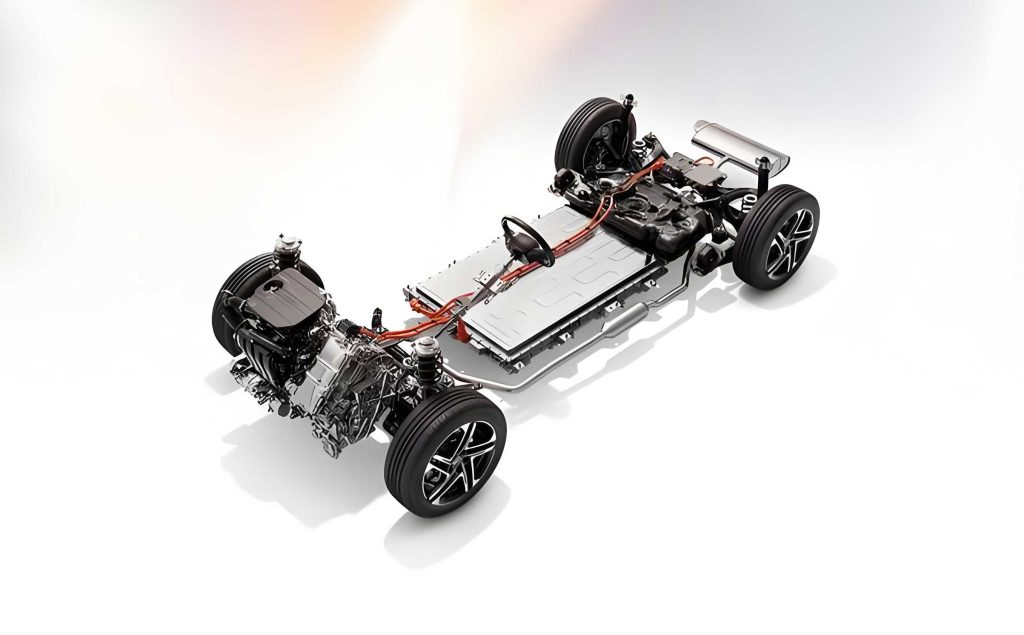
The core of the vibrational energy harvesting device for a hybrid car is the piezoelectric oscillator. Its performance is governed by the constitutive piezoelectric equations. For the widely used d31 mode in bending cantilevers, the fundamental relationships between stress (T), strain (S), electric field (E), and electric displacement (D) are described by:
$$D_m = d_{mj}T_j + \varepsilon_{mn}^T E_n$$
$$S_i = s_{ij}^E T_j + d_{ni} E_n$$
where the indices m, n = 1,2,3 correspond to the x, y, z directions, and i, j = 1,2,…,6 represent reduced notation for tensor components. Here, $d_{mj}$ and $d_{ni}$ are piezoelectric constants, $\varepsilon_{mn}^T$ is the dielectric permittivity under constant stress, and $s_{ij}^E$ is the elastic compliance under constant electric field. For a bimorph cantilever structure with series connection, the output electrical displacement for the top and bottom layers under an external force F can be derived. Ignoring the thin central shim layer, the expressions simplify to:
$$D_{3,top} = \frac{3}{2} \frac{d_{31}}{b h^2} (L – x_1)\frac{x_3}{h} F + \left[ \varepsilon_{33}^T – \left(1 + \frac{3}{2}\frac{x_3}{h}\right)\frac{d_{31}^2}{s_{11}^E} \right] E_3$$
$$D_{3,bottom} = -\frac{3}{2} \frac{d_{31}}{b h^2} (L – x_1)\frac{x_3}{h} F + \left[ \varepsilon_{33}^T – \left(1 – \frac{3}{2}\frac{x_3}{h}\right)\frac{d_{31}^2}{s_{11}^E} \right] E_3$$
These equations reveal that the output charge is directly proportional to the applied force F and is critically dependent on structural parameters: length (L), width (b), and thickness (h). Therefore, optimizing these geometric parameters is essential to maximize the energy harvested from a hybrid car’s vibrations.
Finite Element Analysis of Geometric Influence
We constructed a base model in COMSOL consisting of a PZT-5H piezoelectric bimorph bonded to a nickel alloy substrate, poled along the thickness direction. One end is fixed, and a proof mass is attached to the free end. A concentrated force of 1 N is applied at the free end in the negative z-direction to simulate excitation. The output voltage is analyzed in terms of “Volume Maximum” and “Volume Average” to evaluate peak and overall performance.
Influence of Dimensional Parameters
The length, width, and thickness of the rectangular cross-section cantilever were varied independently to study their effects.
1. Length (L): As the length increases from 50 mm to 100 mm (with constant width and thickness), both the volume maximum and average voltages increase significantly. A longer beam experiences a larger bending moment for the same tip force, leading to greater strain in the piezoelectric material and thus higher voltage generation. This characteristic is beneficial for designing harvesters that fit within the spatial constraints of a hybrid car’s suspension or seat structure.
2. Width (b): Increasing the width from 10 mm to 35 mm (with constant length and thickness) causes both voltage metrics to decrease. A wider beam has higher bending stiffness, reducing its deflection under the same load and consequently lowering the generated strain and voltage.
3. Thickness (h): Similarly, increasing the thickness from 0.3 mm to 0.8 mm results in a decrease in output voltage. Increased thickness substantially raises the bending stiffness, thereby limiting deformation and the resultant piezoelectric effect.
The trends are summarized in the table below:
| Parameter | Trend (Increasing Value) | Effect on Voltage (Vol. Max & Avg) | Primary Reason |
|---|---|---|---|
| Length (L) | Increase | Increases | Larger bending moment, higher strain. |
| Width (b) | Increase | Decreases | Increased stiffness, lower deflection. |
| Thickness (h) | Increase | Decreases | Greatly increased stiffness, lower deformation. |
Optimization of Cross-Sectional Shape
Keeping the overall envelope dimensions constant (70 mm length, 20 mm width, 0.5 mm thickness), we investigated three cross-sectional shapes: Rectangle, Trapezoid, and Triangle. The voltage outputs are compared below:
| Cross-Section Shape | Volume Maximum Voltage (V) | Volume Average Voltage (V) |
|---|---|---|
| Rectangle | 48.06 | 7.51 |
| Trapezoid | 49.03 | 9.92 |
| Triangle | 50.28 | 14.38 |
The triangular cross-section yields the highest voltages. This is attributed to its lower bending stiffness compared to the rectangle and trapezoid with the same bounding dimensions, allowing for larger strain under identical loading. Furthermore, its smaller volume leads to a significantly higher volume-average voltage when the peak stress is similar. Therefore, the triangular shape was selected for further refinement, as it promises greater energy density from the vibrations encountered by a hybrid car.
Refining the Triangle: Edge Profile Optimization
We further optimized the triangle by modifying its edge profile from a straight line to inward and outward arcs (with a radius of 300 mm). The performance is summarized as follows:
| Triangle Edge Profile | Volume Maximum Voltage (V) | Volume Average Voltage (V) |
|---|---|---|
| Outer Arc | 51.77 | 11.46 |
| Inner Arc | 51.77 | 15.11 | Straight Edge | 51.69 | 13.02 |
The volume maximum voltage shows negligible difference between the profiles, as it primarily occurs at the neutral axis near the fixed end where strain is highest. However, the volume average voltage, which reflects the overall performance across the entire active material, is highest for the inner-arc profile. The inner-arc design has a slightly reduced surface area compared to the straight-edge triangle, leading to a higher average voltage when the peak voltage is equivalent. This makes the inner-arc triangular cantilever the optimal geometry for harvesting vibrational energy in a hybrid car application.
Resonant Response for Maximum Power Transfer
To effectively capture the often narrow-band vibrational energy from a hybrid car’s chassis, the harvester should operate at its resonant frequency. We performed a modal analysis on the optimized inner-arc triangular cantilever. The first six natural frequencies were identified:
| Mode Order | Natural Frequency (Hz) |
|---|---|
| 1 | 119.92 |
| 2 | 626.30 |
| 3 | 705.26 |
| 4 | 1362.2 |
| 5 | 1679.3 |
| 6 | 3348.1 |
A harmonic response analysis was conducted by applying the 1 N force at the first natural frequency (119.92 Hz). The output reached its maximum, with the top piezoelectric layer generating 1.73 V and the bottom layer generating 1.77 V, resulting in a total of approximately 3.5 V for the series-connected bimorph. This underscores the importance of matching the harvester’s resonant frequency to the dominant vibration frequency of the hybrid car’s mounting location (e.g., suspension or seat) for optimal energy recovery.
Design of a Power Management Circuit for Hybrid Car Integration
The raw output from a piezoelectric harvester is an alternating current (AC) with variable amplitude and frequency, unsuitable for directly charging a battery. A dedicated power management circuit is required for rectification, regulation, and storage. The target for a 12V hybrid car auxiliary system is a stable output between 13V and 15V.
The designed circuit comprises several key stages:
- Rectification: A full-wave bridge rectifier (D1 3N250) converts the AC output to pulsating DC.
- Filtering: An RC filter (R4, C1) smoothens the pulsating DC.
- Voltage Regulation & Storage: This is the core stage. A supercapacitor (C1) serves as the intermediate storage element due to its high power density and rapid charge/discharge capability, ideal for the intermittent vibrations in a hybrid car. A specialized regulator module controls the flow. When the voltage across the supercapacitor ($u_c$) exceeds a threshold (set by Zener diode D2, e.g., 6V), transistor Q1 activates, enabling the regulator. The regulator module, based on a feedback mechanism using resistors R5 and R6, maintains a constant output voltage according to: $$V_{out} = 1.22 \times \frac{R_5 + R_6}{R_6}$$ By selecting appropriate values for R5 and R6, the output can be set within the 13-15 V range required by the hybrid car’s battery.
- Output Filtering: A final capacitor (C4) provides clean DC output.
The circuit operates cyclically: vibrations charge the supercapacitor; once its voltage is sufficient, the regulation stage engages, delivering power to the load or battery; as the supercapacitor discharges below a lower threshold, the regulator disconnects, allowing it to recharge from subsequent vibrations.
Conclusion
This study presents a comprehensive approach to designing a vibration energy harvester for hybrid cars. Through finite element analysis, we systematically optimized a piezoelectric cantilever beam. The key findings are:
- The voltage output increases with beam length but decreases with width and thickness for a rectangular cross-section.
- A triangular cross-section outperforms rectangular and trapezoidal shapes.
- Among triangular profiles, the inner-arc edge design yields the highest volumetric average voltage output.
- Operating the harvester at its first natural resonance (≈120 Hz for the optimized design) maximizes the voltage generation to around 3.5 V under the simulated load.
Furthermore, we designed a corresponding power management circuit capable of rectifying, stabilizing, and storing the harvested energy, providing a regulated 13-15 V output suitable for supplementing a hybrid car’s low-voltage electrical system. This integrated solution, combining an optimized piezoelectric generator with efficient power electronics, demonstrates a viable pathway for recovering waste vibrational energy in hybrid electric vehicles, contributing to improved energy efficiency and sustainability.