
In the evolving landscape of automotive technology, hybrid cars, particularly plug-in hybrid electric vehicles (PHEVs), have emerged as a crucial transitional solution. They address range anxiety associated with pure electric vehicles while optimizing fuel efficiency for traditional internal combustion engines. As a developer involved in the design and packaging of these vehicles, I have focused on the integration of charging systems, specifically the placement of the charging port on the grille. This article delves into the comprehensive approach for arranging a hidden charging port on the grille of a hybrid car, drawing from practical experience in projects like the development of a new Passat PHEV model. The discussion encompasses critical aspects such as crash safety, pedestrian protection, ergonomics, kinematic checks, emergency unlocking, and gap management, supported by tables and formulas to summarize key insights.
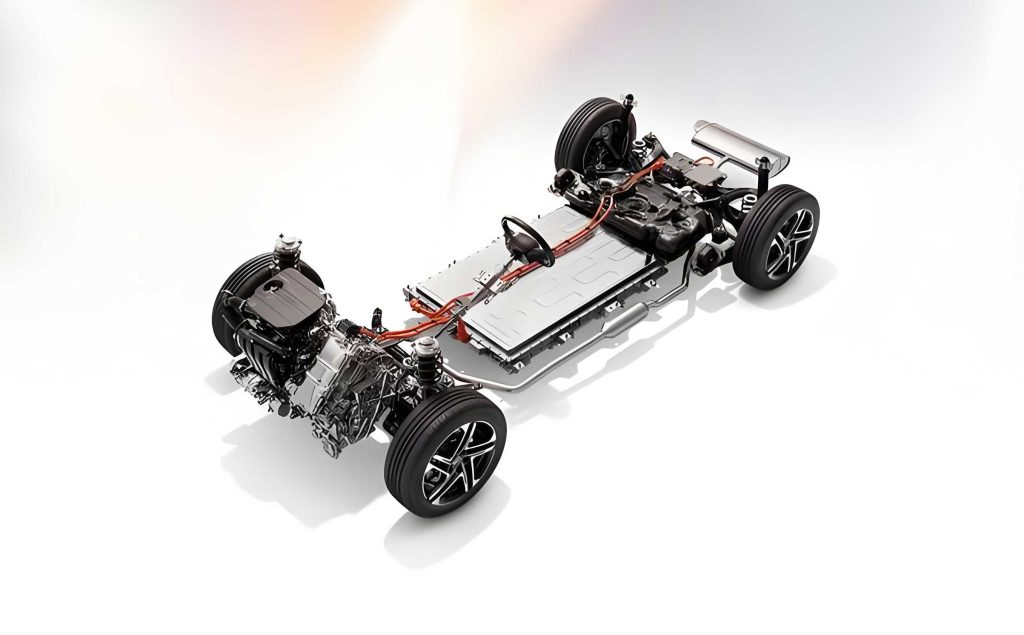
The positioning of the charging port on a hybrid car is not merely a cosmetic decision; it involves intricate engineering considerations to ensure functionality, safety, and user convenience. For hybrid cars that undergo minor facelifts rather than complete redesigns, the grille area—especially the driver’s side—offers an economical and practical location. This choice minimizes changes to existing body panels, reducing development time and cost. In this context, the charging port must be seamlessly integrated into the grille, maintaining a hidden appearance when closed while providing easy access for charging operations. The following sections explore the rationale behind this placement and the technical solutions employed to address associated challenges.
When selecting the location for the charging port on a hybrid car, factors such as styling, brand identity, technical constraints, and human-machine interface requirements are paramount. For many hybrid cars, the front grille is ideal due to its central role in vehicle aesthetics and airflow management. However, with the increasing adoption of advanced driver-assistance systems (ADAS) like adaptive cruise control (ACC) and illuminated logos, the center of the grille may be occupied. Thus, the driver’s side of the grille becomes a preferred alternative. This placement aligns with user habits, as drivers typically approach the vehicle from the left side, and it avoids interference with other critical components. Moreover, for hybrid cars that retain conventional fuel systems, preserving existing structures is essential, and the grille area allows for modular integration of the charging interface without major modifications.
The charging module for a hybrid car typically includes an AC charging socket compliant with standards such as GB/T 20234.2-2015. Given that hybrid cars have smaller battery capacities compared to pure electric vehicles, they often only require an AC charging interface, which suffices for shorter charging times. The socket must withstand frequent plugging and unplugging operations, and it is mounted via brackets to the front crossbeam and front-end module to ensure stability. The charging gun, as per regulatory outlines, has specific dimensional constraints that influence the packaging design. Understanding these elements is crucial for developing a robust layout that meets both functional and safety standards for hybrid cars.
One of the primary concerns in positioning the charging port on the grille of a hybrid car is crash safety. According to national standards like GB17354-1998, which governs front and rear protection devices, vehicles must withstand minor impacts without significant damage. For hybrid cars, the charging port system is a vital functional component, and it must pass pendulum impact tests. During a frontal pendulum collision test, the charging interface should remain undamaged, and the charging cover should be operable post-impact. To achieve this, we ensure that the lower edge of the charging cover is positioned at least 10 mm above the impactor head, as derived from vehicle ride height variations. Additionally, to protect the charging socket during low-speed barrier collisions at 4 km/h, it is placed entirely behind the front crossbeam. This arrangement prevents direct contact with the barrier, leveraging the crossbeam’s protective role. The relationship can be expressed using a simple formula for clearance: $$ \text{Clearance} = H_{\text{cover}} – H_{\text{impactor}} \geq 10 \, \text{mm} $$ where \( H_{\text{cover}} \) is the height of the charging cover’s lower edge and \( H_{\text{impactor}} \) is the height of the pendulum impactor. This ensures compliance with internal testing protocols for hybrid cars.
| Crash Safety Requirement | Specification | Rationale |
|---|---|---|
| Pendulum Test Clearance | ≥10 mm above impactor | Prevents damage to charging port |
| Low-Speed Barrier Collision | Socket behind crossbeam | Protects against 4 km/h impacts |
| Post-Crash Operability | Charging cover functional | Ensures continued usability |
Pedestrian protection is another critical aspect for hybrid cars, especially with regulations like C-NCAP 2018 incorporating lower legform impact tests. The charging port, when located on the grille, must not pose a hazard to pedestrians. In tests, a flexible lower legform exhibits approximately 20° of bending deformation upon impact. To mitigate injury risks, we incorporate a pedestrian protection buffer foam in front of the crossbeam, creating a crush zone free of rigid components. Furthermore, the charging interface module is tilted backward by 20° to align with the legform’s bending angle, reducing the likelihood of hard contact. This tilt also enhances ergonomics, as discussed later. The angular relationship can be summarized as: $$ \theta_{\text{tilt}} = 20^\circ $$ where \( \theta_{\text{tilt}} \) is the backward inclination of the charging socket. This design not only meets safety standards but also integrates seamlessly with the overall front-end architecture of hybrid cars.
| Pedestrian Protection Factor | Value | Impact on Design |
|---|---|---|
| Legform Bending Angle | 20° | Informs socket inclination |
| Buffer Zone Depth | Variable (model-specific) | Prevents rigid part exposure |
| Socket Inclination | 20° backward | Reduces pedestrian injury risk |
Ergonomics play a pivotal role in the user experience of hybrid cars, particularly during charging operations. The charging port on the grille is often positioned at a height around 700 mm from the ground, which is below natural hand height for most users. Inserting and removing the charging gun requires bending, and a tilted socket orientation improves accessibility. We analyze the hand operation space based on the charging gun’s outer contour, as defined in GB/T 20234.2-2015. The process involves gripping the handle, pressing the unlock button with the thumb, and pulling out the gun. To accommodate various charging gun designs, we ensure a minimum thumb clearance of 15 mm and a palm clearance of 25 mm. These dimensions are derived from anthropometric data and can be expressed as: $$ C_{\text{thumb}} \geq 15 \, \text{mm}, \quad C_{\text{palm}} \geq 25 \, \text{mm} $$ where \( C_{\text{thumb}} \) and \( C_{\text{palm}} \) represent the clearances for thumb and palm operations, respectively. This ensures that users can comfortably charge their hybrid cars without strain, regardless of the charging gun model.
| Ergonomic Parameter | Minimum Requirement | Description |
|---|---|---|
| Thumb Clearance | 15 mm | Space for button operation |
| Palm Clearance | 25 mm | Space for gripping the gun |
| Socket Height | ~700 mm | Optimized for bending posture |
The kinematic check of the charging cover is essential to ensure smooth opening and closing without interference. For hybrid cars, the cover typically rotates open to an angle of at least 90° to facilitate charging gun access. During motion, the minimum gap between the cover and the fixed grille parts must exceed 2 mm to prevent rubbing or jamming. However, grille designs often feature pronounced three-dimensional elements, which can necessitate larger gaps at the hinge area—up to 6 mm—to accommodate the swing arc. To maintain aesthetic appeal while meeting technical needs, we employ styling tricks to visually conceal these gaps. For instance, by converting single grille slats into double slats with a spacing of 6 mm, the side gaps blend into the design. Similarly, using raised horizontal grille bars to shadow the upper and lower gaps creates an illusion of seamlessness. This approach effectively hides the necessary clearances, preserving the sleek look of the hybrid car. The gap analysis can be modeled using geometric equations: $$ \Delta_{\text{gap}} = R \cdot \sin(\phi) – t $$ where \( \Delta_{\text{gap}} \) is the required gap, \( R \) is the cover’s radius of rotation, \( \phi \) is the opening angle, and \( t \) is the thickness of adjacent components. By optimizing these parameters, we achieve both functionality and visual integration.
Emergency unlocking mechanisms are vital for hybrid cars to address scenarios like complete battery discharge, where electronic locks may fail. Regulatory requirements, such as GB 18352.6-2016, mandate a mechanical backup to open the charging cover, preventing unnecessary emissions from starting the engine solely to access the port. Our solution involves a manual release cable located in the engine compartment. To activate it, the user opens the hood and pulls the cable, which disengages the lock mechanically. This system ensures that the hybrid car can be charged even in extreme conditions, enhancing reliability. The design prioritizes simplicity and accessibility, with the cable routed to avoid interference with other engine bay components.
In summary, the integration of a hidden charging port on the grille of a hybrid car demands a holistic approach that balances safety, usability, and aesthetics. Through meticulous planning and validation, we have demonstrated that this layout is feasible and effective. The solutions for crash safety, pedestrian protection, ergonomics, kinematic checks, and emergency unlocking have been tested in real-world scenarios, including on the new Passat PHEV, with successful outcomes. The use of tables and formulas herein encapsulates key design criteria, offering a reference for future developments in hybrid cars. As the automotive industry continues to evolve toward electrification, such packaging strategies will remain instrumental in optimizing hybrid car designs for market acceptance and regulatory compliance.
Further considerations for hybrid cars include thermal management of the charging components, given their proximity to the engine bay, and the impact of environmental factors like water ingress. Future iterations may incorporate smart features, such as automated opening mechanisms or indicator lights, to enhance user interaction. Additionally, as battery technology advances, the charging port design may evolve to support faster charging speeds, necessitating updates to the packaging layout. Nonetheless, the principles outlined here—rooted in safety and ergonomics—will continue to guide the development of hybrid cars. By leveraging computational simulations and physical testing, we can refine these layouts to meet the ever-growing demands for efficiency and convenience in hybrid cars.
In conclusion, the hidden charging port on the grille represents a sophisticated engineering solution that exemplifies the integration challenges in hybrid cars. It underscores the importance of interdisciplinary collaboration in automotive design, where styling, safety, and functionality converge. As hybrid cars become more prevalent, such innovations will play a pivotal role in shaping the future of transportation, making sustainable mobility more accessible and user-friendly. The ongoing refinement of these systems will undoubtedly contribute to the broader adoption of hybrid cars, bridging the gap between conventional and fully electric vehicles.