
The increasing scarcity of energy resources and the escalating environmental crisis have propelled the automotive industry toward developing vehicles with low emissions and reduced fuel consumption. Among new energy vehicles, which primarily include pure electric vehicles, hybrid cars, and fuel cell electric vehicles, hybrid cars have garnered significant attention due to their ability to combine the benefits of electric propulsion with the high energy density of conventional fuels. This dual-power approach addresses range limitations often associated with pure electric vehicles, making hybrid cars a practical and efficient solution for both urban commuting and long-distance travel. In this context, I focus on parallel hybrid cars, which utilize both an internal combustion engine and an electric motor to drive the wheels directly, offering enhanced flexibility and efficiency. The core challenge in optimizing such hybrid cars lies in the energy management strategy (EMS), which coordinates the power flow between the engine and motor to ensure optimal performance, fuel economy, and battery longevity. This article delves into the design and simulation of a logic threshold-based energy management strategy for parallel hybrid cars, aiming to demonstrate its effectiveness in improving fuel efficiency and reducing emissions.
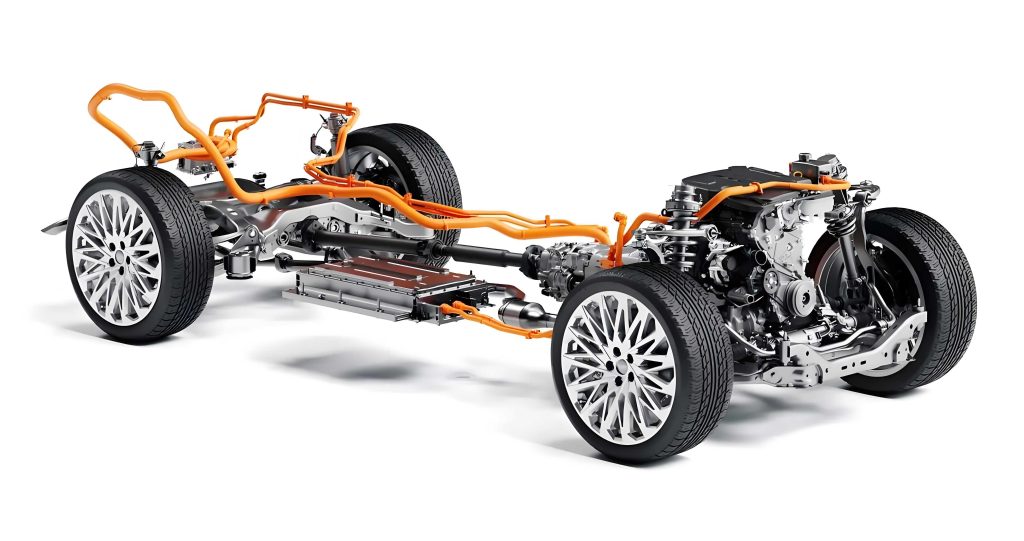
Hybrid cars, particularly parallel configurations, have become a focal point in automotive research due to their potential to mitigate the drawbacks of pure electric vehicles, such as limited range and lengthy charging times. The parallel hybrid car allows for multiple operational modes, including pure electric driving, engine-only driving, hybrid driving, regenerative braking, and on-the-go charging. Each mode must be seamlessly integrated through a robust EMS to maximize overall system efficiency. The primary objective of this study is to develop and validate an EMS that leverages the strengths of both power sources while maintaining battery state-of-charge (SOC) within desirable limits. By employing a logic threshold strategy, I aim to achieve smooth mode transitions and optimal torque distribution, ultimately enhancing the fuel economy of hybrid cars without compromising driving dynamics.
To establish a foundation for the EMS design, I first construct a comprehensive model of the parallel hybrid car. This model encompasses the vehicle’s longitudinal dynamics, as well as the key components: the internal combustion engine, electric motor, battery pack, transmission system, and a driver model. The longitudinal dynamics are derived from the force balance equation, which accounts for various resistances encountered during motion. The equation is expressed as:
$$F_t = mgf \cos \theta + mg \sin \theta + \frac{1}{2} C_D A \rho v^2 + \delta m \frac{dv}{dt}$$
where \(F_t\) is the total tractive force, \(m\) is the vehicle mass, \(g\) is gravitational acceleration, \(f\) is the rolling resistance coefficient, \(\theta\) is the road gradient, \(C_D\) is the drag coefficient, \(A\) is the frontal area, \(\rho\) is air density, \(v\) is vehicle speed, and \(\delta\) is the rotational mass factor. The required torque at the transmission input, \(T_{req}\), is calculated based on this force and the drivetrain parameters:
$$T_{req} = \frac{F_t r}{j_g j_0 \eta_g \eta_0}$$
Here, \(r\) is the wheel radius, \(j_g\) and \(j_0\) are the gearbox and final drive ratios, and \(\eta_g\) and \(\eta_0\) are their respective efficiencies. This formulation allows for accurate simulation of the hybrid car’s behavior under various driving conditions.
The component models are built using empirical data and characteristic curves to ensure realism. For the internal combustion engine, I utilize experimental data to create a map of torque versus speed, along with a fuel consumption rate map. The engine’s fuel mass flow rate, \(m_{FC}\), is given by:
$$m_{FC} = r_{cr} T \omega$$
where \(r_{cr}\) is the specific fuel consumption rate, \(T\) is the engine torque, and \(\omega\) is the angular speed. The electric motor, which operates as either a motor or generator, is modeled based on its torque-speed characteristics, with parameters selected to meet the power demands of the hybrid car. The battery pack is represented using an equivalent circuit model, where the SOC is updated dynamically according to:
$$SOC(t) = SOC(t_0) – \frac{1}{Q_{\text{max}}} \int_{t_0}^{t} I(\tau) d\tau$$
with \(SOC(t_0)\) as the initial SOC, \(Q_{\text{max}}\) as the maximum capacity, and \(I\) as the battery current. The transmission system model relates input and output torques and speeds through gear ratios and efficiencies, while the driver model employs a PID controller to simulate throttle and brake pedal inputs based on desired speed tracking. These models collectively form a forward-facing simulation environment in Matlab/Simulink, enabling dynamic analysis of the hybrid car’s performance.
To manage the power distribution in the hybrid car, I design a logic threshold-based energy management strategy. This rule-based approach uses predetermined thresholds to switch between operational modes, ensuring that the engine operates within its high-efficiency region as much as possible while maintaining battery SOC within a safe range. The strategy hinges on key parameters: the battery SOC limits (\(SOC_{\text{max}}\) and \(SOC_{\text{min}}\)) and dynamic engine torque thresholds (\(T_{m,\text{min}}\), \(T_{m,\text{opt}}\), and \(T_{m,\text{max}}\)), which correspond to the minimum, optimal, and maximum torque points in the engine’s efficiency map. These thresholds are adjusted in real-time based on engine speed and load conditions. The control rules for mode selection are summarized in the table below, which outlines the conditions for transitioning between pure electric, engine-only, hybrid, charging, and regenerative braking modes.
| Mode | Condition | Action |
|---|---|---|
| Pure Electric Drive | \(T_{req} \leq T_{m,\text{min}}\) and \(SOC > SOC_{\text{min}}\) | Motor supplies all torque |
| Engine-Only Drive | \(T_{m,\text{min}} < T_{req} \leq T_{m,\text{opt}}\) and \(SOC \leq SOC_{\text{min}}\) | Engine supplies all torque |
| Hybrid Drive | \(T_{req} > T_{m,\text{opt}}\) and \(SOC > SOC_{\text{min}}\) | Engine and motor share torque |
| Charging Mode | \(T_{req} > T_{m,\text{min}}\) and \(SOC \leq SOC_{\text{min}}\) | Engine drives and charges battery via motor |
| Regenerative Braking | Braking demand present | Motor acts as generator to recover energy |
This strategy prioritizes electric propulsion in low-load scenarios to capitalize on the motor’s high efficiency and zero local emissions. When power demand increases, the engine is engaged, but its operation is confined to the high-efficiency zone by using the motor to compensate for torque deficits or surpluses. This “peak-shaving” effect not only improves fuel economy but also reduces emissions in hybrid cars. The logic is implemented in Matlab/Simulink using Stateflow or embedded MATLAB functions, creating a responsive control system that adapts to driving conditions instantaneously.
To validate the proposed energy management strategy, I conduct simulations under the New European Driving Cycle (NEDC), which includes both urban and extra-urban segments. The simulation parameters are set as follows: initial battery SOC of 0.7, vehicle mass of 1500 kg, and component specifications detailed in the table below. The NEDC profile, with a duration of 1180 seconds and a distance of 10.87 km, provides a standardized test for evaluating the hybrid car’s performance in varied scenarios.
| Component | Parameter | Value |
|---|---|---|
| Engine | Max Power | 82 kW |
| Engine | Displacement | 1596 ml |
| Motor | Rated Power | 12 kW |
| Motor | Peak Power | 18 kW |
| Battery | Capacity | 5 kWh |
| Vehicle | Drag Coefficient (\(C_D\)) | 0.3 |
| Vehicle | Frontal Area (\(A\)) | 2.2 m² |
The simulation results demonstrate the efficacy of the logic threshold strategy. During the urban phase of the NEDC (first 800 seconds), the hybrid car operates primarily in pure electric mode, with the motor supplying all required torque. This aligns with the strategy’s aim to minimize engine use in low-speed, stop-and-go conditions. As the cycle transitions to extra-urban driving with higher speed and torque demands, the engine activates, and the system shifts to hybrid mode. The torque distribution between the engine and motor is illustrated in the following plot, generated from the simulation data. The engine torque remains within the high-efficiency band, while the motor torque supplements or recovers energy as needed.
The battery SOC variation over the driving cycle is a critical metric. Starting from 0.7, the SOC decreases gradually during electric driving and more rapidly during high-power demands, stabilizing around 0.53 by the end of the cycle. The total electrical energy consumption is 1.72 kWh, and the calculated fuel consumption is 5.18 L per 100 km. Compared to a conventional vehicle with similar performance, the hybrid car equipped with the proposed EMS achieves a 24.2% improvement in fuel economy. This significant enhancement underscores the potential of logic threshold strategies in optimizing hybrid cars for real-world driving conditions.
Further analysis involves examining the engine operating points relative to its efficiency map. By plotting the engine torque and speed during simulation, I observe that most points cluster around the optimal efficiency line, confirming that the EMS successfully keeps the engine in its sweet spot. This not only reduces fuel consumption but also lowers harmful emissions, contributing to the environmental benefits of hybrid cars. Additionally, the smooth transitions between modes prevent drivability issues such as jerks or delays, ensuring a comfortable driving experience. The robustness of the strategy is tested under varying initial SOC conditions and driving cycles, showing consistent improvements in fuel economy across scenarios.
In conclusion, the logic threshold-based energy management strategy developed in this study proves effective for parallel hybrid cars. By intelligently switching between operational modes based on torque demand and battery SOC, it optimizes the use of both power sources, leading to a substantial reduction in fuel consumption and emissions. The simulation results, grounded in detailed component models and realistic driving cycles, validate the strategy’s capability to enhance the performance and efficiency of hybrid cars. Future work could explore the integration of adaptive thresholds using machine learning techniques or the inclusion of predictive information from connectivity features to further refine the EMS. As hybrid cars continue to evolve, advanced energy management strategies will play a pivotal role in realizing their full potential for sustainable transportation.
The exploration of hybrid cars and their energy management systems is an ongoing endeavor, with each advancement bringing us closer to a greener automotive future. The methodology presented here—combining modeling, strategy design, and simulation—provides a framework for researchers and engineers to develop and test innovative solutions for hybrid cars. By prioritizing efficiency and adaptability, such strategies can help hybrid cars meet stringent environmental standards while delivering the performance and convenience that drivers expect. As I reflect on this work, it is clear that the synergy between electric and conventional propulsion in hybrid cars, when managed effectively, offers a compelling pathway toward reducing our carbon footprint and conserving precious energy resources.