
As an engineer and researcher in the automotive field, I have witnessed the rapid evolution of hybrid cars, which combine the strengths of traditional internal combustion engines and pure electric vehicles to offer enhanced efficiency and reduced emissions. A critical component that ensures the reliability and performance of these vehicles is the thermal management system. In this article, I will delve into the intricacies of thermal management in hybrid cars, exploring its subsystems, current technologies, and challenges. The goal is to provide a comprehensive overview that highlights the importance of effective thermal control in hybrid cars, using tables and formulas to summarize key concepts. Throughout this discussion, the term “hybrid car” will be emphasized to underscore its relevance in modern automotive engineering.
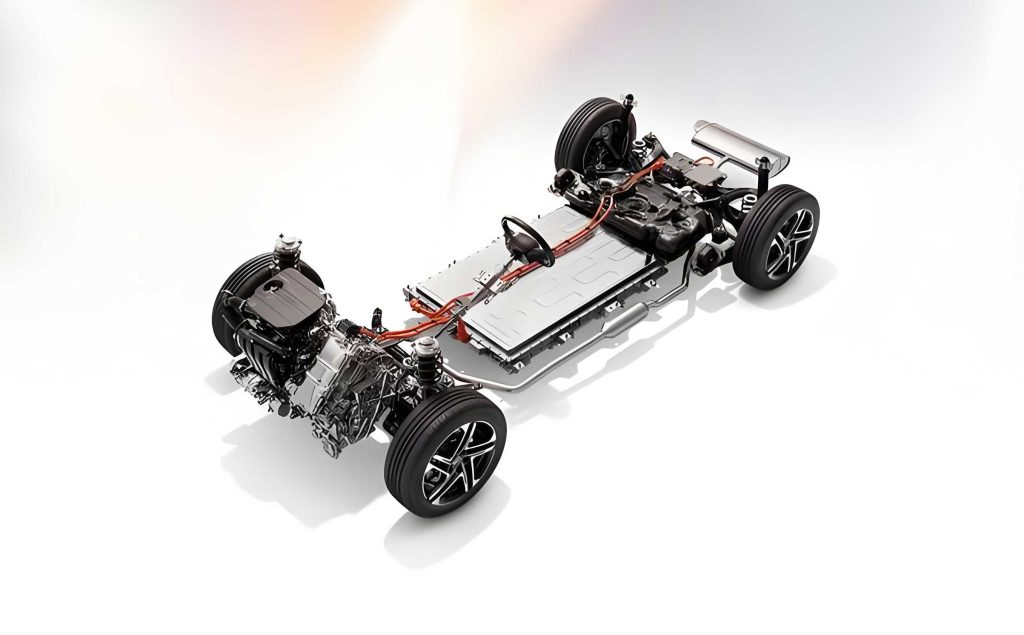
Thermal management in a hybrid car is a complex, multi-faceted system that integrates various components to regulate temperatures across different vehicle parts. It encompasses four primary subsystems: power battery thermal management, passenger cabin thermal management, engine thermal management, and electric drive system cooling. Each subsystem plays a vital role in maintaining optimal operating conditions, ensuring safety, and extending the lifespan of components. For hybrid cars, which operate with multiple power sources, thermal management becomes even more challenging due to the diverse heat generation and dissipation requirements. I will analyze each subsystem in detail, starting with the power battery thermal management, which is crucial for the energy storage and delivery in hybrid cars.
The power battery in a hybrid car is susceptible to temperature fluctuations that can affect its performance, safety, and longevity. Battery thermal management aims to maintain a uniform temperature distribution, preventing overheating or excessive cooling. This is achieved through cooling and heating mechanisms. Cooling methods include natural cooling, forced air cooling, liquid cooling, direct refrigerant cooling, and phase change cooling. To compare these methods, I have summarized their characteristics in the table below:
| Cooling Method | Description | Advantages | Disadvantages | Suitability for Hybrid Cars |
|---|---|---|---|---|
| Natural Cooling | Relies on passive heat convection and radiation without external aids. | Simple, low cost, no energy consumption. | Poor散热efficiency, highly dependent on ambient temperature. | Limited, as hybrid cars often require active cooling for high-power scenarios. |
| Forced Air Cooling | Uses fans to enhance air flow over the battery pack. | Better散热than natural cooling, relatively simple. | Higher noise and energy consumption, uneven temperature distribution. | Suitable for low to medium power hybrid cars. |
| Liquid Cooling | Circulates coolant through channels in the battery pack via a pump. | High散热efficiency, good temperature uniformity. | Complex structure, higher cost and weight. | Widely used in modern hybrid cars for effective thermal control. |
| Direct Refrigerant Cooling | Integrates refrigerant from the AC system into battery evaporators or cold plates. | Very high散热efficiency, fast response. | Complex control, high cost, requires integration with AC system. | Emerging in high-performance hybrid cars. |
| Phase Change Cooling | Utilizes phase change materials (PCM) that absorb/release latent heat during phase transitions. | High latent heat capacity, good temperature uniformity, passive operation. | Low thermal conductivity of pure PCM, may require composite materials (CPCM). | Under research, potential for future hybrid cars. |
The effectiveness of these cooling methods can be quantified using thermal equations. For instance, the heat removal rate in liquid cooling can be expressed as:
$$Q_{cool} = \dot{m} c_p \Delta T$$
where \(Q_{cool}\) is the cooling power, \(\dot{m}\) is the mass flow rate of the coolant, \(c_p\) is the specific heat capacity, and \(\Delta T\) is the temperature difference between the battery and coolant. In hybrid cars, optimizing this equation is essential to balance cooling performance with energy consumption. Additionally, for phase change cooling, the energy absorbed during melting can be modeled as:
$$Q_{PCM} = m_{PCM} L$$
where \(m_{PCM}\) is the mass of the phase change material and \(L\) is the latent heat of fusion. Research shows that composite phase change materials (CPCM) enhance thermal conductivity, making them promising for hybrid car applications.
Battery heating is equally important in cold climates to maintain efficiency. Heating methods primarily include PTC (Positive Temperature Coefficient) heating and waste heat recovery. PTC heating uses resistive elements to generate heat, which is transferred via a liquid medium. Its efficiency can be described by:
$$P_{PTC} = I^2 R(T)$$
where \(P_{PTC}\) is the heating power, \(I\) is the current, and \(R(T)\) is the temperature-dependent resistance. Waste heat recovery captures excess heat from the engine or electric drive system, repurposing it to warm the battery. This method improves overall energy efficiency in hybrid cars, as it reduces reliance on dedicated heating elements. The heat transfer in such systems can be analyzed using:
$$Q_{waste} = h A (T_{source} – T_{battery})$$
where \(h\) is the heat transfer coefficient, \(A\) is the surface area, and \(T_{source}\) and \(T_{battery}\) are the temperatures of the waste heat source and battery, respectively. Implementing these heating strategies requires careful integration into the hybrid car’s thermal management architecture.
Moving to passenger cabin thermal management, this subsystem focuses on maintaining comfort while minimizing energy use. It involves cooling and heating technologies. Traditional air conditioning systems in hybrid cars use a refrigerant cycle comprising a compressor, condenser, expansion valve, and evaporator. The cooling capacity can be estimated with:
$$Q_{AC} = \dot{m}_{ref} (h_{evap,out} – h_{evap,in})$$
where \(\dot{m}_{ref}\) is the refrigerant mass flow rate, and \(h_{evap,in}\) and \(h_{evap,out}\) are the specific enthalpies at the evaporator inlet and outlet. However, such systems are energy-intensive. Heat pump systems offer a more efficient alternative by reversing the refrigerant flow to provide both cooling and heating. In cooling mode, the coefficient of performance (COP) is defined as:
$$COP_{cool} = \frac{Q_{cool}}{W_{comp}}$$
where \(W_{comp}\) is the compressor work input. For heating mode, the COP is:
$$COP_{heat} = \frac{Q_{heat}}{W_{comp}}$$
Heat pumps typically achieve COP values above 2, making them suitable for hybrid cars aiming to reduce energy consumption. The table below compares different cabin heating methods:
| Heating Method | Description | Advantages | Disadvantages | Application in Hybrid Cars |
|---|---|---|---|---|
| PTC Heating | Uses PTC elements to heat air or coolant directly. | Fast response, simple design, high reliability. | High energy consumption, reduces driving range. | Common in many hybrid cars for quick cabin warming. |
| Heat Pump Heating | Transfers heat from outside air to the cabin via refrigerant cycle reversal. | High energy efficiency (COP > 2), environmentally friendly. | Performance declines in very cold temperatures (< -15°C). | Increasingly adopted in advanced hybrid cars. |
| Waste Heat Recovery | Utilizes engine or electric drive waste heat for cabin heating. | Energy-saving, reduces auxiliary load, improves overall efficiency. | Depends on engine operation; less effective in pure electric mode. | Integrated in hybrid cars with internal combustion engines. |
In hybrid cars, combining these heating methods can optimize performance across varying climates. For instance, a heat pump may be supplemented with PTC heating in extreme cold to ensure comfort. The thermal load of the passenger cabin can be modeled as:
$$Q_{cabin} = UA (T_{inside} – T_{outside}) + \dot{m}_{air} c_{p,air} (T_{supply} – T_{return})$$
where \(UA\) is the overall heat transfer coefficient of the cabin, \(T_{inside}\) and \(T_{outside}\) are indoor and outdoor temperatures, \(\dot{m}_{air}\) is the air flow rate, \(c_{p,air}\) is the specific heat of air, and \(T_{supply}\) and \(T_{return}\) are supply and return air temperatures. Effective management of this load is crucial for hybrid cars to balance comfort and energy efficiency.
The engine thermal management system in hybrid cars is another critical area, encompassing cooling, lubrication, and intake/exhaust heat management. The cooling system circulates coolant through the engine block and cylinder head, absorbing heat dissipated by combustion and friction. The heat rejection rate can be expressed as:
$$Q_{engine} = \dot{m}_{coolant} c_{p,coolant} (T_{out} – T_{in})$$
where \(\dot{m}_{coolant}\) is the coolant flow rate, and \(T_{in}\) and \(T_{out}\) are the coolant temperatures at the engine inlet and outlet. In hybrid cars, this system often integrates with other subsystems, such as using engine waste heat for battery or cabin heating. The lubrication system reduces friction and carries away heat from engine components. The oil flow and heat transfer can be analyzed with:
$$Q_{oil} = \dot{m}_{oil} c_{p,oil} \Delta T_{oil}$$
where \(\dot{m}_{oil}\) is the oil flow rate, \(c_{p,oil}\) is the specific heat of oil, and \(\Delta T_{oil}\) is the temperature rise. Proper lubrication is vital for hybrid cars, especially during frequent start-stop cycles typical of hybrid operation.
Intake and exhaust heat management optimizes combustion efficiency and emissions. For turbocharged engines in hybrid cars, an intercooler cools the compressed intake air, increasing air density. The cooling effect can be quantified as:
$$\Delta T_{intake} = \frac{Q_{intercooler}}{\dot{m}_{air} c_{p,air}}$$
Exhaust gas recirculation (EGR) systems reduce nitrogen oxides (NOx) by recirculating cooled exhaust gas back into the cylinders. The heat exchange in the EGR cooler is given by:
$$Q_{EGR} = \epsilon \dot{m}_{exhaust} c_{p,exhaust} (T_{exhaust,in} – T_{coolant})$$
where \(\epsilon\) is the heat exchanger effectiveness. These technologies contribute to the overall thermal efficiency of hybrid cars, aligning with their goal of reduced fuel consumption and emissions.
Electric drive system cooling is essential for components like the motor, motor controller (MCU), onboard charger (OBC), and DC-DC converter. Overheating can degrade performance and lifespan. Cooling methods include air cooling and liquid cooling. Air cooling uses fans to dissipate heat, with the heat transfer rate approximated by:
$$Q_{air} = h_{conv} A_{surface} (T_{component} – T_{ambient})$$
where \(h_{conv}\) is the convective heat transfer coefficient. Liquid cooling, more common in hybrid cars, circulates coolant through dedicated channels. Its performance can be modeled similarly to battery liquid cooling. The table below contrasts these methods:
| Cooling Method | Description | Advantages | Disadvantages | Use in Hybrid Cars |
|---|---|---|---|---|
| Air Cooling | Relies on forced air convection over components. | Simple, lightweight, low cost. | Lower散热capacity, noise, sensitive to ambient conditions. | Found in some economy or low-power hybrid cars. |
| Liquid Cooling | Uses coolant loops to absorb and transfer heat. | High散热efficiency, stable temperature control, compact. | More complex, higher cost, requires maintenance. | Preferred in most hybrid cars for reliable performance. |
In hybrid cars, the electric drive system often operates under variable loads, making liquid cooling advantageous for maintaining optimal temperatures. The thermal balance for a motor can be expressed as:
$$P_{loss} = Q_{cool} + Q_{rad}$$
where \(P_{loss}\) is the power loss due to inefficiencies, \(Q_{cool}\) is the heat removed by cooling, and \(Q_{rad}\) is the heat radiated to surroundings. Effective cooling ensures that hybrid cars can deliver consistent power output and regenerative braking performance.
Integrating all these subsystems into a cohesive thermal management architecture is a key challenge for hybrid cars. Modern hybrid cars employ advanced control strategies, such as model predictive control (MPC), to optimize thermal flows. For example, the overall energy balance can be represented as:
$$\sum Q_{generated} = \sum Q_{dissipated} + \sum Q_{stored}$$
where \(Q_{generated}\) includes heat from the engine, battery, and electric drive, \(Q_{dissipated}\) is heat rejected via radiators or cabin HVAC, and \(Q_{stored}\) is heat absorbed by components. Smart thermal management in hybrid cars aims to minimize energy waste, for instance, by directing waste heat to where it is needed most. This integration enhances the overall efficiency and range of hybrid cars, making them more competitive in the automotive market.
Looking ahead, innovations in materials and control systems will further improve thermal management in hybrid cars. For instance, the development of advanced phase change materials with higher thermal conductivity could revolutionize battery cooling. Similarly, the adoption of CO2 as a refrigerant in heat pumps may boost efficiency in extreme temperatures. Hybrid cars are also exploring unified thermal management systems that dynamically share resources between subsystems, reducing complexity and weight. These advancements will be driven by the need for hybrid cars to meet stringent emissions regulations and consumer demands for longer electric-only range.
In conclusion, thermal management systems are indispensable for the safe, efficient, and durable operation of hybrid cars. From battery and cabin comfort to engine and electric drive cooling, each subsystem requires careful design and integration. As hybrid cars continue to evolve, ongoing research and development in thermal technologies will play a pivotal role in enhancing their performance and sustainability. By leveraging tables and formulas to summarize key aspects, I have aimed to provide a detailed perspective on the current state and future directions of thermal management in hybrid cars. The continuous optimization of these systems will ensure that hybrid cars remain at the forefront of green transportation solutions.