
As an automotive engineer with years of research into sustainable transportation, I have witnessed firsthand the pressing challenges of dwindling global oil reserves, escalating atmospheric pollution, and the undeniable impacts of climate change. These factors collectively threaten the very fabric of our societal and economic sustainability. In the automotive realm, the quest for energy-efficient and environmentally friendly solutions has become paramount. While pure electric vehicles represent the ideal long-term goal, current limitations in battery technology, charging infrastructure, and motor efficiency have made hybrid cars a crucial and practical transitional technology. My extensive analysis, particularly focusing on pioneering models like the Toyota Corolla Hybrid, has deepened my understanding of why hybrid cars are not merely a stopgap but a sophisticated engineering marvel that optimally balances performance, efficiency, and ecological responsibility.
The core philosophy of a hybrid car lies in its ability to synergize multiple power sources—typically an internal combustion engine (ICE) and one or more electric motors—to overcome the inherent inefficiencies of each when used alone. In my professional evaluation, the conventional ICE vehicle wastes a significant portion of its energy because the engine seldom operates at its optimal efficiency point due to constantly varying driver demands. Conversely, a pure electric vehicle, though efficient and clean, grapples with range anxiety and battery lifecycle issues. The hybrid car elegantly bridges this gap. By integrating an electric drivetrain, it allows the ICE to function more frequently within its high-efficiency zone, drastically reducing fuel consumption and emissions in urban driving cycles. This synergy is what makes the modern hybrid car a compelling subject of study and a testament to automotive innovation.
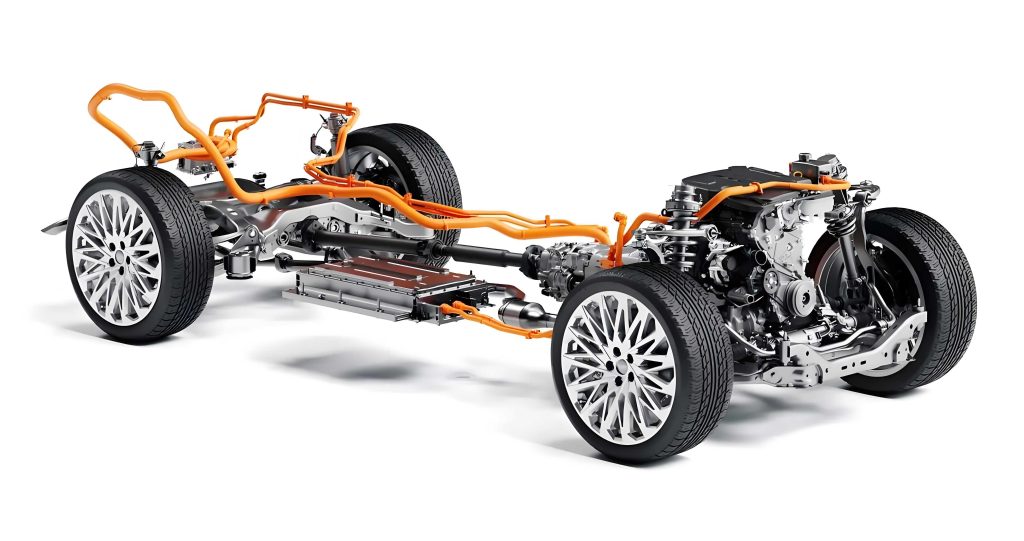
To appreciate the advancements in a hybrid car like the Toyota Corolla Hybrid, one must first understand the fundamental architectures of hybrid powertrains. Through my research, I have categorized them into three primary types based on how the power sources are coupled: series, parallel, and series-parallel (or power-split) systems. Each architecture has distinct operational principles, advantages, and drawbacks, which I will summarize using both descriptive analysis and quantitative models.
Architectural Foundations of Hybrid Car Powertrains
In a series hybrid car, the internal combustion engine is mechanically decoupled from the drive wheels. It functions solely as a generator to charge the battery pack or directly power the electric traction motor that drives the wheels. This setup ensures the engine can run at a constant, optimal speed for generating electricity, maximizing thermal efficiency. The energy flow involves two conversions: chemical energy in fuel to mechanical energy in the engine, then to electrical energy via the generator, and finally back to mechanical energy at the wheels via the motor. The overall system efficiency \( \eta_{series} \) can be expressed as the product of the individual component efficiencies:
$$ \eta_{series} = \eta_{engine} \times \eta_{generator} \times \eta_{battery} \times \eta_{motor} \times \eta_{transmission} $$
Where \( \eta_{engine} \) is the ICE efficiency at its optimal point, \( \eta_{generator} \) and \( \eta_{motor} \) are the electrical machine efficiencies, \( \eta_{battery} \) accounts for charge-discharge losses, and \( \eta_{transmission} \) is the driveline efficiency. While this architecture offers excellent emissions control in urban settings, the double energy conversion inherently introduces losses, making it less efficient for high-speed cruising. Furthermore, the traction motor must be sized to meet peak power demands, leading to a larger, costlier motor.
In contrast, a parallel hybrid car connects both the ICE and the electric motor mechanically to the drive wheels through a coupling device, such as a clutch or planetary gear set. This allows either power source to drive the wheels independently or together. The primary advantage is that mechanical power can be delivered directly without multiple energy conversions, improving highway efficiency. The total torque \( T_{total} \) at the wheels during combined operation is simply the sum of the torques from each source, adjusted by the gear ratios:
$$ T_{total} = (T_{ice} \cdot i_{ice}) + (T_{motor} \cdot i_{motor}) $$
Here, \( T_{ice} \) and \( T_{motor} \) are the output torques of the ICE and motor, and \( i_{ice} \) and \( i_{motor} \) are their respective gear ratios to the wheels. However, the parallel hybrid car struggles to keep the engine operating at its optimal point during variable loads, as it remains mechanically linked to the wheel speed. Control strategy complexity increases significantly to manage the torque coupling between the two sources.
The series-parallel or power-split hybrid car, exemplified by Toyota’s Hybrid Synergy Drive in the Corolla, merges the benefits of both architectures. It employs a planetary gear set that acts as an electromechanical continuously variable transmission (e-CVT). This system allows for both speed and torque coupling between the ICE, a generator (MG1), and a traction motor (MG2). My analysis of this configuration reveals its genius: it decouples engine speed from vehicle speed electronically, enabling the engine to run at its most efficient operating line while providing flexible power distribution. The kinematic relationship in the planetary gear set is fundamental:
$$ \omega_{sun} \cdot R + \omega_{ring} \cdot (S + R) = \omega_{carrier} \cdot (S + R + ?) $$
Where \( \omega_{sun} \), \( \omega_{ring} \), and \( \omega_{carrier} \) are the angular velocities of the sun gear (connected to MG1), ring gear (connected to MG2 and output), and carrier (connected to the ICE), respectively, and S and R are the numbers of teeth on the sun and ring gears. This equation governs the power-split behavior, allowing for infinite variability in the speed ratio between the engine and wheels.
To clearly delineate the characteristics of these hybrid car architectures, I have compiled a comprehensive comparison based on my technical assessments:
| Feature | Series Hybrid Car | Parallel Hybrid Car | Series-Parallel Hybrid Car |
|---|---|---|---|
| Power Coupling | Electrical (Decoupled) | Mechanical (Coupled) | Electro-Mechanical (Power-Split) |
| Engine Operation | Constant Optimal Speed | Variable, Linked to Wheel Speed | Can Be Optimized, Decoupled |
| Energy Conversion Steps | Multiple (Fuel→Mech→Elec→Mech) | Direct (Fuel→Mech; Elec→Mech) | Variable (Can be direct or converted) |
| Typical Efficiency in City Driving | High (Engine at optimum) | Moderate (Engine load varies) | Very High (Optimal engine + regen) |
| Typical Efficiency in Highway Driving | Lower (Conversion losses dominate) | High (Direct mechanical drive) | High (Engine can drive directly) |
| Component Sizing | Large Traction Motor & Generator | Smaller Motor, Conventional Transmission | Moderate-sized Motor & Generator |
| Control Complexity | Moderate | High (Torque blending coordination) | Very High (Real-time power management) |
| Regenerative Braking Integration | Straightforward (Motor acts as generator) | Complex (Requires coordination with friction brakes) | Highly Optimized (Seamless coordination) |
This table underscores why the series-parallel architecture, as used in many modern hybrid cars like the Toyota Corolla, is often considered the most versatile and efficient for a wide range of driving conditions.
Deconstructing the Toyota Corolla Hybrid: A Case Study in Series-Parallel Excellence
My hands-on experience with the Toyota Corolla Hybrid, often referred to as the “Corolla Dual擎” in some markets, provides a concrete example of a series-parallel hybrid car in action. Its powertrain combines a 1.8L Atkinson-cycle gasoline engine with two motor-generators (MG1 and MG2) and a nickel-metal hydride (Ni-MH) battery pack. The Atkinson cycle engine, with its high expansion ratio, sacrifices peak power for improved thermal efficiency, making it ideal for the hybrid car’s operational strategy where the electric motor compensates for low-end torque.
The Power Control Unit (PCU) is the brain of this hybrid car. It continuously calculates the most efficient power split based on driver demand, battery state of charge (SOC), and vehicle speed. I have modeled its decision logic into distinct operational modes, which illustrate the seamless adaptability of this hybrid car:
- Electric Vehicle (EV) Mode (Start/Low Speed): The vehicle is powered solely by MG2 using energy from the battery. The engine is off. This is why a hybrid car is exceptionally quiet and efficient in stop-and-go traffic. The condition for EV mode is typically when the driver’s power request \( P_{req} \) is below a threshold and the battery SOC is sufficient:
$$ P_{req} < P_{threshold}(SOC, T_{batt}) $$ - Series or “Engine Charging” Mode (Low to Moderate Load): The engine starts and drives MG1 to generate electricity. This electricity can either power MG2 directly or charge the battery. The engine runs at its most efficient speed-load point. The power balance is:
$$ P_{engine} = P_{MG1} = P_{MG2} + P_{battery\_charge} $$ - Parallel or “Power Assist” Mode (Acceleration/High Load): Both the engine and MG2 provide mechanical power to the wheels. MG1 may adjust its speed to control the engine’s operating point. The total wheel power \( P_{wheel} \) is:
$$ P_{wheel} = \eta_{mech} \cdot (P_{engine\_mech} + P_{MG2\_mech}) $$ - Regenerative Braking Mode (Deceleration): MG2 operates as a generator, converting the vehicle’s kinetic energy into electrical energy to recharge the battery. This will be discussed in detail later.
- High-Speed Cruise Mode: The planetary gear set locks into a direct mechanical path from the engine to the wheels for optimal highway efficiency, similar to a parallel hybrid car. MG1 may provide minor speed adjustment, and MG2 can assist if needed.
The mathematical optimization problem the PCU solves in real-time can be simplified as minimizing the equivalent fuel consumption \( \dot{m}_{fuel} \):
$$ \min \left( \dot{m}_{fuel}(P_{engine}, \omega_{engine}) + \lambda \cdot (SOC_{target} – SOC(t)) \right) $$
Subject to constraints:
$$ P_{wheel} = P_{engine} + P_{MG2} – P_{losses} $$
$$ SOC_{min} \leq SOC(t) \leq SOC_{max} $$
$$ T_{motor,min} \leq T_{MG2} \leq T_{motor,max} $$
Where \( \lambda \) is a weighting factor that prioritizes battery charge sustenance. This continuous optimization is what gives the Toyota hybrid car its remarkable fuel economy in diverse conditions.
The Critical Role of Regenerative Braking in Hybrid Car Efficiency
Perhaps one of the most impactful technologies in a hybrid car is regenerative braking. In conventional vehicles, the kinetic energy dissipated as heat during braking represents a pure loss. A hybrid car recaptures a significant portion of this energy. My analysis of systems like Toyota’s Electronically Controlled Brake (ECB) system reveals a sophisticated coordination algorithm between regenerative braking and hydraulic friction braking.
The principle is based on converting kinetic energy into electrical energy. The maximum theoretical recoverable energy \( E_{regen,max} \) during a deceleration from speed \( v_1 \) to \( v_2 \) is the change in kinetic energy, minus losses:
$$ E_{regen,max} = \frac{1}{2} m (v_1^2 – v_2^2) \cdot \eta_{regen} $$
Where \( m \) is the vehicle mass and \( \eta_{regen} \) is the efficiency of the recovery path (motor/generator efficiency, battery charge efficiency, etc., typically around 60-70%).
In practice, the recoverable energy is limited by several factors: the maximum generative torque of the motor \( T_{gen,max} \), the battery’s charge acceptance rate (determined by its internal resistance \( R_{batt} \) and SOC), and vehicle stability requirements. The actual regenerative braking torque \( T_{regen} \) is the minimum of these constraints:
$$ T_{regen} = \min \left( T_{driver\_request}, T_{motor\_gen\_max}(\omega_{motor}), \frac{V_{oc} – \sqrt{V_{oc}^2 – 4 \cdot R_{batt} \cdot P_{batt,charge,max}}}{2 \cdot R_{batt} \cdot k_t} \right) $$
Where \( V_{oc} \) is the battery open-circuit voltage, \( P_{batt,charge,max} \) is the maximum safe charging power, and \( k_t \) is the motor torque constant.
The ECB system’s control strategy is paramount. When the driver presses the brake pedal, a stroke simulator creates a natural pedal feel. The vehicle’s master controller calculates the total braking force required \( F_{total} \). It first allocates as much as possible to regenerative braking \( F_{regen} \), up to the aforementioned limits. The remainder is supplied by the hydraulic brakes \( F_{hyd} \):
$$ F_{total} = F_{regen} + F_{hyd} $$
This blending must be smooth and imperceptible to the driver to ensure safety and comfort. The following table summarizes the key parameters and trade-offs in regenerative braking system design for a hybrid car:
| Design Parameter | Influence on Regenerative Braking | Typical Challenge in Hybrid Car |
|---|---|---|
| Motor/Generator Size & Power | Larger motor can provide higher regenerative torque at lower speeds. | Increased cost, weight, and packaging constraints. |
| Battery Charge Acceptance Rate (C-rate) | Higher C-rate allows more kinetic energy to be converted quickly. | High C-rate can reduce battery life and increase thermal management needs. |
| Brake Blending Algorithm | Determines the proportion of regenerative vs. friction brake force. | Must ensure consistent pedal feel and maintain vehicle stability (e.g., on low-μ surfaces). |
| Low-Speed Cut-off | Regeneration ceases below ~5-10 km/h as generated voltage drops. | Final stopping must be done by friction brakes, reducing total energy recovery. |
| Driver Behavior Prediction | Anticipating deceleration can pre-condition the system for optimal recovery. | Requires advanced sensors and AI, increasing system complexity. |
In the Toyota Corolla hybrid car, this system is so well-calibrated that during gentle deceleration, most of the braking is regenerative, with the hydraulic brakes only engaging firmly as the vehicle comes to a complete stop. This maximizes energy recuperation without compromising safety.
Beyond the Drivetrain: Holistic Efficiency of a Hybrid Car
A comprehensive understanding of a hybrid car extends beyond the powertrain. My research emphasizes that ancillary systems also play a vital role in overall efficiency. For instance, the use of an electric air conditioning compressor, powered by the high-voltage battery, allows cooling even when the engine is off in EV mode. Similarly, electric power steering eliminates the parasitic load of a hydraulic pump on the engine. The thermal management system for the battery and power electronics is crucial for maintaining optimal efficiency and longevity. The overall vehicle efficiency \( \eta_{vehicle} \) on a standard drive cycle can be expressed as a function of component-level efficiencies:
$$ \eta_{vehicle} = \frac{E_{wheel}}{E_{fuel} + E_{grid}} = f(\eta_{powertrain}, \eta_{auxiliary}, \eta_{aero}, \eta_{rolling}) $$
Where \( E_{wheel} \) is the energy delivered to the wheels, \( E_{fuel} \) is the chemical energy from fuel, \( E_{grid} \) is any external electrical energy input (for plug-in hybrids), \( \eta_{auxiliary} \) accounts for energy used by non-propulsion systems, and \( \eta_{aero} \) and \( \eta_{rolling} \) are aerodynamic and rolling resistance efficiencies.
Furthermore, the lifecycle analysis of a hybrid car is essential. While the production of its battery pack has a higher environmental footprint than a conventional car’s starter battery, this is offset multiple times over the vehicle’s life through reduced fuel consumption and emissions. The break-even point in terms of cumulative greenhouse gas emissions often occurs within the first few years of operation.
Future Trajectories and Concluding Reflections on Hybrid Car Technology
As I look toward the future, the role of the hybrid car is evolving. It is no longer seen merely as a transition to pure Battery Electric Vehicles (BEVs) but as a durable solution for markets with underdeveloped charging infrastructure or for applications where long-range and quick refueling are critical. The advent of plug-in hybrid cars (PHEVs) increases the electric-only range, further reducing liquid fuel dependency for daily commutes. Advancements in battery chemistry, such as the shift from Ni-MH to Lithium-ion, offer higher energy density and improved charge acceptance for regenerative braking.
In my professional opinion, the lessons learned from perfecting the series-parallel hybrid car—especially in energy management, regenerative braking integration, and component miniaturization—are directly transferable to the development of more advanced electrified vehicles, including fuel cell electric vehicles and range-extended EVs. The hybrid car has served as an indispensable real-world laboratory for these technologies.
In conclusion, my deep dive into hybrid car technology, anchored by the exemplary Toyota Corolla Hybrid, reveals a landscape of remarkable engineering sophistication. The hybrid car masterfully reconciles the practical realities of today’s energy and infrastructure constraints with the urgent need for environmental stewardship. Its core innovations—the power-split drivetrain that decouples engine speed from vehicle demand, and the seamlessly integrated regenerative braking system—represent pinnacle achievements in automotive efficiency. As battery technology continues its steady progress, the hybrid car will likely remain a cornerstone of sustainable mobility for decades to come, continually adapting and improving. Its story is a testament to the power of incremental innovation and systems thinking in tackling one of the most complex challenges of our time: sustainable personal transportation.