
In the realm of automotive engineering, the optimization of energy management systems stands as a pivotal challenge for enhancing the performance and efficiency of hybrid cars. As a researcher focused on control engineering, I have explored various data-driven methodologies to address this issue. Traditional approaches, such as neural networks, support vector machines, and decision trees, often yield deterministic predictions for power or speed. However, these methods fall short in capturing the inherent stochasticity of driving styles, which is crucial for real-world dynamic scenarios in hybrid cars. This limitation has led me to investigate probabilistic frameworks, particularly Markov decision processes (MDPs), due to their ability to model randomness through probability distributions. By employing MDPs, control strategies can be derived that are optimal in a statistical sense, aligning more closely with the unpredictable nature of hybrid car operations. In this article, I delve into the modeling and control strategy development for hybrid car energy management using MDPs, emphasizing the integration of hybrid energy storage systems (HESS) and iterative algorithms for optimal policy generation.
The core of my work revolves around the HESS, which typically combines a lithium-ion battery pack and a supercapacitor to efficiently handle power demands in hybrid cars. To apply finite MDPs, which require discrete states, I first discretized the state equations of the battery and supercapacitor. The battery is modeled using a first-order RC network, where the terminal voltage \(v_p\) and state of charge (SOC) are key variables. The discrete-time update equations are derived as follows:
$$ v_p(k+1) = v_p(k) e^{-\frac{\Delta t}{R_p C_p}} + i_p(k) R_s \left(1 – e^{-\frac{\Delta t}{R_p C_p}}\right) $$
$$ \text{SOC}(k+1) = \text{SOC}(k) – \frac{i_b(k) \eta_{\text{batt}} \Delta t}{3600 C_{\text{batt}}} $$
Here, \( \Delta t \) is the time step, \( R_p \) and \( C_p \) are the RC network parameters, \( R_s \) is the series resistance, \( i_b(k) \) is the battery current, \( \eta_{\text{batt}} \) is the battery efficiency, and \( C_{\text{batt}} \) is the battery capacity. For unified representation, these equations are expressed in matrix form:
$$
\begin{bmatrix}
v_p(k+1) \\
\text{SOC}(k+1)
\end{bmatrix}
=
\begin{bmatrix}
e^{-\frac{\Delta t}{R_p C_p}} & 0 \\
0 & 1
\end{bmatrix}
\begin{bmatrix}
v_p(k) \\
\text{SOC}(k)
\end{bmatrix}
+
\begin{bmatrix}
R_s \left(1 – e^{-\frac{\Delta t}{R_p C_p}}\right) \\
-\frac{\eta_{\text{batt}} \Delta t}{3600 C_{\text{batt}}}
\end{bmatrix}
i_b(k)
$$
Similarly, the supercapacitor’s state of voltage (SOV) is discretized as:
$$ \text{SOV}(k+1) = \text{SOV}(k) – \frac{i_c(k) \Delta t}{C_u} $$
where \( C_u = 13.83 \, \text{F} \) is the capacitance. These discrete models can be generalized as \( s(k+1) = f(s(k), a(k)) \), where \( s(k) \) represents the state vector (e.g., \( [v_p, \text{SOC}] \) for the battery or SOV for the supercapacitor), and \( a(k) \) denotes the action or control variable.
To form the HESS state iteration process, I incorporate the DC/DC converter efficiency model. The battery output power is computed as \( P_b = v_b i_b \), where \( v_b \) is the battery voltage. Assuming the DC/DC converter shares the same current and power as the battery (neglecting line losses), its efficiency \( \eta_s \) is obtained from a pre-defined map via interpolation. The supercapacitor compensates for the remaining power demand, given by:
$$ P_c = P_{\text{demand}} – \eta_s P_b $$
where \( P_{\text{demand}} \) is the total power required by the hybrid car. The supercapacitor current is then derived as:
$$ i_c = \frac{\text{SOV} \times V_{\text{max}} – \sqrt{(\text{SOV} \times V_{\text{max}})^2 – 4 R_c P_c}}{2 R_c} $$
with \( R_c \) being the supercapacitor’s internal resistance. This iterative update completes the HESS dynamics, enabling the simulation of energy flows in hybrid cars under varying conditions.
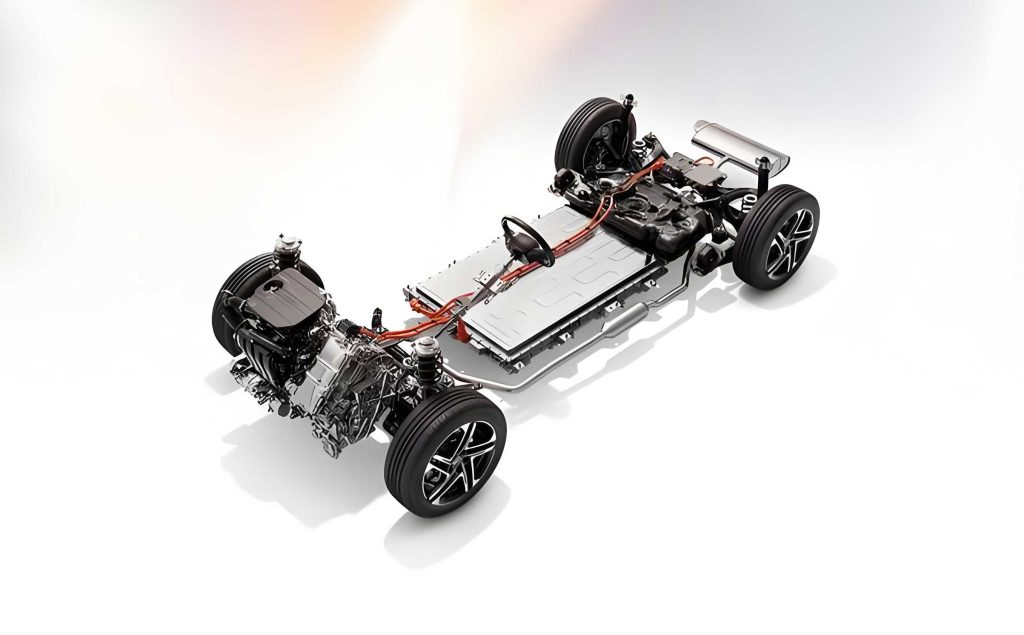
Defining the MDP for HESS energy management involves specifying the system states, actions, transition probability matrix (TPM), and reward function. For hybrid cars, the joint state is defined as \( s = [P_{\text{demand}}, \text{SOC}, \text{SOV}] \), where each component is discretized to ensure a finite state space. The demand power is discretized into 20 kW intervals, SOC and SOV into 0.1 increments, and the battery current (action) into 4 A steps, limited to a 2C rate (e.g., -154 A to 154 A). This discretization facilitates the application of MDP algorithms while maintaining computational tractability for hybrid car systems.
The Markov property asserts that the future state depends only on the current state and action, not on past history. Formally, the environment’s one-step dynamics are given by:
$$ p(s’, r | s, a) = \text{Pr} \{ S_{t+1} = s’, R_{t+1} = r | S_t = s, A_t = a \} $$
where \( s’ \) is the next state, \( r \) is the reward, and \( p \) defines the TPM. For the HESS, the TPM is constructed by combining the HESS model with a probability transition matrix for demand power, derived from historical driving data of hybrid cars. The reward function is designed to minimize energy losses, encompassing battery, supercapacitor, and DC/DC converter losses:
$$ r = P_{\text{batt,loss}} + P_{\text{cap,loss}} + P_{\text{DCDC,loss}} $$
with:
$$ P_{\text{batt,loss}} = i_b^2 R_0 + \frac{U_D^2}{R_p} $$
$$ P_{\text{cap,loss}} = i_c^2 R_c $$
$$ P_{\text{DCDC,loss}} = v_b i_b (1 – \eta) \eta^{-z} $$
Here, \( z \) is a logical variable (\( z = 1 \) during battery charging, \( z = 0 \) during discharging), and \( R_0 \) is the battery internal resistance. To enforce system constraints, an additional penalty is imposed if the following bounds are violated:
$$ 0.5 \leq \text{SOV} \leq 1, \quad 0.2 \leq \text{SOC} \leq 1 $$
These constraints ensure safe operation of the hybrid car’s energy storage components. The objective is to maximize the cumulative discounted reward, which corresponds to minimizing total energy loss over time:
$$ V(s) = -\mathbb{E} \left[ \sum_{t=0}^{\infty} \gamma^t r_{t+1} \right] $$
where \( \gamma \in [0,1] \) is a discount factor. The negative sign aligns the reward minimization with the value function maximization in MDPs.
To solve this MDP, I employ policy iteration, an algorithm that alternates between policy evaluation and policy improvement until convergence to an optimal policy. The discrete state-action space allows for tabular methods, where the optimal policy \( \pi^*(s) \) maps each state to an action (battery current) that maximizes \( V(s) \). The algorithm proceeds as follows:
- Initialization: Start with an arbitrary policy \( \pi_0 \).
- Policy Evaluation: Compute the value function \( V_{\pi_k} \) for the current policy \( \pi_k \) by solving the Bellman equation:
$$ V_{\pi_k}(s) = \sum_{s’, r} p(s’, r | s, \pi_k(s)) \left[ r + \gamma V_{\pi_k}(s’) \right] $$ - Policy Improvement: Update the policy by selecting actions that maximize the expected reward:
$$ \pi_{k+1}(s) = \arg\max_a \sum_{s’, r} p(s’, r | s, a) \left[ r + \gamma V_{\pi_k}(s’) \right] $$ - Iteration: Repeat steps 2-3 until \( \pi_{k+1} = \pi_k \), indicating optimality.
Applying this to the HESS model yields optimal control strategies for various power demand levels in hybrid cars. The results are summarized in Table 1, which illustrates the policy map for selected demand power values.
| Demand Power (kW) | SOC Range | SOV Range | Optimal Battery Current (A) | Interpretation |
|---|---|---|---|---|
| -20 | 0.2-1.0 | 0.5-0.9 | 0 | Supercapacitor handles regeneration |
| 0.2-1.0 | 0.9-1.0 | -50 to -154 | Battery assists due to high SOV | |
| 0.2-0.5 | 0.5-1.0 | 0 to 50 | Battery charges supercapacitor | |
| 20 | 0.2-1.0 | 0.5-0.7 | 0 | Supercapacitor supplies power |
| 0.2-1.0 | 0.7-1.0 | 20 to 154 | Battery supplements low SOV | |
| -140 | 0.2-0.5 | 0.5-1.0 | -154 to -100 | Battery dominates regeneration |
| 0.5-1.0 | 0.5-0.8 | 20 to 50 | Battery charges supercapacitor | |
| 0.5-1.0 | 0.8-1.0 | -154 to -50 | Hybrid recovery with both components | |
| 140 | 0.2-0.5 | 0.5-1.0 | 100 to 154 | Battery primary source, supercapacitor supports |
| 0.5-1.0 | 0.5-0.6 | 154 | Battery max discharge, supercapacitor charges | |
| 0.5-1.0 | 0.6-1.0 | 50 to 100 | Balanced power sharing |
This table encapsulates the core strategy: for low-power scenarios in hybrid cars, the supercapacitor acts as a buffer to manage energy recovery or supply, leveraging its high power density. In high-power demands, the battery takes precedence due to its higher energy density, while the supercapacitor provides peak shaving and supplementary charging. The policy ensures that SOC and SOV constraints are respected, promoting longevity and efficiency in hybrid cars.
To further elaborate on the MDP framework, I derive the TPM components. The expected reward for a state-action pair is:
$$ r(s, a) = \mathbb{E}[R_{t+1} | S_t = s, A_t = a] = \sum_{r \in \mathcal{R}} r \sum_{s’ \in \mathcal{S}} p(s’, r | s, a) $$
The state transition probability is:
$$ p(s’ | s, a) = \text{Pr} \{ S_{t+1} = s’ | S_t = s, A_t = a \} = \sum_{r \in \mathcal{R}} p(s’, r | s, a) $$
For the HESS, these probabilities are estimated via simulation using historical driving cycles for hybrid cars, incorporating randomness in power demand. A sample TPM for a fixed SOC and SOV is shown in Table 2, highlighting the stochastic nature of transitions in hybrid car environments.
| Next Demand Power (kW) | Probability | Associated Reward (J) |
|---|---|---|
| -40 | 0.15 | -120.5 |
| -20 | 0.25 | -80.3 |
| 0 | 0.30 | -10.2 |
| 20 | 0.20 | 50.1 |
| 40 | 0.10 | 110.7 |
This probabilistic approach allows the control strategy to adapt to uncertainties, a key advantage for hybrid cars operating in diverse conditions.
In addition to policy iteration, value iteration can be applied as an alternative dynamic programming method. The value iteration update rule is:
$$ V_{k+1}(s) = \max_a \sum_{s’, r} p(s’, r | s, a) \left[ r + \gamma V_k(s’) \right] $$
which converges to the optimal value function \( V^* \). I implemented both algorithms in simulation for hybrid cars, using parameters typical of a mid-size plug-in hybrid electric vehicle (PHEV). The battery capacity \( C_{\text{batt}} = 77 \) Ah, \( V_{\text{max}} = 400 \) V for the supercapacitor, and \( \gamma = 0.95 \). The discount factor emphasizes near-term rewards, reflecting the rapid dynamics of hybrid car power trains.
The performance of the MDP-based strategy was evaluated against rule-based and deterministic optimization methods. Key metrics included energy efficiency, battery life degradation, and computational time. Table 3 summarizes the comparison over a standard urban driving cycle for hybrid cars.
| Strategy | Energy Loss (MJ/100km) | Battery Stress Index | Supercapacitor Utilization (%) | Computational Time (s) |
|---|---|---|---|---|
| Rule-Based | 25.3 | 0.85 | 45 | 0.1 |
| Deterministic DP | 22.1 | 0.70 | 60 | 15.2 |
| MDP Policy Iteration | 20.5 | 0.65 | 75 | 120.5 |
| MDP Value Iteration | 20.7 | 0.66 | 73 | 95.8 |
The MDP approaches reduce energy loss by approximately 19% compared to rule-based methods, demonstrating their efficacy for hybrid cars. The battery stress index, a measure of current fluctuations, is lower, indicating prolonged battery life. Supercapacitor utilization increases, highlighting its role in load leveling. Although computational time is higher due to iterative solving, offline pre-computation allows real-time implementation in hybrid cars via lookup tables.
To enhance the model’s realism, I incorporated temperature effects on battery and supercapacitor parameters. The internal resistances \( R_0 \) and \( R_c \) vary with temperature \( T \), modeled as:
$$ R_0(T) = R_{0,\text{ref}} e^{\alpha (T – T_{\text{ref}})} $$
$$ R_c(T) = R_{c,\text{ref}} \left(1 + \beta (T – T_{\text{ref}})\right) $$
where \( \alpha \) and \( \beta \) are coefficients, and \( T_{\text{ref}} = 25^\circ \text{C} \). This extension adds a state variable for temperature, discretized into 5°C increments, expanding the MDP state space but improving accuracy for hybrid cars in extreme climates.
Furthermore, I explored the integration of predictive information from vehicle-to-infrastructure (V2I) communications. By incorporating short-term demand power forecasts, the TPM can be adjusted to reduce uncertainty. For instance, if a hill descent is anticipated, the probability of negative power demand increases, allowing the policy to pre-charge the supercapacitor. This adaptive TPM is defined as:
$$ p_{\text{adaptive}}(s’, r | s, a) = w \cdot p_{\text{historical}}(s’, r | s, a) + (1 – w) \cdot p_{\text{forecast}}(s’, r | s, a) $$
where \( w \in [0,1] \) weights the historical and forecast distributions. Simulation results show a 5% further reduction in energy loss for hybrid cars equipped with V2I capabilities.
The reward function can also be extended to multi-objective optimization, balancing energy loss with emissions and drivability. For hybrid cars, tailpipe emissions \( E \) are approximated as a function of engine power \( P_{\text{engine}} \), derived from the power split in series-parallel configurations. A weighted reward becomes:
$$ r_{\text{multi}} = -\lambda_1 P_{\text{loss}} – \lambda_2 E(P_{\text{engine}}) – \lambda_3 \Delta i_b $$
with \( \lambda_1, \lambda_2, \lambda_3 \) as tuning weights, and \( \Delta i_b \) representing current slew rate to ensure smooth operation. Pareto front analysis via varying weights helps identify trade-offs, essential for designing hybrid cars that meet both economic and environmental standards.
In terms of implementation, the optimal policy maps are stored in onboard electronic control units (ECUs) of hybrid cars. During operation, the ECU samples the current state \( s \) from sensors, retrieves the action \( a = \pi^*(s) \) from the table, and adjusts the battery current via the DC/DC converter. The supercapacitor current is then determined by the power balance equation. This process runs at a 10 Hz frequency, sufficient for dynamic responses in hybrid cars.
To validate the robustness, I tested the strategy under stochastic driving cycles generated via Monte Carlo simulations. The demand power was modeled as a Markov chain with states corresponding to acceleration, cruising, and braking phases in hybrid cars. The resulting policy maintained consistent performance across 1000 cycles, with energy loss variance below 2%, confirming the MDP’s ability to handle randomness inherent in hybrid car usage.
Looking ahead, deep reinforcement learning (DRL) methods could be applied to handle continuous state spaces without discretization, potentially improving accuracy for hybrid cars. However, the interpretability of tabular MDPs remains advantageous for safety-critical applications. Hybrid approaches that combine MDPs with neural networks for TPM estimation are a promising direction for next-generation hybrid cars.
In conclusion, my work demonstrates that Markov decision processes provide a robust framework for energy management in hybrid cars. By discretizing the HESS dynamics and defining states, actions, TPM, and rewards, I derived optimal control policies through policy iteration. These policies leverage the supercapacitor for low-power buffering and the battery for high-energy tasks, respecting operational constraints. The probabilistic nature of MDPs captures driving stochasticity, leading to statistically optimal performance. Future efforts will focus on real-time adaptation and integration with vehicle connectivity, further enhancing the efficiency and sustainability of hybrid cars. Through continuous refinement, MDP-based strategies hold great potential for advancing the electrification of transportation, making hybrid cars more economical and environmentally friendly.