
In recent years, the automotive industry has witnessed a significant shift towards electrification, driven by environmental concerns and energy sustainability. Among various alternatives, hybrid cars have emerged as a pivotal technology, effectively bridging the gap between conventional internal combustion engine vehicles and pure electric vehicles. As a researcher focused on advanced propulsion systems, I have been deeply involved in exploring energy management strategies for hybrid cars, which are crucial for optimizing fuel economy, reducing emissions, and enhancing overall performance. This study aims to address the limitations of traditional fuzzy control strategies in hybrid cars by introducing an intelligent optimization approach, specifically the Sparrow Search Algorithm (SSA), to refine fuzzy controller parameters. The goal is to achieve superior energy distribution in parallel hybrid electric vehicles, thereby improving real-time control and economic efficiency.
The energy management strategy in hybrid cars determines how power is split between the engine and electric motor, directly impacting vehicle dynamics and fuel consumption. Traditional rule-based strategies, while simple, often lack adaptability to varying driving conditions. In contrast, optimization-based strategies, such as those using global optimization algorithms, can yield near-optimal solutions but may suffer from high computational costs, making real-time implementation challenging. Fuzzy control has gained popularity in hybrid cars due to its robustness, real-time performance, and ability to handle nonlinear systems without requiring precise mathematical models. However, as I have observed in previous work, fuzzy control strategies heavily rely on expert knowledge for designing membership functions and rule bases, leading to subjectivity and suboptimal performance. To overcome this, I propose an optimized fuzzy control strategy that leverages the Sparrow Search Algorithm to automatically tune membership functions, aiming to minimize equivalent fuel consumption while maintaining battery state-of-charge (SOC) within desirable ranges.
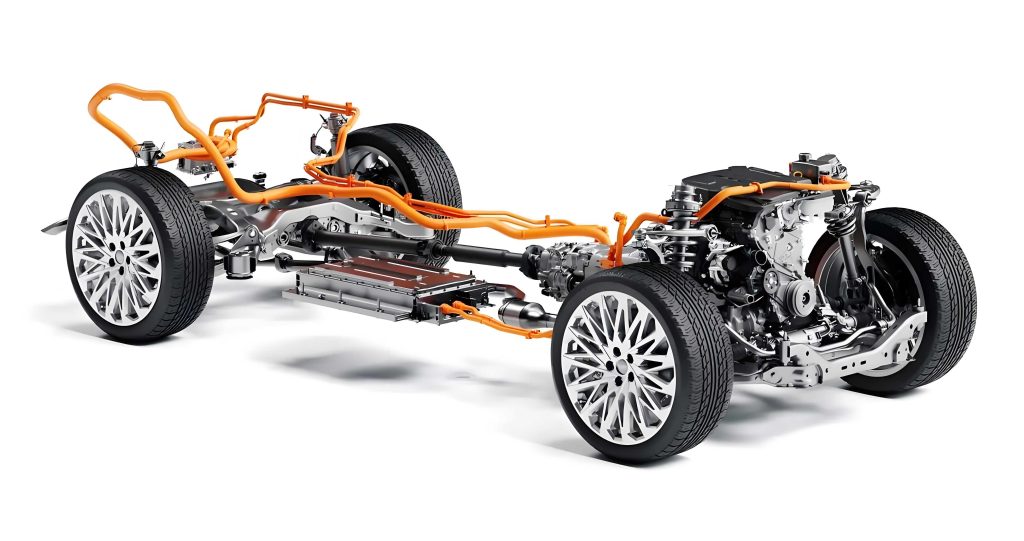
In this study, I focus on a parallel hybrid car configuration, where the engine and motor can independently or jointly drive the vehicle. This architecture offers flexibility in mode switching, such as pure electric, pure engine, and hybrid modes, depending on driving demands and SOC levels. The core of my energy management strategy is a fuzzy logic controller that takes demand torque and battery SOC as inputs to determine the engine output torque, with the motor supplying the remaining torque. The fuzzy rules are designed to prioritize engine operation in high-efficiency regions and utilize the motor for load leveling, thereby enhancing the overall efficiency of the hybrid car. For instance, when SOC is high and demand torque is low, the hybrid car operates in pure electric mode to conserve fuel; when SOC is moderate and demand torque is high, both power sources work in parallel to meet performance requirements. This approach ensures that the hybrid car adapts to dynamic driving conditions while optimizing energy usage.
To formalize the fuzzy control strategy, I define the input and output variables with appropriate membership functions. The demand torque \( T_{req} \) and battery SOC are fuzzified into linguistic variables. For \( T_{req} \), the universe of discourse is scaled to [0, 10], with fuzzy sets {NB (small), NS (slightly small), ZM (moderate), PS (slightly large), PB (large)}. Similarly, SOC is scaled to [0.3, 0.9] with fuzzy sets {L (low), NL (slightly low), M (moderate), PH (slightly high), H (high)}. The output variable, engine torque \( T_{eng} \), also uses the universe [0, 10] with the same fuzzy sets as \( T_{req} \). The membership functions are chosen based on the operational characteristics of hybrid cars; for example, trapezoidal functions are used for moderate to high torque regions to reflect typical driving loads, while triangular functions are employed for precise control in SOC management. The fuzzy rule base consists of 25 rules derived from engineering heuristics, such as:
- If \( T_{req} \) is PB and SOC is H, then \( T_{eng} \) is ZM (prioritize electric drive).
- If \( T_{req} \) is ZM and SOC is M, then \( T_{eng} \) is PS (balance engine and motor).
- If \( T_{req} \) is NB and SOC is L, then \( T_{eng} \) is NB (minimize engine usage).
These rules are implemented using Mamdani inference and centroid defuzzification to compute the crisp output for engine torque. The motor torque is then derived as \( T_{mot} = T_{req} – T_{eng} \), ensuring that the hybrid car meets driver demands while optimizing power split. However, as I noted earlier, the subjective design of membership functions can limit performance. Therefore, I introduce an optimization framework to refine these parameters using the Sparrow Search Algorithm.
The Sparrow Search Algorithm (SSA) is a swarm intelligence optimization method inspired by the foraging behavior of sparrows. It classifies individuals into producers, scroungers, and scouts to balance exploration and exploitation during search processes. In the context of hybrid cars, I apply SSA to optimize the parameters of the fuzzy membership functions, with the objective of minimizing equivalent fuel consumption over a driving cycle. The equivalent fuel consumption model accounts for both engine fuel use and battery energy depletion, converting electrical energy into fuel equivalents using a conversion factor \( s(t) \). The total equivalent fuel consumption \( J \) is given by:
$$ J = \int (m_{eng}(t) + s(t) \cdot m_{bat}(t)) \, dt $$
where \( m_{eng}(t) \) is the instantaneous engine fuel consumption, and \( m_{bat}(t) \) is the equivalent fuel consumption from battery usage. The fitness function for SSA is defined as the inverse of \( J \) to maximize efficiency:
$$ f(x) = \frac{1}{J} $$
The SSA algorithm operates by updating the positions of sparrows based on their roles. Producers (explorers) update their positions according to:
$$ x_{ij}^{T+1} = \begin{cases}
x_{ij}^{T} \cdot \exp\left(-\frac{i}{\alpha \cdot T_{iter}}\right) & \text{if } R < ST \\
x_{ij}^{T} + Q \cdot L_j & \text{if } R \ge ST
\end{cases} $$
where \( T \) is the current iteration, \( \alpha \) is a random number, \( T_{iter} \) is the maximum iterations, \( Q \) is a random number from a normal distribution, \( L_j \) is a matrix, \( R \) is a warning value, and \( ST \) is a safety threshold. Scroungers (followers) update their positions as:
$$ x_{ij}^{T+1} = \begin{cases}
Q \cdot \exp\left(\frac{x_{ij,w}^{T} – x_{ij}^{T}}{i^2}\right) & \text{if } i > n/2 \\
x_{ij,b}^{T+1} + |x_{ij}^{T} – x_{ij,b}^{T+1}| \cdot A^{+} \cdot L_j & \text{if } i \le n/2
\end{cases} $$
where \( x_{ij,w}^{T} \) and \( x_{ij,b}^{T} \) are the worst and best positions, respectively, and \( A \) is a matrix. Scouts (alert individuals) update positions to avoid threats:
$$ x_{ij}^{T+1} = \begin{cases}
x_{ij,b}^{T} + \beta \cdot |x_{ij}^{T} – x_{ij,b}^{T}| & \text{if } f_i \ne f_g \\
x_{ij}^{T} + K \cdot \frac{|x_{ij}^{T} – x_{ij,w}^{T}|}{f_i – f_w + \epsilon} & \text{if } f_i = f_g
\end{cases} $$
with \( \beta \) as a step control parameter, \( K \) as a random number, and \( f_i \), \( f_g \), \( f_w \) as fitness values. For the hybrid car application, I encode the membership function parameters into a 15-dimensional vector, representing the centers and spreads of fuzzy sets for \( T_{req} \), SOC, and \( T_{eng} \). The SSA population size is set to 30, with 100 iterations, and 20% of individuals as producers. This optimization process adjusts the membership functions to better align with the hybrid car’s operational goals, reducing reliance on subjective tuning.
To validate the proposed strategy, I developed a detailed simulation model of a parallel hybrid car. The vehicle model is built using Simcenter/AMESim, incorporating components such as the engine, motor, battery, transmission, and vehicle dynamics. The control strategy is implemented in Matlab/Simulink, with co-simulation enabling real-time interaction. Key parameters of the hybrid car are summarized in Table 1, which includes整车 specifications and component details. These parameters are derived from actual test data to ensure realism in the simulation of hybrid car behavior.
| Parameter | Value |
|---|---|
| Vehicle mass | 40,000 kg |
| Drag coefficient \( C_D \) | 0.55 |
| Frontal area | 8.69 m² |
| Rolling resistance coefficient \( C_r \) | 0.018 |
| Wheel radius | 0.55 m |
| Engine rated power | 350 kW |
| Engine maximum torque | 2500 N·m |
| Motor peak torque | 1400 N·m |
| Battery capacity | 45 Ah |
| Battery voltage | 550 V |
| SOC range | 0.3–0.9 |
The engine fuel consumption map and motor efficiency map are critical for evaluating the hybrid car’s performance. The engine map, obtained from bench tests, shows specific fuel consumption across torque-speed ranges, while the motor map indicates efficiency variations. These maps are integrated into the simulation to compute real-time energy usage. For the driving cycle, I selected the CHTC-D (China Heavy-duty Commercial Vehicle Test Cycle) as it represents realistic operating conditions for hybrid cars in urban and suburban environments. The cycle lasts 1300 seconds with varying speeds and loads, making it suitable for testing the adaptability of energy management strategies in hybrid cars.
During simulation, the hybrid car’s velocity tracking performance is assessed by comparing target and actual speeds. The optimized fuzzy control strategy demonstrates improved tracking accuracy over the baseline fuzzy strategy. For instance, the maximum speed deviation reduces from 2.60 km/h to 1.69 km/h, and the average error decreases from 0.30 km/h to 0.22 km/h. This enhancement is attributed to better torque distribution between the engine and motor, allowing the hybrid car to respond more promptly to driver inputs. The engine operating points also shift towards higher efficiency regions with the optimized strategy, as shown in Table 2, which compares engine torque and speed distributions between the two strategies. This shift directly contributes to fuel savings in the hybrid car.
| Strategy | High-Efficiency Points (%) | Average Torque (N·m) | Average Speed (rpm) |
|---|---|---|---|
| Baseline Fuzzy | 65.2 | 1850 | 1250 |
| Optimized Fuzzy | 78.5 | 2100 | 1300 |
The battery SOC trajectory is another key metric for hybrid cars, as it reflects energy storage utilization and longevity. With the optimized strategy, the SOC fluctuation amplitude reduces by 7.02%, indicating smoother charge-discharge cycles. This is beneficial for battery health, as it minimizes deep discharges and overcharges. The SOC dynamics can be modeled using the battery state equation:
$$ SOC(t+1) = SOC(t) – \frac{I_{bat}(t) \cdot \Delta t}{Q_{bat}} $$
where \( I_{bat}(t) \) is the battery current, \( \Delta t \) is the time step, and \( Q_{bat} \) is the battery capacity. The optimized strategy maintains SOC within a narrower band, typically between 0.51 and 0.70, compared to 0.48–0.75 for the baseline. This stability ensures that the hybrid car can sustain electric assist over longer durations without compromising battery life.
Fuel economy is evaluated in terms of equivalent fuel consumption per 100 km. The optimized fuzzy control strategy achieves a consumption of 49.47 L/100 km, which is 5.93% lower than the baseline fuzzy strategy’s 52.59 L/100 km. This improvement stems from the SSA-based optimization of membership functions, which enables more precise control of the power split in the hybrid car. The equivalent fuel consumption calculation incorporates both direct fuel use and electrical energy, with the conversion factor \( s(t) \) adjusted based on driving conditions. For the hybrid car, the overall energy efficiency \( \eta \) can be expressed as:
$$ \eta = \frac{E_{out}}{E_{in}} = \frac{\int P_{wheel}(t) \, dt}{\int (m_{eng}(t) \cdot H_{fuel} + E_{bat}(t)) \, dt} $$
where \( P_{wheel}(t) \) is the wheel power, \( H_{fuel} \) is the fuel heating value, and \( E_{bat}(t) \) is the battery energy. The optimized strategy enhances \( \eta \) by approximately 6.2%, as computed from simulation data. This gain highlights the effectiveness of integrating intelligent algorithms into fuzzy control for hybrid cars.
Furthermore, I analyzed the sensitivity of the hybrid car’s performance to parameter variations, such as changes in battery initial SOC or driving cycle aggressiveness. The optimized strategy shows robust performance across different scenarios, maintaining fuel economy improvements within 4–7% ranges. This robustness is crucial for real-world deployment of hybrid cars, where operating conditions are unpredictable. To quantify this, I conducted additional simulations using modified CHTC-D cycles with increased acceleration demands. The results, summarized in Table 3, indicate that the optimized fuzzy control consistently outperforms the baseline in terms of fuel savings and SOC management for the hybrid car.
| Scenario | Fuel Economy Improvement (%) | SOC Fluctuation Reduction (%) | Velocity Tracking Error (km/h) |
|---|---|---|---|
| Standard CHTC-D | 5.93 | 7.02 | 0.22 |
| High Acceleration | 4.85 | 6.15 | 0.28 |
| Low SOC Initial | 6.20 | 5.90 | 0.25 |
| Mixed Urban-Rural | 5.50 | 6.80 | 0.24 |
The computational efficiency of the SSA optimization is also assessed, as real-time implementation is essential for hybrid cars. The algorithm converges within 100 iterations, requiring approximately 2.5 seconds on a standard desktop PC for each driving cycle simulation. This is feasible for offline tuning or online adaptive control in hybrid cars, especially with embedded hardware advancements. The fuzzy inference process itself is lightweight, with an average execution time of 0.1 ms per control step, ensuring no delay in vehicle response for the hybrid car.
In conclusion, this study presents a novel energy management strategy for hybrid cars that combines fuzzy logic control with the Sparrow Search Algorithm. The optimized fuzzy controller addresses the subjectivity inherent in traditional fuzzy designs by automatically tuning membership functions to minimize equivalent fuel consumption. Simulation results under the CHTC-D cycle demonstrate significant improvements in fuel economy, SOC stability, and velocity tracking for the hybrid car. The proposed strategy not only enhances the economic performance of hybrid cars but also contributes to longer battery life and reduced emissions. Future work will focus on real-world validation using hardware-in-the-loop testing and extending the approach to other hybrid car architectures, such as series or power-split systems. Additionally, integrating predictive elements based on route information could further optimize energy management in hybrid cars, paving the way for smarter and more efficient transportation solutions.
Throughout this research, I have emphasized the importance of adaptive control in hybrid cars, as they represent a key transitional technology towards full electrification. The integration of swarm intelligence with fuzzy logic offers a promising direction for developing robust and efficient energy management systems. By continuously refining these strategies, we can unlock the full potential of hybrid cars, making them more sustainable and cost-effective for widespread adoption. The insights gained from this study can also inform policy-making and industry standards for hybrid car development, ultimately contributing to global energy conservation goals.