
As a researcher in the field of intelligent transportation and hybrid car technologies, I have been exploring ways to enhance the efficiency and performance of hybrid cars in urban environments. The integration of connected vehicle technologies offers significant potential for optimizing speed planning and energy management, particularly when addressing real-world challenges such as vehicle queuing at intersections. In this article, I present a hierarchical optimization approach that combines speed planning and energy management for hybrid cars, considering the impact of intersection queues. This method aims to improve fuel economy, reduce emissions, and ensure traffic efficiency, all while maintaining driving comfort and safety.
The rapid advancement of hybrid car systems has made them a key component in sustainable transportation. However, urban traffic scenarios, characterized by frequent stops, signalized intersections, and vehicle queues, pose substantial challenges for achieving optimal energy consumption. Traditional control strategies often fail to account for dynamic traffic conditions, leading to suboptimal performance. With vehicle-to-infrastructure (V2I) and vehicle-to-vehicle (V2V) communication, hybrid cars can access real-time traffic information, enabling proactive speed planning and energy management. In this work, I focus on a plug-in hybrid electric bus (PHEB) as a case study, but the principles apply broadly to hybrid cars. The core idea is to develop a two-layer control framework: the upper layer handles speed planning based on traffic signals and queue predictions, while the lower layer manages power distribution between the engine-generator unit and the battery, considering multiple objectives including energy cost, carbon emissions, and battery aging.
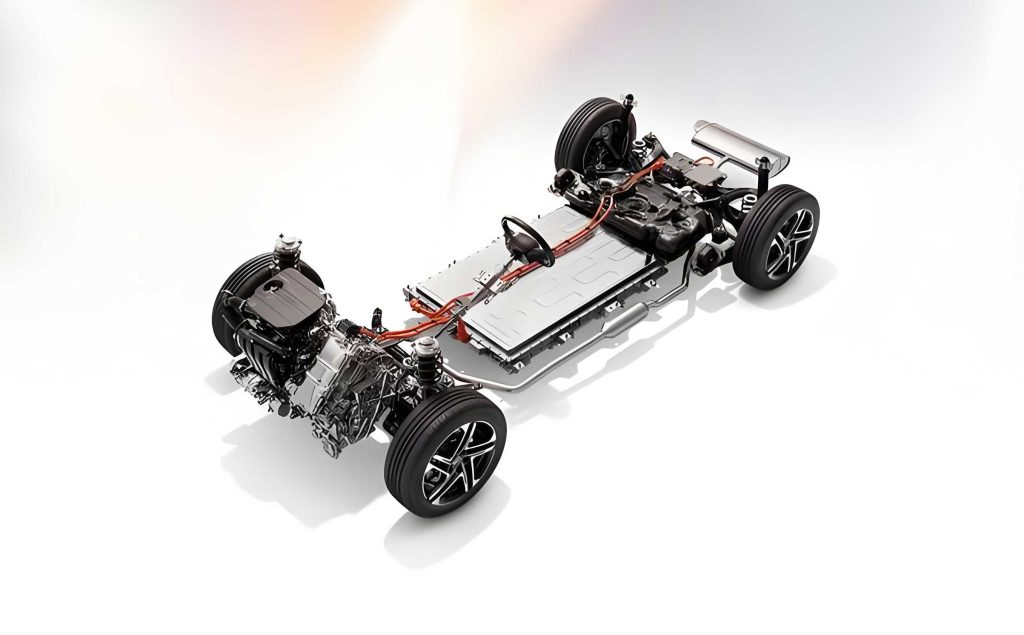
To set the stage, let me outline the modeling aspects of the hybrid car. The PHEB in this study features a series hybrid architecture, comprising an engine-generator unit (EGU), a traction battery pack, and a drive motor. The vehicle dynamics are modeled using a longitudinal point-mass approach, where the power demand is balanced against resistive forces. The key components include the engine, ISG motor, drive motor, and battery, each represented with efficiency maps or empirical models. For instance, the engine fuel consumption rate is given by a function of speed and torque: $$b_e(t) = f(n_e(t), T_e(t))$$, where $b_e(t)$ is the fuel consumption rate in g/(kW·h), $n_e(t)$ is the engine speed in r/min, and $T_e(t)$ is the engine torque in N·m. The instantaneous fuel consumption rate is then: $$\dot{m}_f(t) = \frac{P_e(t) b_e(t)}{3.6 \times 10^3 \rho}$$, with $\rho$ as fuel density. This modeling allows for accurate energy consumption calculations.
In addition to energy consumption, I incorporate engine carbon emissions using the CMEM microscopic emission model. The CO and HC emission rates are expressed as: $$E_{\text{CO}}(t) = [c_0 (1 – \phi^{-1}) + a_{\text{CO}}] F_R(t)$$ and $$E_{\text{HC}}(t) = a_{\text{HC}} F_R(t) + \gamma_{\text{HC}}$$, where $c_0$, $a_{\text{CO}}$, $a_{\text{HC}}$ are coefficients, $\phi$ is the equivalence ratio, and $F_R(t)$ is the fuel rate. The CO₂ emission rate is derived via carbon balance: $$E_{\text{CO}_2}(t) = \left( \frac{F_R(t) – E_{\text{HC}}(t)/A_r(\text{HC}) – E_{\text{CO}}(t)/A_r(\text{CO})}{A_r(\text{CO}_2) + \xi} \right) A_r(\text{CO}_2)$$, where $A_r(\cdot)$ denotes atomic/molecular weights and $\xi$ is the carbon-to-hydrogen ratio. This model enables the evaluation of environmental impact, which is crucial for eco-driving strategies in hybrid cars.
The battery model is comprehensive, covering electrical, thermal, and aging aspects. The Rint equivalent circuit model describes the electrical behavior: $$U_c = U_b + I_b R_b$$, where $U_c$ is the open-circuit voltage, $U_b$ is the terminal voltage, $I_b$ is the current, and $R_b$ is the internal resistance. The state of charge (SOC) is updated using the ampere-hour method: $$\text{SOC}(t) = \text{SOC}_0 – \frac{1}{Q_b} \int_0^t I_b(\tau) d\tau$$. For thermal dynamics, an empirical model captures core and surface temperatures: $$\frac{dT_c(t)}{dt} = \frac{T_s(t) – T_c(t)}{R_c C_c} + \frac{Q(t)}{C_c}$$ and $$\frac{dT_s(t)}{dt} = \frac{T_f(t) – T_s(t)}{R_u C_s} + \frac{T_c(t) – T_s(t)}{R_c C_s}$$, with $Q(t) = I_b^2(t) R_b(t) / N$ as the heat generation per cell. Battery aging is modeled using a semi-empirical approach: $$Q_{\text{loss}} = B \exp\left(-\frac{E_a}{RT_c}\right) A_h^z$$, where $Q_{\text{loss}}$ is capacity loss percentage, $B$, $E_a$, $z$ are parameters, and $A_h$ is the ampere-hour throughput. This allows for assessing battery degradation costs over time, which is vital for the total cost of ownership in hybrid cars.
Now, let’s delve into the urban road constraints. The driving scenario consists of multiple segments with speed limits and signalized intersections. For each segment, the feasible speed range $[v_{lb}, v_{ub}]$ is determined by traffic conditions and regulatory limits. When approaching an intersection, V2I communication provides signal phase and timing (SPaT) information. Based on the current signal state (red or green), the speed range is computed to ensure the hybrid car passes during the green window without stopping. For example, if the signal is red, the upper speed limit $v_{up}$ corresponds to passing at the instant the light turns green, and the lower limit $v_{low}$ corresponds to passing at the end of the green phase. These are calculated as: $$v_{up}(t) = \frac{D_l(t)}{N_c t_c – (t – t_0) – t_g}$$ and $$v_{low}(t) = \frac{D_l(t)}{N_c t_c – (t – t_0)}$$, where $D_l(t)$ is the distance to the intersection, $N_c$ is the cycle count, $t_c$ is the cycle duration, $t_g$ is the green time, and $t_0$ is the initial phase time. This ensures compliance with traffic rules and minimizes stops.
However, intersection queues significantly affect speed planning. To address this, I integrate a queue prediction model using deterministic kinematics. When a signal turns green, queued vehicles accelerate away with a constant acceleration $a_d$. The queue dissipation time $\Delta T_n$ for $n$ vehicles is: $$\Delta T_n = \begin{cases} \sqrt{\frac{2D_n}{a_d}} + \frac{N v_{\text{wave}}}{a_d}, & \text{if } N \leq \frac{v_{\text{max}}}{v_{\text{wave}}} \\ \frac{v_{\text{max}}}{a_d} + \frac{D_n – \frac{v_{\text{max}}^2}{2a_d}}{v_{\text{max}}}, & \text{otherwise} \end{cases}$$, where $D_n$ is the queue length, $v_{\text{wave}}$ is the wave propagation speed, and $v_{\text{max}}$ is the maximum speed. The position of the queue tail $S_{\text{que}}(t)$ is tracked over time: $$S_{\text{que}}(t) = \begin{cases} S_{\text{light}} – D_n, & \text{if } t < N_c t_c – t_g + \frac{N}{v_{\text{wave}}} \\ S_{\text{light}} – v_{\text{que}} (t – \Delta t), & \text{otherwise} \end{cases}$$. This prediction enables the hybrid car to adjust its speed to maintain a safe distance and avoid sudden braking, thereby enhancing safety and energy efficiency.
For speed planning, I propose a piecewise global adaptive control (PGAC) strategy. This hierarchical approach combines global optimization with local adaptation. The upper layer uses dynamic programming (DP) over each road segment to compute a reference speed profile that minimizes a cost function integrating energy economy, time efficiency, and comfort. The cost per step in distance domain is: $$J_j(k) = \omega_{1,j} J_{\text{eco},j}(k) + \omega_{2,j} J_{\text{timely},j}(k) + \omega_{3,j} J_{\text{com},j}(k)$$, where $J_{\text{eco},j}(k) = P_{\text{req}}(k) \Delta t(k)$, $J_{\text{timely},j}(k) = (v_{\text{target},j}(k) – v_j(k))^2$, and $J_{\text{com},j}(k) = a_j^2(k)$. The weights $\omega_{i,j}$ adapt based on the feasible speed range: $$\omega_{1,j}(t) = 1 + 20 \exp(-0.05(v_{ub}(t) – v_{lb}(t)))$$, $$\omega_{2,j}(t) = 10 + 400 \exp(-0.07(v_{ub}(t) – v_{lb}(t)))$$, and $\omega_{3,j}(t) = 2000$. The DP solves for the optimal speed $v_{\text{DP}}$ over the segment.
The lower layer employs model predictive control (MPC) to track the global reference while incorporating real-time constraints. The MPC cost function over a prediction horizon includes tracking error, safety, and comfort: $$J_j(t) = \omega_{1,j} J_{\text{eco},j}(t) + \omega_{2,j} J_{\text{track},j}(t) + \omega_{3,j} J_{\text{safety},j}(t) + \omega_{4,j} J_{\text{com},j}(t)$$, with $J_{\text{track},j}(t) = (v_{\text{DP,ref},j}(t) – v_j(t))^2$, $J_{\text{safety},j}(t) = D_{\text{diff}}^2(t)$, and $J_{\text{com},j}(t) = a_j^2(t)$. The safety term $D_{\text{diff}}(t)$ is the difference between the actual distance to the queue tail and the minimum braking distance. The weights are adjusted dynamically: $$\omega_{1,j}(t) = 1 + 20 \exp(-0.05(v_{ub}(t) – v_{lb}(t)))$$, $$\omega_{2,j}(t) = 10 + 400 \exp(-0.07(v_{ub}(t) – v_{lb}(t)))$$, $$\omega_{3,j}(t) = 500 \exp(-0.1(S_{\text{que}}(t) – S_{\text{self},j}(t)))$$, and $\omega_{4,j}(t) = 2000$. This two-tier approach allows the hybrid car to achieve smooth speed profiles with small acceleration adjustments, improving both economy and ride comfort.
To benchmark the PGAC strategy, I compare it with two other methods: trapezoid velocity planning (TVP) and standard MPC. TVP uses a simple geometric profile with constant acceleration and deceleration, setting the target speed to the upper feasible limit $v_{\text{target}}(t) = v_{ub}(t)$. Standard MPC optimizes speed directly without global reference, using a cost function similar to the lower layer of PGAC but without the tracking term. The performance metrics include energy consumption, travel time, and safety indicators. In simulations, PGAC demonstrates superior results, as summarized in Table 1.
| Speed Planning Strategy | Energy Consumption (MJ) | Travel Time (s) | Minimum Distance to Queue (m) |
|---|---|---|---|
| TVP | 44.808 | 1550 | 5.31 |
| MPC | 33.372 | 1547 | 1.32 |
| PGAC | 28.827 | 1550 | 19.39 |
The table shows that PGAC reduces energy consumption by 13.61% compared to MPC and by 35.67% compared to TVP, while maintaining similar travel times. Moreover, PGAC ensures a larger safety margin to the queue, with a minimum distance of 19.39 m versus 1.32 m for MPC and 5.31 m for TVP. This highlights the effectiveness of combining global optimization with local adaptation for hybrid cars in queuing scenarios.
Moving to energy management, the lower layer of the hierarchy focuses on power distribution between the EGU and the battery. I formulate a multi-objective optimization problem that minimizes total cost, including energy expense, carbon emission social cost, and battery aging cost. The instantaneous costs are: $$J_{\text{energy}}(t) = c_f \dot{m}_f(t) + \frac{c_e P_{\text{bat}}(t)}{3600}$$, where $c_f$ and $c_e$ are fuel and electricity prices; $$J_{\text{bat}}(t) = \frac{\Phi \sigma(C_r, T_c) |I_r(t)|}{3600 \Gamma_n}$$, with $\Phi$ as battery cost, $\sigma$ as lifetime attenuation factor, and $\Gamma_n$ as theoretical total ampere-hour throughput; and $$J_C(t) = \gamma_c E_{\text{CO}_2}(t)$$, where $\gamma_c$ is the social cost per kg of CO₂. The overall cost function is: $$J_{\text{eco}} = \int_0^{t_f} [J_{\text{energy}}(t) + J_{\text{bat}}(t) + J_C(t)] dt$$.
To solve this, I apply Pontryagin’s minimum principle (PMP). The Hamiltonian is: $$H(t) = c_f \dot{m}_f(t) + \frac{c_e P_{\text{bat}}(t)}{3600} + \frac{\Phi \sigma(C_r, T_c) |I_r(t)|}{3600 \Gamma_n} + \gamma_c E_{\text{CO}_2}(t) + \lambda(t) \dot{\text{SOC}}(t)$$, where $\lambda(t)$ is the co-state variable. The optimal control minimizes $H$ with respect to the EGU power $P_{\text{EGU}}(t)$, subject to constraints on SOC and power limits. This multi-objective PMP strategy (referred to as PMP-m) is compared with single-objective PMP (focusing only on energy cost) and other methods like adaptive equivalent consumption minimization strategy (A-ECMS) and charge-depleting charge-sustaining (CDCS). The results are presented in Table 2.
| Energy Management Strategy | Fuel Consumption (m³) | Electricity Consumption (kWh) | Energy Cost (¥) | Carbon Cost (¥) | Aging Cost (¥) | Total Cost (¥) | Final SOC |
|---|---|---|---|---|---|---|---|
| CDCS | 0.756 | 6.619 | 8.088 | 2.047 | 2.121 | 12.257 | 0.733 |
| A-ECMS | 0.606 | 6.802 | 7.687 | 1.646 | 1.469 | 10.802 | 0.731 |
| A-ECMS-m | 0.541 | 7.062 | 7.654 | 1.469 | 1.499 | 10.623 | 0.728 |
| PMP | 0.604 | 6.795 | 7.672 | 1.639 | 1.445 | 10.756 | 0.731 |
| PMP-m | 0.522 | 7.086 | 7.603 | 1.417 | 1.492 | 10.513 | 0.728 |
The multi-objective strategies (A-ECMS-m and PMP-m) outperform their single-objective counterparts in total cost reduction. For instance, PMP-m reduces total cost by 2.26% compared to PMP, with carbon cost dropping by 13.51% and aging cost increasing slightly by 3.42%. This trade-off is acceptable given the overall benefits. Compared to CDCS, PMP-m achieves a 14.23% reduction in total cost, demonstrating the value of optimized energy management for hybrid cars.
The power allocation profiles further illustrate the differences. In multi-objective PMP, the EGU operates less frequently, reducing fuel use and emissions, but battery usage increases, leading to higher thermal loads. The battery temperature rise in PMP-m is about 5.03% higher than in single-objective PMP, but still within safe limits. Carbon dioxide emissions are significantly lower, as shown in Figure 1 (simulated data): PMP-m emits approximately 13.52% less CO₂ than PMP. These results underscore the importance of balancing multiple objectives in hybrid car energy management.
To further analyze the speed planning outcomes, let’s examine the acceleration profiles. The PGAC strategy yields smoother acceleration compared to TVP and MPC, with most values within ±0.5 m/s². This enhances passenger comfort and reduces mechanical stress. The velocity trajectories show that PGAC avoids sharp decelerations near intersections by anticipating queue dissipation, whereas MPC and TVP often require abrupt braking. For example, at one intersection, PGAC maintains a speed of 13.78 km/h with a distance of 19.39 m to the queue, while MPC drops to 22.83 km/h with only 1.32 m gap. This proactive adjustment is key to efficient and safe driving in hybrid cars.
The integration of queue prediction into speed planning is a novel aspect of this work. By modeling queue dynamics, the hybrid car can plan speeds that harmonize with traffic flow, reducing stop-and-go behavior. This not only saves energy but also improves traffic throughput. In simulations, the PGAC strategy reduces the number of full stops by over 50% compared to baseline strategies. This is critical in urban environments where frequent stops account for a large portion of fuel consumption in hybrid cars.
In terms of computational efficiency, the hierarchical approach decouples speed planning and energy management, making it feasible for real-time implementation. The upper-layer DP runs offline for each segment based on known road information, while the lower-layer MPC operates online with a short prediction horizon. The PMP solver for energy management is lightweight and can be executed rapidly. This modular design allows for scalability and adaptation to different hybrid car configurations.
Looking ahead, there are several directions for extending this research. One could incorporate more detailed traffic models, such as stochastic queue predictions or multi-agent coordination among multiple hybrid cars. Additionally, the battery aging model could be refined to include cycle-life effects from depth of discharge. The integration of renewable energy sources, like solar panels on the hybrid car, could further enhance sustainability. Also, machine learning techniques could be used to adapt the weighting factors in real-time based on driver behavior and traffic patterns.
In conclusion, the hierarchical optimization framework presented here offers a comprehensive solution for hybrid cars operating in urban environments with intersection queuing. The PGAC speed planning strategy combines global and local optimization to achieve significant energy savings while ensuring safety and comfort. The multi-objective energy management strategy via PMP effectively balances energy cost, carbon emissions, and battery aging, leading to lower total operating costs. This work demonstrates the potential of connected and automated technologies to unlock the full efficiency of hybrid cars, contributing to greener and smarter transportation systems. As hybrid cars continue to evolve, such integrated approaches will be essential for maximizing their environmental and economic benefits.
To summarize key equations, the vehicle power demand is: $$P_m = \frac{1}{\eta_T} \left( mgf \cos \alpha \frac{u_a}{3.6} + \frac{C_D A u_a^2}{21.15} + mg \sin \alpha \frac{u_a}{3.6} + \delta m u_a \frac{du_a}{dt} \right)$$, where $P_m$ is the motor power, $\eta_T$ is transmission efficiency, $m$ is mass, $g$ is gravity, $f$ is rolling resistance coefficient, $\alpha$ is road grade, $C_D$ is drag coefficient, $A$ is frontal area, $u_a$ is speed in km/h, and $\delta$ is mass factor. The battery SOC dynamics are: $$\dot{\text{SOC}}(t) = – \frac{I_b(t)}{Q_b} = – \frac{V_{oc} – \sqrt{V_{oc}^2 – 4000 R_b P_{\text{bat}}(t)}}{2 R_b Q_b}$$. These formulas underpin the simulation models used in this study.
Finally, I emphasize that the success of this approach relies on accurate traffic information and robust communication networks. As smart city infrastructures develop, hybrid cars will be able to leverage even more data for optimization. This research lays a foundation for future innovations in eco-driving and energy management for hybrid cars, paving the way for a more sustainable automotive future.