
In the rapidly evolving automotive industry, the rise of hybrid cars has become a cornerstone of sustainable transportation. As a researcher focused on enhancing vehicle efficiency, I have dedicated my efforts to improving critical components like the spray pipe used for cooling oil-cooled motors in hybrid car transmissions. This component is vital for preventing motor burnout due to overheating during prolonged operation, especially in hybrid cars where thermal management is paramount for performance and longevity. However, traditional spray pipes often suffer from high costs and excessive weight, which can impede the overall efficiency and affordability of hybrid cars. In this article, I will delve into a detailed exploration of spray pipe technology, from its fundamental principles to material innovation and rigorous validation, aiming to provide insights that advance the development of lightweight and low-cost solutions for hybrid cars.
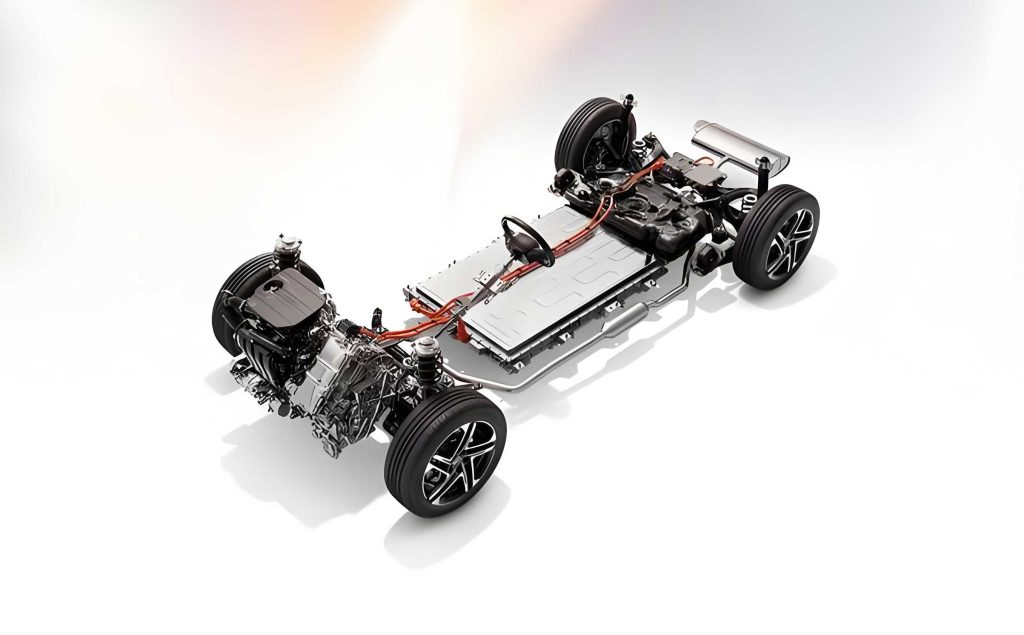
The global shift toward hybrid cars is undeniable, with recent data showing record-breaking production and sales figures. For instance, in 2024, automotive output and sales exceeded 31 million units, highlighting the growing demand for vehicles that integrate electric and internal combustion technologies. Hybrid cars, in particular, have seen a surge due to their balance of fuel efficiency and reduced emissions. This trend places immense pressure on automotive components to be not only high-performing but also cost-effective and lightweight. The spray pipe for cooling oil-cooled motors is a prime example, as it plays a crucial role in maintaining optimal motor temperatures in hybrid cars. Without effective cooling, the motor in a hybrid car can overheat, leading to failures that compromise vehicle safety and reliability. Therefore, my research focuses on reimagining this component through material science and engineering analysis, with the goal of supporting the broader adoption of hybrid cars by addressing weight and cost barriers.
To understand the spray pipe’s function, let’s first examine its working principle. In a hybrid car, the oil-cooled motor relies on a cooling system that circulates oil to dissipate heat. The spray pipe is integral to this system, as it directs cooled oil onto the motor’s windings and stator core. The process begins when oil, cooled to a maximum temperature of 80°C after passing through an oil cooler, enters the spray pipe via an inlet. Under the pressure generated by an oil pump, the oil fills the internal flow channels of the pipe. Once a sufficient flow rate is achieved, the oil is ejected through spray holes, showering the motor components. This direct impingement cooling effectively transfers heat away from the motor, ensuring stable operation in hybrid cars even under demanding conditions. The efficiency of this process can be modeled using heat transfer equations, such as the convective heat transfer formula:
$$Q = hA\Delta T$$
where \(Q\) is the heat transfer rate, \(h\) is the convective heat transfer coefficient, \(A\) is the surface area, and \(\Delta T\) is the temperature difference between the oil and motor surfaces. For hybrid cars, optimizing this equation is key to enhancing cooling performance while minimizing energy consumption.
When selecting materials for the spray pipe in hybrid cars, two primary types are considered: metal and plastic. Metal spray pipes, typically made from SUS304 stainless steel, offer durability but come with drawbacks like high density and complex manufacturing processes. The production of metal pipes involves laser drilling, cutting, bending, and welding steps, such as argon arc welding and brazing, which add to costs and weight. In contrast, plastic spray pipes, made from materials like PPA+GF33% (a glass-fiber reinforced polyphthalamide), present a promising alternative for hybrid cars due to their lightweight nature and lower cost. PPA+GF33% is a high-performance nylon variant with excellent thermal stability, mechanical strength, and weldability, making it suitable for the harsh environments in hybrid car transmissions. Below, I compare the key properties of these materials in a comprehensive table.
| Material Type | Density (g/cm³) | Tensile Strength (MPa) | Flexural Strength (MPa) | Impact Strength (MPa) | Cost Factor | Suitability for Hybrid Cars |
|---|---|---|---|---|---|---|
| SUS304 Stainless Steel | 7.93 | ≥500 | ≥200 | High | High | Moderate due to weight |
| PPA+GF33% (New) | 1.41–1.48 | ≥180 | ≥260 | ≥8.50 | Low | High for lightweight design |
| PPA+GF33% (Aged) | 1.41–1.48 | ≥110 | ≥160 | ≥5.00 | Low | High with reliability |
The table clearly shows that PPA+GF33% has a density approximately 5.3 times lower than SUS304, which translates to significant weight savings for hybrid cars. Additionally, its mechanical properties remain robust even after aging, ensuring long-term reliability. The manufacturing process for plastic spray pipes is also more streamlined, involving injection molding, laser welding, and assembly steps, as illustrated in the workflow diagram. This simplicity reduces production costs, a critical factor for mass-producing components for hybrid cars. To quantify the weight advantage, consider the volume-based mass calculation:
$$m = \rho V$$
where \(m\) is mass, \(\rho\) is density, and \(V\) is volume. For a given spray pipe volume \(V\), using PPA+GF33% instead of SUS304 reduces mass by a factor of:
$$\frac{m_{\text{plastic}}}{m_{\text{metal}}} = \frac{\rho_{\text{plastic}}}{\rho_{\text{metal}}} \approx \frac{1.45}{7.93} \approx 0.183$$
This means the plastic spray pipe is about 18.3% the weight of the metal one, contributing directly to the lightweighting goals of hybrid cars.
Reliability is paramount for any component in hybrid cars, given their rigorous operating conditions. To validate the PPA+GF33% plastic spray pipe, I conducted extensive simulation analyses and experimental tests. The simulation focused on assessing structural strength under various vibrational and impact loads common in hybrid car transmissions. Using finite element analysis (FEA), I modeled the spray pipe subjected to random vibration, sinusoidal vibration, and shock in the X, Y, and Z directions. The stress results were compared to the material’s yield strength to ensure safety. The maximum von Mises stress \(\sigma_{\text{max}}\) was calculated using the formula:
$$\sigma_{\text{max}} = \sqrt{\frac{(\sigma_x – \sigma_y)^2 + (\sigma_y – \sigma_z)^2 + (\sigma_z – \sigma_x)^2 + 6(\tau_{xy}^2 + \tau_{yz}^2 + \tau_{zx}^2)}{2}}$$
where \(\sigma_x, \sigma_y, \sigma_z\) are normal stresses and \(\tau_{xy}, \tau_{yz}, \tau_{zx}\) are shear stresses. The simulation outcomes are summarized in the table below.
| Load Type | Direction | Maximum Stress (MPa) | Material Strength (MPa) | Safety Factor |
|---|---|---|---|---|
| Random Vibration | X | 43.730 | 174 | 3.98 |
| Y | 5.104 | 34.10 | ||
| Z | 4.649 | 37.43 | ||
| Sinusoidal Vibration | X | 0.739 | 174 | 235.45 |
| Y | 0.422 | 412.32 | ||
| Z | 0.945 | 184.13 | ||
| Shock | X | 2.978 | 174 | 58.43 |
| Y | 1.401 | 124.20 | ||
| Z | 2.700 | 64.44 |
The results indicate that the maximum stress of 43.730 MPa under random vibration is well below the material strength of 174 MPa, confirming the spray pipe’s structural integrity for hybrid cars. The safety factors, defined as:
$$\text{Safety Factor} = \frac{\text{Material Strength}}{\text{Maximum Stress}}$$
are all greater than 1, with values ranging from 3.98 to 412.32, demonstrating high reliability. These simulations provide a theoretical foundation for the plastic spray pipe’s performance in hybrid cars, but practical validation is equally important.
To complement the simulations, I performed a series of experimental tests on PPA+GF33% spray pipes under conditions mimicking real-world hybrid car environments. The tests included thermal, mechanical, and durability assessments, as outlined in the table below. Each test was designed to evaluate the spray pipe’s resistance to factors like extreme temperatures, oil exposure, and vibrational stresses that are typical in hybrid car transmissions.
| Test Type | Conditions | Duration/Cycles | Outcome | Relevance to Hybrid Cars |
|---|---|---|---|---|
| Low-Temperature Resistance | -40°C | 168 hours | No deformation or damage | Ensures operation in cold climates for hybrid cars |
| High-Temperature Resistance | 180°C | 1,008 hours | No deformation or damage | Withstands engine bay heat in hybrid cars |
| Thermal Cycling | -40°C to 140°C | 200 cycles | No deformation or damage | Simulates temperature fluctuations in hybrid cars |
| Oil Resistance | 150°C in oil | 1,008 hours | No deformation or damage | Maintains integrity in oil-cooled systems of hybrid cars |
| Transmission Dynamic Endurance | Simulated driving | 1,000 cycles | No deformation or damage | Validates durability under hybrid car driving loads |
| Transmission Vibration | X, Y, Z directions | Standard profiles | No deformation or damage | Ensures stability in hybrid car vibration environments |
All tests passed without failures, proving that the PPA+GF33% spray pipe is highly reliable for hybrid car applications. The oil resistance test, for instance, is critical because hybrid cars often use specialized oils for cooling and lubrication. The spray pipe’s ability to withstand prolonged exposure to hot oil without degrading ensures consistent cooling performance. Furthermore, the vibration tests align with the simulation data, providing empirical evidence for the spray pipe’s robustness in hybrid cars. These results underscore the viability of plastic materials as replacements for traditional metals in hybrid car components.
Beyond reliability, the adoption of plastic spray pipes offers significant advantages for hybrid cars in terms of sustainability and cost-efficiency. The lightweight nature of PPA+GF33% contributes to reduced vehicle mass, which in turn enhances fuel economy and battery range in hybrid cars. This aligns with global efforts to lower carbon emissions from transportation. From a cost perspective, plastic injection molding and laser welding processes are more economical than metal fabrication techniques like welding and brazing. The overall cost reduction can be estimated using a simple formula:
$$C_{\text{savings}} = C_{\text{metal}} – C_{\text{plastic}}$$
where \(C_{\text{metal}}\) and \(C_{\text{plastic}}\) are the total costs of metal and plastic spray pipes, respectively. For mass production in hybrid cars, these savings can be substantial, making the technology more accessible. Additionally, the simplified manufacturing workflow reduces energy consumption and waste, supporting greener production methods for hybrid cars.
In conclusion, my research demonstrates that PPA+GF33% plastic spray pipes are a superior alternative to traditional metal ones for cooling oil-cooled motors in hybrid cars. Through detailed analysis of working principles, material selection, and rigorous validation via simulation and testing, I have shown that these spray pipes offer exceptional strength, durability, and performance while achieving lightweight and low-cost goals. The simulations confirmed stress levels well within material limits, and the experimental tests verified resilience under extreme conditions typical of hybrid cars. By embracing such innovations, the automotive industry can accelerate the development of more efficient and affordable hybrid cars, contributing to a sustainable future. Future work may explore advanced composites or additive manufacturing techniques to further optimize spray pipe designs for next-generation hybrid cars.