
The evolution of the new energy vehicle industry has steadily elevated vehicle intelligence to a critical aspect of automotive configuration. Among the various advanced driver-assistance systems (ADAS), the Automatic Parking Assist (APA) system addresses a significant consumer pain point: the difficulty of maneuvering into tight parking spaces in increasingly congested urban environments. From the perspective of the Vehicle Control Unit (VCU), which acts as the central processing brain of a modern hybrid car, implementing a robust and safe APA function requires intricate coordination between multiple vehicle subsystems. This article details the logical framework, state control strategy, and implementation methodology for an APA system based on a plug-in hybrid electric vehicle (PHEV) platform. The strategy encompasses condition monitoring, state machine management, and coordinated torque control to enable seamless vehicle maneuvering for both parallel and perpendicular parking scenarios.
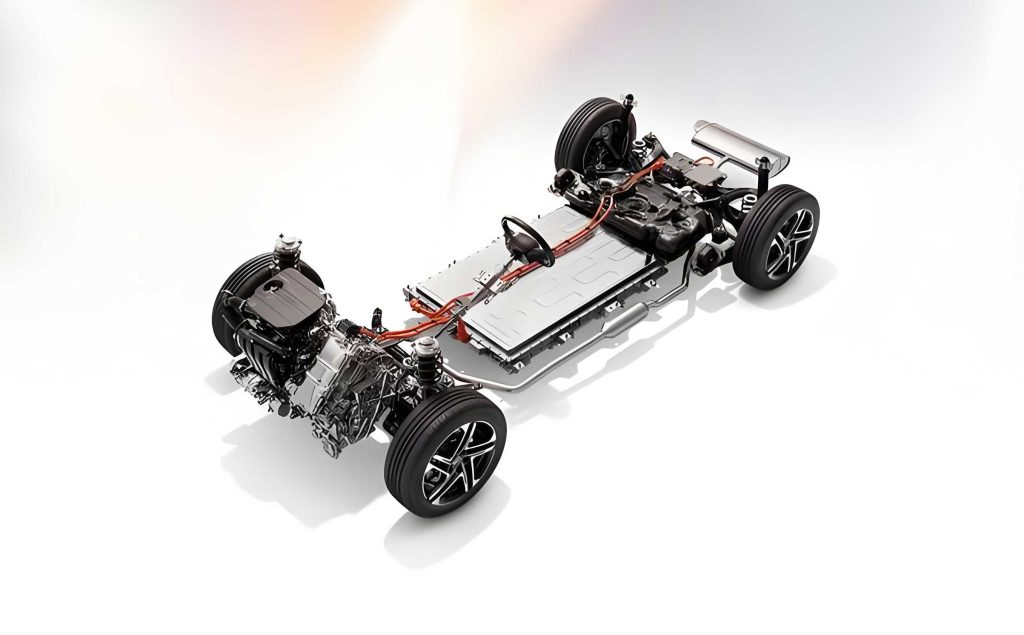
The core architecture of the APA system in a hybrid car involves several key electronic control units (ECUs). The APA module itself, often supplied by a tier-1 supplier, is responsible for perceiving the environment via ultrasonic sensors and cameras, identifying a suitable parking space, and calculating an optimal parking trajectory. To execute this trajectory, it must issue control commands to other vehicle systems. The Electric Power Steering (EPS) system receives target steering angle or torque commands to control the wheels’ direction. The braking system, often an intelligent system like the Integrated Power Brake (IPB), controls deceleration and holds the vehicle stationary. Most critically, the VCU is tasked with managing the longitudinal drive and creep torque of the hybrid car, coordinating the internal combustion engine and electric motor(s), and acting as the gatekeeper for the entire APA function’s activation and safety. This coordination is paramount in a hybrid car due to its complex powertrain with multiple potential power sources and a clutch system.
System Entry and Exit Conditions
The VCU continuously monitors a comprehensive set of vehicle parameters to determine if the hybrid car is in a safe and appropriate state to engage the APA function. The entry logic is designed with multiple layers to ensure reliability. The exit conditions are broader, allowing for a swift and safe deactivation of the function if any system irregularity or driver intervention is detected.
Primary Entry Preconditions (Condition Set A)
These conditions represent the fundamental readiness of the hybrid car’s powertrain and safety systems. All must be simultaneously true for the VCU to even consider allowing APA engagement.
- Vehicle Ready (OK) State: The high-voltage system is operational and the hybrid car is ready to drive.
- Gear Selector Fault-Free: The transmission range sensor reports no faults.
- Battery State of Charge (SOC): $$ SOC \geq 10\% $$. This ensures sufficient electrical energy for powertrain and auxiliary system operation during the parking maneuver.
- Available Drive Torque: The calculated maximum available drive torque at the wheels must exceed a threshold (e.g., $$ T_{avail} \geq 1000\ Nm $$) to ensure adequate torque for the maneuver, especially on inclines.
- Electronic Stability Program (ESP) Status: The ESP system must report a “stable” status, indicating no active intervention or fault.
- Communication Integrity: All Controller Area Network (CAN) messages required for these checks must be valid and received without error.
Secondary Entry & Activation Conditions (Condition Set B)
Once the primary preconditions are met, the following immediate conditions must be true at the moment the driver requests APA activation (e.g., by pressing the start button on the Human-Machine Interface).
- APA Activation Request: The APA module sends an explicit activation request signal.
- Brake Pedal Applied: Brake pedal travel $$ \geq 5\% $$, confirming driver readiness.
- Accelerator Pedal Idle: Accelerator pedal travel $$ = 0\% $$.
- Vehicle Speed Zero: VCU-calculated vehicle speed $$ v \approx 0\ km/h $$.
- Normal Driving Mode: The hybrid car is not in a specialty off-road or sport mode that alters powertrain or stability control characteristics.
- Road Inclination: The absolute value of the road slope angle is within limits (e.g., $$ |\theta| \leq 8\% $$).
- Communication Integrity: All related CAN messages are valid.
APA System Exit Conditions
The APA function will deactivate immediately if any of the following conditions occur. The exit conditions are categorized for clarity.
| Condition Category | Specific Triggers |
|---|---|
| Driver-Requested Exit | APA module deactivation request (e.g., driver presses cancel button). |
| Vehicle State Violation | Vehicle Ready (OK) state turns OFF. |
| VCU-calculated vehicle speed $$ v \geq 10\ km/h $$. | |
| ESP status becomes “unstable”. | |
| Driving mode changes from “Normal”. | |
| Powertrain & Environmental | Battery SOC $$ \leq 8\% $$. |
| Available drive torque falls below a safe threshold (e.g., $$ T_{avail} \leq 800\ Nm $$). | |
| Road slope exceeds limit (e.g., $$ |\theta| \geq 10\% $$). | |
| Driver Intervention | Gear shift from R/N/D to P. |
| System Fault | Communication failure for any signal in Entry Condition Sets A or B. |
The logic can be summarized as:
$$
\text{APA\_Active} = \text{ConditionSetA} \ \& \ \text{ConditionSetB}
$$
$$
\text{APA\_Exit} = \text{DriverRequest} \ || \ \text{VehicleStateViolation} \ || \ \text{PowertrainEnvIssue} \ || \ \text{DriverIntervention} \ || \ \text{SystemFault}
$$
State Control Strategy and Torque Management
The core of the VCU’s APA logic is a deterministic state machine. This ensures that the hybrid car transitions smoothly and safely between different operational phases during the parking sequence.
APA State Machine
The state machine consists of six primary states. Transitions between them are governed strictly by the conditions listed in the tables below.
| State Name | VCU Output Signals | Description |
|---|---|---|
| 1. Standby (Allowed) | APA_State = Allowed APA_ClutchCtrl = Invalid APA_Ctrl = Invalid |
Hybrid car meets all primary preconditions (Set A). The system is ready to accept an activation request. |
| 2. Standby (Prohibited) | APA_State = Prohibited APA_ClutchCtrl = Invalid APA_Ctrl = Invalid |
One or more primary preconditions (Set A) are not met. APA cannot be activated. |
| 3. Wait for Clutch Action | APA_State = Allowed APA_ClutchCtrl = Valid APA_Ctrl = Invalid |
Driver has requested APA activation (Set B satisfied). VCU commands the transmission to open the clutch to decouple the engine, preparing for electric-only creeping/maneuvering typical in a hybrid car. |
| 4. Parking In Progress | APA_State = Active APA_ClutchCtrl = Valid APA_Ctrl = Valid |
Clutch is confirmed open. VCU now accepts and executes torque requests from the APA/VLC module, and enables steering/brake control. The hybrid car moves autonomously. |
| 5. Wait for P (Normal Exit) | APA_State = Prohibited APA_ClutchCtrl = Valid APA_Ctrl = Valid* |
APA module signals completion (Driver-Requested Exit). Vehicle is stationary. VCU maintains control but awaits driver shift to P to fully disengage. |
| 6. Wait for P (Fault Exit) | APA_State = Prohibited APA_ClutchCtrl = Valid APA_Ctrl = Valid* |
A fault or violation triggered an exit. Vehicle is brought to a stop. VCU maintains control but awaits driver shift to P to fully disengage and reset. |
*Control flag may be set to invalid upon achieving zero speed depending on implementation.
| Transition | Trigger Condition |
|---|---|
| 1 → 2 | Condition Set A becomes FALSE. |
| 2 → 1 | Condition Set A becomes TRUE. |
| 1 → 3 | Condition Set A & Condition Set B are TRUE. |
| 3 → 4 | Clutch status is confirmed OPEN. |
| 3 → 2 | Any Exit Condition occurs before clutch opens. |
| 4 → 5 | Driver-Requested Exit (APA completed). |
| 4 → 6 | Any other Exit Condition occurs during parking. |
| 5, 6 → 1 | Gear is shifted to P. |
Longitudinal Torque Control Implementation
When in the “Parking In Progress” state, the VCU acts on the target torque request ($T_{req\_VLC}$) received from the APA or a dedicated Vehicle Longitudinal Control (VLC) module. The control logic must account for the hybrid car’s gear and ensure smooth, safe application of force.
The final torque command ($T_{cmd}$) sent to the motor controller(s) is calculated as follows:
$$
T_{cmd} = \begin{cases}
+1 \cdot T_{req\_VLC} & \text{if Gear = D and Conditions Met} \\
-1 \cdot T_{req\_VLC} & \text{if Gear = R and Conditions Met} \\
0 & \text{otherwise}
\end{cases}
$$
The “Conditions Met” are:
$$
\text{APA\_State} = \text{Active} \quad \& \quad \text{Signal\_Valid}(T_{req\_VLC}) \quad \& \quad \text{Brake\_Pedal} < 30\%
$$
The brake pedal check prevents conflicting torque and brake commands, a crucial safety interlock. The sign inversion for reverse gear ensures intuitive vehicle motion. In a hybrid car, this torque ($T_{cmd}$) is typically supplied solely by the electric motor(s) while the internal combustion engine is off and the clutch is disengaged, allowing for precise, low-speed control.
Functional Application and Hybrid Vehicle Considerations
The described control strategy enables several practical APA features. The system can handle standard parallel (horizontal) parking and perpendicular (vertical) parking scenarios. The search for a parking space is typically initiated by the driver, with the system using fused sensor data to identify viable spots. A key enhancement is the user-defined parking space feature. If the system cannot automatically detect a space (e.g., due to faint markings or unconventional layout), the driver can manually select a target area on the touchscreen, and the APA system will plan a path to that location.
Furthermore, the system includes a parking-out assist for parallel spaces. When the hybrid car is parked in a tight spot, the system can calculate a maneuver to steer the vehicle out to a position where the driver can comfortably take over. Crucially, the system incorporates obstacle reaction. If an ultrasonic sensor detects an approaching obstacle (e.g., a pedestrian) during the maneuver, the system will automatically apply brakes via the IPB, halt the maneuver, and resume automatically once the path is clear.
Implementing APA in a plug-in hybrid car introduces specific considerations that influence the VCU strategy:
- Dual Power Source Management: The VCU must ensure the hybrid system is in the correct mode (typically electric-only creep mode) for smooth, responsive low-speed control during parking. The engine is generally kept off.
- Clutch State Coordination: As seen in the state machine, explicit control and verification of the clutch disengagement is a critical step not present in battery electric vehicles (BEVs). This ensures no unexpected engine torque interferes with the automated maneuver.
- Energy Reserve (SOC): The entry condition for SOC is more critical than in a conventional vehicle. A minimum SOC must be maintained not just for propulsion but also to power the high-demand electrical systems (EPS, IPB, sensors, computing) throughout the potentially extended parking sequence.
- Torque Availability: The check for maximum available drive torque must accurately reflect the combined or electric-only torque capability of the hybrid car’s powertrain architecture, ensuring sufficient force for parking on ramps.
Conclusion
The realization of a reliable and user-friendly Automatic Parking Assist system is a multi-disciplinary task requiring seamless collaboration between perception, planning, and actuation subsystems. From the Vehicle Control Unit’s standpoint, the strategy revolves around rigorous state monitoring, safe state transitions, and precise execution of coordinated control commands. The outlined framework—detailing the layered entry/exit conditions, the deterministic state machine, and the longitudinal torque control logic—provides a viable blueprint for mass production. Special attention must be paid to the unique characteristics of a plug-in hybrid car, such as its dual power sources and clutch system, to tailor the strategy effectively. This approach ensures that the APA function not only delivers convenience but also operates within a paramount framework of functional safety, enhancing the overall ownership experience of modern intelligent hybrid vehicles. Future evolution towards higher levels of parking automation will build upon these foundational control principles, integrating more advanced perception and vehicle-to-everything (V2X) communication while retaining the core safety-centric oversight role of the VCU.