
As an engineer specializing in automotive design, I have always been fascinated by the advancements in hybrid car technology, particularly in the realm of Noise, Vibration, and Harshness (NVH) performance. The increasing popularity of hybrid cars, especially range-extended hybrid vehicles, has brought new challenges in ensuring passenger comfort. In this article, I will delve into a subjective evaluation study of NVH performance in a range-extended hybrid car, employing the Analytic Hierarchy Process (AHP) to systematically assess various driving conditions. The goal is to provide insights that can guide improvements in hybrid car design, enhancing the overall driving experience.
Range-extended hybrid cars combine the benefits of electric vehicles with an onboard range extender, typically an internal combustion engine, to address range anxiety. However, this dual powertrain system introduces complexities in NVH control, as the interaction between electric and combustion modes can lead to vibrations and noise issues. For instance, during range-extended mode at high speeds, drivers may experience steering wheel vibrations and sharp whining sounds, which detract from comfort. Therefore, a comprehensive evaluation of NVH performance in hybrid cars is crucial for optimizing both electric and range-extended modes.
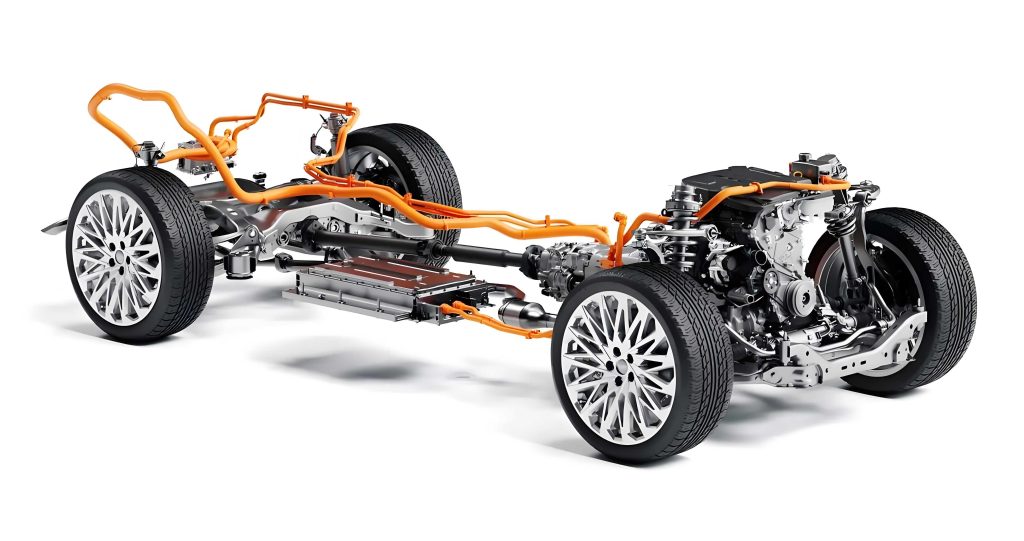
In my research, I focus on a subjective evaluation approach, as it captures human perceptions that objective metrics might miss. The AHP method is ideal for this, as it breaks down the complex NVH performance into hierarchical criteria, allowing for pairwise comparisons based on expert judgments. This study considers four key driving conditions for hybrid cars: idle in range-extended mode, idle in pure electric mode, constant speed cruising, and acceleration-deceleration scenarios. Each condition is further divided into specific NVH indicators, such as steering wheel vibration, noise levels, and speech clarity inside the cabin. By analyzing these factors, I aim to identify the most critical aspects affecting NVH performance in hybrid cars.
The importance of NVH in hybrid cars cannot be overstated. As these vehicles transition between electric and range-extended modes, the NVH characteristics shift dramatically. For example, in pure electric mode, hybrid cars are generally quieter, but auxiliary systems like air conditioning can introduce noise. In contrast, during range-extended mode, the operation of the internal combustion engine adds vibrations and noise, particularly in idle conditions. This duality makes hybrid cars a unique case for NVH studies, requiring a balanced approach that accounts for both modes. Through this evaluation, I hope to contribute to the ongoing development of hybrid cars, making them more comfortable and appealing to consumers.
Methodology: Analytic Hierarchy Process for Hybrid Car NVH Evaluation
To conduct the subjective evaluation, I employed the Analytic Hierarchy Process (AHP), a multi-criteria decision-making tool that structures complex problems into a hierarchy. For hybrid car NVH performance, I defined a three-level hierarchy. The top level represents the overall goal: evaluating NVH performance in a range-extended hybrid car. The second level consists of the four driving conditions, and the third level includes specific NVH indicators under each condition. This structured approach ensures a systematic assessment, capturing the nuances of hybrid car behavior.
The AHP involves constructing pairwise comparison matrices for each level, where experts rate the relative importance of criteria using a scale from 1 to 9. In this study, I gathered input from 10 industry experts and automotive engineers through surveys and questionnaires. Their judgments were used to build the matrices, which are then processed to calculate priority weights. The consistency of these matrices is checked to ensure reliable results. For hybrid cars, this method is particularly useful because it allows us to weigh the importance of different modes, such as electric versus range-extended, in affecting overall NVH satisfaction.
The hierarchical structure for hybrid car NVH evaluation is summarized in the table below. It outlines the driving conditions and their corresponding NVH indicators, providing a clear framework for analysis.
| Goal Level (A) | Criteria Level (B) | Sub-criteria Level (C) |
|---|---|---|
| NVH Performance of Hybrid Car | Idle in Range-Extended Mode (B1) | Powertrain Vibration (C1) |
| Steering Wheel Vibration (C2) | ||
| Driver’s Ear Noise (C3) | ||
| Idle in Pure Electric Mode (B2) | Steering Wheel Vibration (C4) | |
| Air Conditioning Noise (C5) | ||
| Rear Passenger Ear Noise (C6) | ||
| Constant Speed Cruising (B3) | Road Noise (C7) | |
| Seat Vibration (C8) | ||
| In-Cabin Speech Clarity (C9) | ||
| Acceleration-Deceleration (B4) | Wind Noise (C10) | |
| Steering Wheel Vibration (C11) | ||
| In-Cabin Speech Clarity (C12) |
This hierarchy reflects the multifaceted nature of NVH in hybrid cars, where each driving condition presents unique challenges. For instance, in hybrid cars, the idle in range-extended mode involves vibrations from the engine, while in pure electric mode, noise from auxiliary systems becomes more prominent. By breaking it down, we can focus on specific areas for improvement in hybrid car design.
Constructing Pairwise Comparison Matrices for Hybrid Car NVH
Based on expert opinions, I constructed pairwise comparison matrices for each level of the hierarchy. The scale used ranges from 1 (equally important) to 9 (extremely more important), with intermediate values representing gradations. For hybrid cars, these comparisons help quantify how much one NVH factor outweighs another in different conditions. Below, I present the matrices for the criteria level and each sub-criteria level, derived from the aggregated expert judgments.
First, the comparison matrix for the overall goal (A) with respect to the criteria (B) is shown in Table 2. This matrix assesses the relative importance of the four driving conditions in evaluating hybrid car NVH performance.
| A | Idle in Range-Extended Mode (B1) | Idle in Pure Electric Mode (B2) | Constant Speed Cruising (B3) | Acceleration-Deceleration (B4) |
|---|---|---|---|---|
| Idle in Range-Extended Mode (B1) | 1 | 1/4 | 2 | 1/3 |
| Idle in Pure Electric Mode (B2) | 4 | 1 | 8 | 2 |
| Constant Speed Cruising (B3) | 1/2 | 1/8 | 1 | 1/5 |
| Acceleration-Deceleration (B4) | 3 | 1/2 | 5 | 1 |
This matrix indicates that, for hybrid cars, idle in pure electric mode (B2) is considered more important than other conditions, likely due to the expectation of quietness in electric mode. Next, I present the matrices for each criterion. For idle in range-extended mode (B1), the comparison matrix for its sub-criteria is given in Table 3.
| B1 | Powertrain Vibration (C1) | Steering Wheel Vibration (C2) | Driver’s Ear Noise (C3) |
|---|---|---|---|
| Powertrain Vibration (C1) | 1 | 1/4 | 2 |
| Steering Wheel Vibration (C2) | 4 | 1 | 8 |
| Driver’s Ear Noise (C3) | 1/2 | 1/8 | 1 |
Here, steering wheel vibration (C2) is prioritized, as it directly affects driver comfort in hybrid cars during range-extended idle. For idle in pure electric mode (B2), the matrix is shown in Table 4.
| B2 | Steering Wheel Vibration (C4) | Air Conditioning Noise (C5) | Rear Passenger Ear Noise (C6) |
|---|---|---|---|
| Steering Wheel Vibration (C4) | 1 | 5 | 2 |
| Air Conditioning Noise (C5) | 1/5 | 1 | 1/2 |
| Rear Passenger Ear Noise (C6) | 1/2 | 2 | 1 |
In this mode, steering wheel vibration (C4) is again highlighted, but air conditioning noise (C5) is less critical, reflecting the quieter baseline of hybrid cars in electric operation. For constant speed cruising (B3), Table 5 presents the matrix.
| B3 | Road Noise (C7) | Seat Vibration (C8) | In-Cabin Speech Clarity (C9) |
|---|---|---|---|
| Road Noise (C7) | 1 | 1/3 | 2 |
| Seat Vibration (C8) | 3 | 1 | 5 |
| In-Cabin Speech Clarity (C9) | 1/2 | 1/5 | 1 |
Seat vibration (C8) is deemed most important here, as it impacts long-term comfort during cruising in hybrid cars. Finally, for acceleration-deceleration (B4), Table 6 shows the matrix.
| B4 | Wind Noise (C10) | Steering Wheel Vibration (C11) | In-Cabin Speech Clarity (C12) |
|---|---|---|---|
| Wind Noise (C10) | 1 | 5 | 7 |
| Steering Wheel Vibration (C11) | 1/5 | 1 | 2 |
| In-Cabin Speech Clarity (C12) | 1/7 | 1/2 | 1 |
Wind noise (C10) dominates in this condition, likely due to aerodynamic effects during speed changes in hybrid cars. These matrices form the basis for calculating priority weights, which I will discuss in the next section.
Calculating Priority Weights for Hybrid Car NVH Indicators
Using the pairwise comparison matrices, I computed the priority weights for each criterion and sub-criterion. The process involves calculating the eigenvector for each matrix and normalizing it to obtain weights. For a matrix \( M \) with elements \( a_{ij} \), the eigenvector \( w \) can be approximated using the geometric mean method. For each row \( i \), the geometric mean \( g_i \) is calculated as:
$$ g_i = \left( \prod_{j=1}^{n} a_{ij} \right)^{1/n} $$
Then, the weight \( w_i \) is obtained by normalizing \( g_i \):
$$ w_i = \frac{g_i}{\sum_{k=1}^{n} g_k} $$
This method ensures that the weights sum to 1, representing the relative importance. Additionally, I checked consistency using the Consistency Ratio (CR), calculated as \( CR = CI / RI \), where \( CI \) is the Consistency Index and \( RI \) is the Random Index. For all matrices, CR was below 0.1, indicating acceptable consistency.
For the criteria level matrix (Table 2), the calculated weights for the driving conditions in hybrid car NVH evaluation are as follows:
- Idle in Range-Extended Mode (B1): 0.1171
- Idle in Pure Electric Mode (B2): 0.5183
- Constant Speed Cruising (B3): 0.0613
- Acceleration-Deceleration (B4): 0.3033
These weights show that idle in pure electric mode is the most significant condition for hybrid car NVH, followed by acceleration-deceleration. This underscores the importance of maintaining quietness in electric mode for hybrid cars. Next, I computed the weights for sub-criteria under each condition. The results are summarized in Table 7, which includes the eigenvector values for deeper insight.
| Criteria Level (B) | Weight (W1) | Eigenvector | Sub-criteria Level (C) | Weight (W2) | Eigenvector |
|---|---|---|---|---|---|
| Idle in Range-Extended Mode (B1) | 0.1171 | 0.6389 | Powertrain Vibration (C1) | 0.1818 | 0.7937 |
| Steering Wheel Vibration (C2) | 0.7273 | 3.1748 | |||
| Driver’s Ear Noise (C3) | 0.0909 | 0.5969 | |||
| Idle in Pure Electric Mode (B2) | 0.5183 | 2.8284 | Steering Wheel Vibration (C4) | 0.5954 | 2.1544 |
| Air Conditioning Noise (C5) | 0.1283 | 0.4642 | |||
| Rear Passenger Ear Noise (C6) | 0.2764 | 1.0000 | |||
| Constant Speed Cruising (B3) | 0.0613 | 0.3344 | Road Noise (C7) | 0.2297 | 0.8736 |
| Seat Vibration (C8) | 0.6483 | 2.4662 | |||
| In-Cabin Speech Clarity (C9) | 0.1220 | 0.4836 | |||
| Acceleration-Deceleration (B4) | 0.3033 | 1.6549 | Wind Noise (C10) | 0.7396 | 3.2711 |
| Steering Wheel Vibration (C11) | 0.1666 | 0.7368 | |||
| In-Cabin Speech Clarity (C12) | 0.0938 | 0.4149 |
The eigenvectors represent the relative magnitudes derived from the geometric means, and the weights (W2) are the normalized values for sub-criteria. From Table 7, we can observe that for hybrid cars, steering wheel vibration during idle in range-extended mode (C2) has the highest eigenvector (3.1748) and weight (0.7273), indicating it is a critical satisfaction factor. In contrast, in-cabin speech clarity during acceleration-deceleration (C12) has the lowest eigenvector (0.4149) and weight (0.0938), suggesting it is an area of dissatisfaction.
To further analyze the overall impact, I calculated the global weights for each sub-criterion by multiplying W1 and W2. For example, the global weight for steering wheel vibration in idle range-extended mode (C2) is \( 0.1171 \times 0.7273 = 0.0852 \). These global weights provide a comprehensive view of NVH priorities in hybrid cars. However, for brevity, I focus on the relative rankings from Table 7.
Results and Analysis of Hybrid Car NVH Subjective Evaluation
Based on the priority weights, the subjective evaluation reveals key insights into NVH performance for hybrid cars. The highest satisfaction is observed for steering wheel vibration during idle in range-extended mode, with a weight of 0.7273 under its criterion. This suggests that in hybrid cars, the vibration isolation for the steering wheel in this condition is effective, likely due to optimized mounting systems. Conversely, the lowest satisfaction areas include in-cabin speech clarity during acceleration-deceleration (weight 0.0938), air conditioning noise during idle in pure electric mode (weight 0.1283), and in-cabin speech clarity during constant speed cruising (weight 0.1220). These indicate that noise interference from aerodynamics and auxiliary systems in hybrid cars needs improvement.
The weights for criteria level show that idle in pure electric mode is the most important condition (weight 0.5183), reflecting the high expectations for quietness in electric operation of hybrid cars. This is followed by acceleration-deceleration (weight 0.3033), which highlights the dynamic NVH challenges during mode transitions in hybrid cars. The lower weights for idle in range-extended mode (0.1171) and constant speed cruising (0.0613) imply that these conditions are less critical but still require attention, especially for overall balance in hybrid car design.
To quantify the overall satisfaction score, we can compute a composite index. Let \( S_i \) represent the satisfaction rating for each sub-criterion on a scale (e.g., 1 to 9), and \( W_{gi} \) be the global weight. The overall NVH performance score \( P \) for the hybrid car can be expressed as:
$$ P = \sum_{i=1}^{n} S_i \cdot W_{gi} $$
In this study, assuming satisfaction ratings from experts (e.g., based on survey averages), we can derive \( P \) to compare different hybrid car models. However, without specific ratings, the weights alone guide us toward focus areas. For instance, improving in-cabin speech clarity in hybrid cars could involve adding sound-absorbing materials to the dashboard, floor, doors, and roof. Similarly, reducing air conditioning noise might require better sealing or optimized fan designs.
Another aspect to consider is the interaction between modes in hybrid cars. The transition from electric to range-extended mode can cause abrupt NVH changes, affecting passenger comfort. By analyzing the weights, we see that steering wheel vibration is a common concern across multiple conditions (e.g., C2, C4, C11), suggesting that holistic solutions, such as enhanced suspension or active vibration control, could benefit hybrid cars broadly.
Proposed Improvements for Hybrid Car NVH Performance
Drawing from the evaluation results, I propose several measures to enhance NVH performance in hybrid cars. First, to address low satisfaction with in-cabin speech clarity, especially during acceleration-deceleration and constant speed cruising, I recommend increasing the use of acoustic materials. For example, applying multi-layer absorbers and barriers to the front wall, floor panels, and door trims can reduce noise transmission. The formula for sound transmission loss \( TL \) in decibels can be modeled as:
$$ TL = 20 \log_{10}(f \cdot m) – 47 $$
where \( f \) is frequency and \( m \) is surface density. By optimizing \( m \) with lightweight materials, we can improve speech clarity without adding significant weight to hybrid cars.
Second, for air conditioning noise during idle in pure electric mode, I suggest redesigning the HVAC system to include quieter fans and better insulation around ducts. The sound pressure level \( L_p \) from a fan can be estimated using:
$$ L_p = L_w + 10 \log_{10}\left(\frac{Q}{4\pi r^2}\right) $$
where \( L_w \) is the sound power level, \( Q \) is the directivity factor, and \( r \) is distance. By reducing \( L_w \) through aerodynamic blade designs, noise can be minimized in hybrid cars.
Third, to mitigate steering wheel vibrations across conditions, especially in range-extended mode, I propose optimizing the powertrain mounting system. The vibration isolation efficiency \( \eta \) can be expressed as:
$$ \eta = 1 – \frac{T}{T_0} $$
where \( T \) is the transmissibility and \( T_0 \) is the baseline. Using hydraulic or active mounts can lower \( T \), enhancing comfort in hybrid cars. Additionally, for wind noise during acceleration-deceleration, improving aerodynamic shapes and sealing window gaps can be effective. Computational fluid dynamics (CFD) simulations can guide these modifications.
Furthermore, regular NVH testing protocols for hybrid cars should include both electric and range-extended modes, with a focus on the identified weak points. By implementing these improvements, hybrid cars can achieve better NVH performance, leading to higher customer satisfaction and competitive advantage in the market.
Conclusion
In this study, I conducted a subjective evaluation of NVH performance for a range-extended hybrid car using the Analytic Hierarchy Process. By considering four key driving conditions—idle in range-extended mode, idle in pure electric mode, constant speed cruising, and acceleration-deceleration—and their specific NVH indicators, I derived priority weights that highlight areas of satisfaction and dissatisfaction. The results show that for hybrid cars, steering wheel vibration during idle in range-extended mode is highly satisfactory, while in-cabin speech clarity during dynamic conditions and air conditioning noise need attention. The AHP framework proved effective in structuring the complex NVH assessment for hybrid cars, allowing for targeted improvements.
This research underscores the importance of a balanced approach in hybrid car design, where both electric and range-extended modes are optimized for NVH. Future work could involve objective measurements to correlate with subjective ratings, or expanding the evaluation to include more hybrid car models. By addressing the identified issues, manufacturers can enhance the comfort and appeal of hybrid cars, contributing to the broader adoption of sustainable vehicles. Ultimately, the synergy between subjective insights and engineering solutions will drive the evolution of hybrid cars toward quieter, smoother, and more enjoyable rides.