
Hybrid cars have become a focal point in the automotive industry due to their high fuel efficiency and reduced environmental impact. Among various configurations, the P2 hybrid car architecture, where an electric motor is placed between the engine and the transmission, offers flexibility in power management. Understanding the dynamic behavior of the power transmission system in such hybrid cars is crucial for optimizing performance, durability, and noise-vibration-harshness (NVH) characteristics. Power sources, including internal combustion engines and electric motors, act as significant external excitations, and their torque fluctuations can profoundly influence the dynamic response of the drivetrain. This study aims to comprehensively investigate the effects of different power source excitations—specifically, from a four-cylinder engine and a permanent magnet synchronous motor—on the dynamic characteristics of a P2 hybrid car power transmission system. By developing an electromechanical rigid-flexible coupled dynamic model, we analyze the system’s response under pure electric drive, engine drive, and combined drive modes, providing insights into vibration mechanisms and potential design improvements for hybrid cars.
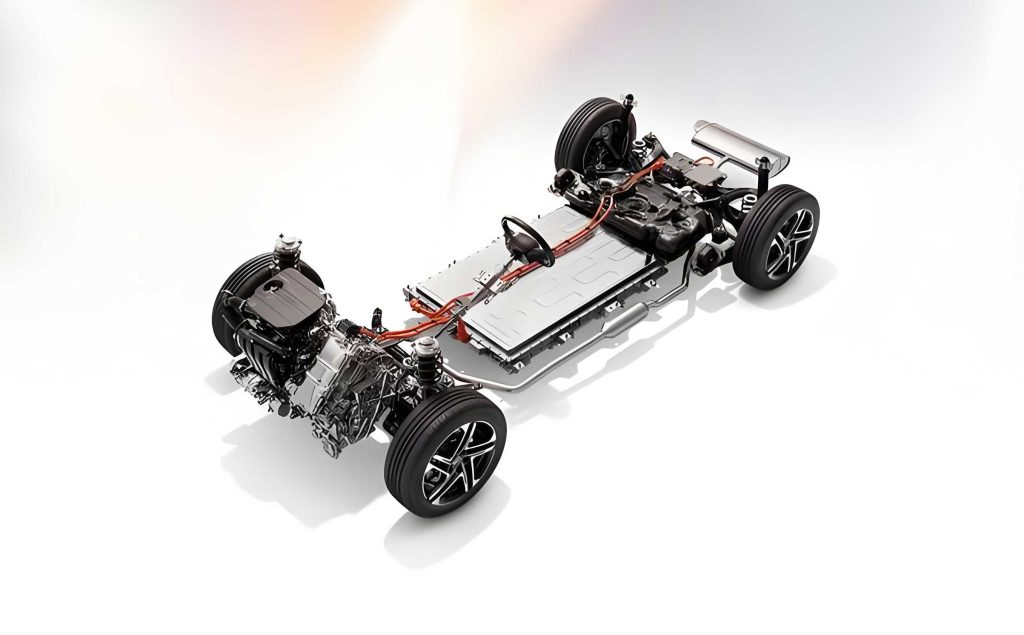
The dynamic analysis of hybrid car powertrains requires accurate modeling of both power sources and the transmission system. In this study, we first derive the dynamic driving torques for a four-cylinder engine and a permanent magnet synchronous motor, expressing them as functions of angular displacement. For the engine, the torque output from each cylinder results from gas pressure forces and reciprocating inertial forces. The total force on a piston can be expressed as:
$$F = F_g + F_j$$
where $F_g$ is the gas force and $F_j$ is the inertial force. The inertial force is given by:
$$F_j = -m_j R\omega^2 \cos \alpha – m_j R\omega^2 \lambda \cos 2\alpha$$
Here, $m_j$ is the reciprocating mass, $R$ is the crank radius, $\omega$ is the angular velocity, $\alpha$ is the crank angle, and $\lambda$ is the connecting rod ratio. The gas force $F_g$ depends on cylinder pressure $P$ and piston diameter $D$:
$$F_g = \frac{\pi D^2 P}{4}$$
The pressure $P$ is simulated using a normal distribution function to represent the combustion cycle. By decomposing these forces and considering the firing order “1-3-4-2”, the total engine driving torque $T_e$ for the four-cylinder configuration is obtained as a periodic function of crankshaft angle, exhibiting significant fluctuations at frequencies related to the engine’s base frequency and its harmonics.
For the permanent magnet synchronous motor in the hybrid car, the electromagnetic torque is derived from Maxwell’s stress tensor theory. The tangential force density $p_t(\theta, t)$ on the rotor surface is:
$$p_t(\theta, t) = \frac{1}{\mu_0} b_r(\theta, t) b_t(\theta, t)$$
where $\mu_0$ is the magnetic constant, $b_r$ and $b_t$ are the radial and tangential magnetic flux densities, $\theta$ is the angular position, and $t$ is time. Integrating this force density over the stator inner surface yields the tangential force, which is then converted to a driving torque $T_m$ acting on the rotor. This torque also exhibits fluctuations due to electromagnetic phenomena, primarily at the motor’s base frequency and its multiples.
To model the transmission system of the hybrid car, we employ a hybrid dynamics approach combining finite element condensation and lumped-parameter methods. The drivetrain includes a dual-clutch transmission (DCT) with seven gears, differential, and coupling mechanisms. Key components such as gears, shafts, and bearings are represented with concentrated nodes, totaling 142 nodes across the system. For rotating components like shafts, flexibility is accounted for using finite element condensation, while rigid body motion is described by equations of motion. For instance, the rotational dynamics of a shaft segment is given by:
$$J \alpha_g = T_{\text{drive}} – T_{\text{load}}$$
where $J$ is the moment of inertia, $\alpha_g$ is the angular acceleration, and $T_{\text{drive}}$ and $T_{\text{load}}$ are the driving and load torques, respectively. Non-rotating components, such as the housing, are modeled directly using condensed finite element models derived from modal reduction theory. The system’s equations of motion in matrix form are:
$$\mathbf{M} \ddot{\mathbf{u}} + \mathbf{C}_d \dot{\mathbf{u}} + \mathbf{K} \mathbf{u} = \mathbf{F}$$
Here, $\mathbf{M}$, $\mathbf{C}_d$, and $\mathbf{K}$ are the mass, damping, and stiffness matrices, $\mathbf{u}$ is the displacement vector, and $\mathbf{F}$ is the force vector including excitations from gears and power sources. Through modal transformation, these equations are decoupled into a set of ordinary differential equations in modal coordinates:
$$\ddot{y}_j + 2\xi_j \omega_j \dot{y}_j + \omega_j^2 y_j = \boldsymbol{\Phi}_j^T \mathbf{F}, \quad j = 1, 2, \dots, n_f$$
where $y_j$ is the modal coordinate, $\xi_j$ is the modal damping ratio, $\omega_j$ is the natural frequency, $\boldsymbol{\Phi}_j$ is the mode shape vector, and $n_f$ is the number of degrees of freedom. A reduced-order model is constructed by retaining only the dominant modes, enhancing computational efficiency while preserving accuracy.
Gear meshing dynamics are critical in the hybrid car transmission. For helical gears, the relative displacement along the line of action $\Delta \delta$ is computed considering translational and rotational degrees of freedom:
$$\Delta \delta = \left[ (x_d – x_g) \sin \phi + (y_d – y_g) \cos \phi – (r_{bd} \theta_{zd} + r_{bg} \theta_{zg}) \right] \cos \beta_b + \left[ -(z_d – z_g) – (r_{bd} \theta_{xd} + r_{bg} \theta_{xg}) \sin \gamma + (r_{bd} \theta_{yd} + r_{bg} \theta_{yg}) \cos \gamma \right] \sin \beta_b – e$$
In this equation, subscripts $d$ and $g$ denote driving and driven gears, $x, y, z$ are translational displacements, $\theta_x, \theta_y, \theta_z$ are rotational displacements, $r_b$ is the base radius, $\beta_b$ is the base helix angle, $\phi$ is the pressure angle, $\gamma$ is the line-of-center angle, and $e$ is the gear error. The error $e$ is simulated using harmonic functions to represent cumulative pitch deviation and tooth-to-tooth error:
$$e = e_n \sin(\theta + \varphi_n) + e_m \sin(z_m \theta + \varphi_m)$$
where $e_n$ and $e_m$ are amplitudes, $\theta$ is the angular displacement, $z_m$ is the tooth number, and $\varphi_n$, $\varphi_m$ are phase angles. The meshing force $F_n$ along the line of action includes stiffness and damping terms:
$$F_n = k_m \Delta \delta + c_m \Delta \dot{\delta}$$
Here, $k_m$ is the time-varying mesh stiffness calculated via finite element analysis, and $c_m$ is the damping coefficient given by:
$$c_m = 2 \xi_r \sqrt{k_m \frac{m_1 m_2}{m_1 + m_2}}$$
with $\xi_r$ as the damping ratio (typically 0.03–0.17), $\bar{k}_m$ as the mean mesh stiffness, and $m_1$, $m_2$ as gear masses. The meshing forces and moments in Cartesian coordinates are derived from $F_n$ and applied to the gear nodes.
Bearings and supports in the hybrid car drivetrain are modeled with linear stiffness and damping. For a bearing supporting a gear, the forces are:
$$F_{bx} = -k_x \delta_x – c_x \dot{\delta}_x, \quad F_{by} = -k_y \delta_y – c_y \dot{\delta}_y, \quad F_{bz} = -k_z \delta_z – c_z \dot{\delta}_z$$
where $k_x, k_y, k_z$ and $c_x, c_y, c_z$ are stiffness and damping coefficients in $x$, $y$, $z$ directions, and $\delta$ are relative displacements. The coupling between power sources and transmission involves clutches: a one-way clutch and a friction clutch connect the engine crankshaft and motor rotor. The torque transmission through the one-way clutch is conditionally based on relative speeds, while the friction clutch is used for mode transitions.
Validation of the hybrid car model was performed through experimental tests on a bench setup. The transmission was operated in fifth gear with an input speed of 1200 rpm and a load torque of 150 N·m. Vibration accelerations at housing measuring points were compared between simulation and experiment. The results showed good agreement in frequency spectra, confirming the accuracy of the modeling approach. Key frequency components, such as gear mesh frequencies and shaft orders, matched closely, though slight amplitude differences were noted due to real-world clearances and imperfections.
To analyze the dynamic characteristics of the hybrid car powertrain, simulations were conducted under three drive modes: pure electric drive, engine drive, and combined drive. In each mode, the system’s response was evaluated in terms of gear meshing torques, bearing reaction forces, and housing vibration trajectories. The following tables summarize key parameters used in the simulations.
| Parameter | Symbol | Value | Unit |
|---|---|---|---|
| Engine reciprocating mass | $m_j$ | 0.5 | kg |
| Crank radius | $R$ | 0.05 | m |
| Connecting rod ratio | $\lambda$ | 0.3 | – |
| Motor magnetic constant | $\mu_0$ | $4\pi \times 10^{-7}$ | H/m |
| Gear base radius (1st gear) | $r_b$ | 0.03 | m |
| Base helix angle | $\beta_b$ | 20 | ° |
| Mesh stiffness mean | $\bar{k}_m$ | 1e8 | N/m |
| Bearing stiffness (x-direction) | $k_x$ | 1e7 | N/m |
| Bearing damping ratio | $\xi_r$ | 0.05 | – |
For the pure electric drive mode, the hybrid car operates with only the motor providing torque. Simulations were run at a motor speed of 1000 rpm in first gear. The gear meshing torque for the first gear pair was analyzed with and without motor torque fluctuations. The time-domain results showed that including motor torque fluctuations increased the amplitude of the meshing torque while the mean value remained unchanged. Frequency spectrum analysis revealed that without motor fluctuations, the dominant frequencies were the gear mesh frequency $f_{m1}$ and its harmonics. With motor fluctuations, additional peaks appeared at the motor base frequency $f_d$ and its multiples, with the second harmonic $2f_d$ having the largest amplitude. This indicates that motor excitations significantly contribute to dynamic loads in the hybrid car transmission.
The bearing reaction forces and housing trajectories were also affected. For instance, the reaction force at engine bearing 2 exhibited increased amplitude when motor torque fluctuations were considered. The frequency spectrum showed peaks at $f_d$, $2f_d$, etc. Housing bearing center trajectories, which represent vibration displacements, expanded in range due to motor excitations. Bearings farther from mounting points showed larger mean displacements, highlighting areas prone to higher wear in the hybrid car.
In engine drive mode, the hybrid car uses only the engine at 2000 rpm in third gear. The engine torque fluctuations, characterized by the four-cylinder base frequency $f_e$ and single-cylinder frequency $f_q$, were included. The meshing torque for the third gear pair showed a substantial amplitude increase with engine fluctuations. The spectrum was dominated by $f_e$ and $f_q$, with $f_e$ having the highest amplitude. Bearing reaction forces, such as at engine bearing 4, displayed similar trends, with $f_e$ being the primary contributor to vibration amplification. Housing trajectories became more irregular and chaotic, suggesting potential shaft misalignment and gear偏载 in the hybrid car drivetrain.
Under combined drive mode, both power sources operate simultaneously at 3000 rpm in fifth gear. The system response was evaluated with and considering both engine and motor torque fluctuations. The results resembled those of engine drive mode, with engine fluctuations having a dominant effect. The meshing torque spectrum showed prominent peaks at $f_e$ and $f_q$, while motor-related frequencies were less significant. Bearing forces on output shafts increased markedly, with $f_e$ and $f_q$ as key frequency components. This implies that in hybrid car applications, engine excitations are the primary concern for dynamic response, even when the motor is active.
To quantify the impact, the following table compares the amplitude increases in key dynamic indicators across drive modes for the hybrid car.
| Drive Mode | Excitation Source | Gear Meshing Torque Amplitude Increase | Bearing Force Amplitude Increase | Housing Trajectory Range Increase |
|---|---|---|---|---|
| Pure Electric | Motor fluctuations | 15-20% | 10-15% | 20-25% |
| Engine | Engine fluctuations | 30-40% | 25-30% | 30-35% |
| Combined | Engine + Motor fluctuations | 35-45% | 30-35% | 35-40% |
The mathematical models used in this analysis for the hybrid car can be summarized with key equations. The engine torque $T_e(\alpha)$ as a function of crank angle $\alpha$ is approximated by:
$$T_e(\alpha) = \sum_{i=1}^{4} T_{cyl,i}(\alpha – \phi_i)$$
where $T_{cyl,i}$ is the torque from cylinder $i$ and $\phi_i$ is the phase shift based on firing order. For a single cylinder, $T_{cyl}$ is derived from forces as described earlier. The motor torque $T_m(\theta)$ is expressed as:
$$T_m(\theta) = T_{avg} + \sum_{k=1}^{n} A_k \sin(k \omega_m t + \psi_k)$$
with $T_{avg}$ as average torque, $A_k$ as harmonic amplitudes, $\omega_m$ as motor rotational speed, and $\psi_k$ as phases. The gear mesh stiffness $k_m(t)$ varies with time and can be represented by Fourier series:
$$k_m(t) = k_0 + \sum_{j=1}^{m} \left[ a_j \cos(j \omega_m t) + b_j \sin(j \omega_m t) \right]$$
where $k_0$ is the mean stiffness, and $\omega_m$ is the mesh frequency. These periodic excitations interact with the structural dynamics of the hybrid car transmission, leading to complex responses.
In terms of frequency analysis, the dominant excitation frequencies for the hybrid car are summarized below:
| Excitation Type | Base Frequency | Key Harmonics | Impact on System |
|---|---|---|---|
| Four-cylinder engine | $f_e = 2 \times \text{engine speed in Hz}$ | $f_e, 2f_e, f_q$ (single-cylinder freq) | High amplitude vibrations in gears and bearings |
| Permanent magnet motor | $f_d = \text{motor speed in Hz}$ | $f_d, 2f_d, 3f_d$ | Moderate amplitude increase, especially at $2f_d$ |
| Gear mesh | $f_{mp} = \text{gear tooth count} \times \text{shaft speed in Hz}$ | $f_{mp}, 2f_{mp}, 3f_{mp}$ | Fundamental vibration source in transmission |
The results demonstrate that both engine and motor torque fluctuations exacerbate dynamic responses in the hybrid car powertrain. However, the engine’s influence is more pronounced due to higher torque amplitudes and lower frequency excitations that often coincide with structural resonances. The motor’s impact, while significant, is more localized to its operating harmonics. In all modes, bearings distant from housing mounts experience larger displacements, indicating that support stiffness plays a critical role in mitigating vibrations in hybrid cars.
This study underscores the importance of considering power source excitations in the design and analysis of hybrid car drivetrains. The developed electromechanical coupled model provides a tool for predicting dynamic behavior and optimizing components such as dampers, mounts, and gear profiles. Future work could explore active control strategies to suppress torque fluctuations or enhance modal properties for improved NVH performance in hybrid cars.
In conclusion, the dynamic characteristics of a P2 hybrid car power transmission system are significantly influenced by power source excitations. Engine torque fluctuations, particularly at the four-cylinder base frequency, are the primary driver of increased gear meshing torque amplitudes, bearing reaction forces, and housing vibration trajectories. Motor torque fluctuations also contribute, especially at twice the base frequency, but to a lesser extent in combined operations. These findings highlight the need for integrated design approaches that account for both mechanical and electrical excitations in hybrid cars to ensure durability and comfort. By leveraging advanced modeling techniques, engineers can better predict and mitigate dynamic issues, paving the way for more efficient and reliable hybrid car systems.