
In the rapidly evolving landscape of automotive technology, the shift towards battery electric vehicles (BEVs) represents a critical step in reducing carbon emissions and dependence on fossil fuels. However, the thermal management of these vehicles, particularly in cold climates, poses significant challenges. Unlike traditional internal combustion engine vehicles, which can utilize waste heat from the engine for cabin heating, battery electric vehicles lack this readily available heat source. Consequently, in winter conditions, the heating, ventilation, and air conditioning (HVAC) system must draw power directly from the vehicle’s battery pack, leading to a substantial reduction in driving range. This range anxiety is a major barrier to the widespread adoption of battery electric vehicles, especially in regions with harsh winters. Therefore, developing efficient and reliable thermal management systems is paramount for enhancing the usability and consumer acceptance of battery electric vehicles. My research focuses on the performance optimization of heat pump systems for battery electric vehicles under low-temperature environments, utilizing one-dimensional simulation modeling and experimental validation to explore energy-saving strategies and control methodologies.
The core objective of this study is to systematically investigate the energy consumption and coefficient of performance (COP) of a heat pump air conditioning system in a battery electric vehicle when operating at sub-zero temperatures. The heat pump system, which operates on a reverse refrigeration cycle, is capable of transferring heat from the cold outside environment to the warm cabin interior, thereby providing heating with higher efficiency compared to conventional positive temperature coefficient (PTC) heaters. However, its performance degrades significantly in extreme cold due to issues such as low compressor suction pressure, insufficient refrigerant flow, and frosting on the outdoor heat exchanger. To address these challenges, I developed a detailed one-dimensional simulation model of the entire vehicle thermal management system, calibrated it with bench test data, and employed it to analyze two distinct air handling modes: full external circulation and double-layer flow. Furthermore, I examined the influence of electronic expansion valve (EXV) opening on system COP under steady-state heating conditions, aiming to identify an optimal control point that maximizes energy efficiency. The insights gained from this work are intended to guide the design and optimization of thermal management systems for next-generation battery electric vehicles.
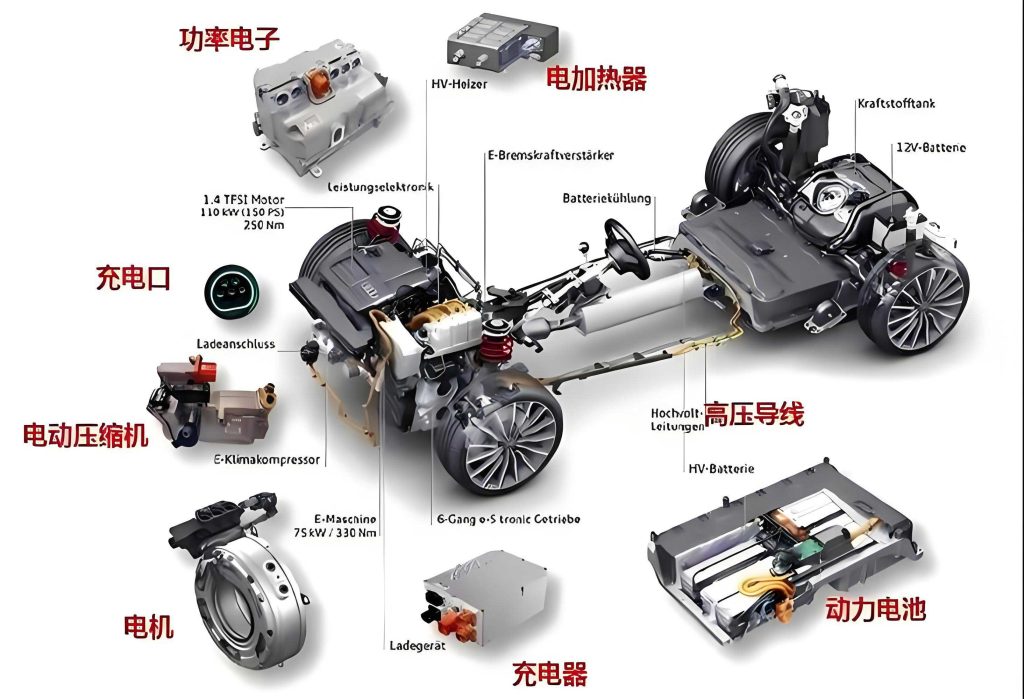
The thermal management system in a battery electric vehicle is a complex network that regulates the temperature of the cabin, battery pack, and power electronics. For cabin heating, the heat pump system is a promising solution due to its potential for high energy efficiency. The basic working principle involves four main processes: compression, condensation, expansion, and evaporation. The refrigerant is compressed to a high-pressure, high-temperature state by an electric compressor. It then releases heat to the cabin air stream via the indoor condenser (acting as a heater core). After condensation, the high-pressure liquid refrigerant passes through an expansion valve, where it undergoes throttling to become a low-pressure, low-temperature mixture. This mixture then absorbs heat from the outside air in the outdoor heat exchanger (evaporator in heating mode). Finally, the refrigerant returns to the compressor to complete the cycle. The performance metric of primary interest is the coefficient of performance (COP), defined as the ratio of heating capacity delivered to the cabin to the electrical power input to the compressor and other auxiliary components. For a battery electric vehicle, a higher COP directly translates to less energy drain from the battery and, consequently, a longer driving range. The COP can be expressed mathematically as:
$$ \text{COP} = \frac{Q_{\text{heating}}}{W_{\text{comp}} + W_{\text{fan}} + W_{\text{aux}}} $$
where \( Q_{\text{heating}} \) is the heating capacity (in watts), \( W_{\text{comp}} \) is the compressor power, \( W_{\text{fan}} \) is the blower and fan power, and \( W_{\text{aux}} \) represents other auxiliary loads. In low ambient temperatures (e.g., -10°C), the evaporation temperature drops, reducing the refrigerant density and mass flow rate, which in turn lowers \( Q_{\text{heating}} \) and increases the pressure ratio across the compressor, leading to higher \( W_{\text{comp}} \). This dual effect causes a pronounced decrease in COP. Therefore, optimizing system components and control strategies is essential for maintaining acceptable performance in cold weather for battery electric vehicles.
To conduct a thorough analysis, I constructed a one-dimensional simulation model using a specialized thermal system modeling software. The model encompasses all major components of the heat pump system: the electric compressor, indoor condenser, outdoor evaporator, electronic expansion valves, accumulators, and interconnecting tubing. The vehicle cabin is modeled as a thermal mass with heat transfer characteristics, and the HVAC unit (air conditioning box) is configured to operate in different air intake modes. The modeling process began with the selection of components based on target heating capacity and outlet air temperature specifications for a specific battery electric vehicle project. Each component model was then individually calibrated against experimental data obtained from component-level bench tests to ensure predictive accuracy. Several simplifying assumptions were made to render the model computationally tractable while preserving physical fidelity:
- Refrigerant Distribution and Pressure Drop: The refrigerant flow is assumed to be uniformly distributed across the tubes and fins of the heat exchangers. The pressure drop in all piping segments is modeled using a consistent friction factor correlation.
- Pipe Heat Transfer: Heat exchange between the refrigerant and the environment through low-pressure piping is considered negligible. For high-pressure piping, a lumped thermal resistance model is applied to account for heat losses to the surroundings.
- Compressor Heat Loss: The heat dissipation from the compressor shell is modeled as a function of its external surface area and the temperature difference between the shell and the ambient air.
- Cabin Thermal Load: The sensible and latent heat loads from the cabin are primarily linked to the fresh air intake rate. A fixed value is assigned for radiative heat load from passengers and interior surfaces.
The compressor is a pivotal component whose performance significantly impacts the overall system efficiency. For this study, a variable-speed scroll compressor with a displacement volume of 34 cm³ was selected. Its performance characteristics, including volumetric efficiency (\( \eta_v \)), isentropic efficiency (\( \eta_{is} \)), and mechanical efficiency (\( \eta_{m} \)), are functions of rotational speed (N) and pressure ratio (\( \Pi = P_{\text{discharge}} / P_{\text{suction}} \)). These relationships were characterized through extensive testing and compiled into multi-dimensional performance maps. The maps were imported into the simulation environment. The efficiencies can be described by empirical correlations such as:
$$ \eta_v = f_1(N, \Pi), \quad \eta_{is} = f_2(N, \Pi), \quad \eta_{m} = f_3(N, \Pi) $$
The actual mass flow rate of refrigerant (\( \dot{m}_r \)) and the compressor power consumption (\( W_{\text{comp}} \)) are then calculated as:
$$ \dot{m}_r = \eta_v \cdot \rho_{\text{suct}} \cdot V_{\text{disp}} \cdot \frac{N}{60} $$
$$ W_{\text{comp}} = \frac{\dot{m}_r \cdot (h_{\text{discharge, is}} – h_{\text{suction}})}{\eta_{is} \cdot \eta_{m}} $$
where \( \rho_{\text{suct}} \) is the suction density, \( V_{\text{disp}} \) is the displacement volume, \( h_{\text{suction}} \) is the suction enthalpy, and \( h_{\text{discharge, is}} \) is the isentropic discharge enthalpy.
The HVAC module contains two critical heat exchangers: the indoor condenser (for heating) and the outdoor evaporator. Both are micro-channel parallel-flow type heat exchangers. To ensure accuracy, individual component tests were conducted on sample units under various operating conditions. The test data for heat transfer rate and refrigerant-side pressure drop were used to calibrate the respective one-dimensional models in the simulation software. For the evaporator, three test points were used, varying air and refrigerant mass flow rates. The condensation heat exchanger (used as condenser in heating mode) was tested under seven different conditions, covering a range of air inlet temperatures from -5°C to 15°C and varying refrigerant flow rates. The calibration results showed excellent agreement between simulation and experiment. The heat transfer rate discrepancy was less than 5%, and the refrigerant pressure drop difference was within 10%, validating the models for system-level analysis. The key parameters from the calibration tests are summarized in the following tables.
| Test Point | Air Mass Flow (kg/h) | Air Inlet Temp (°C) | Refrigerant Mass Flow (kg/h) | Experimental Q (kW) | Simulated Q (kW) | Error (%) | Experimental ΔP (kPa) | Simulated ΔP (kPa) | Error (%) |
|---|---|---|---|---|---|---|---|---|---|
| 1 | 333.5 | 40.0 | 156.6 | 4.85 | 4.92 | +1.4 | 12.3 | 13.1 | +6.5 |
| 2 | 444.1 | 40.0 | 196.8 | 6.18 | 6.32 | +2.3 | 15.7 | 16.8 | +7.0 |
| 3 | 500.4 | 40.0 | 216.7 | 6.92 | 7.06 | +2.0 | 17.2 | 18.5 | +7.6 |
| Test Point | Air Mass Flow (kg/h) | Air Inlet Temp (°C) | Refrigerant Mass Flow (kg/h) | Experimental Q (kW) | Simulated Q (kW) | Error (%) | Experimental ΔP (kPa) | Simulated ΔP (kPa) | Error (%) |
|---|---|---|---|---|---|---|---|---|---|
| 1 | 303.9 | 15.0 | 99.3 | 3.21 | 3.15 | -1.9 | 48.5 | 52.0 | +7.2 |
| 2 | 303.9 | 15.0 | 116.3 | 3.78 | 3.70 | -2.1 | 65.2 | 69.8 | +7.1 |
| 3 | 303.9 | 15.0 | 147.1 | 4.81 | 4.72 | -1.9 | 102.1 | 109.5 | +7.2 |
| 4 | 608.1 | 15.0 | 174.0 | 5.67 | 5.80 | +2.3 | 138.5 | 148.0 | +6.9 |
| 5 | 262.2 | -5.0 | 91.6 | 2.55 | 2.49 | -2.4 | 32.8 | 35.2 | +7.3 |
| 6 | 458.9 | -5.0 | 145.0 | 4.05 | 4.12 | +1.7 | 78.9 | 84.5 | +7.1 |
| 7 | 550.8 | -5.0 | 167.0 | 4.68 | 4.77 | +1.9 | 103.7 | 111.0 | +7.0 |
With the component models validated, the full vehicle system model was assembled. The system includes three electronic expansion valves (EXVs) for flow control, but for the heating mode under study, only one (EXV3) was actively modulated. The simulation conditions were set to replicate a severe winter scenario: an ambient temperature of -10°C. The target outlet air temperature from the HVAC unit was set to a comfortable level for cabin heating. To maintain this target temperature, a proportional-integral-derivative (PID) controller was implemented to adjust the compressor speed based on the error between the measured and desired outlet air temperatures. This mimics the real-world control logic in a battery electric vehicle. The blower speed was fixed at a 22% duty cycle to provide a constant air volume flow rate. Two distinct air intake modes for the HVAC unit were investigated:
- Mode A (Full External Circulation): All air supplied to the cabin is drawn from the outside environment at -10°C.
- Mode B (Double-Layer Flow): A portion of the air is recirculated from the cabin interior (which is warmer), and the remainder is fresh outdoor air. In this simulation, the total air mass flow rate was kept identical to Mode A, with 115.5 kg/h from outside and 94.5 kg/h from cabin recirculation.
The vehicle speed profile was also incorporated into the model as a time-dependent map derived from actual driving data over a 5000-second period, affecting the ram air effect on the outdoor heat exchanger. The primary outputs monitored were compressor power, total system energy consumption, heating capacity, and the resulting COP.
The first major analysis compared the system performance between the full external circulation mode and the double-layer flow mode. In both cases, the total air mass flow rate through the HVAC unit was identical. The key difference lies in the temperature of air entering the indoor condenser. In the full external mode, the condenser inlet air is at the cold ambient temperature (-10°C), requiring a large temperature lift from the refrigerant to achieve the target outlet air temperature. In the double-layer mode, the mixed air entering the condenser is warmer due to the recirculated cabin air, reducing the required temperature lift. The simulation results clearly demonstrated the impact of this difference. To achieve a steady HVAC outlet air temperature of 65°C, the compressor in the full external mode had to operate continuously at its maximum speed of 8000 rpm. In contrast, in the double-layer flow mode, after an initial transient period, the compressor speed stabilized around 6000 rpm with minor fluctuations. This is because the mixed air temperature gradually increases as the cabin warms up, reaching a dynamic equilibrium where less compressor work is needed.
Since the blower and cooling fan power consumption were identical in both modes (due to fixed blower duty cycle and the same vehicle speed map), the total energy consumption difference was dominated by the compressor work. Over the simulated driving cycle, the double-layer flow mode consumed significantly less energy. The quantitative comparison is presented in the table below.
| Performance Metric | Full External Circulation Mode | Double-Layer Flow Mode | Percentage Change |
|---|---|---|---|
| Average Compressor Power (W) | 3120 | 2820 | -9.6% |
| Total Blower & Fan Energy (Wh) | 185 | 185 | 0% |
| Total System Energy (Wh) | 2540 | 2230 | -12.2% |
| Average Heating Capacity (W) | 5850 | 5070 | -13.3% |
The double-layer flow mode reduced total system energy consumption by 12.2%. However, it is crucial to analyze the energy efficiency, not just the absolute consumption. The coefficient of performance provides this insight. The COP for each mode was calculated over the stable operating period. The results indicate that while the double-layer mode required less compressor work (a reduction of 300 W), the heating capacity delivered also decreased by 780 W. The net effect on COP is given by:
$$ \text{COP}_{\text{full}} = \frac{5850}{3120 + P_{\text{aux}}} \approx 1.78 \quad \text{(assuming } P_{\text{aux}} \text{ constant)} $$
$$ \text{COP}_{\text{double}} = \frac{5070}{2820 + P_{\text{aux}}} \approx 1.72 $$
Where \( P_{\text{aux}} \) represents the constant auxiliary power from blowers and fans. This shows a slightly lower COP for the double-layer mode in this specific steady-state comparison. However, the significant reduction in total energy draw from the battery (12.2%) is often more critical for extending the range of a battery electric vehicle, even if the instantaneous thermodynamic efficiency is marginally lower. This highlights a key trade-off in thermal management for battery electric vehicles: between maximizing cabin heat output and minimizing total battery drain.
The second part of the study focused on identifying the optimal operating point for the heat pump system by investigating the effect of electronic expansion valve opening on the system COP under constant heating demand. The EXV opening is typically controlled in pulse steps, which modulates the refrigerant mass flow rate. The simulation was run at a constant -10°C ambient, with the PID controller actively adjusting compressor speed to maintain a fixed HVAC outlet air temperature of 35°C (a moderate heating target). The EXV pulse steps were increased incrementally from 70 to 480 in intervals of 10 steps. At each step, the system was allowed to reach steady-state, and key parameters were recorded: compressor speed, refrigerant mass flow rate (\( \dot{m}_r \)), compressor power (\( W_{\text{comp}} \)), heating capacity (\( Q_{\text{heating}} \)), and COP.
The simulation results revealed clear trends. As the EXV opening increased, the refrigerant mass flow rate rose proportionally. To maintain the target outlet air temperature against this increased flow, the PID controller reduced the compressor speed. However, the net effect on compressor power was an increase because the rise in mass flow rate outweighed the reduction in speed and pressure ratio. The heating capacity initially increased with flow rate but eventually plateaued as the heat transfer approach temperature differences changed. The COP, being the ratio of heating capacity to compressor power, exhibited a distinct maximum. The data from a key segment of this sweep is summarized below.
| EXV Pulse Steps | Refrigerant Flow (kg/h) | Compressor Speed (rpm) | Compressor Power (W) | Heating Capacity (W) | Calculated COP |
|---|---|---|---|---|---|
| 70 | 98.5 | 4520 | 2150 | 3650 | 1.70 |
| 100 | 112.3 | 4180 | 2280 | 4120 | 1.81 |
| 130 | 125.8 | 3910 | 2410 | 4380 | 1.82 |
| 160 | 138.6 | 3680 | 2540 | 4550 | 1.79 |
| 190 | 150.9 | 3480 | 2670 | 4680 | 1.75 |
| 220 | 162.5 | 3320 | 2790 | 4780 | 1.71 |
| 250 | 173.8 | 3170 | 2910 | 4860 | 1.67 |
The relationship between COP and EXV opening can be conceptualized as an optimization problem. At very small EXV openings, the system is severely restricted, leading to high pressure ratios, low mass flow, and suboptimal heat transfer, resulting in low COP. As the valve opens, flow increases, improving heat exchanger utilization and reducing pressure ratio, thus increasing COP. However, beyond an optimal point, further opening leads to excessive flow that requires more compressor work without a proportional gain in heating capacity, causing COP to decline. The peak COP observed in the simulation occurred around 100-130 pulse steps. This behavior can be modeled using a quadratic approximation for the region near the optimum:
$$ \text{COP}(x) \approx a x^2 + b x + c $$
where \( x \) represents the EXV opening (in pulse steps), and \( a \), \( b \), and \( c \) are coefficients derived from curve fitting. The optimum opening \( x_{\text{opt}} \) is found at the vertex:
$$ x_{\text{opt}} = -\frac{b}{2a} $$
To validate the simulation findings, a physical bench test was conducted on a complete vehicle thermal management system rig, replicating the same -10°C ambient condition and control strategy. The experimental results corroborated the simulation trend, showing a clear COP maximum in the range of 100 to 150 pulse steps for the EXV. This convergence between simulation and experiment confirms the reliability of the one-dimensional model as a design and optimization tool for thermal management systems in battery electric vehicles. The experimental COP values were systematically about 0.1-0.15 lower than the simulated values across the range. This consistent offset is attributed primarily to heat losses from the compressor discharge line and other components that were modeled simplistically. In the real system, the high-temperature refrigerant gas loses heat to the environment before reaching the condenser, reducing the effective heating capacity available for the cabin. This underscores an important area for improvement: insulating high-temperature lines or recovering this waste heat could further enhance the real-world COP of heat pump systems for battery electric vehicles.
The implications of this research for battery electric vehicle development are substantial. First, the demonstrated benefit of the double-layer flow (air recirculation) strategy highlights an effective, low-cost method to reduce HVAC energy consumption in cold weather, directly alleviating range reduction. Vehicle control systems should prioritize recirculation modes when cabin air quality permits. Second, the existence of an optimal EXV opening for maximum COP under given conditions points to the necessity of sophisticated control algorithms. Rather than using a fixed EXV map, adaptive control strategies that dynamically adjust the valve opening based on ambient temperature, cabin heating demand, and compressor speed could maintain the system near its peak efficiency across diverse operating scenarios. For instance, a model-based controller or a machine learning algorithm trained on simulation and experimental data could be implemented in the vehicle’s thermal management controller.
Furthermore, this study lays the groundwork for investigating more advanced system architectures. For example, integrating the battery electric vehicle’s battery thermal management system with the cabin heat pump could allow for waste heat recovery from the battery or power electronics during operation or fast charging, further improving overall vehicle energy efficiency. The use of alternative refrigerants with better low-temperature performance, such as R-1234yf or CO₂ (R-744), could also be explored using the validated simulation model. The model can also be extended to study transient behaviors like defrosting cycles, which are critical for real-world operation in humid, cold climates.
In conclusion, this comprehensive performance study of a battery electric vehicle heat pump system under low-temperature conditions successfully leveraged one-dimensional system simulation and experimental validation to derive actionable insights. The double-layer air intake mode was shown to reduce total system energy consumption by over 12% compared to full external circulation, a significant gain for electric vehicle range. The analysis of EXV control revealed a well-defined optimal opening that maximizes the system COP, a finding confirmed by bench tests. These results emphasize the importance of integrated system design and intelligent control in unlocking the full potential of heat pump technology for battery electric vehicles. As the automotive industry continues its transition to electrification, optimizing every aspect of energy use, especially for cabin comfort, is not merely an engineering challenge but a crucial factor in achieving consumer satisfaction and meeting global sustainability targets. Future work will involve refining the model with more detailed loss mechanisms, testing under more extreme temperatures, and developing real-time optimal control strategies for implementation in prototype battery electric vehicles.