
In recent years, the rapid growth in the adoption of battery electric vehicles has introduced both opportunities and challenges for modern power systems. As a flexible resource, battery electric vehicles can participate in grid services through vehicle-to-grid technology, enhancing system stability and efficiency. This paper addresses the load frequency control problem in multi-area interconnected power systems integrated with battery electric vehicles, proposing a sliding mode control strategy based on an adaptive event-triggered mechanism. We consider the integration of battery electric vehicles in both primary and secondary frequency regulation, analyze the impacts of renewable energy fluctuations and load disturbances, and design a control framework that improves network utilization while handling communication delays. Stability is proven via an asymmetric Lyapunov functional, and simulation results validate the effectiveness of our approach.
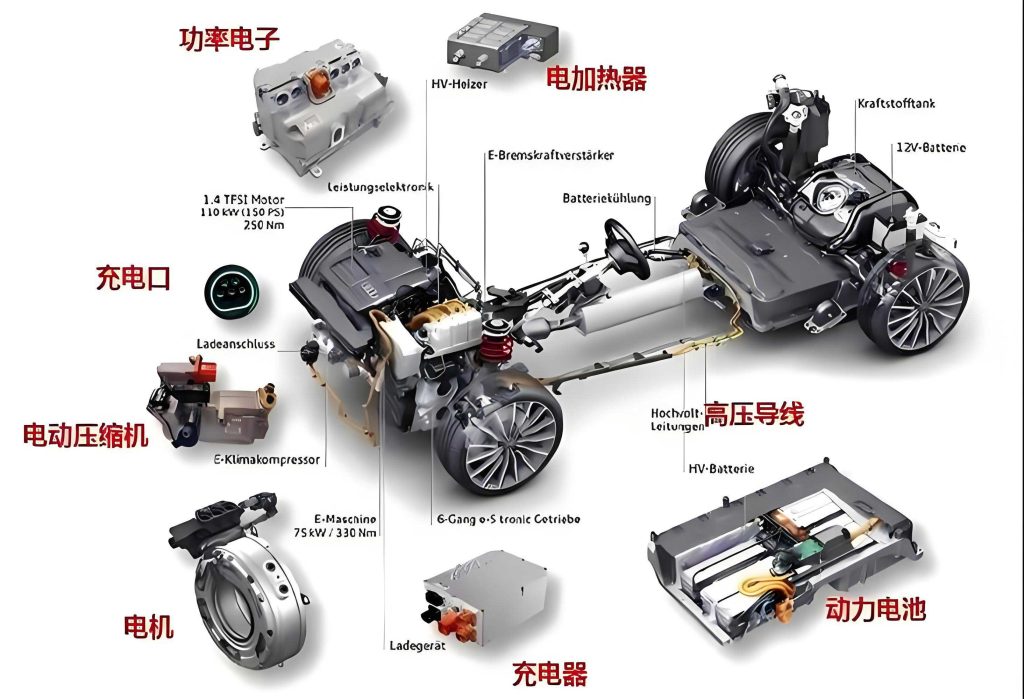
The proliferation of battery electric vehicles has transformed them from mere loads to dynamic assets capable of providing grid support. In multi-area interconnected power systems, frequency regulation becomes critical due to increasing renewable penetration and variable demand. Traditional load frequency control methods often neglect communication delays and network congestion, which can degrade performance. Here, we develop an adaptive event-triggered sliding mode control strategy that leverages the flexibility of battery electric vehicles to enhance frequency stability. Our contributions include a detailed system model, a novel triggering mechanism, and a comprehensive stability analysis, all aimed at optimizing the participation of battery electric vehicles in frequency control.
We begin by establishing the system model for an n-area interconnected power system, where each area includes thermal generators, governors, and aggregated battery electric vehicle groups. The dynamics incorporate frequency deviations, renewable power fluctuations, governor valve positions, and load disturbances. Let $\Delta f_i$, $\Delta P_{\omega i}$, $\Delta X_{gi}(t)$, and $\Delta P_{li}$ denote the frequency deviation, renewable power fluctuation, governor valve position deviation, and load disturbance deviation in area $i$, respectively. The thermal power deviation is $\Delta P_{gi}$, the control input vector is $u_i(t)$, the engine inertia constant is $M_i$, the control error is $E_{ACEi}$, and the governor time constant is $T_{gi}$. Parameters such as EV gain $K_{eji}$, participation factors $\alpha_{eji}$ and $\alpha_{gji}$, droop coefficient $\rho_{eji}$, EV power deviation $\Delta P_{eji}$, and EV time constant $T_{ij}$ define the interactions between areas $i$ and $j$. Additionally, $R_i$, $D_i$, $\beta_i$, and $T_{ti}$ represent the droop coefficient, engine damping coefficient, bias constant, and turbine time constant, respectively.
The system dynamics can be derived from the block diagram, resulting in the following equations for area $i$:
$$ \dot{\Delta P}_{gi}(t) = \frac{1}{T_{ti}} \Delta X_{gi}(t) – \frac{1}{T_{ti}} \Delta P_{gi}(t) $$
$$ \dot{\Delta P}_{e1i}(t) = -\frac{1}{T_{1i}} \Delta P_{e1i}(t) + \frac{K_{e1i} \alpha_{e1i}}{T_{1i}} u_i(t) – \frac{K_{e1i} \rho_{e1i}}{T_{1i}} \Delta f_i(t) $$
$$ \dot{\Delta P}_{e2i}(t) = -\frac{1}{T_{2i}} \Delta P_{e2i}(t) + \frac{K_{e2i} \alpha_{e2i}}{T_{2i}} u_i(t) $$
$$ \dot{\Delta P}_{e3i}(t) = -\frac{1}{T_{3i}} \Delta P_{e3i}(t) – \frac{K_{e3i} \rho_{e3i}}{T_{3i}} \Delta f_i(t) $$
$$ \dot{\Delta X}_{gi}(t) = -\frac{1}{T_{gi} R_i} \Delta f_i(t) – \frac{1}{T_{gi}} \Delta X_{gi}(t) + \frac{\alpha_{gi}}{T_{gi}} u_i(t) $$
$$ \dot{\Delta f}_i(t) = -\frac{D_i}{M_i} \Delta f_i(t) – \frac{1}{M_i} \Delta P_{gi}(t) + \frac{1}{M_i} \Delta P_{e1i}(t) + \frac{1}{M_i} \Delta P_{e2i}(t) + \frac{1}{M_i} \Delta P_{e3i}(t) – \frac{1}{M_i} \Delta P_{li}(t) – \frac{1}{M_i} \Delta P_{\omega i}(t) $$
These equations account for the contributions of battery electric vehicles in primary and secondary frequency regulation. The state-space model for the multi-area system is then formulated as:
$$ \dot{x}(t) = (A + \Delta A)x(t) + (B + \Delta B)u(t) + F\omega(t) $$
$$ y(t) = Cx(t) $$
where $x(t)$ is the state vector, $y(t)$ is the output vector, $u(t)$ is the control input vector, and $\omega(t)$ is the disturbance vector. The matrices $A$, $B$, $C$, $F$, $\Delta A$, and $\Delta B$ are defined with appropriate dimensions, incorporating uncertainties related to battery electric vehicle parameters. For instance, $\Delta A$ and $\Delta B$ include terms that depend on the state-of-charge of battery electric vehicles, modeled as a time-varying function $g(t)$:
$$ g(t) = \begin{cases}
\left( \frac{S_{soc} – S_{low}}{S_{max} – S_{low}} \right)^2 & \text{for first state} \\
\left( \frac{S_{soc} – S_{high}}{S_{min} – S_{high}} \right)^2 & \text{for second state}
\end{cases} $$
Here, $S_{soc}$, $S_{low}$, $S_{high}$, $S_{min}$, and $S_{max}$ represent the state-of-charge, low charge state, high charge state, minimum charge state, and maximum charge state of the battery in a battery electric vehicle, respectively. The EV gain $K_{ev}$ is expressed as $K_{ev} = K_{max} – K_{max} g(t)$, where $K_{max}$ is the maximum droop coefficient. This formulation captures the dynamic behavior of battery electric vehicles in the system.
To handle communication delays and reduce network traffic, we design an adaptive event-triggered mechanism. The triggering condition determines when sampled data should be transmitted, based on the error between the current state and the last transmitted state. The triggering instants $t_{k+1,h}$ are defined by:
$$ t_{k+1,h} = t_{k,h} + \min \left\{ lh \mid e^T(i_{k,h}) \Phi e(i_{k,h}) > \sigma_s(t_{k,h}) x^T(t_{k,h}) \Phi x(t_{k,h}) \right\} $$
where $t_{k,h}$ and $t_{k+1,h}$ are the current and next transmission instants, $h$ is the sampling period, $x(t_{k,h})$ is the transmitted signal, $\Phi$ is a positive definite matrix, $e(i_{k,h}) = x(t_{k,h}) – x(i_{k,h})$ is the error, $i_{k,h} = t_{k,h} + lh$ for $l \in \mathbb{N}$, and $\sigma_s(t_{k,h})$ is the adaptive threshold satisfying $0 < \sigma_s(t_{k,h}) < 1$. The control input is held constant between triggered instants: $u(t) = u(t_{k,h})$ for $t \in (t_{k,h} + \tau_k, t_{k+1,h} + \tau_{k+1}]$, where $\tau_k$ and $\tau_{k+1}$ are time delays. The total delay $r(t)$ is bounded by $0 \leq r_m \leq r(t) \leq r_M \leq \bar{r}$, with $\bar{r}$ being the upper bound.
This mechanism reduces unnecessary data transmission, alleviating network congestion and mitigating the effects of time-varying delays. The closed-loop system under event-triggered control becomes:
$$ \dot{x}(t) = (A + \Delta A)x(t) + (B + \Delta B)u(t_{k,h}) + F\omega(t) $$
$$ y(t) = Cx(t) $$
We now design a sliding mode control law to ensure robust performance against disturbances and uncertainties. The integral sliding surface $\sigma$ is chosen as:
$$ \sigma = G x(t) – \int_0^t G \left[ (A + \Delta A) – (B + \Delta B)K_i \right] x(s) \, ds $$
where $G$ is a matrix such that $GB$ is nonsingular, and $K_i$ is a gain matrix. Taking the derivative of $\sigma$ and setting $\sigma = \dot{\sigma} = 0$ yields the equivalent control law $u_{eq}(t)$:
$$ u_{eq}(t) = -K_i x(t) – [G(B + \Delta B)]^{-1} G F \omega(t) $$
Substituting this into the system dynamics gives the closed-loop sliding mode dynamics:
$$ \dot{x}(t) = (A + \Delta A)x(t) – (B + \Delta B)K_i \left[ x(t – r(t)) + e(i_{k,h}) \right] + \hat{F} \omega(t) $$
$$ y(t) = C x(t) $$
with $\hat{F} = F – (B + \Delta B)[G(B + \Delta B)]^{-1} G F$. To guarantee reachability of the sliding surface, the actual control law is designed as:
$$ u(t) = -K_i x(t) + [G(B + \Delta B)]^{-1} K_i x(t) – d_i [G(B + \Delta B)]^{-1} \| G \hat{F} \| \cdot \text{sgn}(\sigma(t)) $$
where $d_i > 0$ is a parameter, and $\text{sgn}(\cdot)$ is the sign function. This ensures that the system trajectories converge to the sliding manifold in finite time, providing robustness against disturbances.
Stability analysis is conducted using an asymmetric Lyapunov functional. We consider the functional $V(t) = V_0(t) + V_1(t) + V_2(t)$ for $t \in [t_{k,h} + \tau_k, t_{k+1,h} + \tau_{k+1}]$, where:
$$ V_0(t) = x^T(t) P \psi(t) $$
$$ V_1(t) = \int_{t – r(t)}^t x^T(s) Q_1 x(s) \, ds + \int_{t – \bar{r}}^{t – r(t)} x^T(s) Q_2 x(s) \, ds $$
$$ V_2(t) = \bar{r} \int_{-\bar{r}}^0 \int_{t+\theta}^t \dot{x}^T(s) Z \dot{x}(s) \, ds \, d\theta – \frac{\pi^2}{4} \int_{t – r(t)}^t [x(s) – x(t – r(t))]^T R [x(s) – x(t – r(t))] \, ds $$
and $\psi(t) = \text{col} \left( x(t), \int_{t – r(t)}^t x(s) \, ds, \int_{t – \bar{r}}^{t – r(t)} x(s) \, ds \right)$. Here, $P$, $Q_1$, $Q_2$, $Z$, and $R$ are symmetric positive definite matrices. The derivative of $V(t)$ is evaluated along the system trajectories, and using integral inequalities such as the Wirtinger-based inequality, we derive sufficient conditions for asymptotic stability.
Specifically, for given positive scalars $\sigma_1 > 1$, $\sigma_2 > 1$, $\gamma$, and $r(t) \in [0, \bar{r}]$, if there exist symmetric positive definite matrices $P$, $Q_1$, $Q_2$, $Z$, $R$, $\Phi$, matrices $P_1$, $P_2$, $P_3$, and gain matrix $K$ such that the following matrix inequalities hold, then the system is stable with an $H_\infty$ performance level $\gamma$:
$$ T_1 = \begin{bmatrix} P_1 & \frac{1}{2} P_2 & \frac{1}{2} P_3 \\ \frac{1}{2} P_2 & Q_1 & 0 \\ \frac{1}{2} P_3 & 0 & \frac{Q_1}{\bar{r} – r(t)} \end{bmatrix} > 0 $$
$$ T_2 = \begin{bmatrix} Z_\eta & N_\eta \\ N_\eta & Z_\eta \end{bmatrix} < 0 $$
$$ T_3 = \Sigma_1 + \Sigma_2 < 0 $$
$$ T_4 = Q_1 – \sigma_2 Q_2 < 0 $$
$$ T_5 = Q_2 – \sigma_1 Q_1 < 0 $$
where $\Sigma_1$ and $\Sigma_2$ are matrices derived from the system dynamics and Lyapunov functional. These conditions ensure that $\dot{V}(t) + y^T(t) y(t) – \gamma^2 \omega^T(t) \omega(t) < 0$, proving input-to-state stability and robustness.
To validate our control strategy, we conduct simulations on a four-area interconnected power system with battery electric vehicles. The parameters for each area are listed in the table below.
| Parameter | Area 1 | Area 2 | Area 3 | Area 4 | Parameter | Area 1 | Area 2 | Area 3 | Area 4 |
|---|---|---|---|---|---|---|---|---|---|
| $D_i$ | 1.5 | 1 | 1.25 | 1.3 | $\beta_i$ | 21 | 22 | 21.5 | 20 |
| $T_{ti}$ (s) | 0.4 | 0.3 | 0.35 | 0.38 | $\alpha_{gi}$ | 0.7 | 0.6 | 0.65 | 0.8 |
| $T_{gi}$ (s) | 0.2 | 0.17 | 0.18 | 0.19 | $K_{e1i}$ | 0.7 | 0.8 | 0.75 | 0.9 |
| $R_i$ | 0.05 | 0.04 | 0.06 | 0.07 | $K_{e2i}$ | 1 | 0.95 | 0.9 | 0.98 |
| $M_i$ | 12 | 10 | 11 | 13 | $K_{e3i}$ | 1 | 0.7 | 0.8 | 0.9 |
The gain matrix $K_i$ is designed as $K_i = \text{diag}(K_1, K_2, K_3, K_4)$ with values obtained from the stability conditions. We set $\gamma = 20$ and $g(t) = 0.5$ for simulation. The frequency deviations $\Delta f_i$ for all areas under renewable and load disturbances are shown to converge to zero, demonstrating system stability. The tie-line power exchange deviations also settle, indicating effective area coordination.
We further investigate the impact of battery electric vehicle participation by comparing scenarios where EV groups participate in primary frequency regulation only, secondary frequency regulation only, or both. The results indicate that simultaneous participation in both primary and secondary regulation yields the fastest convergence and smallest overshoot, highlighting the advantages of fully utilizing battery electric vehicles. For instance, the frequency response in Area 1 under different participation modes can be summarized by the following performance metrics.
To optimize the participation level of battery electric vehicles, we employ particle swarm optimization. The optimal participation factors are found to be $\alpha_{e11} = 0.22$, $\alpha_{e21} = 0.02$, $\alpha_{e12} = 0.01$, $\alpha_{e22} = 0.05$, $\alpha_{e13} = 0.01$, $\alpha_{e23} = 0.72$, $\alpha_{e14} = 0.18$, and $\alpha_{e24} = 0.43$. With these values, the system exhibits improved dynamic performance compared to other configurations.
Comparing our sliding mode control with traditional proportional-integral control, we evaluate performance indices such as integral absolute error (IAE), integral time absolute error (ITAE), integral error (IE), integral square error (ISE), and integral time square error (ITSE). The formulas for these indices are:
$$ \text{IAE} = \int_0^T |e(t)| \, dt $$
$$ \text{ITAE} = \int_0^T t |e(t)| \, dt $$
$$ \text{IE} = \int_0^T e(t) \, dt $$
$$ \text{ISE} = \int_0^T e^2(t) \, dt $$
$$ \text{ITSE} = \int_0^T t e^2(t) \, dt $$
where $e(t)$ is the frequency deviation. The computed values for each area under sliding mode control and PI control are presented in the table below.
| Area | Controller | ITAE | IAE | IE | ISE | ITSE |
|---|---|---|---|---|---|---|
| Area 1 | SMC | 163.441 | 1.392 | -0.095 | 0.003 | 0.262 |
| PI | 592.426 | 6.041 | 1.588 | 0.042 | 2.571 | |
| Area 2 | SMC | 160.410 | 1.089 | -0.067 | 0.001 | 0.124 |
| PI | 565.304 | 5.330 | 0.505 | 0.031 | 1.953 | |
| Area 3 | SMC | 167.105 | 1.240 | -0.090 | 0.001 | 0.142 |
| PI | 568.435 | 5.672 | 1.597 | 0.036 | 2.208 | |
| Area 4 | SMC | 165.354 | 1.451 | -0.085 | 0.002 | 0.143 |
| PI | 571.623 | 5.906 | 1.324 | 0.038 | 1.984 |
Clearly, sliding mode control achieves lower values across all indices, indicating superior performance. Additionally, the economic aspects are assessed by computing total energy consumption and power fluctuations. The total energy consumption $E_{total}$ and power fluctuation $P_{fluct}$ are given by:
$$ E_{total} = \int_0^T \sum_{i=1}^n |u_i(t)| \, dt $$
$$ P_{fluct} = \sqrt{ \frac{1}{T} \int_0^T \left( \sum_{i=1}^n \Delta f_i(t) \right)^2 \, dt } $$
Simulation results show that sliding mode control reduces both energy consumption and power fluctuations compared to PI control, enhancing economic efficiency.
The adaptive event-triggered mechanism also proves effective in reducing communication burden. With a threshold $\sigma_s(t_{k,h}) = 0.001$, the triggering intervals are significantly longer under sliding mode control than under PI control, demonstrating efficient network resource utilization. This is crucial for large-scale systems with numerous battery electric vehicles, where frequent communication can lead to congestion.
In conclusion, we have proposed a comprehensive frequency control strategy for multi-area interconnected power systems with battery electric vehicles. The integration of battery electric vehicles in both primary and secondary frequency regulation, combined with an adaptive event-triggered sliding mode control, addresses key challenges such as renewable variability, load disturbances, and communication delays. Stability is rigorously proven using Lyapunov methods, and simulations confirm the strategy’s effectiveness in improving frequency regulation performance, reducing control efforts, and optimizing battery electric vehicle participation. Future work may extend this approach to more complex scenarios, including heterogeneous battery electric vehicle fleets and cyber-physical security considerations.
The flexibility of battery electric vehicles is a cornerstone of modern smart grids. By effectively harnessing their potential through advanced control strategies like the one presented, we can achieve more resilient and efficient power systems. The continuous evolution of battery technology and vehicle-to-grid integration will further enhance the role of battery electric vehicles in grid stability, making such control frameworks increasingly vital for future energy networks.