
In recent years, the development of electric vehicle cars has become a pivotal trend in the automotive industry, driven by the need for sustainable transportation. However, the limited driving range remains a significant bottleneck for widespread adoption, often causing concern among consumers. To address this issue, enhancing the energy efficiency of the powertrain system is one of the most effective solutions, alongside advancements in battery technology. In this study, I focus on a dual-motor four-speed powertrain for electric vehicle cars, proposing innovative optimization methods to improve performance and reduce energy consumption. The goal is to explore how motor sizing and gear ratios can be optimized to maximize efficiency while maintaining dynamic performance, ultimately contributing to longer ranges for electric vehicle cars.
The motivation behind this research stems from the growing demand for more efficient electric vehicle cars. Traditional single-motor systems often face challenges in balancing acceleration and energy use, especially under varying driving conditions. By employing a dual-motor setup, we can distribute torque more effectively, potentially reducing wear and tear and improving overall efficiency. This approach aligns with global efforts to enhance the sustainability of electric vehicle cars, making them more appealing to consumers. In this article, I will delve into the mathematical modeling, optimization algorithms, and energy management strategies that underpin this research, providing a comprehensive analysis of how dual-motor systems can revolutionize the performance of electric vehicle cars.
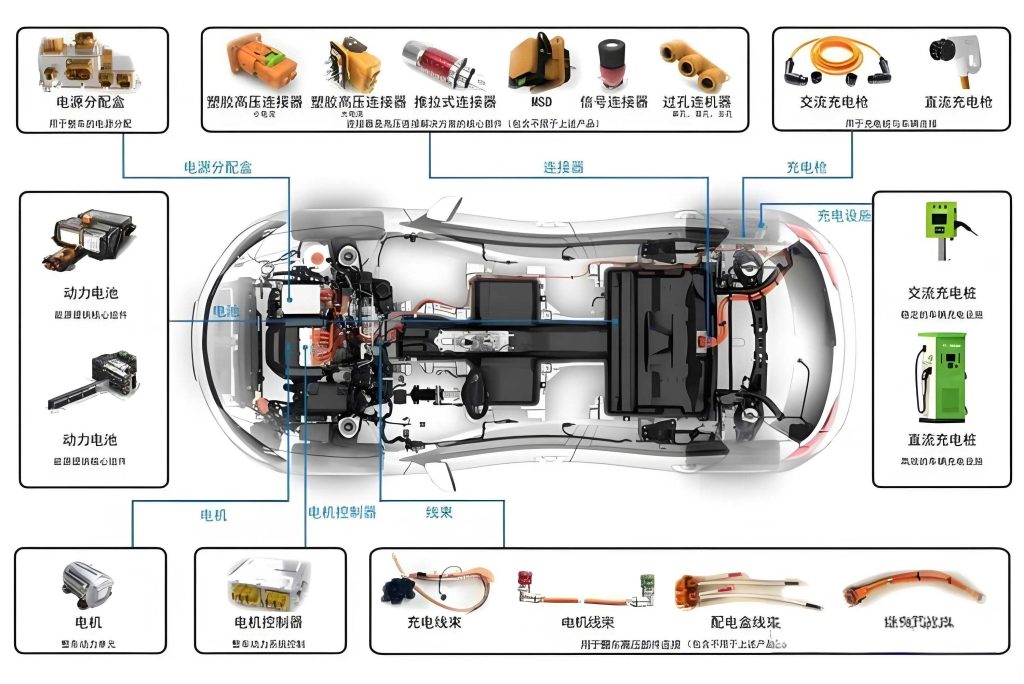
To begin, I establish a detailed dynamic model for the electric vehicle car, which serves as the foundation for all subsequent optimizations. The powertrain configuration includes two motors (EM1 and EM2) coupled with a four-speed transmission, as illustrated in the schematic. This setup allows for flexible torque distribution and efficient energy recovery during braking. The longitudinal vehicle dynamics are governed by several forces, including aerodynamic drag, rolling resistance, and gravitational effects on slopes. The desired torque for the electric vehicle car can be expressed using the following equation:
$$ T_v = \left( \delta M_v \frac{d v_v}{dt} + M_v g \sin \alpha + M_v g f_r \cos \alpha + \frac{1}{2} \rho_a C_d A_f v_v^2 \right) R_t $$
Here, \( T_v \) is the vehicle’s desired torque, \( \delta \) is the rotational inertia coefficient, \( M_v \) is the mass of the electric vehicle car, \( v_v \) is the velocity, \( g \) is gravitational acceleration, \( \alpha \) is the road inclination angle, \( f_r \) is the tire rolling resistance coefficient, \( \rho_a \) is air density, \( C_d \) is the aerodynamic drag coefficient, \( A_f \) is the frontal area, and \( R_t \) is the tire radius. This equation captures the essential dynamics that influence the performance of an electric vehicle car, highlighting the interplay between various resistive forces. The parameters for a typical bus used in this study are summarized in Table 1, which provides a baseline for simulations and optimizations.
| Parameter | Value | Unit |
|---|---|---|
| Total Vehicle Mass | 15000 | kg |
| Frontal Area | 8.46 | m² |
| Tire Radius | 0.526 | m |
| Final Drive Ratio | 5.2 | – |
| Rolling Resistance Coefficient | 0.013 | – |
| Drag Coefficient | 0.51 | – |
| Air Density | 1.127 | kg/m³ |
| Gravitational Acceleration | 9.81 | m/s² |
| Wheelbase | 6.0 | m |
| Center of Gravity Height | 0.8 | m |
| Battery Type | Lithium-ion | – |
| Battery Voltage/Capacity | 680/180 | V·Ah |
In the dual-motor system, the torque requirements during acceleration are met by both motors, and their relationship is given by:
$$ (T_{\text{EM1}} r_{\text{odd}} + T_{\text{EM2}} r_{\text{Even}}) r_0 \eta_{\text{tr}} = T_v $$
where \( T_{\text{EMi}} \) is the torque of motor i (i=1,2), \( r_{\text{odd}} \) and \( r_{\text{Even}} \) are the gear ratios for odd and even gears (e.g., \( r_1 \) or \( r_3 \), and \( r_2 \) or \( r_4 \), respectively), \( r_0 \) is the final drive ratio, and \( \eta_{\text{tr}} \) is the mechanical transmission efficiency, assumed constant at 0.95. During braking, the system can recover energy through regenerative braking, with torque distribution adjusted for safety and efficiency. The battery output power is calculated as:
$$ P_{\text{bat}} = \sum_{i=1}^{2} \frac{2\pi}{60} T_{\text{EMi}} n_{\text{EMi}} \eta_{\text{EMi}}^{\text{sgn}(P_{\text{EMi}})} \eta_{\text{ivt}} + P_{\text{aux}} $$
Here, \( P_{\text{bat}} \) is the battery output power, \( n_{\text{EMi}} \) and \( \eta_{\text{EMi}} \) are the speed and efficiency of motor i, \( P_{\text{aux}} \) is auxiliary power, and \( \eta_{\text{ivt}} \) is inverter efficiency (0.94). This model is crucial for evaluating the energy consumption of the electric vehicle car under various driving cycles.
Next, I develop the motor model for the dual-motor electric vehicle car. The peak power of the motors is constrained to meet acceleration requirements, with the total peak power kept constant to ensure fair comparisons. A scale factor \( s_{\text{EM}} \) is introduced to size the motors: if \( s_{\text{EM}} = 1 \), both motors are identical to a baseline motor; if \( s_{\text{EM}} < 1 \), motor EM1 is smaller and EM2 larger. The peak powers are defined as:
$$ P_{\text{EM1,max}} = \frac{2s_{\text{EM}}}{1 + s_{\text{EM}}} P_{\text{EMbase,max}}, \quad P_{\text{EM2,max}} = \frac{2}{1 + s_{\text{EM}}} P_{\text{EMbase,max}} $$
The baseline motor parameters are shown in Table 2. The efficiency maps for these motors are interpolated to compute motor efficiency based on speed and torque, which is essential for energy optimization in the electric vehicle car.
| Parameter | Value | Unit |
|---|---|---|
| Type | PMSM | – |
| Peak Power | 112 | kW |
| Peak Torque | 690 | Nm |
| Maximum/Base Speed | 4500/1800 | rpm |
The battery model for the electric vehicle car is based on lithium-ion cells, with internal resistance and open-circuit voltage varying with state of charge (SOC). The battery power is expressed as:
$$ P_{\text{bat}} = U_{\text{OC}} I_{\text{bat}} – I_{\text{bat}}^2 R_{\text{bat}} $$
where \( U_{\text{OC}} \) is the open-circuit voltage, \( I_{\text{bat}} \) is the current, and \( R_{\text{bat}} \) is the internal resistance. The SOC dynamics are given by:
$$ \frac{d\text{SOC}}{dt} = -\frac{I_{\text{bat}}}{C_{\text{bat}}} $$
with \( C_{\text{bat}} \) as the nominal capacity. This model helps simulate the energy flow in the electric vehicle car during driving cycles.
With the models established, I formulate a multi-objective optimization problem to find the optimal motor sizing and gear ratios for the dual-motor electric vehicle car. The objectives are to minimize acceleration time \( t_{\text{acc}} \) (from 0 to 40 km/h) and total energy consumption \( EC \) over a driving cycle. The control variables include the motor scale factor \( s_{\text{EM}} \) and the four gear ratios \( r_1, r_2, r_3, r_4 \). The optimization is subject to dynamic constraints, such as maximum speed and gradeability requirements. The acceleration time is derived from the maximum traction force:
$$ F_{t,\text{max}} = \max_{r_{\text{odd}} \in \{r_1, r_3\}, r_{\text{Even}} \in \{r_2, r_4\}} \frac{(T_{\text{EM1,max}}(n_{\text{EM1}}) r_{\text{odd}} + T_{\text{EM2,max}}(n_{\text{EM2}}) r_{\text{Even}}) r_0 \eta_{\text{tr}}}{R_t} $$
and the energy consumption is computed as:
$$ EC = \int_0^{t_f} P_{\text{bat}} \, dt $$
where \( t_f \) is the total driving cycle duration. The constraints ensure feasible gear ratios, such as \( r_3 \leq r_1 \), \( r_4 \leq r_2 \), and \( r_4 \leq r_3 \), along with bounds for maximum speed and gradeability. For instance, the maximum fourth gear ratio is limited by motor speed:
$$ r_{4,\text{max}} = \frac{1}{r_0} \frac{n_{\text{EM2,max}} \pi}{30} \frac{R_t}{v_{v,\text{max}}} $$
and the minimum fourth gear ratio must overcome resistance at high speed:
$$ r_{4,\text{min}} = \frac{1}{r_0} \frac{(M_v g f_r + \frac{1}{2} \rho_a C_d A_f v_{v,\text{max}}^2) R_t}{\eta_{\text{tr}} T_{\text{EM2,max}}(n_{\text{EM2,max}})} $$
These constraints define the feasible region \( \Omega_r \) for gear ratios, which is critical for optimizing the electric vehicle car’s performance.
To solve this optimization problem, I propose a double-loop algorithm. The outer loop uses a global search method to explore all possible motor scale factors \( s_{\text{EM}} \) in the range [0,1], discretized with a step size of 0.02. For each candidate \( s_{\text{EM}} \), the inner loop employs the NSGA-II (Non-dominated Sorting Genetic Algorithm II) to optimize the four gear ratios, minimizing both acceleration time and energy consumption. NSGA-II is chosen for its efficiency in handling multi-objective problems with a large design space. The algorithm parameters include a population size of 100, maximum generations of 100, crossover distribution index of 20, and mutation distribution index of 10. This approach allows for a comprehensive search of the optimal configuration for the dual-motor electric vehicle car.
In the inner loop, NSGA-II evaluates each gear ratio set by simulating the driving cycle to compute energy consumption, while acceleration time is derived analytically. The Pareto optimal front is obtained, representing trade-offs between acceleration and energy use. For example, with identical motors (\( s_{\text{EM}} = 1 \)), the Pareto front shows solutions that outperform a reference single-motor design. Extreme solutions minimize either acceleration time or energy consumption, while balanced solutions offer compromises. This optimization process is repeated for all \( s_{\text{EM}} \) values, resulting in a set of optimal designs for the electric vehicle car.
After optimizing the hardware parameters, I focus on the energy management strategy (EMS) for the electric vehicle car. The goal is to optimize torque distribution and gear shifting in real-time to minimize energy consumption while preventing unnecessary shifts. The control inputs include gear states (\( r_{\text{odd}}, r_{\text{Even}} \)), operating mode, and motor torques (\( T_{\text{EM1}}, T_{\text{EM2}} \)), with disturbances being vehicle speed and desired torque. The equivalent motor efficiency is defined as:
$$ \bar{\eta}_{\text{EM}} = \frac{\left( \sum_{i=1}^{2} P_{\text{EMi}} \eta_{\text{EMi}}^{\text{sgn}(P_{\text{EMi}})} \right)}{\sum_{i=1}^{2} P_{\text{EMi}}} \text{sgn}\left( \sum_{i=1}^{2} P_{\text{EMi}} \right) $$
To avoid frequent shifting, a priority factor \( p > 0 \) is introduced, modifying the efficiency metric to favor current gear engagement. The optimal gear state and torque distribution are determined by discretizing the vehicle speed and power demand into grids and solving:
$$ [r_{\text{odd}}^{(j,k)}, r_{\text{Even}}^{(j,k)}, T_{\text{EM1}}^{(j,k)}, T_{\text{EM2}}^{(j,k)}] = \arg \max \bar{\eta}_{\text{EM},p}(v_v^{(j)}, P_v^{(k)}) $$
subject to dynamic constraints. This yields shift schedules for acceleration and braking conditions, with shift commands (upshift, downshift, or hold) based on current gear engagement. For instance, if odd gear is \( r_1 \) and even gear is \( r_2 \), the shift commands are derived from the schedule. In real-time application, motor torques are computed to minimize battery power and torque oscillations:
$$ [T_{\text{EM1}}(t), T_{\text{EM2}}(t)] = \arg \min \left( P_{\text{bat}}(t) + \sum_{i=1}^{2} \rho_i (\Delta T_{\text{EMi}}(t))^2 \right) $$
where \( \Delta T_{\text{EMi}}(t) \) is the torque change over time step \( \Delta t \). This strategy ensures smooth operation and high efficiency for the electric vehicle car.
I now present simulation results to validate the optimization and energy management strategy for the electric vehicle car. The driving cycle used includes varying speeds and power demands, as shown in Figure 6 (though not displayed here, it represents typical urban and highway conditions). The simulations are conducted in MATLAB/Simulink, with parameters from Tables 1 and 2. The global search over \( s_{\text{EM}} \) reveals that energy consumption is minimized when \( s_{\text{EM}} \) is between 0.42 and 1.0, with significant increases as \( s_{\text{EM}} \) approaches zero (single-motor case). Table 3 summarizes three key designs: Design A (single motor, \( s_{\text{EM}} = 0 \)), Design B (asymmetric motors, \( s_{\text{EM}} = 0.42 \)), and Design C (symmetric motors, \( s_{\text{EM}} = 1.0 \)).
| Design | Motor Scale Factor (\( s_{\text{EM}} \)) | Motor 1 / Motor 2 Power (kW) | Optimal Gear Ratios (\( r_1, r_2, r_3, r_4 \)) | Acceleration Time (s) | Energy Consumption (kWh) |
|---|---|---|---|---|---|
| A | 0 | 0 / 224 | 4.98, 1.82, -, – | 8.50 | 7.48 |
| B | 0.42 | 66 / 158 | 6.67, 4.58, 2.24, 2.08 | 8.50 | 7.12 (-4.82%) |
| C | 1.0 | 112 / 112 | 6.69, 3.97, 2.58, 1.67 | 8.50 | 7.10 (-5.08%) |
Designs B and C show substantial energy savings compared to Design A—4.82% and 5.08% reduction, respectively—demonstrating the benefit of dual-motor systems in electric vehicle cars. The distribution of motor operating points reveals that Designs B and C spend more time in high-efficiency regions (80-100%), whereas Design A has fewer high-efficiency points. This highlights how optimal motor sizing and gear ratios enhance the energy efficiency of an electric vehicle car.
The energy management strategy is tested with and without shift schedules. Without schedules, frequent shifting occurs to maximize efficiency, but this leads to wear and potential discomfort. With the proposed shift schedules, shifting is reduced by 46.5% for Design A, 54.8% for Design B, and 49.4% for Design C, while energy consumption increases only marginally (e.g., 1.61% for Design C). This trade-off is acceptable for real-world applications of electric vehicle cars, as it balances efficiency with practicality. The shift schedules for acceleration and braking are derived based on vehicle speed and power demand, ensuring optimal gear selection for the electric vehicle car under various conditions.
For instance, in Design C, the shift schedules prevent unnecessary shifts, as shown in simulation plots (not included here, but described in the context). The motor torques are smoothly distributed, minimizing battery power fluctuations. The overall energy consumption over the driving cycle is computed, confirming that the dual-motor electric vehicle car with optimized parameters and energy management achieves lower energy use compared to single-motor counterparts. This is crucial for extending the range of electric vehicle cars, addressing one of the key consumer concerns.
In conclusion, this research presents a comprehensive framework for optimizing the power structure and energy consumption of dual-motor electric vehicle cars. The double-loop optimization algorithm, combining global search and NSGA-II, effectively identifies optimal motor sizes and gear ratios, leading to significant energy savings—up to 5.08% in the studied case. The proposed energy management strategy further enhances efficiency by optimizing torque distribution and reducing unnecessary shifts, making it suitable for real-world implementation in electric vehicle cars. These findings underscore the potential of dual-motor systems to improve the performance and sustainability of electric vehicle cars, contributing to longer driving ranges and greater consumer adoption. Future work could explore adaptive algorithms for varying driving conditions or integrate battery degradation models, but this study lays a solid foundation for advancing electric vehicle car technology.