
The pursuit of enhanced vehicular safety and dynamic performance, particularly under extreme driving conditions, represents a paramount challenge in modern automotive engineering. For electric vehicle car platforms, especially those employing distributed drive architectures, this challenge is coupled with both unique opportunities and complexities. The independent torque control at each wheel offers an unprecedented actuation authority for stability enhancement. However, effectively harnessing this authority to maintain lateral stability—primarily defined by the regulation of yaw rate and sideslip angle—against model uncertainties and nonlinear tire behavior is a non-trivial control problem. This article delves into the design of a robust, integrated chassis control system that synergistically coordinates Active Front Steering (AFS) and Direct Yaw Moment Control (DYC) to address this very issue for distributed drive electric vehicles.
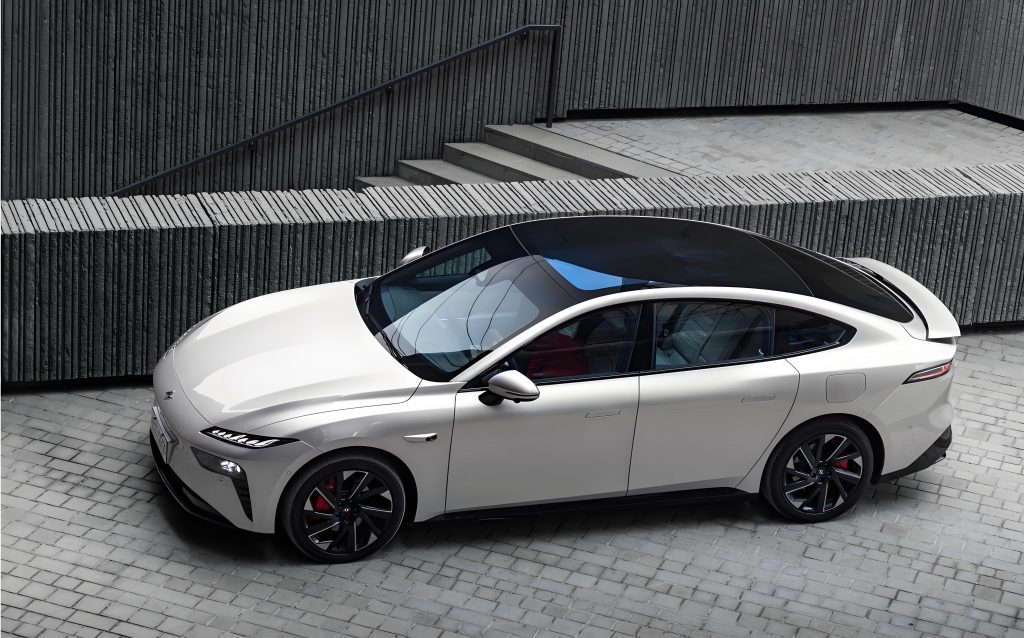
The core challenge stems from the inherent limitations of vehicle dynamics models used for controller synthesis. Parameters such as tire cornering stiffness are notoriously uncertain, varying significantly with tire wear, road surface conditions, load transfer, and the very nonlinearity of the tire-force relationship as the vehicle approaches its handling limits. A controller designed on a nominal model may suffer performance degradation or even instability when these uncertainties manifest, especially for an electric vehicle car operating at high speeds or on low-friction surfaces. Therefore, the control strategy must be inherently robust. The proposed methodology is structured in a modular yet cohesive framework comprising four fundamental modules: an AFS controller, an integrated AFS & DYC controller, a coordination strategy, and a torque allocation controller.
1. Vehicle Dynamics Modeling and Problem Formulation
To establish a foundation for controller design, we begin with a simplified yet insightful vehicle model. For lateral stability analysis, the yaw and lateral motions are most critical. We consider a linear bicycle model, augmented with terms for direct yaw moment, which serves as the reference for understanding vehicle response. The equations of motion are given by:
$$
\begin{aligned}
m v_x (\dot{\beta} + \omega_r) &= F_{yf} + F_{yr} \\
I_z \dot{\omega}_r &= l_f F_{yf} – l_r F_{yr} + \Delta M_z
\end{aligned}
$$
Here, \(m\) is the vehicle mass, \(v_x\) is the longitudinal velocity, \(\beta\) is the vehicle sideslip angle, \(\omega_r\) is the yaw rate, \(I_z\) is the yaw moment of inertia, \(l_f\) and \(l_r\) are the distances from the center of gravity to the front and rear axles, respectively. The forces \(F_{yf}\) and \(F_{yr}\) are the total lateral forces on the front and rear axles. The term \(\Delta M_z\) is the corrective yaw moment generated by the difference in longitudinal forces between the left and right wheels of the distributed drive electric vehicle car, calculable as \(\Delta M_z = \frac{l_w}{2} ( -F_{xfl} + F_{xfr} – F_{xrl} + F_{xrr} )\) for small steering angles, where \(l_w\) is the track width and \(F_{xij}\) are the individual wheel longitudinal forces.
Using a linear tire model, the axle lateral forces are expressed as:
$$
F_{yf} = 2C_f \alpha_f, \quad F_{yr} = 2C_r \alpha_r
$$
where \(C_f\) and \(C_r\) are the cornering stiffness values for the front and rear tires, and the tire slip angles are \(\alpha_f = \delta_f – \beta – \frac{l_f \omega_r}{v_x}\) and \(\alpha_r = -\beta + \frac{l_r \omega_r}{v_x}\). The total front steering angle \(\delta_f\) is the sum of the driver’s input \(\delta_{fd}\) and the AFS corrective angle \(\Delta \delta_f\).
The control objective is to make the actual vehicle states (\(\beta\), \(\omega_r\)) track desired references (\(\beta_d\), \(\omega_{rd}\)). These desired references are typically derived from a linear reference model that represents ideal, neutral-steer behavior, bounded by physical limits of tire-road friction:
$$
\omega_{rd} = \min \left( \frac{v_x/L}{1+K v_x^2} \delta_{fd}, \quad \frac{0.85 \mu g}{v_x} \right) \cdot \text{sgn}(\delta_{fd})
$$
$$
\beta_d = \min \left( \frac{ \frac{2C_r l_r}{L} – \frac{m l_f v_x^2}{2L C_f} }{1+K v_x^2} \delta_{fd}, \quad \arctan(0.2 \mu g) \right) \cdot \text{sgn}(\delta_{fd})
$$
where \(L=l_f+l_r\), \(K=\frac{m}{L^2}\left(\frac{l_f}{C_r}-\frac{l_r}{C_f}\right)\) is the stability factor, \(\mu\) is the road friction coefficient, and \(g\) is gravity.
The tracking error state vector is defined as \(\mathbf{x} = [\beta – \beta_d, \quad \omega_r – \omega_{rd}]^T\). Substituting the dynamics and accounting for variations in the cornering stiffness parameters, we derive an error dynamics model suitable for robust control synthesis:
$$
\dot{\mathbf{x}} = (\mathbf{A}_0 + \Delta\mathbf{A})\mathbf{x} + (\mathbf{B}_0 + \Delta\mathbf{B})\mathbf{u} + \mathbf{w}
$$
where \(\mathbf{u} = [\Delta \delta_f, \Delta M_z]^T\) is the control input vector. The matrices \(\mathbf{A}_0\) and \(\mathbf{B}_0\) are the nominal state and input matrices, respectively. The terms \(\Delta\mathbf{A}\) and \(\Delta\mathbf{B}\) represent the structured uncertainties arising from variations in \(C_f\) and \(C_r\), and \(\mathbf{w}\) encapsulates unmodeled dynamics and external disturbances. This form explicitly highlights the parameter uncertainties that the controller for the electric vehicle car must overcome.
| Parameter | Symbol | Value | Unit |
|---|---|---|---|
| Vehicle Mass | \(m\) | 1430 | kg |
| Yaw Moment of Inertia | \(I_z\) | 2059.2 | kg·m² |
| Distance from CoG to Front Axle | \(l_f\) | 1.15 | m |
| Distance from CoG to Rear Axle | \(l_r\) | 1.51 | m |
| Nominal Front Cornering Stiffness | \(C_{f0}\) | 65489 | N/rad |
| Nominal Rear Cornering Stiffness | \(C_{r0}\) | 52337 | N/rad |
| Wheel Track Width | \(l_w\) | 1.565 | m |
| Wheel Radius | \(R\) | 0.293 | m |
2. Modular Controller Design
2.1 Active Front Steering Controller via Nonlinear Disturbance Observer and Terminal Sliding Mode
The AFS module is designed as a first line of defense, primarily effective in the linear tire region. Its goal is to compute a corrective steering angle \(\Delta \delta_f\) so that the yaw rate \(\omega_r\) tracks \(\omega_{rd}\). Considering the system uncertainties, we treat them as a lumped disturbance \(d_1(t)\). The yaw rate dynamics can be isolated from the error model as:
$$
\dot{\omega}_r = f(\omega_r, \beta, \delta_{fd}) + g \Delta \delta_f + d_1(t)
$$
where \(g = 2l_f C_{f0} / I_z\) is the known input gain and \(f(\cdot)\) contains the nominal dynamics.
We define the yaw rate tracking error \(e = \omega_r – \omega_{rd}\). An Integral Terminal Sliding Mode (ITSM) surface is chosen to guarantee finite-time convergence and steady-state error elimination:
$$
s_1 = e(t) – e(0) + \int_0^t \left( \mu_1^2 e(\tau) + \mu_2^2 e^\lambda(\tau) \right) d\tau
$$
where \(\mu_1, \mu_2 > 0\) and \(0 < \lambda < 1\). The derivative of \(s_1\) is:
$$
\dot{s}_1 = \dot{e} + \mu_1^2 e + \mu_2^2 e^\lambda = f + g \Delta \delta_f + d_1(t) – \dot{\omega}_{rd} + \mu_1^2 e + \mu_2^2 e^\lambda
$$
To obviate the need for knowing the bound of \(d_1(t)\) a priori, a Nonlinear Disturbance Observer (NDO) is constructed:
$$
\begin{aligned}
\dot{z} &= -l z – l(p(s_1) + f + g \Delta \delta_f) \\
\hat{d}_1 &= z + p(s_1), \quad \text{with } p(s_1) = l s_1
\end{aligned}
$$
where \(l > 0\) is the observer gain, \(z\) is the internal state, and \(\hat{d}_1\) is the estimated disturbance. It can be shown that the estimation error \(\tilde{d}_1 = d_1 – \hat{d}_1\) is bounded and converges to a small region.
With this estimate, the robust AFS control law is formulated as:
$$
\Delta \delta_f = g^{-1} \left( -f + \dot{\omega}_{rd} – \mu_1^2 e – \mu_2^2 \text{sgn}(e) – \hat{d}_1 – (E_{ob}+\epsilon_1)\text{sgn}(s_1) \right)
$$
where \(E_{ob}\) is the bound on the observation error and \(\epsilon_1 > 0\). This control law ensures that the sliding surface \(s_1\) is reached in finite time, driving the yaw rate tracking error to zero robustly. This module is vital for the electric vehicle car during moderate maneuvers where steering correction is sufficient and preserves driver feel.
2.2 Integrated AFS & DYC Controller via LMI and Adaptive RBF Neural Network
When the electric vehicle car operates near its limits, tire nonlinearities become significant, and AFS alone may be inadequate or could even induce instability by demanding unrealistic slip angles. The integrated controller activates DYC alongside AFS to provide a restoring yaw moment. To handle the explicit parameter uncertainties \(\Delta\mathbf{A}, \Delta\mathbf{B}\), we design an adaptive integral sliding mode controller (SMC) based on Linear Matrix Inequalities (LMI).
First, an integral sliding surface is defined:
$$
\mathbf{s}_2 = \mathbf{S}\mathbf{x} + \boldsymbol{\nu}, \quad \dot{\boldsymbol{\nu}} = -\mathbf{S}\mathbf{K}\mathbf{x}, \quad \boldsymbol{\nu}(0) = -\mathbf{S}\mathbf{K}\mathbf{x}(0)
$$
where \(\mathbf{S}\) is a chosen matrix such that \(\mathbf{S}\mathbf{B}_0\) is invertible, and \(\mathbf{K}\) is a state feedback gain matrix to be designed. The time derivative of the surface is:
$$
\dot{\mathbf{s}}_2 = \mathbf{S}\mathbf{A}_0\mathbf{x} – \mathbf{S}\mathbf{K}\mathbf{x} + \mathbf{S}\mathbf{B}_0\mathbf{u} + \mathbf{S}\mathbf{d}
$$
Here, \(\mathbf{d} = \Delta\mathbf{A}\mathbf{x} + \Delta\mathbf{B}\mathbf{u} + \mathbf{w}\) is the aggregated uncertainty. We assume it lies in the range space of \(\mathbf{B}_0\), i.e., \(\mathbf{d} = \mathbf{B}_0 \mathbf{d}_m\), where \(\mathbf{d}_m\) is an unknown nonlinear function.
An equivalent control \(\mathbf{u}_{eq}\) can be derived by setting \(\dot{\mathbf{s}}_2 = 0\):
$$
\mathbf{u}_{eq} = -(\mathbf{S}\mathbf{B}_0)^{-1}(\mathbf{S}\mathbf{A}_0\mathbf{x} – \mathbf{S}\mathbf{K}\mathbf{x}) – \mathbf{d}_m
$$
Since \(\mathbf{d}_m\) is unknown, we employ a Radial Basis Function (RBF) neural network to approximate it online:
$$
\mathbf{d}_m = \mathbf{W}^{*T} \mathbf{h}(\mathbf{x}) + \boldsymbol{\varepsilon}
$$
where \(\mathbf{W}^{*}\) is the ideal weight matrix, \(\mathbf{h}(\mathbf{x})\) is the Gaussian basis function vector, and \(\boldsymbol{\varepsilon}\) is the approximation error. The adaptive estimate is \(\hat{\mathbf{d}}_m = \hat{\mathbf{W}}^T \mathbf{h}(\mathbf{x})\).
The core of the design is to find the gain matrix \(\mathbf{K}\) and a Lyapunov matrix \(\mathbf{P}\) that ensure robust stability of the sliding motion. Using the Lyapunov function candidate \(V = \mathbf{x}^T \mathbf{S}^T \mathbf{P} \mathbf{S} \mathbf{x} + \gamma^{-1} \text{tr}(\tilde{\mathbf{W}}^T \tilde{\mathbf{W}})\), the stability condition can be translated into the following Linear Matrix Inequality (LMI):
$$
\begin{bmatrix}
\mathbf{R} + \mathbf{R}^T + \gamma \mathbf{B}_0 \mathbf{B}_0^T + \sigma \mathbf{Q} & * \\
\mathbf{S} \mathbf{Q} & -\mathbf{I}
\end{bmatrix} < 0, \quad \text{and} \quad \mathbf{Q} > 0
$$
where \(\mathbf{Q} = (\mathbf{S}^T \mathbf{P} \mathbf{S})^{-1}\), \(\mathbf{R} = \mathbf{K} \mathbf{Q}\), and \(\gamma, \sigma > 0\) are tuning parameters. Solving this LMI yields valid \(\mathbf{K}\) and \(\mathbf{P}\). The adaptive law for the neural network weights is derived as \(\dot{\hat{\mathbf{W}}} = \gamma \mathbf{S}^T \mathbf{P} \mathbf{S} \mathbf{x} \mathbf{h}(\mathbf{x})^T\).
The final integrated control law consists of the equivalent control (with the neural network estimate) and a discontinuous switching term to reject residual errors:
$$
\mathbf{u} = \mathbf{u}_{eq} + \mathbf{u}_{sw} = -(\mathbf{S}\mathbf{B}_0)^{-1}(\mathbf{S}\mathbf{A}_0\mathbf{x} – \mathbf{S}\mathbf{K}\mathbf{x}) – \hat{\mathbf{d}}_m – \eta \frac{\mathbf{s}_2}{\|\mathbf{s}_2\|}
$$
where \(\eta > \|\boldsymbol{\varepsilon}\|\) is the switching gain. This controller guarantees that the state errors converge to a small region around zero despite the parameter uncertainties, ensuring the lateral stability of the electric vehicle car in demanding scenarios.
2.3 Coordination Strategy and Torque Allocation
A critical aspect of the integrated control system is the seamless and effective coordination between the AFS and AFS&DYC modules. A brute-force simultaneous use of both is suboptimal, as DYC intervention can affect ride comfort and energy efficiency. Therefore, a smooth, state-dependent blending strategy is employed.
A stability index \(\xi\) is calculated in real-time to assess the vehicle’s proximity to its stability limits:
$$
\xi = \sqrt{ \kappa_u v_x^2 + \kappa_a a_y^2 + \kappa_\beta \beta^2 }
$$
where \(a_y\) is the lateral acceleration, and \(\kappa_u, \kappa_a, \kappa_\beta\) are weighting coefficients. This index amalgamates key stability metrics. Based on \(\xi\), a coordination weight \(\kappa \in [0, 1]\) is computed using a piecewise quadratic function:
$$
\kappa =
\begin{cases}
0, & 0 \leq \xi < \xi_s \\
2\left(\frac{\xi – \xi_s}{\xi_l – \xi_s}\right)^2, & \xi_s \leq \xi < \xi_m \\
1 – 2\left(1 – \frac{\xi – \xi_s}{\xi_l – \xi_s}\right)^2, & \xi_m \leq \xi < \xi_l \\
1, & \xi_l \leq \xi
\end{cases}
$$
where \(\xi_s, \xi_m=(\xi_s+\xi_l)/2, \xi_l\) are pre-defined thresholds. The final control commands are then blended as:
$$
\Delta \delta_f^{final} = \kappa \cdot u_{integrated}^{(1)} + (1-\kappa) \cdot \Delta \delta_{f}^{AFS}, \quad \Delta M_z^{final} = \kappa \cdot u_{integrated}^{(2)}
$$
Thus, when the electric vehicle car is well within stable operation (\(\xi\) low), only the AFS controller acts. As stability margins decrease, the integrated controller smoothly takes over, culminating in full AFS&DYC intervention at the limit (\(\xi\) high).
The final step is to translate the desired global yaw moment \(\Delta M_z^{final}\) and the total traction force demand into individual wheel torques for the four in-wheel motors of the distributed drive electric vehicle car. This is formulated as an optimization problem. The primary objective is to minimize the sum of squared tire workload ratios \(\rho_{ij} = (F_{xij}^2 + F_{yij}^2)/(\mu F_{zij})^2\) to maximize adhesion margin. For simplification and focusing on longitudinal force allocation, the cost function becomes:
$$
J = \min \sum_{ij \in \{fl,fr,rl,rr\}} \frac{T_{ij}^2}{(\mu R F_{zij})^2}
$$
where \(T_{ij}\) is the wheel torque and \(F_{zij}\) is the vertical load.
The optimization is subject to equality constraints for total force and yaw moment, and inequality constraints for motor torque and friction limits:
$$
\begin{aligned}
\text{s.t.} \quad & T_{fl} + T_{fr} + T_{rl} + T_{rr} = T_{req} \\
& \frac{l_w}{2R} (-T_{fl} + T_{fr} – T_{rl} + T_{rr}) = \Delta M_z^{final} \\
& |T_{ij}| \leq \min(T_{max}^{motor}, \mu R F_{zij})
\end{aligned}
$$
This forms a standard Quadratic Programming (QP) problem, \(\min \frac{1}{2} \mathbf{T}^T \mathbf{H} \mathbf{T} + \mathbf{f}^T \mathbf{T}\), which can be solved efficiently in real-time to obtain the optimal torque vector \(\mathbf{T} = [T_{fl}, T_{fr}, T_{rl}, T_{rr}]^T\) for the electric vehicle car.
| Module | Primary Control Input | Key Technique | Main Objective |
|---|---|---|---|
| AFS Controller | \(\Delta \delta_f\) | NDO + Terminal SMC | Yaw rate tracking in linear region |
| Integrated AFS&DYC Controller | \([\Delta \delta_f, \Delta M_z]^T\) | LMI-based Adaptive SMC with RBFNN | Robust state error convergence under uncertainty |
| Coordination Strategy | Blending weight \(\kappa\) | Stability Index \(\xi\) | Smooth transition between control modes |
| Torque Allocation | \(T_{fl}, T_{fr}, T_{rl}, T_{rr}\) | Quadratic Programming (QP) | Optimal distribution of yaw moment and traction |
3. Simulation Analysis and Performance Validation
To validate the proposed integrated control system, high-fidelity co-simulations were conducted using MATLAB/Simulink for the controller and CarSim for the detailed vehicle dynamics, including nonlinear tire models (e.g., Pacejka). The performance of the proposed “Integrated Control” was compared against two benchmarks: a standalone “AFS (ITSMC)” controller and a conventional “DYC (SMC)” controller based on standard sliding mode control. Two critical double-lane-change (DLC) maneuvers were tested to challenge the electric vehicle car’s lateral stability.
3.1 High-Speed, High-Friction Scenario
A DLC maneuver was performed at a high speed of 108 km/h on a dry asphalt road (\(\mu=0.8\)). The results are summarized below:
| Performance Metric | DYC (SMC) | AFS (ITSMC) | Integrated Control |
|---|---|---|---|
| Yaw Rate RMSE (°/s) | 2.3 | 4.1 | 1.2 |
| Max Yaw Rate Error (°/s) | 7.2 | 10.7 | 3.5 |
| Max Sideslip Angle, \(|\beta|_{max}\) (°) | 3.0 | 3.6 | 2.5 |
| Max Lateral Path Error (m) | ~0.8 | ~0.8 | 0.29 |
Without control, the vehicle spun out. The Integrated Control showed superior performance, with the lowest tracking errors and the smoothest trajectory. The AFS controller alone, while stable, exhibited larger errors as the tires approached nonlinearity. The conventional DYC controller was effective but showed noticeable chattering in the yaw moment command. The phase portrait (\(\beta\) vs. \(\dot{\beta}\)) for the Integrated Control remained tightly within the stable region, while others showed larger deviations.
3.2 Medium-Speed, Low-Friction Scenario
A DLC maneuver was performed at 72 km/h on a slippery road (\(\mu=0.35\)). This scenario severely tests the controller’s ability to manage the electric vehicle car with highly uncertain and saturated tire forces.
| Performance Metric | DYC (SMC) | AFS (ITSMC) | Integrated Control |
|---|---|---|---|
| Yaw Rate RMSE (°/s) | 2.4 | 3.7 | 1.1 |
| Max Yaw Rate Error (°/s) | 7.1 | 7.9 | 3.9 |
| Max Sideslip Angle, \(|\beta|_{max}\) (°) | 1.8 | 2.9 | 1.0 |
| Max Lateral Path Error (m) | ~0.6 | ~0.6 | 0.21 |
The results reinforce the conclusions from the high-speed test. The Integrated Control system consistently provided the best stability, with the smallest errors and no instability. The coordination strategy was clearly observed: the stability index \(\xi\) increased during lane changes, triggering a smooth increase in the coordination weight \(\kappa\) from 0 to near 1, thereby seamlessly engaging the DYC system to assist the AFS. The torque allocation module successfully generated the required differential torques, as seen in the motor torque plots, while adhering to actuator constraints.
4. Conclusion
This article presented a comprehensive, modular control framework for enhancing the lateral stability of distributed drive electric vehicles under parameter uncertainties and extreme driving conditions. The proposed system strategically coordinates Active Front Steering (AFS) and Direct Yaw Moment Control (DYC). Key innovations include an AFS controller fortified with a nonlinear disturbance observer for robustness, an integrated AFS&DYC controller synthesized via LMI and empowered by an adaptive RBF neural network to actively learn and compensate for model uncertainties, a smooth state-dependent coordination strategy, and an optimal quadratic programming-based torque allocator.
The co-simulation results under high-speed and low-friction double-lane-change maneuvers unequivocally demonstrate the efficacy of the proposed integrated control system. It outperformed both standalone AFS and conventional DYC controllers in terms of tracking accuracy, stability margin preservation, and robustness, with significantly reduced chattering. The AFS-only controller, while stable, confirmed its limitation in extreme conditions where tire nonlinearities dominate. The integrated approach ensures that the electric vehicle car remains stable and predictable, thereby enhancing safety and drivability. Future work will focus on hardware-in-the-loop validation and further refinement of the coordination logic for even more complex real-world scenarios.