
The rapid proliferation of the electric vehicle car market is fundamentally reshaping personal transportation. This growth, driven by global energy strategies and policy incentives, brings heightened focus on the safety of high-voltage electrical systems. Operating at several hundred volts, these systems pose significant risks of electric shock and arcing if integrity is compromised. The High-Voltage Interlock Loop (HVIL) serves as a critical safety guardian in every modern electric vehicle car. This paper delves into the operational principles of HVIL and explores prevalent detection methodologies, integrating analytical formulas and comparative tables to provide a comprehensive technical reference for ensuring the reliability and safety of electric vehicle car platforms.
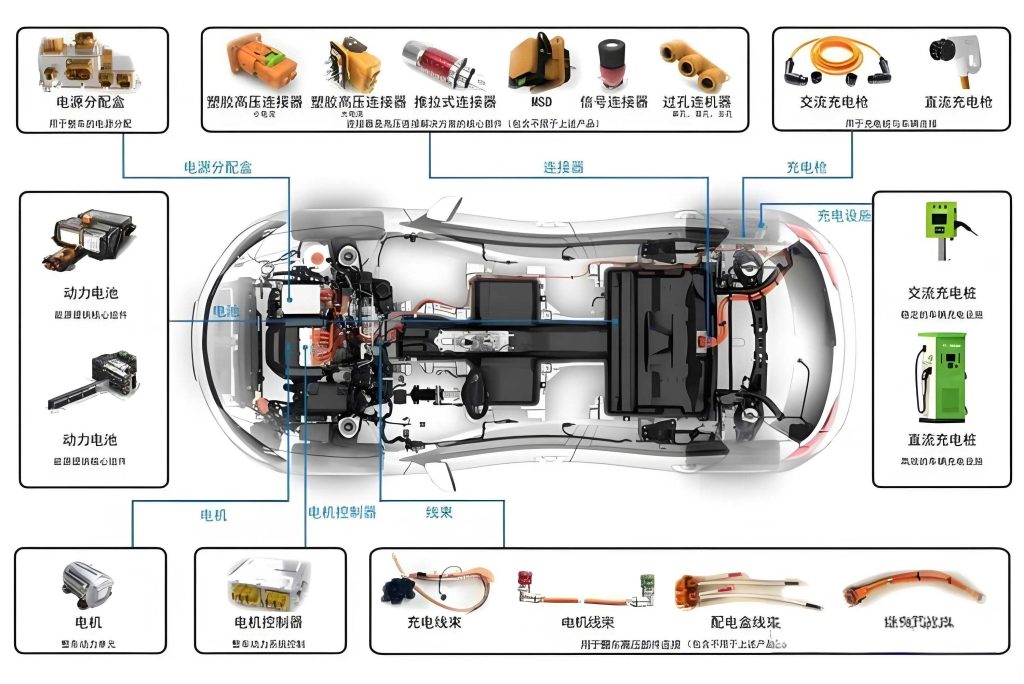
Electric vehicle car technology relies on complex high-voltage networks for propulsion, climate control, and charging. Any discontinuity in this network—such as a loose connector or an unsecured service cover—can create hazardous conditions. The HVIL system mitigates this by using a low-voltage signal circuit that mirrors the path of the high-voltage power lines. Its primary function is to continuously verify the physical integrity and electrical continuity of all high-voltage components and connections before and during operation. This exploration of detection methods is vital for the maintenance and advancement of safe electric vehicle car technology.
1. Principles of the High-Voltage Interlock System
1.1 Core Concept and Objective
The HVIL is a safety interlock system designed to prevent the presence of unsafe high voltage during fault conditions. It forms a continuous, low-current monitoring loop that interconnects all high-voltage components, connectors, and protective covers in an electric vehicle car. Before enabling the high-voltage contactors, the vehicle’s master controller (often the Vehicle Control Unit or Battery Management System) initiates a check of this loop. Only if the loop is confirmed to be continuous and intact will the system permit high-voltage power-up. Furthermore, if the loop is broken during vehicle operation, the system commands an immediate shutdown of the high-voltage system.
1.2 System Architecture
The architecture of an HVIL is elegantly simple yet robust. Key components include:
- Signal Source & Monitor: Typically the VCU or BMS, which generates the interrogation signal and analyzes the return signal.
- Interlock Wiring: Dedicated low-voltage wires that daisy-chain through the entire high-voltage system.
- Interlock Contacts: Specialized pins within high-voltage connectors. They are mechanically designed to mate before and disconnect after the main power pins, ensuring the HVIL detects a disconnection event before arcing can occur at the power terminals.
- Monitoring Switches: Integrated into the protective covers or service disconnects of high-voltage components (e.g., battery pack, power distribution unit).
- Ground Reference: The loop is typically completed through a system ground.
This creates a single, series circuit: Signal Source → Wire → Connector A Interlock → Component A → … → Connector Z Interlock → Wire → Ground/Signal Return.
1.3 Operational Mechanism
The operational logic can be summarized in two states:
Normal State (Loop Closed): The low-voltage signal circulates unimpeded. The monitoring circuit detects the expected signal characteristic (e.g., 0V, a specific voltage, or a PWM waveform) and reports “HVIL OK” to the vehicle network. The electric vehicle car is allowed to power its high-voltage system.
Fault State (Loop Open): If any monitored element is disconnected—a connector is unplugged, a cover is opened, or a wire breaks—the circuit opens. The signal characteristic at the monitor changes dramatically (e.g., voltage rises, PWM signal disappears). The controller detects this anomaly within milliseconds (typically 10-100 ms), logs a fault, and commands the opening of all high-voltage contactors to depower the system. This mechanism is crucial for the safe servicing of any electric vehicle car.
2. High-Voltage Interlock Detection Methodologies
Several distinct electrical methods are employed to interrogate the state of the HVIL loop. The choice of method depends on the specific architecture and controller strategy of the electric vehicle car.
2.1 Voltage Detection Method
This is a straightforward and common technique. The signal source applies a constant DC reference voltage (V_ref, commonly 5V or 12V) to the loop. A simplified equivalent circuit is a series of resistances (wires, contacts) connected to ground.
In a healthy, closed loop, the applied voltage is pulled down to near-ground potential at the monitor’s sensing point due to the completed path to ground. The measured voltage V_measure is approximately 0V.
If the loop is open, the sensing point is no longer connected to ground. Instead, it sees the open-circuit voltage of the source. Therefore, the fault condition is characterized by:
$$ V_{measure} \approx V_{ref} $$
Diagnostically, a technician can probe the two pins at any HVIL connector. The pattern reveals the fault location:
| Measurement Point Relative to Fault | Voltage on Pin from Source (V1) | Voltage on Pin to Ground (V2) | Interpretation |
|---|---|---|---|
| Upstream of the open fault | V_ref | V_ref | The open circuit isolates this point from ground. |
| At the open fault | V_ref | ~0 V | Clear indication of the fault location. |
| Downstream of the open fault | ~0 V | ~0 V | This section remains connected to ground. |
2.2 PWM Signal Detection Method
This more advanced method uses a Pulse Width Modulation (PWM) signal for interrogation, offering enhanced diagnostic capabilities. The signal source transmits a PWM wave with a specific frequency (f) and duty cycle (D_tx) through the HVIL loop. The loop may include a conditioning circuit that modifies the signal (e.g., inverts it, changes duty cycle) before returning it to the monitor.
The monitor compares the received signal’s characteristics (frequency f_rx and duty cycle D_rx) against the transmitted signal or an expected profile.
The duty cycle (D) is defined as:
$$ D = \frac{T_{on}}{T} \times 100\% $$
where \( T_{on} \) is the time the signal is active (high) and \( T \) is the total period of the signal.
In a healthy state, the received signal is consistent and matches expectations. Faults manifest as:
- Open Circuit: The PWM signal is lost entirely. The monitor input may be pulled to a fixed logic high or low voltage.
- Short Circuit to Ground/Power: The signal may be clamped, distorting the waveform and altering its average DC voltage.
- Intermittent Connection: The signal shows dropouts or jitter, identifiable on an oscilloscope.
Average voltage measurement can be a practical diagnostic proxy without an oscilloscope. For a PWM signal with amplitude A (e.g., 12V), the average DC voltage \( V_{avg} \) is:
$$ V_{avg} = D \times A $$
If the expected healthy \( V_{avg} \) is known (e.g., 6V for a 50% duty cycle 12V signal), a significant deviation indicates a problem, guiding the technician to use an oscilloscope for detailed analysis.
2.3 Resistance Measurement Method
This is a fundamental off-line verification technique, performed when the electric vehicle car is powered down and the high-voltage system is confirmed safe (depleted). It involves measuring the DC resistance of the entire HVIL loop or segments of it.
Using Ohm’s Law as the basis:
$$ R_{loop} = \frac{V}{I} $$
where a known test current from a multimeter is used. The total loop resistance \( R_{loop} \) is the sum of all wire resistances and contact resistances in series.
$$ R_{loop} = R_{wire1} + R_{contact1} + R_{wire2} + … + R_{contactN} $$
Each connection point and length of wire adds a small resistance. Manufacturers define a specification for the maximum allowable loop resistance \( R_{max} \).
A measurement revealing an open circuit (infinite resistance) clearly indicates a break. A resistance reading significantly higher than \( R_{max} \) suggests high-resistance connections (corrosion, partial contact), while a reading near zero ohms indicates a short circuit, which is also a fault condition for the HVIL monitor.
| Detection Method | Operating Principle | Primary Equipment | Key Advantages | Key Limitations |
|---|---|---|---|---|
| Voltage Detection | Measures DC voltage level at monitoring point. Fault = voltage rise to source level. | Digital Multimeter (DMM) | Simple, intuitive, fast for locating hard opens. | Less diagnostic detail; cannot easily diagnose shorts or signal degradation. |
| PWM Signal Detection | Analyzes frequency, duty cycle, and integrity of a square wave signal. | Oscilloscope, DMM with duty cycle function | Rich diagnostic data; can identify shorts, waveform distortion, and intermittents. | Requires more advanced equipment and skill to interpret waveforms. |
| Resistance Measurement | Measures DC resistance of the loop or its segments. | Digital Multimeter (DMM) | Excellent for verifying wiring integrity and connector contact quality during repair/assembly. | Off-line test only; cannot diagnose faults that occur only under dynamic conditions (vibration). |
3. Integrated Fault Diagnosis and Case Study Analysis
Effective troubleshooting of HVIL faults in an electric vehicle car requires a systematic approach that combines diagnostic trouble codes (DTCs), a understanding of the system architecture, and the strategic application of the detection methods described.
3.1 Systematic Diagnostic Procedure
- Scan for DTCs: Use a professional diagnostic scanner to read codes from the VCU, BMS, and other relevant controllers. Codes often specify the circuit or general area (e.g., “HVIL Open Circuit,” “PWM Signal Fault”).
- Visual Inspection: Perform a thorough visual check of all high-voltage components, orange cables, connectors, and service covers for obvious damage, disconnection, or tampering.
- Select Detection Strategy: Based on the DTC and symptoms, choose the most efficient detection method.
- For hard faults (persistent no-start), begin with voltage or resistance checks.
- For intermittent faults, PWM signal analysis with an oscilloscope, possibly during a road test to induce the fault, is most effective.
- Segment and Isolate: Use wiring diagrams to mentally or physically segment the HVIL loop. Test between known access points to isolate the faulty section (e.g., between the PDU output and the motor controller input).
- Pinpoint and Repair: Once the faulty segment is found, inspect and test individual components (connectors, wires, switches) within that segment to find the root cause (bent pin, broken wire, failed micro-switch).
| Step | Action | Tool/Resource | Goal |
|---|---|---|---|
| 1 | Retrieve Diagnostic Trouble Codes | OBD-II Scanner / OEM Tool | Obtain system-reported fault guidance. |
| 2 | Preliminary Visual & Physical Check | Technical Manual, Visual Inspection | Identify obvious, accessible faults. |
| 3 | Perform Dynamic/Static Electrical Test | DMM, Oscilloscope | Verify electrical signal integrity in the loop. |
| 4 | Circuit Segmentation & Isolation | Wiring Diagram, DMM | Narrow down the fault to a specific sub-circuit. |
| 5 | Component-Level Verification & Repair | DMM, Terminal Repair Tools | Identify and fix the root cause (connector, wire, switch). |
3.2 Case Study: Intermittent Power Loss in an Electric Vehicle Car
Symptom: A battery-electric vehicle car experiences sudden and complete loss of propulsion while driving, accompanied by a master warning light. The vehicle can sometimes be re-started after stopping, but the fault recurs, especially on rough roads.
Initial Diagnosis: A scanner reveals a historical DTC for “High-Voltage Interlock Circuit – Performance,” but the code is not always present. A basic voltage check of the HVIL circuit at the VCU with the vehicle stationary shows the correct ~0V, suggesting the loop is closed at that moment.
Advanced Analysis: Suspecting an intermittent connection, a technician connects an oscilloscope to monitor the HVIL PWM signal at the VCU while a second technician drives the vehicle to replicate the fault. During the test, the return PWM signal intermittently drops out for brief periods (2-50 ms). Each dropout correlates exactly with a momentary illumination of the warning light and a recorded fault in the data logger.
Fault Isolation: The wiring diagram is consulted. By systematically wiggling connectors and harnesses along the HVIL path while monitoring the scope, the fault is triggered by manipulating the harness near the high-voltage power distribution unit (PDU).
Root Cause & Repair: Upon disassembling the PDU connector, a slightly recessed (backed-out) interlock terminal pin is discovered. The terminal’s crimp was weak, causing the pin to lose proper contact with its mating terminal when subjected to vehicle vibration. The terminal was replaced, the connector reassembled, and a prolonged road test confirmed the fault was eliminated. This case underscores the value of dynamic PWM signal analysis for diagnosing elusive intermittent faults in electric vehicle car systems.
4. Conclusion and Future Perspectives
The High-Voltage Interlock system is a non-negotiable safety pillar in modern electric vehicle car design. This exploration of its detection methodologies—Voltage, PWM, and Resistance measurement—highlights the multi-faceted approach required for development, validation, and service. Each method provides a different lens: voltage for simplicity, PWM for diagnostic depth, and resistance for foundational verification. Mastery of these techniques is essential for engineers and technicians working to ensure the absolute safety of electric vehicle car high-voltage systems.
Looking forward, the evolution of the electric vehicle car will drive further sophistication in HVIL technology. Trends include the integration of more intelligent, software-defined monitoring capable of predictive diagnostics—identifying degrading connectors before they fail. Furthermore, the use of digital communication protocols over the safety loop, or the implementation of dual-redundant monitoring circuits, could enhance robustness for higher levels of vehicle automation. The interplay between HVIL and other high-voltage safety systems, such as insulation resistance monitoring and advanced arc-fault detection, will continue to strengthen the holistic safety architecture. As the electric vehicle car becomes ever more prevalent, the relentless refinement of these fundamental safety systems remains paramount to securing public trust and enabling a sustainable electric mobility future.