
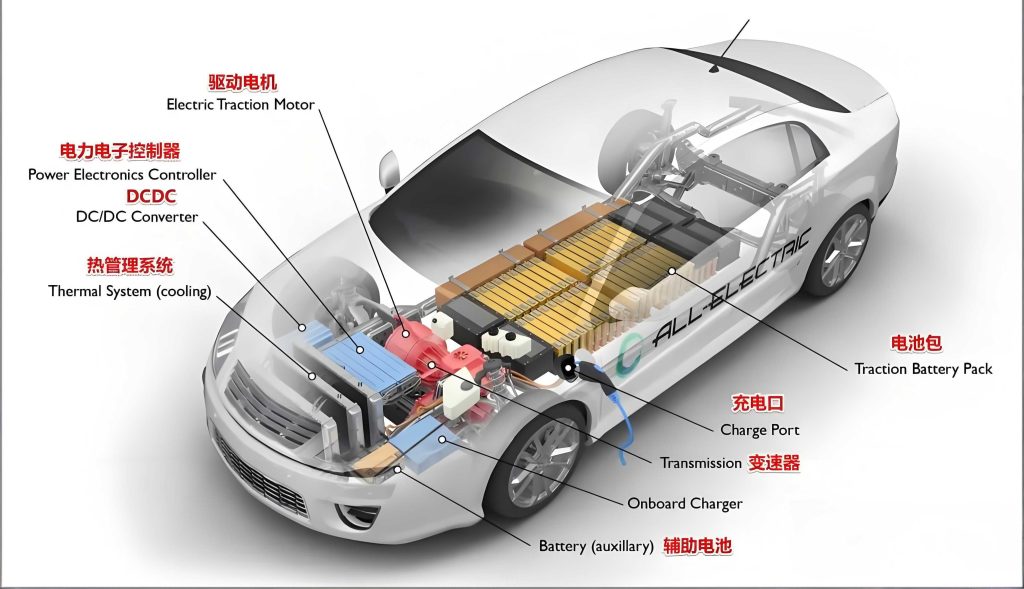
The transition to sustainable transportation is fundamentally driven by advancements in battery electric cars. At the heart of every high-performance battery electric car lies the electric drive unit, with the Permanent Magnet Synchronous Motor (PMSM) being the dominant technology due to its high power density and efficiency. However, the relentless pursuit of higher torque, power, and compactness in modern battery electric cars pushes these motors to their thermal limits. The rotor, housing the critical permanent magnets, is particularly vulnerable. Excessive rotor temperature can lead to irreversible demagnetization of the magnets, a catastrophic failure that directly compromises the drivetrain’s performance and reliability, ultimately impacting the safety and consumer confidence in battery electric cars. Therefore, precise rotor temperature testing and intelligent thermal control are not merely academic pursuits but essential engineering challenges for the next generation of battery electric cars.
This article systematically investigates the state-of-the-art in rotor temperature estimation and control strategies for PMSMs in battery electric cars. It analyzes the characteristics and limitations of mainstream and emerging sensing technologies, explores active and predictive control methodologies, and presents experimental validation of an integrated intelligent thermal management system. The overarching goal is to outline a path toward more reliable, efficient, and powerful electric drive systems for future battery electric cars.
1. Rotor Heat Generation Characteristics
The thermal load on the rotor in a PMSM for a battery electric car originates from multiple loss mechanisms that are heavily dependent on operating conditions such as speed, torque, and control strategy. A precise understanding of these heat sources is the foundation for any thermal management system. The primary contributors are:
1. Permanent Magnet Eddy Current Losses ($P_{eddy,PM}$): This is often the dominant heat source on the rotor. The rotating magnetic field from the stator, rich in time and space harmonics (especially due to stator slotting and inverter PWM switching), induces circulating currents (eddy currents) within the conductive permanent magnets. The power loss density can be remarkably high. For example, analysis shows that without mitigation, eddy current density on the magnet surface can reach on the order of $10^6 A/m^2$. This loss is proportional to the square of the frequency and the induced voltage. It can be modeled as:
$$P_{eddy,PM} \propto \sum_h (B_h \cdot f_h)^2$$
where $B_h$ is the amplitude of the h-th harmonic flux density and $f_h$ is its frequency. A common mitigation technique is magnet segmentation or skewing. While implementing a segmented skew can reduce eddy current losses by approximately 42%, it typically increases manufacturing complexity and cost by around 18%.
2. Rotor Core Iron Losses ($P_{Fe,rotor}$): The rotating stator field also causes hysteresis and eddy current losses within the rotor’s laminated silicon steel core. Although smaller than magnet losses, they are not negligible at high speeds. Advanced lamination processing, using thinner gauge and higher-grade electrical steel, can significantly reduce this loss. For instance, improving the stacking and material processing can lower the specific core loss from 2.8 W/kg to 1.9 W/kg.
3. Mechanical Friction and Windage Losses ($P_{fw}$): These losses arise from bearing friction and the aerodynamic drag on the rotating rotor. Bearing selection is a critical trade-off. For example, using ceramic hybrid bearings can reduce the friction coefficient from approximately 0.003 to 0.001, offering lower losses at high speed. However, this may come at the cost of a 25% reduction in impact load capacity, which must be considered for the dynamic usage profile of a battery electric car.
The total heat generation on the rotor ($Q_{rotor}$) is the sum of these components, which must be balanced by the cooling system:
$$Q_{rotor} = P_{eddy,PM} + P_{Fe,rotor} + P_{fw}$$
This heat generation is highly dynamic, making real-time monitoring and control imperative for the demanding drive cycles of a modern battery electric car.
2. Rotor Temperature Testing Technologies
Accurately determining the rotor temperature in a spinning, enclosed, and electromagnetically noisy environment is a significant challenge for battery electric car engineers. The technologies can be broadly classified into direct measurement, indirect estimation, and emerging data-driven methods.
2.1 Traditional Measurement Methods and Limitations
These methods involve physical sensing elements and have been the backbone of laboratory validation and prototype testing.
| Method | Typical Accuracy | Key Advantages | Major Limitations | Primary Application Context |
|---|---|---|---|---|
| Thermocouple with Slip Ring/Telemetry | ±1.5 °C | Low cost, mature technology, direct point measurement. | Requires complex signal/power transmission (slip rings or wireless telemetry), reliability concerns at very high speeds (>10,000 rpm), invasive installation. | Laboratory testing, prototype validation on test benches. |
| Infrared (IR) Pyrometry/Thermography | ±2 °C (highly variable) | Non-contact, fast response, can provide surface temperature mapping. | Requires a clear optical path (viewing window), highly sensitive to surface emissivity calibration, measures only surface temperature, difficult to implement on a sealed production motor for a battery electric car. | External surface measurement, diagnostic testing on open motors. |
| Resistance Temperature Detection (RTD) | ±1 °C | High accuracy, stable output, can be integrated into windings. | Shares the same installation and signal transmission challenges as thermocouples for rotor use. More commonly used for direct stator winding temperature measurement. | Stator winding temperature monitoring in some high-performance applications. |
2.2 Indirect Estimation: The Electromagnetic Observer Method
This widely researched class of methods infers rotor temperature by monitoring temperature-dependent electromagnetic parameters of the motor itself, requiring no additional rotor-mounted hardware. This makes it highly attractive for series production in battery electric cars.
The Principle: Certain motor parameters vary predictably with temperature. The most common approach is based on the temperature dependence of the permanent magnet flux linkage ($\psi_{PM}$) or the high-frequency impedance of the motor.
Flux-Linkage-Based Estimation: The magnet’s remanent flux density ($B_r$) decreases almost linearly with temperature. This change affects the back-EMF constant ($K_e$) and the d-axis inductance ($L_d$). By using the motor’s voltage equation and a state observer (e.g., a Kalman Filter), the change in $\psi_{PM}$ can be tracked in real-time and converted to a temperature estimate:
$$ \psi_{PM}(T) = \psi_{PM,ref} \cdot [1 + \alpha_{Br} (T – T_{ref})] $$
where $\alpha_{Br}$ is the reversible temperature coefficient of the magnet (typically -0.09% to -0.12%/°C for NdFeB), and $\psi_{PM,ref}$ is the flux linkage at reference temperature $T_{ref}$. The online model calculates $\hat{\psi}_{PM}$, and the temperature is solved from the equation above.
High-Frequency Signal Injection: A high-frequency (HF) voltage signal is superimposed on the fundamental excitation. The resulting HF current response is sensitive to the saliency and, indirectly, to the magnet temperature due to its influence on magnetic saturation. This method can work at zero speed but adds acoustic noise and requires careful filtering.
Advantages & Challenges: The main advantage is hardware-free integration into the motor controller. However, its accuracy (±2-5°C typically) depends on the precision of the motor model, parameter identification, and can be affected by magnetic saturation, cross-coupling effects, and inverter nonlinearities. It requires extensive offline calibration for each motor design, a step that is manageable in the mass production of battery electric cars.
2.3 Emerging and Novel Testing Technologies
The quest for higher fidelity and more robust temperature monitoring in battery electric cars is driving innovation beyond traditional methods.
Fiber Bragg Grating (FBG) Sensors: FBG sensors are immune to electromagnetic interference (EMI), can withstand high temperatures and pressures, and are very small. They can be embedded within motor windings or potentially on the rotor (with optical rotary joints) to provide direct, precise measurements. Research shows embedding FBG sensors in stator windings can achieve accuracies of ±0.5°C. However, the system cost, complexity of installation, and challenges with reliable rotor integration currently limit its use to specialized applications rather than mainstream battery electric car production.
Multi-Sensor Data Fusion Systems: This approach combines inputs from multiple, possibly heterogeneous, sensors (e.g., thermistors on the stator end-windings, a coolant temperature sensor, and an electromagnetic observer) using advanced fusion algorithms (e.g., Bayesian filtering, neural networks). The goal is to create a more accurate and robust estimate of the internal rotor temperature than any single sensor could provide. A system might use a high-precision 32-bit Σ-Δ ADC to sample various signals and fuse them using a thermal model as a backbone.
AI-Based Virtual Temperature Sensing (The “TempAI” Approach): This represents a paradigm shift. Instead of adding physical sensors or relying solely on a fixed physics-based observer, this method uses artificial intelligence (AI) to create a “virtual sensor.” The core idea is to train a machine learning model (e.g., a deep neural network or a gradient boosting model) on vast datasets collected from test benches and fleet vehicles. These datasets contain millions of data points mapping easily measurable operational parameters—such as motor speed ($\omega$), torque current ($I_q$), DC-link voltage ($V_{dc}$), coolant inlet temperature ($T_{cool}$), and ambient temperature ($T_{amb}$)—to the actual rotor temperature ($T_{rotor}$) measured during development.
$$ T_{rotor}^{pred} = f_{AI}( \omega, I_q, V_{dc}, T_{cool}, T_{amb}, \text{…historical states…} ) $$
The AI model learns the complex, nonlinear relationship between these inputs and the thermal state of the rotor and stator. The major advantage for a battery electric car manufacturer is that once trained, this model runs on the existing motor controller’s ECU, requiring no additional hardware cost. It offers high accuracy (reportedly within ±1°C) and can predict future temperature trends, enabling proactive control. Field data suggests such a system can increase the available peak power of a drive unit by up to 6% over a WLTP driving cycle by allowing more aggressive use of the motor’s thermal headroom.
3. Rotor Temperature Control Strategies
Accurate temperature knowledge is only valuable if it enables effective control actions to maintain the rotor within a safe operating window. Control strategies have evolved from static, passive cooling to dynamic, intelligent systems.
3.1 Active Cooling Control Technology
This is the foundational layer of thermal management, focusing on the physical removal of heat from the motor. The choice of cooling method is a key design decision for a battery electric car, balancing performance, cost, and complexity.
| Cooling Method | Description | Advantages | Disadvantages | Typical Application |
|---|---|---|---|---|
| Air Cooling | Uses forced air (fans) over finned motor housing. | Very simple, low cost, lightweight. | Low heat transfer coefficient, poor performance at high load, noisy. | Low-power auxiliary motors, some early-generation or low-cost battery electric cars. |
| Liquid Cooling (Jacket) | Coolant circulates through channels in the motor housing (stator jacket). | High heat transfer, compact, quiet, excellent for continuous high load. | More complex, heavier, requires a pump, radiator, and coolant circuit. | Industry standard for main traction motors in modern battery electric cars. |
| Direct Cooling (Oil Spray/Shaft Channel) | Coolant (often oil) is sprayed directly onto end-windings or circulated through channels in the rotor shaft. | Superior cooling, especially for the rotor and end-windings, can also lubricate bearings. | Highest complexity, potential for windage losses, requires careful sealing. | High-performance sports battery electric cars or very high-power density applications. |
Advanced Liquid Cooling Systems: State-of-the-art systems for battery electric cars feature intelligent coolant flow control. By integrating an electronically controlled valve or a variable-speed pump, the coolant flow rate can be modulated based on the motor’s thermal state, optimizing the trade-off between cooling performance and parasitic pump power. This is a form of model-predictive control for the cooling circuit itself.
Material Innovations: Control is also enhanced at the component level. Using high-thermal-conductivity insulation materials, potting compounds, and thermal interface materials (TIMs) improves the heat transfer path from the hot spots (copper windings, rotor core) to the coolant. For example, high-thermal-conductivity impregnation varnish can reduce winding hot-spot temperatures, and applying thermal grease between the stator lamination pack and the housing can decrease the contact thermal resistance, potentially lowering temperatures by 10-15% under the same cooling conditions.
Low-Temperature Operation: For a battery electric car operating in cold climates, thermal management must also include heating capabilities to ensure proper motor operation and efficiency. This can involve using the motor’s own losses in a controlled “self-heating” mode or integrating a separate Positive Temperature Coefficient (PTC) heater into the coolant loop, managed by the vehicle’s thermal management controller.
3.2 Intelligent Predictive Control Strategy
This represents the pinnacle of thermal management, moving from reactive to predictive control. It leverages the temperature estimation methods (especially AI-based ones) to forecast thermal trajectories and proactively adjust motor operation and cooling.
The Predictive Control Loop:
1. State Estimation: The AI-based virtual sensor provides a real-time, accurate estimate of the current rotor temperature ($\hat{T}_{rotor}(k)$).
2. Thermal Prediction: A thermal model (either physics-based or data-driven) of the motor is used to predict the future temperature trajectory over a finite time horizon ($N$ steps) based on the current state and anticipated future torque/speed demands from the vehicle controller.
$$ \hat{T}_{rotor}(k+1), \hat{T}_{rotor}(k+2), …, \hat{T}_{rotor}(k+N) = \text{Model}(\hat{T}_{rotor}(k), I_q^*, \omega^*, T_{cool}, …) $$
3. Optimization & Actuation: An optimizer (e.g., Model Predictive Controller – MPC) evaluates different control actions (e.g., slightly derating torque, increasing coolant pump speed, pre-emptively adjusting the inverter switching frequency) to keep the predicted temperatures within safe limits while minimizing performance impact. The optimal action is then applied.
Benefits for the Battery Electric Car: This strategy allows the motor to operate closer to its true thermal limits safely. Instead of applying a fixed, conservative derating curve, the system can use the full thermal capacity dynamically. This translates to:
- Sustained higher performance during demanding driving (e.g., uphill towing, repeated acceleration).
- Extended component life by avoiding sharp thermal cycles.
- Improved overall vehicle efficiency by optimizing the energy used for cooling (parasitic loads).
The integration of this intelligent predictive control is what transforms a collection of sensors and actuators into a cohesive, self-optimizing thermal management system, a critical differentiator for advanced battery electric cars.
4. Experimental Platform and Results Analysis
To validate and compare the effectiveness of these technologies, a comprehensive experimental platform was established, emulating the conditions faced by a drive unit in a battery electric car.
Platform Setup: The test bench centered on a liquid-cooled PMSM with specifications typical for a compact-to-midsize battery electric car: a nominal power of 60 kW and a peak power of 120 kW, capable of reaching 16,000 rpm. The integrated cooling system was a controllable liquid jacket. The data acquisition system employed a multi-sensor fusion approach, including thermocouples (on stator and housing), an RTD in the coolant stream, and a high-precision power analyzer. The motor was coupled to a dynamometer for load simulation. The control and data logging were managed by a real-time controller and a host PC.
Testing Protocols: Tests were designed per standard durability and performance profiles relevant to battery electric cars, including:
- Rated load continuous operation to steady-state temperature.
- Peak power overload cycles.
- Thermal cycling tests.
- Simulated aggressive driving cycles (e.g., repeated 0-100 kph acceleration).
During these tests, motor performance parameters (torque, speed, efficiency) and all temperature readings were synchronously recorded.
Key Experimental Findings:
| Test Aspect | Method / Strategy | Key Result | Implication for Battery Electric Car |
|---|---|---|---|
| Measurement Accuracy | Thermocouple (Slip Ring) | Reliable up to ~8,000 rpm. Signal noise increased error to ±3°C at >10,000 rpm. | Not suitable for high-speed production motors. |
| Electromagnetic Observer | Online accuracy of ±2.5°C after careful calibration. Performance degraded during rapid transients. | Viable for series production but requires significant calibration effort. | |
| AI-Based Virtual Sensor (TempAI-like) | Prediction error within ±1.2°C across diverse dynamic cycles. No additional hardware. | High-accuracy solution suitable for mass production, enabling smarter control. | |
| Control Performance | Conventional vs. Predictive Control | Under a repeated high-load cycle, the intelligent predictive control strategy maintained average power 6.2% higher than a conventional reactive (PID-based) cooling/torque derate strategy. | Directly translates to better vehicle acceleration, gradeability, and overtaking performance for the battery electric car driver. |
| Thermal Consistency | Active Liquid Cooling with Smart Flow Control | Intelligent pump modulation reduced the temperature spread across the stator by 8°C compared to fixed-speed pumping, while consuming 15% less pump energy. | Improves motor reliability and overall vehicle energy efficiency, extending the range of the battery electric car. |
5. Conclusion
The thermal management of the PMSM rotor is a critical engineering discipline that directly influences the performance envelope, longevity, and consumer perception of a battery electric car. This research has systematically traversed the landscape from fundamental heat generation analysis to cutting-edge AI-driven control.
The evolution is clear: the future lies in software-defined thermal management. While traditional sensing and cooling methods provide the necessary physical infrastructure, the highest value is created by intelligent algorithms that fuse available data into precise real-time temperature awareness and predictive capability. The AI-based virtual sensor approach, requiring no incremental hardware cost, emerges as a particularly compelling solution for the cost-sensitive and performance-competitive market of battery electric cars. When coupled with model-predictive control strategies, it allows the electric drive system to safely exploit its full thermal capacity, translating into tangible benefits for the end-user: more consistent power, enhanced durability, and ultimately, a more compelling and reliable battery electric car experience. As motor power densities continue to rise, these advanced thermal management techniques will become not just an advantage, but a necessity for the next generation of electric vehicles.