
The global imperative to address escalating energy supply challenges and mitigate severe environmental pollution has catalyzed an accelerated transition towards the electrification of transportation. At the heart of this transformation lies the battery electric car, a vehicle whose performance, safety, and economic viability are fundamentally governed by the efficiency of its core energy source: the lithium-ion battery pack. The operational envelope of these batteries is remarkably narrow, with optimal performance and longevity achieved only within a strict temperature range, typically between -20°C and 50°C. Exceeding this range precipitates a cascade of detrimental effects: accelerated aging, capacity degradation, and in extreme cases, thermal runaway—a dangerous, self-sustaining exothermic reaction. Consequently, the development of sophisticated Battery Thermal Management Systems (BTMS) is not merely an engineering concern but a critical enabler for the widespread adoption and reliability of battery electric cars.
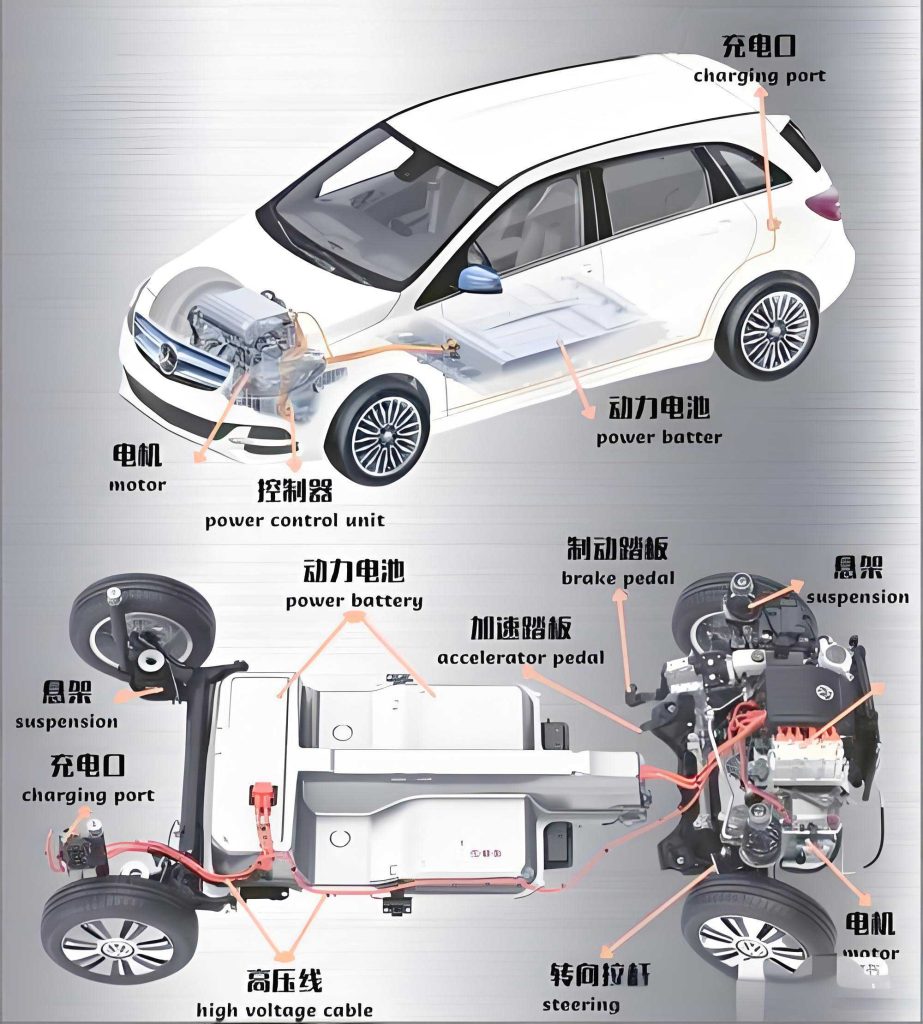
Thermal management strategies are broadly classified into three categories: active, passive, and hybrid (or coupled). Active systems expend energy to circulate a coolant (air or liquid) and forcibly remove heat. Passive systems rely on inherent material properties or phase changes to absorb and redistribute heat without external power input. Hybrid systems synergistically combine elements from both active and passive domains to overcome the limitations of singular approaches. This article provides a comprehensive analysis of the research progress in these technologies, focusing on their principles, advantages, limitations, and future trajectories, with continuous reference to their application in modern battery electric cars.
1. Active Thermal Management Technologies
Active BTMS utilize powered components like fans, pumps, and compressors to drive a coolant medium, thereby achieving controlled and powerful heat exchange. Their effectiveness is high but comes at the cost of parasitic energy consumption, which can impact the driving range of a battery electric car.
1.1 Air Cooling
Air cooling is one of the earliest and most cost-effective BTMS implementations. It operates on the principle of convective heat transfer, expressed by Newton’s law of cooling:
$$q = hA(T_{battery} – T_{air})$$
where \(q\) is the heat transfer rate, \(h\) is the convective heat transfer coefficient, \(A\) is the surface area, and \(T\) denotes temperature. The simplicity, low weight, and minimal maintenance of air-cooling systems made them prevalent in early-generation battery electric cars.
There are two primary modes: natural convection and forced convection. Forced convection, driven by fans, is essential for managing the heat loads of dense battery packs. The design of the air flow path is paramount. Two fundamental topologies exist:
- Serial Ventilation: Cooling air enters one end of the module, flows sequentially past each cell, and exits at the opposite end. This leads to a significant temperature gradient along the flow path, as the air becomes progressively heated.
- Parallel Ventilation: Air is distributed via a manifold to flow simultaneously through channels parallel to the cells, ensuring more uniform cooling. Structural optimizations, such as adding auxiliary fans or designing angled flow channels, have been shown to significantly reduce the maximum temperature (\(T_{max}\)) and the maximum temperature difference (\(\Delta T_{max}\)) within a module.
While improvements are ongoing, the intrinsic limitations of air cooling are becoming apparent. Its heat transfer coefficient is low compared to liquids, and its efficiency is heavily dependent on ambient temperature. In hot climates, cooling capacity diminishes; in cold climates, active heating (e.g., using Positive Temperature Coefficient heaters) is required, adding complexity. As battery electric cars evolve towards faster charging and higher energy densities, the thermal dissipation demands often surpass the capabilities of even optimized air-cooling systems.
| Cooling Method | Typical h (W/m²·K) | Advantages | Disadvantages | Suitability for Modern Battery Electric Cars |
|---|---|---|---|---|
| Air Cooling (Forced) | 10 – 100 | Low cost, simple structure, lightweight, easy maintenance | Low cooling capacity, high noise, sensitive to ambient temperature, large temperature gradients | Decreasing; suitable for low-power or low-cost applications |
| Liquid Cooling (Cold Plate) | 500 – 5000 | High cooling capacity, excellent temperature uniformity, compact | Higher cost, complex system, risk of leakage, parasitic power for pump | High; industry standard for high-performance and long-range vehicles |
1.2 Liquid Cooling
Liquid cooling has emerged as the dominant solution for high-performance battery electric cars due to the superior thermal properties of coolants (e.g., water-glycol mixtures). The heat transfer rate is governed by:
$$q = \dot{m} C_p (T_{out} – T_{in})$$
where \(\dot{m}\) is the mass flow rate, \(C_p\) is the specific heat capacity of the coolant, and \(T_{out}\) and \(T_{in}\) are the outlet and inlet temperatures, respectively.
Liquid cooling systems are categorized by contact method:
- Direct Cooling (Immersion): Battery cells are fully immersed in a dielectric coolant (e.g., mineral oil). This allows for extremely uniform temperature distribution and eliminates interface resistance. However, it increases weight, cost, and complicates pack assembly and servicing.
- Indirect Cooling: A coolant circulates through channels or plates that are in thermal contact with the cells. Common designs include:
- Cold Plates: Used predominantly with prismatic or pouch cells. Cells are mounted onto metal plates with internal serpentine or channeled flow paths.
- Serpentine Tubes/Battery Jackets: Often used for cylindrical cells, where tubes are routed around or through the battery module.
Research focuses on optimizing channel geometry (e.g., mini-channels, drop-shaped deflectors, honeycomb-like structures) to enhance heat transfer uniformity while minimizing pump power. Studies consistently show that liquid cooling maintains lower \(T_{max}\) and \(\Delta T_{max}\) compared to air cooling under equivalent heat loads. For instance, at a 2C discharge rate, a well-designed liquid cold plate can keep \(\Delta T_{max}\) below 5°C, whereas an air-cooled system might struggle to stay below 10°C. The primary trade-offs are the increased system complexity, weight, cost, and the ever-present risk of coolant leakage, which necessitates rigorous sealing and monitoring in a battery electric car.
2. Passive Thermal Management Technologies
Passive BTMS do not consume battery power for operation, making them highly efficient from an energy-centric viewpoint. They rely on materials with high thermal conductivity or latent heat to manage temperature.
2.1 Heat Pipe Cooling
Heat pipes are sealed vessels containing a working fluid that transfers heat via rapid evaporation and condensation cycles. The effective thermal conductivity can be orders of magnitude higher than solid copper. A simplified model for their heat transport limit (capillary limit) is:
$$q_{max} = \frac{\rho_l \sigma_l h_{fg} K A_w}{\mu_l L_{eff}}$$
where \(\rho_l\) is liquid density, \(\sigma_l\) is surface tension, \(h_{fg}\) is latent heat, \(K\) is wick permeability, \(A_w\) is wick cross-sectional area, \(\mu_l\) is liquid viscosity, and \(L_{eff}\) is effective length. Their integration into a battery electric car’s battery pack involves attaching the evaporation section to the cells and the condensation section to a heat sink (ambient air or a cold plate).
| Configuration | Battery Format | Key Finding | ΔTmax Control | Challenge |
|---|---|---|---|---|
| Flat Plate Heat Pipe | Prismatic | Superior to natural convection; Tmax reduced by >8°C at 1C. | Good (<2°C) | Contact resistance, dry-out at high flux |
| U-Type Heat Pipe Array with Air Cooling | Cylindrical | Effective at 3C; Tmax ~51.7°C. | Excellent (~1.1°C) | Requires external finned heat sink and airflow |
| Nanofluid (Fe3O4) as Working Fluid | Prismatic | Simulated control of Tmax < 50°C at 3C. | Good (<5°C) | Long-term stability of nanofluid suspension |
The advantages for a battery electric car are significant: high heat flux handling, lightweight, and no moving parts. However, challenges include orientation sensitivity (gravity-assisted vs. loop heat pipes), high cost for large-scale integration, and the risk of “dry-out” if the heat flux exceeds the capillary pumping limit, leading to failure.
2.2 Phase Change Material (PCM) Cooling
PCM cooling exploits the high latent heat of fusion (\(L\)) absorbed or released during a solid-liquid phase change at a nearly constant temperature. The energy storage is given by:
$$Q = m [C_{p,s}(T_m – T_i) + L + C_{p,l}(T_f – T_m)]$$
where \(m\) is mass, \(C_p\) is specific heat, \(T_i\), \(T_m\), and \(T_f\) are initial, melting, and final temperatures. When battery temperature rises, the solid PCM melts, absorbing heat and buffering the temperature rise. Common PCMs for battery electric cars include paraffin waxes, salt hydrates, and fatty acids, with a phase change temperature tuned around the optimal battery operating range (25-40°C).
The primary limitation of pure PCMs is low thermal conductivity (\(k\)), leading to slow heat diffusion and localized melting. Research is intensely focused on developing Composite PCMs (CPCM):
- Conductivity Enhancement: Embedding highly conductive fillers like Expanded Graphite (EG), metal foams (copper, aluminum), or nanoparticles (Al2O3, CuO).
- Form-Stability: Using porous matrices (e.g., EG, polymer scaffolds) to prevent liquid leakage.
| CPCM Composition | Melting Temp. (°C) | Latent Heat (J/g) | Enhanced Conductivity (W/m·K) | Key Benefit for Battery Electric Car |
|---|---|---|---|---|
| Paraffin/Copper Foam | ~38-45 | ~94-160 | >5 (up to ~35 with nano-additives) | Excellent temperature uniformity, high heat storage |
| Salt Hydrate (SAT)/EG | ~29-47 | ~160-184 | ~2-4 | High latent heat, delays thermal runaway |
| Paraffin-Lauric Acid/EG | ~36 | ~147 | ~1.2 | Tuned phase change temperature, form-stable |
PCM-based systems are entirely passive, silent, and provide exceptional temperature uniformity. However, their finite heat storage capacity can be exhausted under continuous high-load or fast-charging scenarios in a battery electric car. Furthermore, they do not actively reject heat to the environment; they only delay temperature rise, making them ideal for pulse loads or as part of a hybrid system.
3. Hybrid (Coupled) Thermal Management Technologies
Recognizing that single-mode systems have inherent ceilings, hybrid BTMS combine two or more technologies to create synergistic solutions that offset individual weaknesses. This is considered the most promising path forward for next-generation battery electric cars.
3.1 Air-Liquid Coupled Cooling
This approach typically uses liquid cooling for high-intensity thermal loads (e.g., during fast charging or aggressive driving) and switches to or supplements with air cooling during milder conditions or for cabin climate coupling. For example, a system might circulate coolant through a cold plate only when battery temperature exceeds a threshold, while using a low-power fan for ambient air cooling otherwise. Optimization algorithms (e.g., NSGA-II, Particle Swarm Optimization) are used to balance cooling performance and energy consumption. Studies show such systems can achieve nearly the thermal performance of full liquid cooling while reducing pumping/fan energy consumption by 50% or more, directly benefiting the range of a battery electric car.
3.2 PCM-Liquid Coupled Cooling
This is a highly effective strategy where PCM handles transient peak loads and ensures uniformity, while a liquid circuit provides sustained heat rejection to the environment. A common architecture involves battery cells embedded in a CPCM block, which is in turn interfaced with liquid-cooled cold plates. The liquid loop activates when the PCM’s latent heat is nearing saturation. This coupling allows for a smaller, lighter liquid system (lower flow rate, smaller pump) because it doesn’t need to handle peak loads alone. The challenge lies in the design integration, as the PCM volume can be significant. Optimization techniques, including response surface methodology, are employed to minimize system volume and weight while maximizing performance.
3.3 PCM-Heat Pipe Coupled Cooling
This system leverages the passive, high-flux heat extraction of heat pipes with the high-capacity, isothermal storage of PCM. Heat pipes are embedded in or attached to a CPCM matrix surrounding the batteries. The evaporation section absorbs heat from both the cells and the PCM. The condensation section is attached to a heat sink (often a simple finned structure exposed to cabin or external air). This configuration efficiently spreads heat within the module via the PCM and then actively transfers it to the sink via the heat pipes. Advanced designs use Mini/Micro Heat Pipe Arrays (MHPAs) for better contact and lighter weight. Research indicates such systems can lower \(T_{max}\) by over 10°C compared to PCM-only systems under the same cycling conditions, making them a robust passive-dominant solution for a battery electric car.
4. Conclusion and Future Perspectives
The evolution of the battery electric car is inextricably linked to advances in Battery Thermal Management System technology. While active liquid cooling currently dominates the market for high-performance vehicles, its complexity and cost drive the search for alternatives. Passive technologies like advanced CPCMs and heat pipes offer compelling benefits in terms of energy efficiency and uniformity. However, the future clearly points toward intelligent, hybrid systems. The next generation of BTMS for battery electric cars will likely feature:
- Adaptive & Intelligent Control: Systems using real-time data (temperature, current, State of Charge) and machine learning algorithms to predict thermal loads and dynamically optimize the operation of coupled cooling components, minimizing total energy consumption.
- New Material Integration: Development of higher-performance CPCMs with enhanced conductivity and latent heat, as well as flexible or low-weight heat pipe designs. Exploration of thermoelectric elements for localized heating/cooling.
- System-Level Integration & Lightweighting: Designing BTMS as an integral, multifunctional part of the battery pack and vehicle chassis to save space and weight. This includes using structural materials with thermal management properties.
- Holistic Energy Management: Tightly coupling the BTMS with the vehicle’s cabin HVAC system and powertron waste heat recovery systems to improve overall vehicle energy efficiency.
- Focus on Low-Temperature Performance: More research is needed on efficient, rapid heating strategies for cold climates, possibly combining PCM (for heat storage) with embedded heaters or coupled fluid loops.
In conclusion, the thermal management of batteries is a critical discipline that will continue to evolve rapidly. The successful development of more efficient, reliable, and cost-effective BTMS is paramount not only for enhancing the performance and safety of individual battery electric cars but also for supporting the broader societal goals of energy security and environmental sustainability embodied by the global transition to electric mobility.