
As the world increasingly prioritizes environmental protection and energy sustainability, the battery electric car has emerged as a pivotal clean-energy transportation solution. However, during operation, vibrations in its mechanical structures have become a significant concern, impacting comfort, reliability, and durability. In-depth research and effective strategies are crucial for enhancing the performance and industrial development of battery electric cars. In this article, I explore the vibration characteristics of battery electric car mechanical structures and propose optimization approaches, drawing from my experience and analysis in this field.
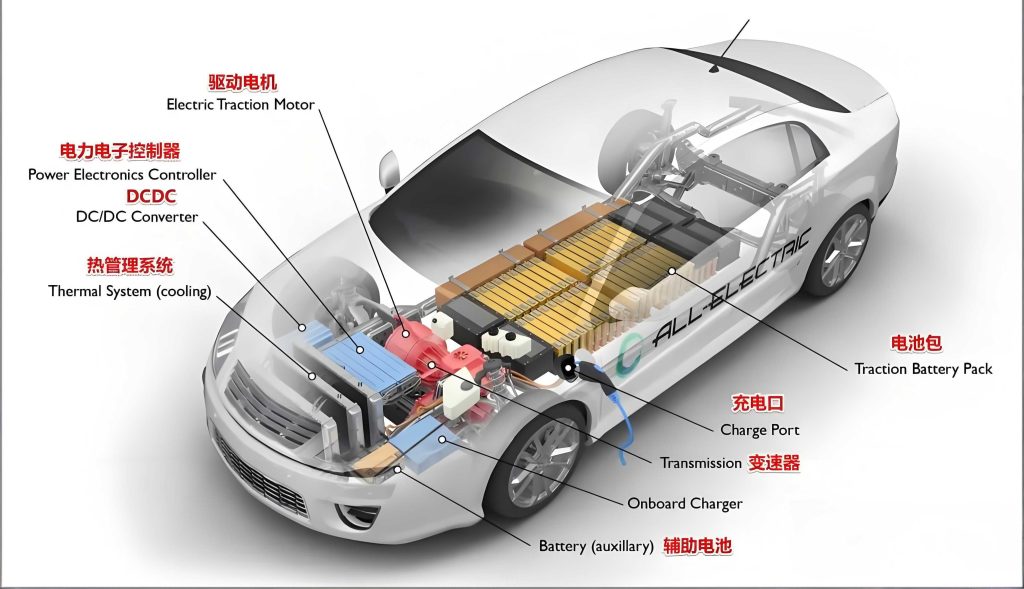
The vibration characteristics of a battery electric car’s mechanical structures critically influence overall performance, involving vibration generation mechanisms, propagation paths, and modal behaviors. Understanding these aspects is essential for designing effective countermeasures in a battery electric car.
From the perspective of vibration generation mechanisms, a battery electric car exhibits multiple vibration sources. The electric motor is a primary source, where electromagnetic forces during operation create unbalanced forces leading to vibration. For instance, in permanent magnet synchronous motors, non-uniform air-gap magnetic fields between stator and rotor at high speeds cause radial and tangential electromagnetic force fluctuations. This can be modeled using electromagnetic force equations. The radial electromagnetic force density \( F_r \) can be expressed as:
$$ F_r = \frac{B^2}{2\mu_0} $$
where \( B \) is the magnetic flux density and \( \mu_0 \) is the permeability of free space. At high rotational speeds, such vibrations become more pronounced. Optimization through precision bearings and balanced rotors can reduce unbalanced forces, while vibration isolators like rubber mounts dampen transmission to the chassis. The table below summarizes common motor vibration sources and mitigation techniques in a battery electric car.
| Vibration Source | Description | Mitigation Technique | Effectiveness |
|---|---|---|---|
| Electromagnetic Forces | Non-uniform forces in motor gaps | Optimized motor design, balancing | High (30-50% reduction) |
| Rotor Imbalance | Mass distribution issues | Precision manufacturing | High |
| Bearing Defects | Wear or misalignment | High-quality bearings | Medium-High |
Tire-road interaction is another significant vibration source in a battery electric car. Road irregularities excite tires, transmitting shocks through the suspension system. Tire properties like pressure and tread wear affect vibration; low pressure increases deformation and vibration amplitudes. The vibration transmission can be modeled as a spring-mass-damper system. For a quarter-car model, the equation of motion is:
$$ m_s \ddot{z}_s + c_s (\dot{z}_s – \dot{z}_u) + k_s (z_s – z_u) = 0 $$
$$ m_u \ddot{z}_u + c_s (\dot{z}_u – \dot{z}_s) + k_s (z_u – z_s) + k_t (z_u – z_r) = 0 $$
where \( m_s \) is sprung mass, \( m_u \) is unsprung mass, \( k_s \) and \( c_s \) are suspension stiffness and damping, \( k_t \) is tire stiffness, and \( z_r \) is road displacement. This highlights how road inputs propagate in a battery electric car.
The drivetrain also contributes to vibrations in a battery electric car. Imbalances in components like drive shafts generate centrifugal forces during high-speed rotation, leading to vibrations transmitted to the body. Manufacturing precision and assembly quality are key factors. The vibration frequency \( f \) from an unbalanced shaft is given by:
$$ f = \frac{\omega}{2\pi} $$
where \( \omega \) is the angular velocity. Addressing this requires balancing and stiffening drivetrain mounts.
To tackle these issues, I propose several optimization strategies for a battery electric car. First, enhancing the body structure’s vibration resistance is vital. Using high-strength steel or aluminum alloys improves stiffness. Topology optimization can reinforce critical areas like A-pillars and floor rails. For example, adding triangular stiffeners reduces vibration energy transmission. The table below compares materials for body structures in a battery electric car.
| Material | Yield Strength (MPa) | Density (kg/m³) | Vibration Damping | Application in Battery Electric Car |
|---|---|---|---|---|
| High-Strength Steel | 500-800 | 7800 | Low | Frame, pillars |
| Aluminum Alloy | 200-500 | 2700 | Medium | Body panels |
| Composite Materials | 300-600 | 1500 | High | Limited use |
Second, selecting optimal vibration isolation materials is crucial for a battery electric car. Rubber and polyurethane are common choices. Rubber, with a damping ratio \( \zeta \) of 0.05 to 0.15, effectively absorbs energy. For motor mounts in a battery electric car, rubber with Shore A hardness of 50-70 HA is used, reducing vibration transmissibility by 30-50%. The force transmissibility \( T_r \) for a rubber isolator is:
$$ T_r = \frac{1}{\sqrt{(1 – r^2)^2 + (2\zeta r)^2}} $$
where \( r \) is the frequency ratio. Polyurethane, with a damping ratio of 0.1 to 0.3, suits sensitive areas like battery packs. A polyurethane pad of thickness 10-20 mm can protect the battery in a battery electric car from shock. The table below summarizes isolation materials.
| Material | Damping Ratio (ζ) | Typical Thickness (mm) | Application in Battery Electric Car | Advantages |
|---|---|---|---|---|
| Natural Rubber | 0.05-0.15 | 5-15 | Motor mounts, bushings | Good elasticity, cost-effective |
| Polyurethane | 0.1-0.3 | 10-20 | Battery isolators | High strength, good damping |
| Silicone Rubber | 0.02-0.1 | 3-10 | Specialized mounts | Temperature resistant |
Third, active vibration control technology offers advanced solutions for a battery electric car. It involves real-time monitoring and counter-force generation. The system includes sensors, controllers, and actuators. Accelerometers with precision of ±0.01 m/s² capture vibration data. Controllers use algorithms like adaptive control to compute control signals. For instance, an adaptive control law can be:
$$ u(t) = -K(t) e(t) $$
where \( u(t) \) is the control signal, \( K(t) \) is the adaptive gain, and \( e(t) \) is the error signal. Actuators, such as electromagnetic types with force output of 10-100 N, produce opposing forces. This technology can reduce vibrations by up to 60% in a battery electric car, enhancing comfort significantly.
Fourth, intelligent algorithm parameter tuning optimizes vibration systems in a battery electric car. Genetic algorithms (GA) and particle swarm optimization (PSO) are effective. GA mimics natural selection to optimize parameters like suspension stiffness \( k \) and damping coefficient \( c \). The fitness function \( F \) might minimize vibration energy:
$$ F = \min \int (a(t))^2 dt $$
where \( a(t) \) is acceleration. Starting with \( k \) in 1000-5000 N/m and \( c \) in 50-200 Ns/m, GA iterates to find optimal values. PSO treats parameters as particles in search space. For motor isolation in a battery electric car, with stiffness range 500-3000 N/m and damping 30-150 Ns/m, PSO updates positions to minimize vibration transmission. These algorithms can improve performance by 30-40%. The table below compares optimization algorithms for a battery electric car.
| Algorithm | Key Parameters | Application in Battery Electric Car | Typical Improvement |
|---|---|---|---|
| Genetic Algorithm | Population size, mutation rate | Suspension tuning | 25-35% vibration reduction |
| Particle Swarm Optimization | Inertia weight, learning factors | Motor isolation optimization | 30-40% reduction |
| Neural Networks | Layers, activation functions | Adaptive control | 20-30% reduction |
In conclusion, optimizing mechanical structure vibrations is essential for advancing battery electric car quality. Through body structure enhancement, material selection, active control, and intelligent algorithms, vibrations can be markedly reduced. However, as battery electric car technology evolves, continuous research into vibration mechanisms and innovative strategies is needed. I believe that by deepening our understanding and applying these methods, we can strengthen the foundation for high-quality battery electric cars, promoting their role in global green mobility. The future of battery electric car development hinges on such interdisciplinary efforts, ensuring reliability and comfort for users worldwide.
From my perspective, the integration of these strategies in a battery electric car not only addresses current challenges but also paves the way for next-generation designs. For instance, combining active control with smart algorithms could lead to self-adapting systems that respond dynamically to road conditions in a battery electric car. Additionally, exploring new materials like metamaterials with negative stiffness might revolutionize isolation. The vibration dynamics of a battery electric car can be further analyzed using finite element methods, where modal analysis equations like:
$$ [M]\{\ddot{x}\} + [C]\{\dot{x}\} + [K]\{x\} = \{F\} $$
help simulate complex behaviors. As we move forward, collaboration across engineering domains will be key to refining the battery electric car experience, making it smoother and more efficient. Ultimately, every improvement in vibration control contributes to the broader adoption of battery electric cars, supporting sustainable transportation goals.