
With the explosive growth of the new energy vehicle industry, electric vehicle power supply equipment, serving as the critical infrastructure for energy replenishment, has seen its safety and reliability become a paramount concern. The implementation of new mandatory national standards, such as GB 39752-2024 and GB 44263-2024, has established a more stringent and unified technical baseline for the industry. Based on these standards and a series of supporting national and industry specifications, this paper systematically analyzes typical technical problems encountered during the type-testing and certification of both AC and DC charging equipment. Through practical test cases, key issues are dissected, and actionable improvement suggestions are provided to assist manufacturers in enhancing product compliance and facilitating the technical upgrade of the industry’s inspection ecosystem.
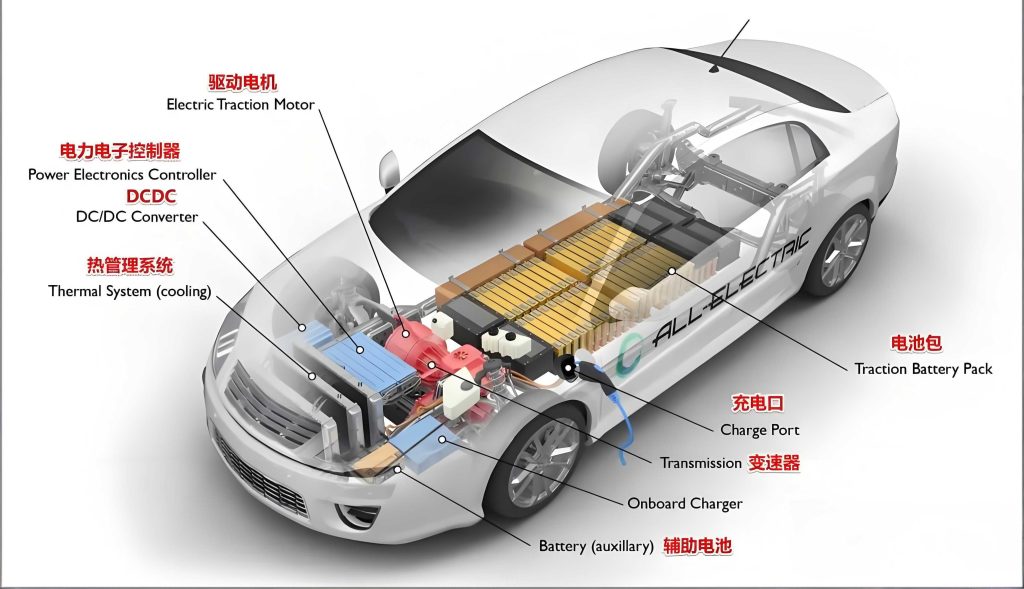
The charging infrastructure for the battery electric car is broadly categorized into Alternating Current (AC) Supply Equipment and Direct Current (DC) Supply Equipment. The operational framework is defined by different charging modes (Mode 1 to Mode 4) and connection methods (A to E), each with distinct control pilot circuit protocols and safety requirements. The test regime for a battery electric car charger is comprehensive, drawing from a multi-layered standard system outlined in the table below.
| Standard Category | Standard Number | Primary Focus |
|---|---|---|
| Mandatory Safety | GB 39752-2024, GB 44263-2024 | Fundamental safety requirements for equipment and systems. |
| Interoperability & Basic Performance | GB/T 18487.1-2023, GB/T 34657.1-2017, GB/T 27930-2023 | Charging interface, communication protocols, and basic functional tests. |
| Industry Technical Conditions | NB/T 33001-2018, NB/T 33002-2018 | Specific technical requirements for AC charging piles. |
| Industry Test Specifications | NB/T 33008.1-2018, NB/T 33008.2-2018 | Detailed test methods for DC and AC charging equipment. |
This analysis delves into the most recurrent non-conformities identified during testing against this framework.
1. Insufficient Hold Time for Output Overcurrent Protection
For AC supply equipment, standards mandate a specific response to an output overcurrent condition during the energy transfer phase. The test simulates a continuous overcurrent state (e.g., 1.1 times the set current for currents >20A). The crucial requirement is that the equipment must maintain this fault condition for a minimum of 5 seconds before initiating a shutdown sequence within the next 5 seconds. A prevalent finding is premature disconnection.
Problem: The overcurrent state is not held for the required 5-second duration. The protection circuit or software algorithm triggers a shutdown too quickly, often within 2-3 seconds.
Root Cause Analysis: The fault typically stems from the control logic design. The protection algorithm may use an instantaneous or a very short-time delay trip characteristic instead of implementing a fixed 5-second delay threshold upon fault detection. Furthermore, issues with current sensor accuracy or signal processing can cause erroneous early triggering.
Standard Requirement vs. Common Defect:
| Aspect | Standard Requirement (e.g., GB/T 34657.1) | Common Non-Conformity |
|---|---|---|
| Overcurrent Threshold (I_f) | I_f = 1.1 * I_set (for I_set > 20A) | Often correct. |
| Fault Hold Time (t_hold) | t_hold ≥ 5 s | t_hold << 5 s (e.g., ~2.5 s) |
| Subsequent Action | Disconnect within next 5 s | May occur correctly but timing is invalid. |
The correct timing sequence can be defined as:
$$ t_{\text{hold}} \geq 5 \text{ s} $$
$$ t_{\text{disconnect}} \leq t_{\text{hold}} + 5 \text{ s} $$
where $t_{\text{disconnect}}$ is the time when the main contactor opens.
2. Absence of Contact Adhesion Alarm
This test verifies the self-diagnostic capability of the AC supply equipment. During the energy transfer phase, a contactor feedback signal is simulated to indicate that one of the output contactors has failed in a closed (welded) state. Upon commanded shutdown, the equipment must detect this failure and issue a clear alarm before the connection to the battery electric car is physically broken.
Problem: The equipment completes its shutdown sequence without generating any alarm or fault indication when a contactor adhesion is simulated.
Root Cause Analysis: The design often lacks a dedicated monitoring circuit for the main contactor’s auxiliary contacts. Even if the state is monitored, the software may not be programmed to evaluate this signal at the precise moment after a shutdown command and before releasing the connector lock. The alarm generation and reporting logic to the upper-level management system may also be missing or improperly prioritized.
3. Compatibility Defect: Charging Initiation at Abnormally Low Voltage
This test checks the safety interlock logic in DC supply equipment. During the handshake phase with the vehicle, the battery electric car communicates its “Maximum Allowable Charge Voltage.” If this value is below the lower limit of the charger’s rated output voltage range, charging must be prohibited. A common lower limit is 200 V DC.
Problem: The DC charger proceeds to initiate the charging process even when the vehicle’s reported maximum voltage is significantly below its operational range (e.g., 90 V).
Root Cause Analysis: This is primarily a software protocol handling issue. The charger’s control unit may not properly parse and validate the “Maximum Allowable Charge Voltage” parameter from the vehicle’s communication message (e.g., GB/T 27930). It might use a default value or only check for an upper limit violation. Inadequate testing during development that fails to simulate edge-case scenarios is a key contributing factor.
The logical check that must be implemented is:
$$ \text{If } V_{\text{vehicle,max}} < V_{\text{charger,min}} \rightarrow \text{Terminate Handshake, Send “Charging Prohibited” Command} $$
where $V_{\text{vehicle,max}}$ is the parameter received from the battery electric car and $V_{\text{charger,min}}$ is the charger’s minimum output voltage.
4. Non-Compliant Grounding Design in AC Supply Equipment
Grounding is a fundamental safety requirement to protect users from electric shock. Standards specify precise mechanical requirements for the protective earth connection on metal enclosures.
Problem: Frequent non-conformities include the use of an undersized grounding bolt and an undersized protective conductor for connecting doors/panels to the main chassis.
Root Cause Analysis: This is often an oversight in mechanical design and production sourcing. Designers may not strictly reference the standard’s specific dimensions, opting for commonly available hardware without verifying compliance.
| Component | Standard Requirement (e.g., NB/T 33002) | Common Non-Comformity |
|---|---|---|
| Main Grounding Bolt Diameter | ≥ 6 mm | M4 (~4 mm) or M5 (~5 mm) bolt used. |
| Protective Conductor for Doors/Panels | Cross-sectional area ≥ 2.5 mm² | 1.5 mm² wire used. |
5. Risk of Missing or Inadequate Short-Circuit Protection
Both AC and DC equipment must be protected against short-circuit faults at their output. The consequences of an unprotected short circuit can be severe, including catastrophic failure and fire risk.
Problem: Some equipment, particularly older designs or certain portable models, lack integrated short-circuit protection devices like fuses or circuit breakers on their output circuits.
Root Cause Analysis: Cost-saving measures or miniaturization efforts may lead to the omission of these critical safety components, relying instead on upstream protection in the building installation, which may not act quickly enough to protect the charger itself.
Test Case & Design Strategy: A test on a Mode 2 (portable) AC supply device without internal fuses resulted in a destructive failure when a short was applied. The measured short-circuit peak current ($I_p$) was 875 A, with an let-through energy ($I^2t$) of 1.67 kA²s before an external breaker cleared the fault in 4.1 ms. This highlights the necessity for integrated protection. The design strategy must be tailored:
| Charging Mode / Application | Recommended Protection Strategy |
|---|---|
| Mode 2 (Portable / Domestic) | Integrate fast-acting, replaceable fuses on both input and output lines. Fuse rating ($I_{\text{fuse}}$) must satisfy: $I_{\text{rated}} < I_{\text{fuse}} \leq I_{\text{cable}}$, where $I_{\text{cable}}$ is the cable’s current rating. |
| Mode 3 / DC (Public Station) | Use molded-case circuit breakers (MCCBs) with appropriate short-circuit breaking capacity. For AC units, combine with Residual Current Protection (RCD). The breaker’s instantaneous trip threshold must be calibrated to protect the equipment’s power electronics. |
The required breaking capacity ($I_{cu}$) for a protective device can be estimated based on the prospective short-circuit current ($I_{psc}$) at its installation point:
$$ I_{cu} \geq I_{psc} $$
Ensuring the let-through energy of the protective device is below the withstand rating of the charger’s components is critical for the battery electric car charging system’s safety.
Improvement Recommendations and Conclusion
To address the identified problems and ensure compliance, manufacturers of electric vehicle supply equipment should implement the following targeted improvements:
- Software & Logic Optimization: Revise control firmware to enforce strict timing for overcurrent protection (guaranteeing the 5-second hold). Implement robust parsing and validation of all digital communication parameters from the battery electric car, including voltage limits. Integrate mandatory end-of-charge contactor state checks to trigger adhesion alarms.
- Hardware & Circuit Enhancements: Incorporate auxiliary contact feedback from all main power contactors into the monitoring system. Utilize current sensors with sufficient bandwidth and accuracy. Integrate appropriately rated fuses or circuit breakers as fundamental protection elements within the equipment design.
- Mechanical & Design Compliance: Strictly adhere to standard specifications for grounding components (bolt size, conductor cross-section) in design documents and part sourcing. Clearly differentiate design rules for metal vs. non-metal enclosures.
- Validation Testing Rigor: Expand pre-compliance testing to include all edge cases mandated by standards, such as low-voltage handshake rejection, full-duration overcurrent tests, and contactor fault simulations.
In conclusion, the evolving standard landscape for battery electric car charging infrastructure presents a clear roadmap for safety and reliability. The typical problems analyzed—ranging from software timing issues and protocol handling errors to fundamental hardware design oversights—highlight critical areas for manufacturer focus. By proactively integrating these technical requirements and improvement suggestions into the product development lifecycle, companies can significantly enhance product quality, reduce certification risks, and contribute to building a safer and more reliable charging network for the global adoption of electric vehicles. The role of comprehensive testing, as framed by standards like GB 44263-2024, remains indispensable in this process.