
The rapid proliferation of battery electric cars represents a monumental shift in global transportation, demanding equally advanced and reliable infrastructure for energy replenishment. The conductive charging system, forming the critical link between the grid and the vehicle’s high-voltage battery pack, is paramount to the safe, efficient, and widespread adoption of battery electric cars. Recognizing the evolving technological landscape and the need for heightened safety rigor, the new mandatory national standard GB 44263—2024, “Safety Requirements for Electric Vehicle Conductive Charging Systems,” establishes a comprehensive framework. This standard defines stringent requirements and corresponding test methods for overall system safety, charging interface integrity, and the specific processes for both alternating current (AC) and direct current (DC) charging. Its implementation is crucial for mitigating risks of electric shock, fire, thermal events, and equipment failure, thereby ensuring the protection of users, first responders, property, and the battery electric car itself throughout the charging lifecycle.
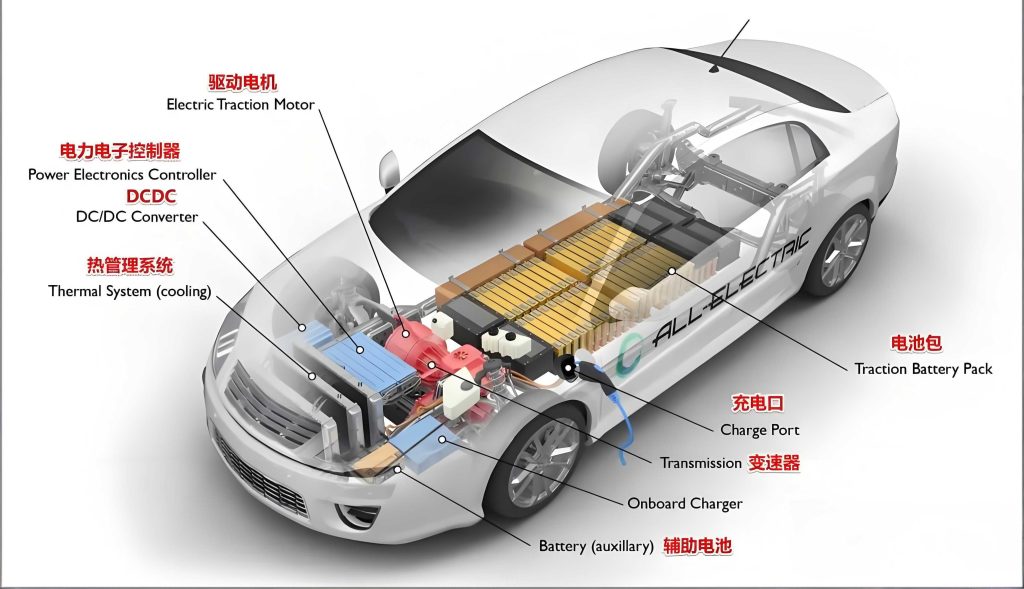
The foundation of any safe charging event for a battery electric car lies in the holistic “General Safety Requirements.” The standard explicitly prohibits the use of “Charging Mode 1” (connection to a standard socket-outlet without a dedicated charging equipment), due to its inherent lack of protective control and communication functions. It mandates strict current limits based on the plug type used on the supply side, ensuring the charging cable and socket are not overloaded. For instance, when using a standard 10 A plug, the output current must not exceed 8 A. Furthermore, the use of non-compliant vehicle adapters in publicly accessible locations is forbidden. These provisions ensure that every conductive charging session for a battery electric car initiates under fundamentally safe conditions, aligning with and building upon the prerequisites that the supply equipment meets GB 39752 and the vehicle itself complies with GB 18384.
Charging Interface Safety: The First Line of Defense
The physical connection point between the charging cable and the battery electric car is a critical vulnerability. The “Charging Interface Safety” section addresses this directly. It mandates a minimum degree of protection (e.g., IP54 or IP55) for the interface when mated and unmated to prevent ingress of dust and water that could lead to short circuits or corrosion. More importantly, it requires integrated temperature monitoring and protection functions. For AC interfaces, a temperature sensor must be present in the vehicle inlet or the plug of the cable. For DC vehicle inlets, which handle significantly higher power, temperature sensors are mandatory. If abnormal heating is detected, the charging process must be safely controlled or terminated to prevent melting, fire, or damage to the expensive connectors on both the infrastructure and the battery electric car. The key tests are summarized below:
| Test Item | Key Technical Requirement | Test Method Principle |
|---|---|---|
| Charging Interface Protection Grade | Interfaces must achieve specified IP ratings against solid objects and water. | Subject interfaces to dust chamber and water spray/jet tests per relevant standards. |
| AC Charging Interface Temperature Protection | Must monitor temperature and adjust/stop charging if limits are exceeded. | Artificially heat the sensor or contact points while monitoring system response. |
| DC Vehicle Interface Temperature Protection | Must monitor temperature in the vehicle inlet and take protective action. | Simulate overheating conditions at the DC vehicle inlet contacts during charging. |
AC Charging Safety: Systematic Protection for Slower Refueling
AC charging, often used for overnight or destination charging of a battery electric car, involves onboard chargers and lower power levels but still necessitates robust safety systems. The standard’s “AC Charging Safety” requirements are divided into System Design Safety and Charging Fault Protection.
System Design Safety ensures the basic control logic is fail-safe. The Control Pilot (CP) and Connection Confirm (CC) circuits must be correctly implemented for proper communication and state detection. Functions like the “Equipment Power Rating Declaration” allow the electric vehicle supply equipment (EVSE) to tell the battery electric car its available current. Conversely, the “Charging Cable Current-Carrying Capacity Detection” allows the car to verify the cable’s capability. An interface lock (where fitted) must prevent disconnection under load. “Contact Welding Detection” is required for the main power contactors or relays inside the EVSE to prevent a hazardous live disconnect. Finally, “Short-Circuit Protection” must be present to clear faults.
Charging Fault Protection defines the system’s response to specific failures. Protections are required for abnormalities in both the equipment-side and vehicle-side CC and CP circuits. For example, if the battery electric car presents an invalid resistance on the CC line, the EVSE must not energize the cable. Similarly, “Grid Power Loss Protection” ensures the output is de-energized if input power fails, and “Output Overcurrent Protection” guards against fault currents.
The performance of an AC charging system for a battery electric car is verified through the tests outlined below:
| Test Item (For AC EVSE) | Test Item (For Battery Electric Car) | Core Safety Objective |
|---|---|---|
| Control Pilot Circuit | Control Pilot Circuit | Verify correct state machine and signal generation/interpretation. |
| Equipment Power Rating Declaration | Charging Cable Capacity Detection | Ensure power transfer does not exceed weakest link rating. |
| Interface Lock Function | Interface Lock Function | Prevent energized disconnection. |
| Contact Welding Detection | – | Detect stuck power contacts in EVSE. |
| Short-Circuit Protection | – | Protect against L-N, L-PE, N-PE faults. |
| Equipment-side CC Fault Protection | Vehicle-side CC Fault Protection | Respond safely to broken or shorted connection circuits. |
| Equipment-side CP Fault Protection | Vehicle-side CP Fault Protection | Respond safely to broken or shorted control pilot circuits. |
| Grid Power Loss Protection | – | De-energize output upon AC input loss. |
| Output Overcurrent Protection | – | Limit or shut down output during overcurrent events. |
DC Charging Safety: Managing High-Power Energy Transfer
DC fast charging places the highest demands on safety due to the direct transfer of high-voltage, high-current DC power to the battery electric car’s pack. The “DC Charging Safety” chapter is consequently the most detailed, covering sophisticated design and fault scenarios.
System Design Safety requirements are extensive. The control guide circuit (using CC1 and CC2) must be flawless. “Short-Circuit Protection” on the DC output is mandatory. “Capacitive Coupling” limits are defined to prevent unacceptable voltage on accessible parts. A “Discharge Circuit” must actively bring the DC output voltage to a safe level (e.g., below 60 V DC) within a specified time after charging stops. An “Insulation Monitoring Device (IMD)” must continuously check the insulation resistance between the DC live parts and ground, shutting down if it falls below a threshold. For a battery electric car, this is critical for detecting internal insulation faults. The insulation resistance $R_{ins}$ must be maintained above a safe limit, often defined by the system voltage $U$. A common requirement is:
$$R_{ins} \ge \frac{k \cdot U_{rated}}{1 \Omega/V}$$
where $k$ is a constant (e.g., 500 or 1000). “Interface Lock Function” is required for DC. “High-voltage DC Contactor Welding Detection” is crucial for both the EVSE and the battery electric car to ensure contacts can open. “Inrush Current Limiting” prevents damaging current spikes when connecting to the capacitive load of the battery electric car’s system. Finally, “Thermal Management System Fault Protection” requires the charging session to be paused or stopped if the cooling system for the battery electric car’s charging inlet or the cable fails.
Charging Fault Protection addresses communication and hardware failures. “Communication Time-out Protection” is required. Protections for faults in the vehicle-side and equipment-side CC1 and CC2 circuits are specified. “DC Supply Circuit Fault” and “Vehicle Power Circuit Fault” protections guard against broken connections during charging. “Output Overvoltage,” “Output Overcurrent,” and “Load Drop” (sudden disconnection) protections are mandated to safeguard both the infrastructure and the sensitive battery system within the battery electric car. The inrush current limiting function, for instance, ensures the initial current $I_{start}$ does not exceed a safe multiple of the nominal current $I_{nom}$:
$$I_{start}(t) \le f_{limit} \cdot I_{nom} \quad \text{for } t < t_{ramp}$$
where $f_{limit}$ is the limiting factor and $t_{ramp}$ is the soft-start period.
The comprehensive testing regime for DC charging systems is summarized in the following table:
| Test Item (For DC EVSE) | Test Item (For Battery Electric Car) | Core Safety Objective |
|---|---|---|
| Control Guide Circuit | Control Guide Circuit | Verify correct connection sequencing and state logic. |
| Short-Circuit Protection | Short-Circuit Protection | Protect against DC+ to DC- and DC to PE faults. |
| Capacitive Coupling | – | Limit touch currents on enclosures. |
| Discharge Circuit | – | Ensure DC output de-energizes to safe voltage within required time. |
| Insulation Monitoring Function | Insulation Monitoring Function | Continuously monitor DC bus insulation to ground. |
| Interface Lock Function | Interface Lock Function | Prevent high-power DC disconnection under load. |
| HV DC Contactor Welding Detection | HV DC Contactor Welding Detection | Detect stuck main power contactors in EVSE/car. |
| Inrush Current Limiting Function | – | Limit current spike when connecting to vehicle capacitance. |
| Thermal Management Fault Protection | – | Respond to failure of connector/cable cooling. |
| Equipment-side CC1 Fault Protection | Vehicle-side CC1 Fault Protection | Respond to faults in the primary connection detection circuit. |
| – | Vehicle-side CC2 Fault Protection | Respond to faults in the secondary connection detection circuit. |
| Communication Time-out Protection | Communication Time-out Protection | Stop charging if digital communication fails. |
| DC Supply Circuit Fault Protection | – | Handle open-circuit faults during power transfer. |
| Vehicle Power Circuit Fault Protection | – | Handle open-circuit faults on the vehicle side. |
| Output Overvoltage Protection | – | Prevent excessive voltage being applied to the car. |
| Output Overcurrent Protection | – | Prevent excessive current being applied to the car. |
| Load Drop Protection | – | Safely manage sudden disconnection of the battery electric car. |
Test Methods: Validating Safety Through Simulation
The standard’s “Test Methods” section provides the blueprint for verifying compliance. Testing must be conducted under specified environmental and electrical conditions. Crucially, tests are performed using defined “Test Systems” that simulate the counterpart device, allowing for controlled and repeatable fault injection.
For AC Charging Tests, an AC EVSE is tested using an “AC Vehicle Control Simulator Box.” This box contains the resistive and capacitive circuits that mimic the control pilot and connection confirm behavior of a real battery electric car. It allows the tester to simulate various fault conditions (e.g., open CP, shorted CC) to verify the EVSE’s protective responses. Conversely, a battery electric car’s AC charging system is tested using an “AC Supply Equipment Control Simulator Box,” which simulates the control signals from a safe EVSE and can likewise inject faults to test the vehicle’s reactions.
The control signal voltage $V_{CP}$ at the detection point in a functional system is governed by the resistances in the CP circuit. When connected and ready to charge, the voltage is determined by the voltage divider formed by the EVSE’s internal resistance $R_1$ and the vehicle’s resistance $R_2$ and $R_3$:
$$V_{CP} = \frac{R_2 + R_3}{R_1 + R_2 + R_3} \cdot V_S$$
where $V_S$ is the source voltage from the EVSE. Deviations from expected values trigger protective actions.
For DC Charging Tests, the setup is more complex due to the communication protocol and high power. A DC EVSE is tested using a “DC Vehicle Control Simulator Box,” which includes not only the control guide simulation but also “Vehicle Communication Simulator Software” implementing the GB/T 27930 digital protocol, and a “Battery Simulator” that can emulate the load and voltage of a battery electric car’s traction battery. This system can simulate all communication sequences, fault conditions, and load profiles. Testing a battery electric car’s DC charging system requires a “DC Supply Equipment Control Simulator Box,” which generates the control guide signals and acts as a simulated DC charging station through its communication software and programmable power source.
The test for insulation resistance involves measuring the combined resistance $R_{meas}$ between the isolated DC poles (connected together) and the protective earth (PE). The measurement is performed with a test voltage $U_{test}$. The standard specifies the minimum acceptable value, ensuring:
$$R_{meas} \ge R_{min}$$
where $R_{min}$ is the threshold defined in the standard (e.g., 100 Ω/V for the vehicle side during charging).
Conclusion and Industry Impact
The implementation of GB 44263—2024 marks a significant advancement in the safety standardization of conductive charging for battery electric cars. By consolidating and elevating requirements across the entire charging ecosystem—from the AC plug to the DC vehicle inlet and the complex digital handshake in between—it provides a unified and rigorous safety benchmark. For manufacturers of charging equipment and battery electric cars, it clarifies design imperatives, particularly around fault detection, thermal management, and interoperability under fault conditions. For test laboratories and certification bodies, it offers a clear and consistent methodology for evaluation. For regulators and operators, it establishes a robust foundation for market surveillance and infrastructure safety management. Ultimately, this standard is instrumental in building the essential trust that a battery electric car can be refueled as safely, if not more safely, than a conventional internal combustion vehicle, thereby supporting the sustainable growth of electric mobility. The phased enforcement timeline ensures a smooth transition, allowing the industry to adapt while prioritizing new products entering the market.