
As the global transition to sustainable transportation accelerates, the proliferation of battery electric cars has created an urgent and massive demand for supporting charging infrastructure. For investors and construction entities, understanding the economic viability of charging station projects is paramount to ensuring sustainable development and attracting further capital into this critical sector. This analysis delves into a detailed case study of a battery electric car charging station project in a county-level region, systematically deconstructing its investment return pathway. The focus is on verifying the feasibility of achieving target financial metrics under a baseline scenario while identifying the core drivers and constraints for profitability.
The fundamental challenge lies in the capital-intensive nature of charging infrastructure, coupled with operational uncertainties in demand and electricity costs. Success hinges not merely on building stations but on designing a robust, data-informed business model that can withstand market fluctuations. This article adopts a first-person analytical perspective to explore the full lifecycle cost structure,精细化运营 strategies, and revenue optimization mechanisms essential for a profitable battery electric car charging venture.
1. Project Overview and Financial Targets
The subject of this analysis is a centralized battery electric car charging station located in a county-level city in Southern China. It is designed to serve a mix of private battery electric car owners, ride-hailing vehicles, and public transport feeder buses. The station’s configuration is strategic, featuring 8 units of 120 kW DC fast chargers (supporting dual-gun charging) and 2 units of 7 kW AC slow chargers, resulting in a total installed capacity of 974 kW. The site is secured via a 10-year lease agreement. Supporting infrastructure includes dual-transformer capacity expansion (630 kVA and 400 kVA to accommodate future photovoltaic grid connection), an intelligent monitoring system with license plate recognition, and a typhoon-resistant canopy.
The total initial investment is calculated at 3.8595 million CNY. The capital allocation is as follows: equipment procurement accounts for 10.26% (396,000 CNY), power engineering for 31.09% (1.2 million CNY), and construction & preliminary expenses (including smart management system integration and canopy) for the remaining 58.65% (2.2635 million CNY). This project is a joint venture between a local state-owned enterprise and a charging operator, with operations scheduled to commence in the fourth quarter of 2025.
The project’s core financial goals are clearly defined: a dynamic investment payback period of no more than 5 years and a full lifecycle annualized real rate of return not less than 10%. These targets are quantified through several key performance indicators (KPIs), as outlined in Table 1.
| Financial Metric | Target Value | Basis for Calculation |
|---|---|---|
| Full Lifecycle Annualized Real Rate of Return | ≥ 10% | Reference to industry average (8%-15%), adjusted for county-level market risk premium. |
| Dynamic Investment Payback Period | ≤ 5 years | Based on stress testing for cash flow breakeven by Year 4. |
| Net Present Value (NPV) during Operation Period | > 2 million CNY (Discount Rate=8%) | To cover initial investment and provide reasonable return on capital. |
| Annual Return on Investment (ROI) at Steady State | ≥ 20% |
Achieving these targets is intrinsically linked to core operational drivers. Charging volume follows a tiered growth pattern. In the initial ramp-up phase (Years 1-2), daily utilization rates are projected at 27% for fast chargers and 15.2% for slow chargers. The cornerstone for the stable phase (Years 3-10) is a guaranteed usage agreement with the local public bus fleet, locking in 4 hours of full-load operation daily for 6 of the fast chargers. This agreement significantly boosts the baseline charging demand for battery electric cars.
The revenue model is sophisticated, employing time-of-use (TOU) pricing for fast charging services to maximize margin from the electricity price spread. It also incorporates ancillary income streams. Cost control is anchored to local industrial TOU electricity tariffs. Key operational parameters are summarized in Table 2.
| Element Category | Key Parameter | Implementation Standard / Value |
|---|---|---|
| Charging Volume Plan | Initial Daily Fast Charging (8 units) | 6,220.8 kWh |
| Initial Daily Slow Charging (2 units) | 51.07 kWh | |
| Daily Guaranteed Bus Charging (Steady State) | 2,102.4 kWh | |
| Revenue Structure | Fast Charging Peak Price | 1.25 CNY/kWh |
| Fast Charging Off-Peak Price | 0.45 CNY/kWh | |
| Fast Charging Standard Price | 0.85 CNY/kWh | |
| Parking Space Rental Income | 120,000 CNY/year | |
| Cost Control | Peak Electricity Procurement Cost | 0.98 CNY/kWh |
| Standard Electricity Procurement Cost | 0.59 CNY/kWh | |
| Off-Peak Electricity Procurement Cost | 0.21 CNY/kWh | |
| Intelligent O&M Expenditure | 160,000 CNY/year |
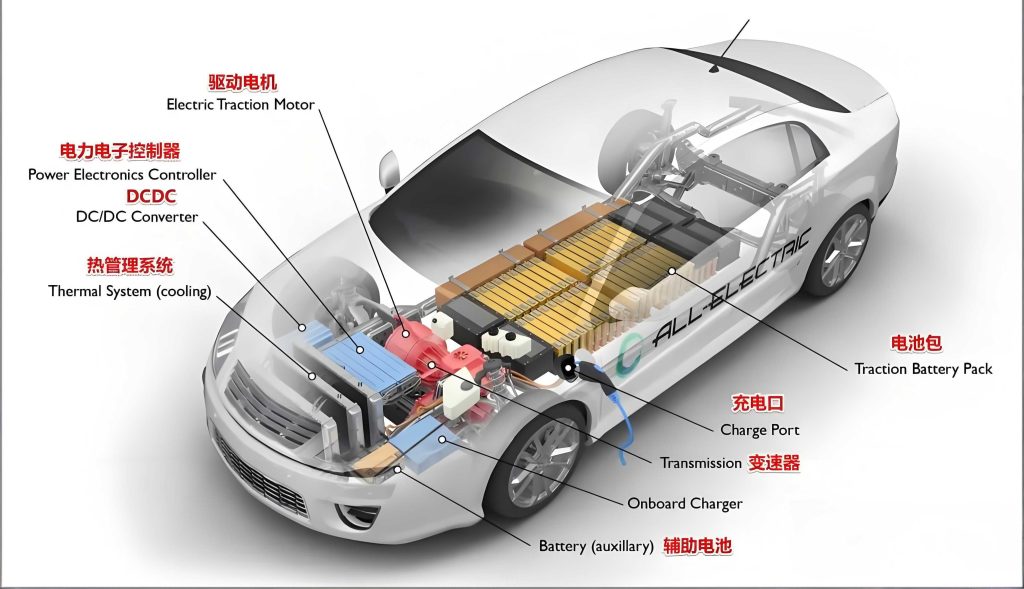
2. Investment Cost Structure and Lifecycle Analysis
A granular understanding of the cost composition is the first step in evaluating the investment return for a battery electric car charging station. To align with the goal of a 10% annualized return, we employ a full lifecycle dynamic cost model. This model integrates the initial capital expenditure (CAPEX) with the present value of all future operational and maintenance (OPEX) costs, providing a more accurate picture than simple summation. The core formula is expressed as:
$$
C_T = \sum_{t=0}^{n} \frac{C_{I,t} + C_{M,t}}{(1+r)^t} + \gamma \cdot S
$$
Where:
\( C_T \) = Total present value of project lifecycle investment.
\( C_{I,t} \) = Initial construction cost in year \( t \) (e.g., equipment, civil works).
\( C_{M,t} \) = Operation, maintenance, and potential expansion cost in year \( t \).
\( r \) = Discount rate, set at 7% (reflecting financing cost).
\( n \) = Operational lifespan, set at 10 years.
\( \gamma \) = Land cost attribute coefficient (0 for lease, 1 for purchase). This project uses a lease model, so \( \gamma = 0 \).
\( S \) = Land purchase cost (not applicable here).
This discounted cash flow approach is critical for a meaningful analysis of a project supporting battery electric car infrastructure, as it properly accounts for the time value of money—a necessity when targeting a specific rate of return.
Initial Construction Costs (t=0): The initial investment of 3.8595 million CNY is broken down as follows:
• Equipment: 396,000 CNY (2 V2G fast chargers @ 140,000 CNY, 6 standard fast chargers @ 240,000 CNY, 2 slow chargers @ 16,000 CNY).
• Power Engineering: 1.2 million CNY (transformer expansion and PV grid connection).
• Canopy & Site Preparation: 1.5 million CNY (lease advance and site hardening).
• Contingency Reserve: ~413,500 CNY (calculated at 12% of direct costs).
Operation & Maintenance Costs (t ≥ 1): Annual OPEX is modeled with a stepwise increase, starting at 160,000 CNY in Year 1 and rising by 10,000 CNY each year to account for equipment aging and labor cost inflation. These future costs are discounted back to their present value (PV) at the 7% rate. Table 3 details this calculation.
| Year | O&M Cost (CNY ‘0000) | Discount Factor (1+7%)^{-t} | Present Value (CNY ‘0000) |
|---|---|---|---|
| 1 | 16.00 | 0.9346 | 14.95 |
| 2 | 17.00 | 0.8734 | 14.85 |
| 3 | 18.00 | 0.8163 | 14.69 |
| 4 | 19.00 | 0.7629 | 14.50 |
| 5 | 20.00 | 0.7130 | 14.26 |
| 6 | 21.00 | 0.6663 | 13.99 |
| 7 | 22.00 | 0.6227 | 13.70 |
| 8 | 23.00 | 0.5820 | 13.39 |
| 9 | 24.00 | 0.5439 | 13.05 |
| 10 | 25.00 | 0.5083 | 12.71 |
| Total PV | 140.09 | ||
Therefore, the total lifecycle investment present value \( C_T \) is the sum of the initial investment and the PV of O&M: 3.8595 + 1.4009 = 5.2604 million CNY. The detailed cost structure is shown in Table 4.
| Cost Category | Amount (CNY ‘0000) | Percentage | Description |
|---|---|---|---|
| V2G Equipment | 14.00 | 2.66% | 2 bi-directional fast charging units |
| Standard Charging Equipment | 25.60 | 4.87% | 6 fast + 2 slow charging units |
| Power Facilities | 120.00 | 22.81% | Transformer expansion & PV grid connection |
| Site Lease (Advance) | 150.00 | 28.52% | 10-year site使用权预付 |
| Construction & Contingency | 76.35 | 14.51% | Canopy, site hardening, reserve fund |
| PV of O&M Costs | 140.09 | 26.63% | Discounted智能运维 costs over 10 years |
| TOTAL (C_T) | 526.04 | 100.00% |
3. Operational Revenue, Costs, and Profitability Mechanics
The operational phase is where the financial model for a battery electric car charging station comes to life. Effective management of the spread between service revenue and electricity procurement cost, coupled with ancillary income, is crucial for hitting the 10% return target. A dynamic revenue-cost balance model is necessary to capture the interplay between growing demand from battery electric cars, TOU pricing, and cost fluctuations. The annual net cash flow can be modeled as:
$$
\text{Net Cash Flow}_t = \sum_{k=1}^{m} (\text{Charging Volume}_{k,t} \times \text{Service Fee}_k) + \text{Ancillary Income}_t – (\text{Fixed OPEX}_t + \text{Total Charging Volume}_t \times \text{Blended Electricity Price} \times \beta_t)
$$
Where:
\( \text{Charging Volume}_{k,t} \) = Actual electricity delivered by charger type \( k \) (fast/slow) in year \( t \).
\( \text{Service Fee}_k \) = Service fee unit price for charger type \( k \), incorporating TOU multipliers.
\( \text{Ancillary Income}_t \) = Revenue from ads,会员费, V2G arbitrage, etc.
\( \text{Fixed OPEX}_t \) = Rigid costs like site management fees and base运维.
\( \text{Blended Electricity Price} \) = Average power procurement cost weighted by TOU periods.
\( \beta_t \) = An off-peak utilization factor reflecting the system’s ability to shift load to cheaper periods, thus reducing the effective \( \text{Blended Electricity Price} \).
This model dynamically links service volume, price arbitrage, and cost optimization, providing a realistic foundation for validating the target收益率.
Steady-State Operational Analysis (Years 3-10):
1. Charging Volume: Total annual volume stabilizes at approximately 3.3424 million kWh, combining a base volume from general battery electric car users and the guaranteed bus fleet volume.
2. Revenue Streams:
• Charging Service Fee: Calculated using the TOU prices and assumed load distribution (Peak 20%, Off-Peak 55%, Standard 25%). Total annual revenue: ~2.1702 million CNY.
• Ancillary Income: This is a critical profit booster. It includes V2G峰谷套利 (~82,000 CNY),广告收入 (200,000 CNY), and parking space rental (120,000 CNY), summing to 402,000 CNY.
• Total Operational Revenue: 2.1702 + 0.402 = 2.5722 million CNY.
3. Cost Streams:
• Fixed OPEX: Intelligent O&M (160,000 CNY) + site management fees (280,000 CNY) = 440,000 CNY.
• Electricity Procurement Cost: Calculated strictly using TOU industrial rates on the total charged energy. Total annual cost: ~1.4029 million CNY.
4. Annual Net Cash Flow: 2.5722 – 0.44 – 1.4029 = 0.7293 million CNY (or 729,300 CNY).
This steady-state net cash flow yields an Annual ROI of approximately \( \frac{0.7293}{5.2604} \approx 13.87\% \) on the total lifecycle investment present value. While positive, it is below the original 20% steady-state target, indicating the significant impact of the discounted O&M costs on the investment base and highlighting the importance of the ancillary income streams.
4. Investment Return Calculation and Risk Assessment
Based on the integrated model of lifecycle costs and steady-state operations, the key financial metrics for this battery electric car charging station can be projected.
Baseline Scenario Results:
• Dynamic Investment Payback Period: The cumulative discounted cash flows turn positive in Year 5.13, meeting the ≤5 year target very closely.
• Full Lifecycle Annualized Real Rate of Return (IRR): The internal rate of return that sets the Net Present Value (NPV) of the project to zero is calculated to be approximately 21.04%. This comfortably exceeds the 10% target, demonstrating strong project attractiveness. The elevated IRR is largely driven by the公交保底 agreement securing baseline demand, and the substantial ancillary income from广告 and V2G套利.
• Net Present Value (NPV): Using the 8% discount rate (as per Table 1 target), the project’s NPV is approximately 2.6637 million CNY, surpassing the 2 million CNY goal.
The success of this battery electric car charging infrastructure project is not guaranteed and is subject to risks. A formal risk assessment through stress testing is essential.
Pessimistic Scenario Stress Test: We model a dual adverse condition where (a) total charging volume drops by 9% due to lower-than-expected adoption of battery electric cars, and (b) competitive pressure forces a 9% reduction in service fee prices. Ancillary income is held constant.
• Resulting IRR: 8.22%.
• Resulting Dynamic Payback Period: Extends to 9.86 years.
This stress test reveals that even under significant pressure on the core revenue drivers for the battery electric car charging service, the project’s return remains above the financing cost (7%), and the payback period, while lengthy, stays within the leasehold period. This indicates a reasonable degree of financial resilience.
5. Conclusion
This detailed analysis confirms that constructing and operating a profitable battery electric car charging station at the county level is feasible but requires a meticulously planned and multi-faceted approach. The case study demonstrates that achieving target financial metrics, such as a payback period under 5 years and a double-digit rate of return, hinges on several interconnected factors:
1. Stable Demand Anchor: A guaranteed off-take agreement, such as with a public bus fleet, is invaluable for de-risking the initial investment by providing a predictable baseline load.
2. Sophisticated Revenue Management: Simply selling electricity is insufficient. Implementing TOU pricing for battery electric car owners, actively pursuing V2G峰谷套利, and developing异业合作 (advertising, value-added services) are critical for enhancing profit margins.
3. Rigorous Cost Control: A full lifecycle view of costs—from initial grid connection expenses to escalating O&M—is necessary for accurate financial planning. The choice of site acquisition model (lease vs. purchase) significantly impacts the capital outlay.
4. Risk-Aware Planning: Financial models must incorporate stress tests to understand the project’s vulnerability to demand fluctuations and price competition, ensuring long-term viability even in suboptimal market conditions for battery electric cars.
In summary, the transition to electric mobility necessitates not just the physical deployment of chargers but the development of financially sustainable business models. This analysis provides a replicable framework for evaluating battery electric car charging station investments, emphasizing that profitability is built on a triad of secured demand, diversified and intelligent revenue streams, and disciplined lifecycle cost management. As the population of battery electric cars grows, such data-driven and resilient project designs will be fundamental to building a robust and scalable charging network.