
In recent years, the rapid adoption of battery electric cars has highlighted critical challenges in charging infrastructure development. As a researcher focused on optimization and management science, I have explored the reliability of charging station location planning to enhance user experience and support market growth. This article presents a comprehensive study on optimizing the location of charging stations for battery electric cars, considering scenarios with random interruptions and user emergency charging needs. The goal is to develop a robust model that minimizes total costs while ensuring reliable service, even under disruption risks. We integrate multiple constraints, including station reliability, user behavior diversity, and economic feasibility, to derive practical solutions. Through this work, we aim to contribute to the sustainable expansion of battery electric car networks by providing decision-makers with effective tools for charging station layout.
The proliferation of battery electric cars is driven by environmental concerns and energy efficiency, but inadequate charging infrastructure remains a significant barrier. Traditional location models often assume perfect station reliability, which is unrealistic due to natural disasters, power failures, or technical faults. In practice, charging stations for battery electric cars face random interruption risks, leading to service disruptions and increased costs for users. Moreover, users may encounter emergency situations where their battery charge is critically low, limiting their ability to travel to distant stations. Addressing these issues requires a reliability-based approach that accounts for both station failures and user urgency. In this article, we construct an optimization model that incorporates interruption probabilities and emergency charging scenarios, aiming to minimize overall costs—including construction, travel, and penalty costs—while ensuring high service reliability. We then design an immune optimization algorithm with an elite strategy to solve the model efficiently. By analyzing case studies and conducting sensitivity analyses, we validate the model’s effectiveness and provide insights for real-world applications.
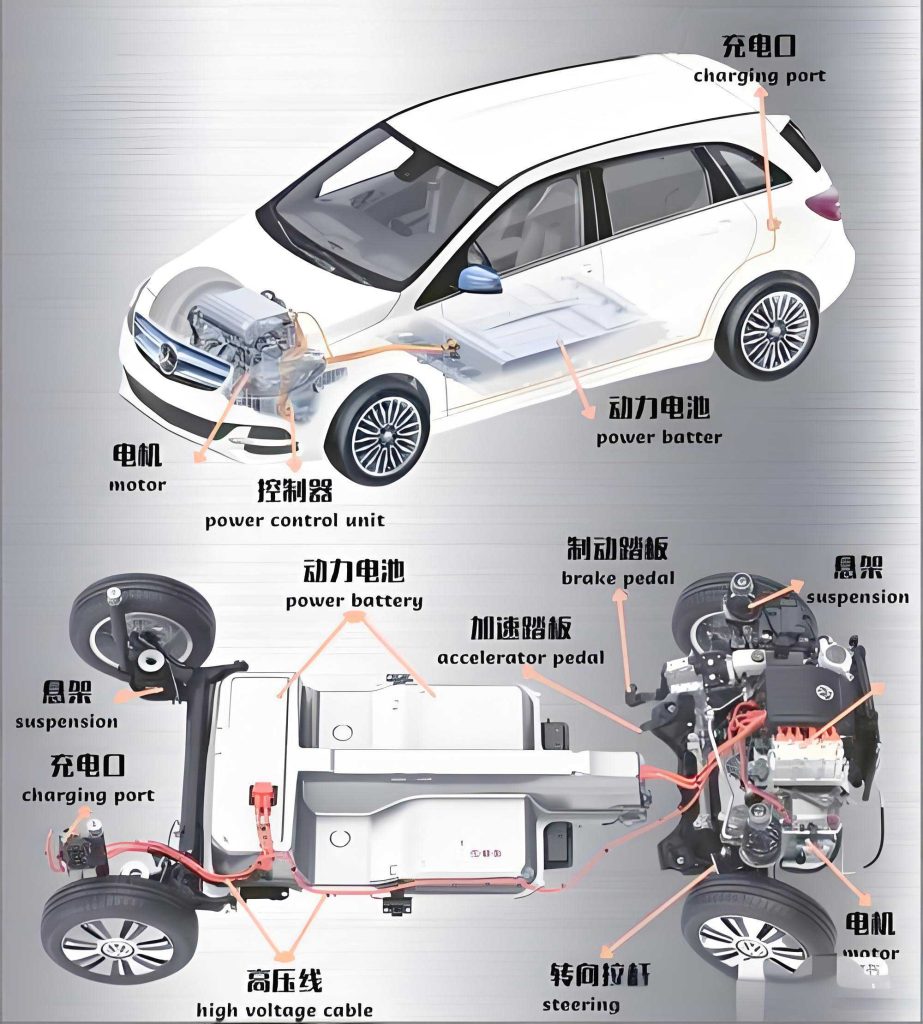
To frame the problem, we consider a set of demand points representing areas where users of battery electric cars require charging services. These demand points have varying levels of demand, reflecting the number of battery electric cars needing charge. A set of candidate charging stations is available for construction, each with associated costs and interruption risks. We categorize users into emergency and non-emergency types based on their charging urgency. Emergency users, such as those with very low battery levels, have limited travel range and thus can only be assigned to charging stations within a short distance. Non-emergency users, on the other hand, can be assigned to stations farther away if necessary. This distinction is crucial for modeling realistic behavior of battery electric car drivers. Additionally, we assume that each charging station has an independent interruption probability, meaning it may randomly become unavailable. To handle extreme cases where all stations fail, we introduce a virtual station that always operates but incurs a high penalty cost, simulating the dissatisfaction or additional travel for users. Our model seeks to select a subset of stations to open and assign demand points to them in a hierarchical manner, minimizing the expected total cost over all possible interruption scenarios.
The mathematical formulation involves several key parameters and decision variables. Let \( I = \{0, 1, \dots, M-1\} \) denote the set of demand points for battery electric cars, where \( i \in I \). Let \( J = \{0, 1, \dots, N\} \) be the set of candidate charging stations, including a virtual station indexed as \( N \). The decision variable \( y_j \) equals 1 if station \( j \) is opened, and 0 otherwise. The variable \( x_{ijr} \) equals 1 if demand point \( i \) is assigned to station \( j \) at hierarchy level \( r \), where \( r \in R’ = \{1, 2, \dots, R\} \). The hierarchy levels represent the order of preference based on distance, with lower levels indicating closer stations. For battery electric car users, we define \( \alpha \) as the proportion of emergency situations, so \( 1 – \alpha \) is the proportion of non-emergency situations. The interruption probability for each station is denoted as \( q \), assumed to be in the range (0,1). The cost components include construction cost \( f_j \) for opening station \( j \), travel cost \( c_{ijr} = \beta \cdot d_{ijr} \) where \( \beta \) is the unit travel cost per distance and \( d_{ijr} \) is the distance between demand point \( i \) and station \( j \) at level \( r \), and penalty cost \( \pi \) for assignments to the virtual station. The total demand at point \( i \) is \( d_i \).
The objective function minimizes the sum of construction costs and expected travel and penalty costs, considering both emergency and non-emergency users. For non-emergency users, assignments can extend to all hierarchy levels, but for emergency users, assignments are limited to the first two levels (i.e., \( r \leq 2 \)) to reflect their range constraints. The expected cost accounts for the probability that a station at level \( r \) is operational, given by \( q^{r-1}(1-q) \), as stations at higher levels are only used if lower-level stations are interrupted. The model is formulated as follows:
Minimize:
$$
\min z = \sum_{j=0}^{N-1} f_j y_j + \sum_{i=0}^{M-1} \sum_{j=0}^{N} d_i \left[ \alpha \sum_{r=1}^{2} q^{r-1}(1-q) c_{ijr} x_{ijr} + (1-\alpha) \sum_{r=1}^{R} q^{r-1}(1-q) c_{ijr} x_{ijr} \right]
$$
Subject to:
$$
\sum_{j=0}^{N-1} x_{ijr} + \sum_{s=1}^{r} x_{iNs} = 1, \quad \forall i \in I, r \in R’
$$
$$
\sum_{r=1}^{R} x_{ijr} \leq y_j, \quad \forall i \in I, j \in J
$$
$$
\sum_{r=1}^{R} x_{iNr} = 1, \quad \forall i \in I
$$
$$
\sum_{j=0}^{N-1} y_j = p, \quad y_N = 1
$$
$$
c_{ijr} = \beta \cdot d_{ijr}, \quad \forall i \in I, j \in J, r \in R’
$$
$$
x_{ijr}, y_j \in \{0, 1\}, \quad \forall i \in I, j \in J, r \in R’
$$
$$
q \in (0,1), \quad \alpha \in (0,1), \quad f_j \in [c_1, c_2]
$$
In this model, the first constraint ensures that each demand point for battery electric cars is assigned to either a regular station at level \( r \) or the virtual station at some level \( s \leq r \), maintaining hierarchical assignment. The second constraint links assignment variables to opening decisions, preventing assignments to unopened stations. The third constraint guarantees that every demand point is ultimately assigned to the virtual station if all regular stations fail, which is necessary for model completeness. The fourth constraint sets the number of opened stations to \( p \) and forces the virtual station to be always open. The remaining constraints define cost relationships and variable domains.
To solve this optimization problem, we design an immune optimization algorithm with an elite strategy. This algorithm is inspired by biological immune systems and evolutionary processes, offering global search capabilities and adaptability. The key steps include initializing a population of antibodies (each representing a candidate solution for charging station locations), calculating fitness values based on the total cost, evaluating antibody concentration to maintain diversity, and performing immune operations like selection, crossover, and mutation. The elite strategy preserves the best solutions across iterations to accelerate convergence. For battery electric car charging station location, each antibody encodes a set of selected stations, and the fitness function computes the total cost from the model. The algorithm iteratively improves solutions until a termination criterion, such as a maximum number of iterations, is met.
The algorithm proceeds as follows: First, we generate an initial population of \( L \) antibodies randomly. For example, if selecting 4 stations from 10 candidates, an antibody might be represented as a vector of station indices like [7, 8, 5, 4]. Second, we calculate the fitness value for each antibody using the objective function, which incorporates construction, travel, and penalty costs for battery electric car users. The fitness \( F_l \) for antibody \( l \) is given by:
$$
F_l = \sum_{j=0}^{N-1} \left( f_j y_j + \sum_{i=0}^{M-1} \sum_{r=1}^{R} d_i c_{ijr} x_{ijr} \right) + \sum_{i=0}^{M-1} \sum_{s=1}^{R} d_i \pi x_{iNs}
$$
where the assignments \( x_{ijr} \) are determined based on the hierarchical assignment rules for the given antibody. Third, we compute antibody concentration \( C_l \) to measure diversity, using a similarity threshold \( T \). The similarity between two antibodies is defined as the proportion of common stations in their selections. Fourth, we calculate reproduction probability \( E_l \) based on fitness and concentration:
$$
E_l = \frac{1/F_l}{p_s \cdot \sum_{l=1}^{L} 1/F_l} + \frac{C_l}{(1-p_s) \cdot \sum_{l=1}^{L} C_l}
$$
where \( p_s \) is a diversity evaluation parameter. Fifth, we update a memory library by retaining elite antibodies (e.g., the top \( e \) solutions with lowest fitness) and selecting other antibodies based on reproduction probability. Sixth, we perform immune operations: selection via roulette wheel based on reproduction probability, crossover at random points to exchange station indices, and mutation to randomly change indices, ensuring feasibility. Seventh, we generate a new population by combining the memory library and operated antibodies. Finally, we repeat iterations until convergence or a maximum iteration count, outputting the best solution found.
To validate the model and algorithm, we conduct numerical experiments with different scales of demand points and candidate stations. We consider a scenario with 27 demand points for battery electric cars and 10 candidate charging stations, aiming to select 4 stations. The parameters are set as: interruption probability \( q = 0.05 \), emergency proportion \( \alpha = 0.05 \), unit travel cost \( \beta = 0.5 \) per distance unit, penalty cost \( \pi = 1000 \) per battery electric car, construction costs randomly generated between 80,000 and 100,000, and distances computed from random coordinates in a plane. The algorithm parameters include population size \( L = 40 \), memory size \( L_m = 10 \), elite count \( e = 3 \), crossover probability 0.6, mutation probability 0.4, similarity threshold \( T = 0.7 \), and maximum iterations 100. The results show that the algorithm converges efficiently, yielding a reliable location-allocation scheme with minimized total cost.
We present key data in tables to summarize the experimental setup. Table 1 shows candidate station coordinates and construction costs, while Table 2 lists demand point coordinates and demands for battery electric cars.
| Station | Coordinates (X, Y) | Construction Cost |
|---|---|---|
| J1 | (4128, 1500) | 941209 |
| J2 | (2500, 1670) | 806366 |
| J3 | (3200, 3200) | 855384 |
| J4 | (3500, 2280) | 809234 |
| J5 | (2400, 2640) | 819426 |
| J6 | (3840, 2800) | 964692 |
| J7 | (2000, 2100) | 938966 |
| J8 | (3000, 2750) | 863420 |
| J9 | (3250, 1800) | 970045 |
| J10 | (3850, 1950) | 806889 |
| Demand Point | Coordinates (X, Y) | Demand \( d_i \) |
|---|---|---|
| I1 | (1335, 2298) | 30 |
| I2 | (3636, 1316) | 80 |
| I3 | (4173, 2238) | 70 |
| I4 | (3012, 1979) | 80 |
| I5 | (3679, 2579) | 50 |
| I6 | (4309, 1894) | 60 |
| I7 | (4192, 1048) | 30 |
| I8 | (3240, 1235) | 40 |
| I9 | (3325, 1560) | 70 |
| I10 | (3491, 1540) | 50 |
| I11 | (3722, 1397) | 60 |
| I12 | (4308, 1578) | 30 |
| I13 | (2372, 2974) | 70 |
| I14 | (2567, 1759) | 50 |
| I15 | (2783, 1495) | 40 |
| I16 | (2385, 1683) | 30 |
| I17 | (1830, 1697) | 20 |
| I18 | (3715, 1685) | 60 |
| I19 | (3912, 2176) | 50 |
| I20 | (4064, 2368) | 80 |
| I21 | (3783, 2219) | 50 |
| I22 | (4026, 2839) | 50 |
| I23 | (4265, 2929) | 40 |
| I24 | (3428, 1909) | 70 |
| I25 | (3509, 2374) | 50 |
| I26 | (3394, 2646) | 40 |
| I27 | (3441, 3202) | 60 |
Table 3 provides sample distances between some demand points and candidate stations, illustrating the travel cost calculations for battery electric cars.
| Station | I1 | I2 | I3 | I4 | I5 | I6 |
|---|---|---|---|---|---|---|
| J1 | 2905 | 525 | 739 | 1215 | 1169 | 434 |
| J2 | 1324 | 1190 | 1767 | 598 | 1489 | 1823 |
| J3 | 2071 | 1934 | 1368 | 1235 | 784 | 1713 |
| J4 | 2165 | 974 | 674 | 573 | 349 | 896 |
| J5 | 1119 | 1811 | 1818 | 901 | 1281 | 2050 |
| J6 | 2555 | 1498 | 653 | 1166 | 273 | 1020 |
| J7 | 694 | 1814 | 2177 | 1019 | 1746 | 2318 |
| J8 | 1725 | 1569 | 1280 | 771 | 700 | 1564 |
| J9 | 1979 | 619 | 1022 | 298 | 889 | 1063 |
| J10 | 2539 | 669 | 433 | 839 | 652 | 462 |
The optimization results for this case show that stations J4, J9, J5, and J10 are selected, with specific assignments to demand points. For instance, J4 serves demand points I5, I22, I23, I25, I26, and I27, catering to battery electric car users in those areas. The total minimized cost is 3,596,541.48 units. The algorithm convergence is demonstrated by plotting fitness values over iterations, where the best fitness decreases rapidly and stabilizes, indicating effective optimization. We also test a larger-scale scenario with 60 demand points and 10 candidate stations, yielding similar convergence trends but with higher total costs due to increased complexity.
To further analyze the model’s behavior, we conduct sensitivity analyses on key parameters: interruption probability \( q \) and emergency proportion \( \alpha \). For battery electric car charging networks, these parameters significantly impact reliability and cost. We vary \( q \) from 0 to 0.2 in steps of 0.02, and \( \alpha \) from 0 to 0.2 similarly, running 200 experiments for each combination to compute average optimal fitness values. The results are summarized in Table 4 and discussed below.
| Parameter Variation | Trend in Optimal Fitness | Impact on Station Allocation |
|---|---|---|
| Increasing \( q \) from 0 to 0.2 | Fitness increases monotonically | More stations may be opened to mitigate risks |
| Increasing \( \alpha \) from 0 to 0.2 | Fitness shows no clear pattern | Allocation shifts to prioritize closer stations |
| Low \( q \) (e.g., 0.01) | Fitness remains low | Stations are selected based primarily on cost |
| High \( q \) (e.g., 0.1) | Fitness rises sharply | Backup stations become more important |
The sensitivity analysis reveals that interruption probability is a critical factor influencing both optimal fitness and charging station allocation for battery electric cars. As \( q \) increases, the expected cost rises because interruptions become more likely, requiring more redundant stations or incurring higher penalty costs. This underscores the importance of reliable infrastructure for battery electric car networks. In contrast, the emergency proportion \( \alpha \) does not exhibit a consistent effect on fitness; its impact is nuanced and depends on other factors like distance distributions and station capacities. However, higher \( \alpha \) values tend to force allocations to nearer stations, aligning with the urgency of battery electric car users. These insights can guide policymakers in designing resilient charging systems for battery electric cars, especially in regions prone to disruptions.
From a methodological perspective, the immune optimization algorithm with elite strategy proves effective for solving this reliability location problem. Its ability to maintain diversity through concentration calculations and preserve elite solutions accelerates convergence, making it suitable for large-scale instances involving numerous battery electric car demand points. Compared to traditional exact methods, which may struggle with combinatorial complexity, this heuristic approach balances solution quality and computational time. We further enhance the algorithm by tuning parameters like crossover and mutation probabilities, which improve search performance. For instance, setting crossover probability to 0.6 and mutation probability to 0.4 yields robust results across different scenarios, ensuring that new solutions are generated without losing good traits.
In practical applications, the model can be extended to incorporate additional real-world factors. For example, battery electric car charging stations often have capacity limits, which could be integrated as constraints on the number of vehicles served. Similarly, time-dependent demand patterns, such as peak hours for battery electric car usage, could be modeled using dynamic parameters. The interruption probabilities might also vary based on geographical risks, like flood zones or grid stability, allowing for more nuanced reliability assessments. Furthermore, user behavior for battery electric cars could be refined through data analytics, such as GPS trajectories, to estimate emergency proportions more accurately. These extensions would make the model even more valuable for urban planners and energy companies investing in battery electric car infrastructure.
To illustrate the algorithm’s iterative process, we derive formulas for key steps. The fitness function, as defined earlier, computes total cost. The concentration calculation for antibody \( l \) involves similarity with other antibodies \( l’ \):
$$
S_{l,l’} = \frac{\text{Number of common stations in } l \text{ and } l’}{\text{Total stations selected}}
$$
Then, concentration \( C_l \) is:
$$
C_l = \frac{\sum_{l’ \neq l} K_{l,l’}}{L}, \quad \text{where } K_{l,l’} =
\begin{cases}
1 & \text{if } S_{l,l’} \geq T \\
0 & \text{if } S_{l,l’} < T
\end{cases}
$$
The reproduction probability combines fitness and concentration to guide selection, promoting solutions that are both low-cost and diverse. This mechanism helps avoid local optima, which is common in complex location problems for battery electric car charging stations.
In conclusion, this study addresses the reliability location problem for battery electric car charging stations by developing an optimization model that considers interruption risks and user emergency scenarios. We formulate a mathematical program to minimize total costs and design an immune optimization algorithm with elite strategy to solve it efficiently. Through numerical experiments, we demonstrate the model’s capability to produce reliable location-allocation schemes for battery electric cars, even under uncertainty. Sensitivity analyses highlight the significant impact of interruption probability on costs, while emergency proportion has a more variable effect. These findings provide valuable guidelines for deploying charging infrastructure that supports the growing adoption of battery electric cars. Future work could explore multi-objective formulations, incorporating environmental or social goals, and integrate real-time data for adaptive planning. As battery electric car technology evolves, reliability-focused approaches like ours will be essential for building sustainable and user-friendly charging networks.
The proliferation of battery electric cars is not just a trend but a necessity for reducing carbon emissions and achieving energy independence. However, the success of battery electric cars hinges on reliable and accessible charging infrastructure. Our research contributes to this goal by offering a robust framework for location optimization that accounts for real-world disruptions and user needs. By minimizing costs and maximizing reliability, we help ensure that battery electric car users can charge conveniently and confidently, fostering wider adoption. The methods presented here are scalable and adaptable, making them applicable to various regions and contexts. As we continue to refine these models, we envision a future where battery electric car charging stations are seamlessly integrated into urban and rural landscapes, powered by intelligent planning tools like the one described in this article.
In summary, the key takeaways are: First, reliability must be a core consideration in charging station location for battery electric cars, as interruptions can severely impact service. Second, user diversity, including emergency situations, should be modeled to reflect actual behavior. Third, heuristic algorithms like immune optimization with elite strategy are effective for solving such complex problems. Fourth, sensitivity analyses provide insights into parameter influences, aiding decision-making. We hope this work inspires further research and practical implementations to advance the infrastructure for battery electric cars, ultimately supporting a cleaner and more efficient transportation system.