
The proliferation of battery electric cars represents a pivotal shift towards sustainable transportation. However, the performance and safety of their core energy source, the lithium-ion traction battery, are severely compromised in low-temperature environments. Reduced ionic conductivity and sluggish electrochemical kinetics lead to drastic power loss, charging difficulties, and accelerated degradation. To ensure the reliable operation of battery electric cars in cold climates, effective preheating strategies are essential. Among various methods, alternating current (AC) heating, which leverages the battery’s own impedance to generate heat internally, has emerged as a promising solution due to its potential for rapid and uniform temperature rise. This study focuses on developing and validating an optimized AC heating strategy that remains effective and safe throughout the entire lifecycle of a traction battery for a battery electric car, from its fresh state to significant aging.
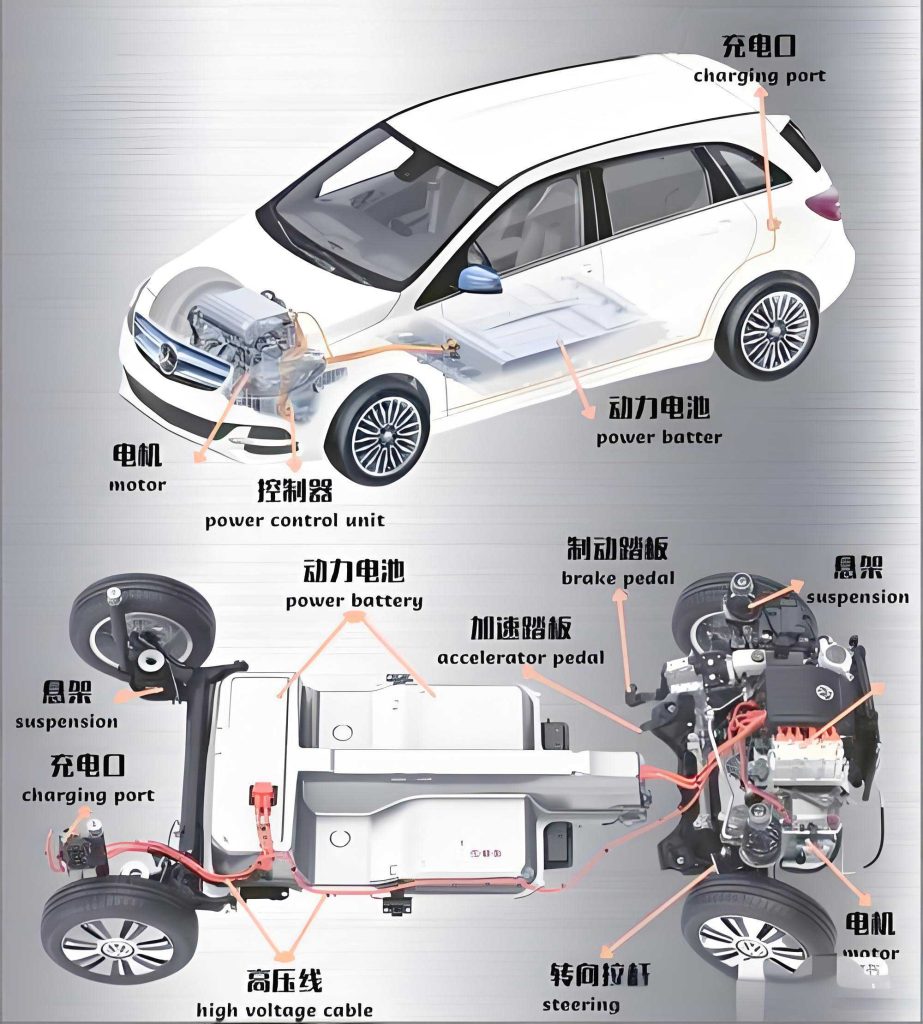
The cornerstone of developing a lifecycle-aware heating strategy is a high-fidelity model that captures the coupled electrical, thermal, and aging behaviors of the battery. As a battery electric car accumulates mileage, its battery ages, manifesting as capacity fade and increased internal resistance. These changes directly impact its impedance characteristics and, consequently, its response to an AC heating stimulus. An AC heating strategy optimized for a fresh battery may become inefficient or even unsafe when applied to an aged battery in a battery electric car. Therefore, this research employs a second-order RQ (Resistor-Constant Phase Element) equivalent circuit model, a lumped thermal model, and a parameter-aging interaction model to form a comprehensive electro-thermal-aging coupled model. The RQ model, using constant phase elements instead of ideal capacitors, provides a more accurate description of the frequency-dependent impedance, which is crucial for AC heating analysis. The model parameters are dynamically updated based on the battery’s State-of-Health (SOH) and temperature.
The aging interaction model is derived from accelerated cycle life testing. Cells were cycled at 25°C to various SOH levels (approximately 95%, 90%, 85%, and 80%). Electrochemical Impedance Spectroscopy (EIS) was then conducted at different temperatures for each SOH level to map the parameter space. Key parameters like ohmic resistance ($R_0$), charge transfer resistance ($R_{ct}$), and SEI film resistance ($R_{SEI}$) were found to increase with aging and decreasing temperature. For instance, the ohmic resistance model incorporates both temperature and SOH effects:
$$R_0(T, SOH) = (AT^2 + BT + C) \cdot \exp\left(\beta\left(1-\frac{SOH}{100}\right) + \gamma T\left(1-\frac{SOH}{100}\right)\right)$$
Where $A$, $B$, $C$, $\beta$, and $\gamma$ are fitted coefficients. Similar coupled expressions were developed for other equivalent circuit model parameters, as summarized in the table below.
| Parameter | Aging-Coupled Model Expression |
|---|---|
| Ohmic Resistance, $R_0$ | $(3.3\times10^{-5}T^2 + 3.33\times10^{-4}T + 3.116\times10^{-2}) \cdot \exp(-1.031(1-SOH/100) + 0.058T(1-SOH/100))$ |
| Charge Transfer Res., $R_{ct}$ | $1.54\times10^{-9} \exp(8.51(100-SOH)) / (T+95.86) + 0.675$ |
| SEI Film Resistance, $R_{SEI}$ | $0.011 \exp(-0.115T – (7.3\times10^{-3} – 2.11\times10^{-3}T)(SOH/100))$ |
| CPE Coefficient, $Q_{dl}$ | $0.559\exp(-0.115T -1.591(1-SOH/100)) \cdot (0.005T^2 + 0.211T + 1.774)$ |
The core of the AC heating strategy is to maximize the heat generation rate ($Q_{gen}$) within safe limits. The heat generated by a sinusoidal AC current ($I_{ac}$) of frequency $f$ is given by:
$$Q_{gen} = \frac{1}{2} I_{ac}^2 \cdot Re\{Z(f, T, SOH)\}$$
Where $Re\{Z\}$ is the real part of the battery’s complex impedance, obtainable from the RQ model. To ensure the safety of the battery electric car’s powertrain during heating, dual constraints are enforced:
- Lithium Plating Constraint: The anode potential must not drop to 0 V vs. Li/Li+, preventing metallic lithium deposition which accelerates aging.
- Voltage Window Constraint: The terminal voltage must remain within specified safe limits (e.g., 2.5V to 4.2V) to avoid over-discharge or overcharge.
These constraints define the maximum allowable current amplitude ($I_{ac, max}$) for any given frequency, temperature, and SOH. The optimal heating point is found by solving for the frequency $f^*$ that maximizes $Q_{gen}$ under these constraints:
$$f^*, I_{ac}^* = \arg \max_{f, I_{ac}} \left( \frac{1}{2} I_{ac}^2 \cdot Re\{Z(f)\} \right) \quad \text{subject to:} \quad I_{ac} \leq I_{ac, max}(f, T, SOH; \text{Constraints})$$
The solution yields temperature-dependent optimal frequency and amplitude profiles for each SOH level. Typically, the optimal frequency is in the range of 1-10 Hz, balancing the high $Re\{Z\}$ at low frequencies with the higher $I_{ac,max}$ allowed at moderate frequencies before the impedance becomes too capacitive. The following table exemplifies the optimal strategy for a battery at SOH=95%.
| Temperature Range | Optimal Amplitude (A) | Optimal Frequency (Hz) | Max Heat Rate (W) |
|---|---|---|---|
| -20°C to -15°C | 9.08 | 4.48 | 2.25 |
| -15°C to -10°C | 12.94 | 2.31 | 3.22 |
| -10°C to -5°C | 13.57 | 1.96 | 3.38 |
| -5°C to 0°C | 13.79 | 1.82 | 3.43 |
| 0°C to 5°C | 14.04 | 1.62 | 3.50 |
The proposed coupled model and heating strategy were validated experimentally. Batteries at different SOH levels were heated from -20°C using their respective optimal AC profiles. The model demonstrated high accuracy in predicting both voltage response and temperature rise. The validation results for the temperature and voltage simulations are summarized below.
| Battery SOH (%) | Avg. Temp. Rise Rate (°C/min) | Voltage RMSE (mV) | Temperature RMSE (°C) |
|---|---|---|---|
| 95.03 | 2.70 | 27.4 | 0.30 |
| 89.97 | 2.45 | 20.2 | 0.31 |
| 84.54 | 2.36 | 26.6 | 0.13 |
| 80.14 | 1.90 | 30.4 | 0.20 |
The results confirm several key points. First, the heating efficiency decreases with aging; the average heating rate drops from 2.70 °C/min for a near-new battery (SOH=95.03%) to 1.90 °C/min for a significantly aged battery (SOH=80.14%) in a battery electric car. This is primarily because the increased impedance of the aged battery restricts the maximum safe current amplitude ($I_{ac,max}$) under the voltage constraint, reducing the maximum achievable $Q_{gen}$. Second, the low RMSE values for voltage and temperature validate the precision of the electro-thermal-aging coupled model across the battery’s lifecycle.
Most importantly, the long-term impact of the AC heating strategy on battery health was investigated. A battery at SOH=95% was subjected to 500 consecutive heating cycles using the optimized strategy. For comparison, another battery was heated using a fixed, non-optimal AC profile (1.5C, 100 Hz). The SOH degradation was starkly different. The battery heated with the optimized strategy lost only 2.2% SOH over 500 cycles, with the degradation rate stabilizing after the initial cycles. In contrast, the battery subjected to the non-optimal heating degraded rapidly. Furthermore, Incremental Capacity (IC) analysis performed on the optimally heated battery showed negligible changes in the characteristic peak positions and shapes after 500 cycles, indicating minimal loss of active material and very stable electrode states. This confirms that the dual-constrained, SOH-adaptive AC heating strategy is not only effective but also minimally invasive, preserving the long-term health of the traction battery in a battery electric car.
In conclusion, this study presents a comprehensive framework for implementing safe and efficient AC heating in battery electric cars, accounting for the inevitable aging of the traction battery. By integrating a high-fidelity electro-thermal-aging coupled model with dual safety constraints (lithium plating and voltage window), an adaptive heating strategy that maximizes the internal heat generation rate was developed. The strategy automatically adjusts the AC frequency and amplitude based on the battery’s real-time temperature and State-of-Health. Experimental validation proves its effectiveness across the battery’s lifecycle and demonstrates its minimal impact on long-term battery health. This work provides a critical foundation for advanced battery thermal management systems that can enhance the reliability, longevity, and all-climate performance of battery electric cars.