
As a battery electric car owner and an enthusiast of sustainable mobility, I have often grappled with the pervasive “charging anxiety” and “range anxiety” that plague many drivers. The rapid adoption of battery electric cars globally has outpaced the development of robust charging infrastructure, creating a critical bottleneck. However, recent policy initiatives, such as the “Interim Measures for the Construction and Operation Management of Electric Vehicle Charging Infrastructure” in Henan Province, China, signal a transformative shift. This article delves into the multifaceted approach to accelerating the charging network for battery electric cars, exploring technical specifications, economic models, and societal impacts from my firsthand perspective. I will use tables, formulas, and detailed analysis to unpack how such frameworks can revolutionize our experience with battery electric cars.
The core of the challenge lies in the mismatch between the growing fleet of battery electric cars and the available charging points. For a typical battery electric car, the charging time is governed by the fundamental equation: $$ T = \frac{C}{P} $$ where \( T \) is the charging time in hours, \( C \) is the battery capacity in kilowatt-hours (kWh), and \( P \) is the charging power in kilowatts (kW). For instance, a battery electric car with a 60 kWh battery charging at a 7 kW AC slow charger would require approximately: $$ T = \frac{60}{7} \approx 8.57 \text{ hours} $$ whereas at a 150 kW DC fast charger, it would be: $$ T = \frac{60}{150} = 0.4 \text{ hours or 24 minutes} $$ This disparity underscores the need for a diversified charging network. The Henan policy emphasizes differentiated construction, tailoring infrastructure to various scenarios, which I will elaborate on through tables and analysis.
First, let’s examine the classification of charging stations as per the guidelines. The policy categorizes charging stations into four levels based on scale and safety considerations, which directly impact the deployment for battery electric cars. The following table summarizes these levels:
| Charging Station Level | Description | Preferred Location | Restrictions |
|---|---|---|---|
| Level 1 | Large-scale station with multiple fast chargers | Ground-level parking lots | Not inside major public or civil buildings; charging area not above fourth floor; not in semi-basement or basement |
| Level 2 | Medium-scale station with mix of fast and slow chargers | Ground-level areas | Same as Level 1 |
| Level 3 | Small-scale station | Ground-level or accessible areas | Same as Level 1 |
| Level 4 | Compact station, often for specific uses | Can be underground if fire safety rules are met | Allowed in basements with strict compliance |
This stratification ensures safety and practicality, especially for high-density areas where battery electric cars are increasingly common. As a battery electric car user, I appreciate that Level 1 to 3 stations are kept out of basements to mitigate fire risks, a concern often raised in urban settings. The policy’s focus on “provincial deployment, three-level application, and multi-network integration” for the smart service platform is crucial. It means that data from public and dedicated charging points will be aggregated, enabling real-time monitoring and optimization for battery electric car drivers like myself. Imagine a system where I can check charger availability and book slots seamlessly—this is where the platform aims to head.
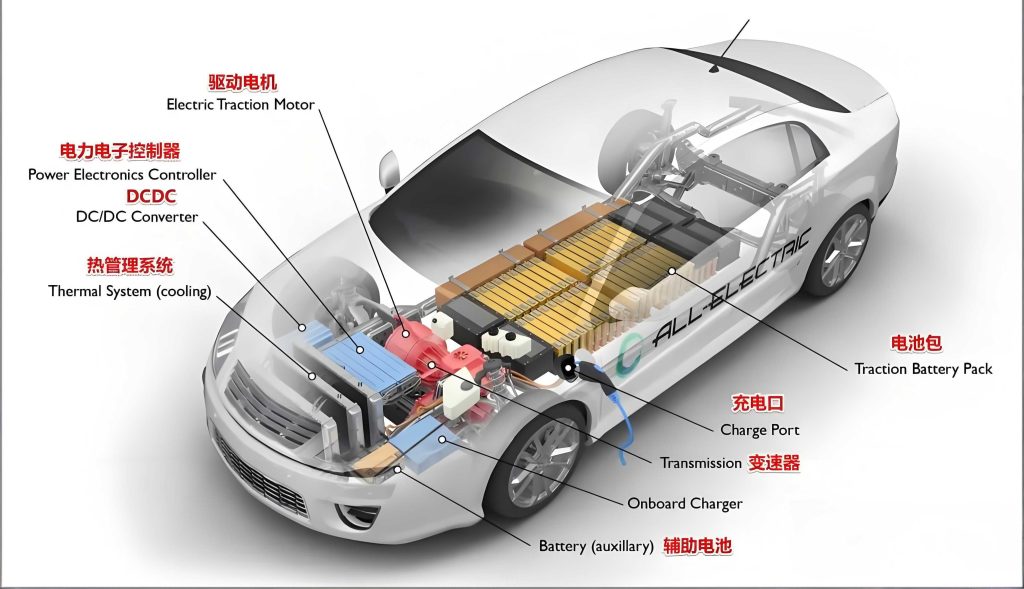
Moving to the heart of the policy: differentiated construction for various scenarios. The approach recognizes that a one-size-fits-all solution is ineffective for battery electric cars. Each environment has unique demands, and the infrastructure must adapt. Below is a table outlining the recommended charging infrastructure configurations across different settings:
| Scenario | Charging Type Emphasis | Key Specifications | Rationale |
|---|---|---|---|
| Residential Areas | Slow charge为主, fast charge为辅 | Smart有序充电; new住宅 fixed车位预留安装条件; private charger max power ≤ 8 kW | Meets overnight charging needs for battery electric cars, reduces grid peak load |
| Government/Office Spaces | Combination of fast and slow | Dedicated chargers for fleet or employee battery electric cars | Supports daily commutes and公务用车 |
| Highway Rest Stops, Public Parks | Fast charge为主 | High-power DC chargers (e.g., 150 kW+) | Enables long-distance travel for battery electric cars, alleviating range anxiety |
| Rural and County Areas | Mix of fast and slow | Adapt to local grid capacity and battery electric car adoption rates | Promotes equity in access for battery electric car owners in underserved regions |
For residential areas, the emphasis on slow charging aligns with the typical usage pattern of a battery electric car. Most owners, including myself, charge overnight when electricity demand is lower. The policy mandates that new residential projects预留安装条件 for direct meter connection, which simplifies the process. The power limit of 8 kW for private chargers is derived from safety and grid stability considerations. The charging efficiency can be modeled as: $$ \eta = \frac{E_{delivered}}{E_{consumed}} \times 100\% $$ where \( \eta \) is efficiency, typically around 90% for AC chargers. Thus, for an 8 kW charger, the actual power draw might be: $$ P_{draw} = \frac{8}{0.9} \approx 8.89 \text{ kW} $$ This ensures compatibility with standard household circuits while charging a battery electric car.
A significant hurdle for battery electric car owners in residential complexes has been the reluctance of property management to cooperate. The policy explicitly requires物业管理单位 to assist owners by providing图纸资料 and facilitating site surveys and construction. This is a game-changer; in my experience, navigating bureaucratic delays can be frustrating. The encouragement of “统建统服” (unified construction and service) by charging operators can streamline installations. For individually purchased private chargers, the policy mandates installation by qualified units, ensuring safety. This is critical because improper installation can lead to hazards for battery electric cars and properties alike.
Regarding costs and pricing, the policy establishes clear guidelines to protect consumers. For battery electric car charging, the total cost per session can be expressed as: $$ Cost_{total} = E \times P_{electricity} + F_{service} $$ where \( E \) is the energy consumed in kWh, \( P_{electricity} \) is the electricity price per kWh (set by state policy), and \( F_{service} \) is the service fee per kWh or session (market-driven). The policy requires明码标价 and compliance with price regulations. To illustrate, consider the following table of hypothetical pricing structures for a battery electric car charging session:
| Charging Type | Electricity Price (元/kWh) | Service Fee (元/kWh) | Total Cost for 50 kWh Charge (元) |
|---|---|---|---|
| Slow AC (Residential) | 0.5 | 0.2 | 50 × (0.5 + 0.2) = 35 |
| Fast DC (Public) | 0.7 | 0.5 | 50 × (0.7 + 0.5) = 60 |
| Highway Ultra-Fast | 0.8 | 0.8 | 50 × (0.8 + 0.8) = 80 |
These numbers are illustrative; actual rates vary. The policy forbids转供电企业 from arbitrary markups without实质性服务, with市场监管部门 oversight. As a battery electric car driver, transparent pricing helps me plan trips and budgets effectively. Moreover, the operational efficiency of charging stations can be analyzed using metrics like utilization rate: $$ U = \frac{T_{charging}}{T_{total}} \times 100\% $$ where \( U \) is the utilization rate, \( T_{charging} \) is the time chargers are in use, and \( T_{total} \) is the total operational time. Higher utilization for battery electric car chargers justifies investment and reduces costs over time.
The policy also outlines robust保障措施. For land use, standalone charging stations are treated as public utility网点用地, integrated into spatial plans. This ensures dedicated space for battery electric car infrastructure. In terms of power supply, grid planning must accommodate charging demand. The required grid capacity can be estimated using the formula: $$ P_{grid} = N \times P_{avg} \times D $$ where \( P_{grid} \) is the additional grid capacity needed, \( N \) is the number of battery electric cars, \( P_{avg} \) is the average charging power per car, and \( D \) is the diversity factor (simultaneity rate). For example, if a city plans for 10,000 battery electric cars with an average charging power of 10 kW and a diversity factor of 0.3, then: $$ P_{grid} = 10000 \times 10 \times 0.3 = 30,000 \text{ kW or 30 MW} $$ This highlights the scale of grid upgrades needed to support widespread battery electric car adoption.
Furthermore, the policy mandates that充电基础设施运营企业公示 information on the provincial smart platform, including safety and fee承诺. This transparency builds trust among battery electric car users. I envision a future where I can rate chargers and report issues in real-time, much like ride-sharing apps. The emphasis on smart infrastructure is pivotal;智能有序充电 can modulate charging based on grid load, reducing peak demand. The charging power adjustment can be modeled as: $$ P_{actual}(t) = P_{max} \times f(t) $$ where \( P_{actual}(t) \) is the actual power at time \( t \), \( P_{max} \) is the maximum power, and \( f(t) \) is a load-shaping function between 0 and 1. This benefits both the grid and battery electric car owners through lower tariffs.
The退出机制 for decommissioning “zombie chargers” is another thoughtful aspect. Charging infrastructure owners must deregister with grid operators and remove unused equipment. This prevents clutter and safety hazards. The lifecycle of a charging桩 for battery electric cars can be described as: $$ L = T_{installation} + T_{operation} + T_{decommissioning} $$ Proper management at each stage ensures sustainability.
From a broader perspective, the acceleration of charging networks is integral to the adoption of battery electric cars. The energy consumption of a battery electric car per kilometer can be calculated as: $$ E_{km} = \frac{C}{R} $$ where \( C \) is battery capacity in kWh and \( R \) is the range in km. For a battery electric car with a 60 kWh battery and 400 km range, \( E_{km} = \frac{60}{400} = 0.15 \text{ kWh/km} \). Comparing this to internal combustion engines, the environmental benefits are clear, but only if charging infrastructure is ubiquitous. The policy’s focus on rural areas addresses equity, ensuring that battery electric car owners outside cities are not left behind.
In conclusion, as a battery electric car advocate, I see the Henan policy as a blueprint for tackling charging anxiety head-on. By mandating differentiated construction, ensuring物业 cooperation, regulating prices, and leveraging smart technologies, it paves the way for a seamless charging experience. The tables and formulas presented here quantify the benefits and challenges, underscoring the importance of such frameworks. For battery electric cars to become the norm, robust charging networks are not just an accessory but a necessity. I am optimistic that with continued policy support and innovation, the vision of “charging freedom” for every battery electric car owner will soon be a reality, transforming our transportation landscape for the better.
To further illustrate the impact, consider the following table summarizing key performance indicators (KPIs) for battery electric car charging infrastructure under this policy:
| KPI | Formula | Target Value | Implication for Battery Electric Car Owners |
|---|---|---|---|
| Charger Density | Number of chargers per 100 battery electric cars | ≥ 10 | Reduces wait times and range anxiety |
| Average Charging Power | \( \bar{P} = \frac{\sum P_i}{N} \) | Increase from 50 kW to 100 kW | Faster charging for battery electric cars |
| Grid Integration Score | Based on smart charging compliance | High (e.g., 90%) | Lower electricity costs and stable supply for battery electric cars |
| User Satisfaction Index | Survey-based评分 | ≥ 4.5/5 | Improved experience for battery electric car drivers |
These KPIs can guide future iterations of the policy. Ultimately, the success of battery electric cars hinges on such holistic approaches, and I, as a battery electric car owner, eagerly await their full implementation to enjoy worry-free journeys.