
In recent years, the rapid adoption of battery electric cars has presented both challenges and opportunities for power grid operations. As intermittent renewable energy sources integrate on a large scale, maintaining grid stability becomes increasingly difficult. However, battery electric cars, with their fast response capabilities, can serve as excellent distributed energy storage resources, enhancing grid flexibility and providing ancillary services. This study aims to develop an efficient resource aggregation strategy for battery electric car charging stations (EVCS) to participate in grid interactions, thereby ensuring power balance and secure operation.
The core idea is to aggregate numerous charging piles within an EVCS into an equivalent battery model, termed the EVCS equivalent battery (EVB). This model accurately captures the feasible region of each charging pile, considering the charging demands of battery electric car owners and the charging characteristics, particularly the decrease in charging power as the state of charge (SOC) increases. By employing the vertex method and incorporating an incremental correction mechanism driven by events such as battery electric car arrivals and departures, we can efficiently and precisely update the EVB feasible region.
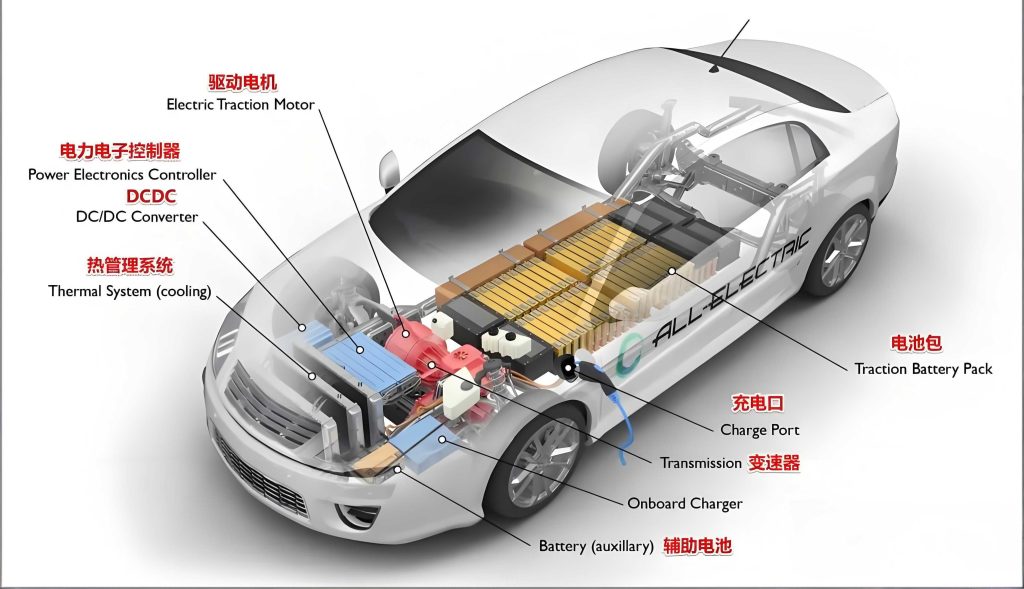
To model an individual battery electric car, we define key parameters based on owner behavior and car specifications. Let the battery capacity be \(C\), the initial SOC be \(s_{in}\), the desired SOC be \(s_{aim}\), and the safety limits be \(s_{min}\) and \(s_{max}\). The corresponding energy levels are:
$$E_{min} = C s_{min}, \quad E_{in} = C s_{in}, \quad E_{aim} = C s_{aim}, \quad E_{max} = C s_{max}$$
The energy dynamics over discrete time intervals \(\Delta t\) are governed by:
$$E_{T+1} = E_T + P_T \eta_T \Delta t$$
where \(P_T\) is the average active power during period \(T\), and \(\eta_T\) is the charging or discharging efficiency.
The charging power \(P_n\) of a battery electric car typically depends on its SOC. We describe this relationship as \(P_n = F(s)\), where for \(s_{min} < s < s_0\), \(P_n = P_N\) (rated power), and for \(s_0 < s < s_{max}\), \(P_n = P_N e^{\lambda (s_0 – s)}\). Here, \(s_0\) is the SOC threshold where power begins to drop, and \(\lambda\) is the decay coefficient. This relationship is crucial for determining the energy domain of each battery electric car.
Transforming \(P_n = F(s)\) into energy versus time \(E_n = f(t)\) involves solving a differential equation. For \(s \leq s_0\), we have:
$$E_n = (t – t_{in}) \eta P_N + E_{in}$$
For \(s > s_0\), the expression becomes:
$$E_n = \frac{C}{\lambda} \ln\left[\frac{\lambda P_N \eta (t – t_{s0})}{C} + 1\right] + C s_0$$
where \(t_{s0} = t_{in} + \frac{C(s_0 – s_{in})}{P_N \eta}\). The lower bound of the energy domain, \(E_c\), is derived by shifting \(f(t)\) to meet the desired energy \(E_{aim}\) at departure time \(t_u\), given by:
$$E_c = f(t – t_g)$$
with \(t_g\) calculated accordingly.
The feasible region for a battery electric car charging pile encompasses active power \(P\), reactive power \(Q\), and energy \(E\), coupled in time and space. The constraints are:
For \(E_{min} < E < C s_0\):
$$-P_N \leq P \leq P_N$$
For \(C s_0 < E < E_{max}\):
$$-P_N e^{\lambda(s_0 – E/C)} \leq P \leq P_N e^{\lambda(s_0 – E/C)}$$
The reactive power is bounded by:
$$-\sqrt{S_m^2 – P^2} \leq Q \leq \sqrt{S_m^2 – P^2}$$
where \(S_m\) is the apparent power capacity of the charging pile.
Aggregating multiple charging piles into an EVB involves computing the Minkowski sum of their individual feasible regions. Let \(X_i\) be the feasible region for pile \(i\). The aggregated region \(X_{ag}\) is:
$$X_{ag} = \sum_{i=1}^{M} X_i = \left\{ x_{ag} = \sum_{i=1}^{M} x_i \mid x_i \in X_i \right\}$$
Assuming independence among piles, the EVB feasible region \(\phi\) can be approximated by summing the constraints:
$$\phi = \left\{ e \mid \sum_{i=1}^{M} E_{min,i,T} \leq E_{ag,T} \leq \sum_{i=1}^{M} E_{max,i,T}, \quad \sum_{i=1}^{M} P_{min,i,T} \leq P_{ag,T} \leq \sum_{i=1}^{M} P_{max,i,T}, \quad \sum_{i=1}^{M} Q_{min,i,T} \leq Q_{ag,T} \leq \sum_{i=1}^{M} Q_{max,i,T} \right\}$$
where \(E_{ag,T}\), \(P_{ag,T}\), and \(Q_{ag,T}\) are the aggregated energy, active power, and reactive power at time \(T\), respectively.
To decouple active and reactive power constraints for simplification, we use box approximations. The reactive power limits are adjusted to ensure:
$$(Q_{max,i,T})^2 + (\max\{P_{max,i,T}, -P_{min,i,T}\})^2 = S_{m,i}^2$$
This allows for easier aggregation while maintaining feasibility.
The time-coupling of the EVB feasible region is captured by:
$$E_{ag,T+1} = E_{ag,T} + P_{ag,T} \eta \Delta t$$
This means the energy feasible region in the next period is a slight adjustment of the current one based on active power.
Incremental correction is introduced to reduce computational effort. Instead of recalculating the entire feasible region at each time step, we update it based on events such as battery electric car arrivals or departures. Let \(y_{ag,T}\) represent the bounds of the EVB feasible region at time \(T\). When a battery electric car arrives or departs, we adjust:
$$y_{ag,T’} = y_{ag,T} + y_{in,T} \quad \text{(for arrival)}$$
$$y_{ag,T’} = y_{ag,T} – y_{out,T} \quad \text{(for departure)}$$
where \(y_{in,T}\) and \(y_{out,T}\) are the feasible region contributions of the arriving or departing battery electric car.
Additionally, we monitor thresholds to detect when a battery electric car’s energy approaches its limits, triggering corrections to the active power bounds. For example, if a battery electric car’s SOC exceeds \(s_0\), its charging power decreases, affecting the aggregated bounds. The correction terms for active power are:
$$\Delta P_{max,ag,T} = -\left( N_{u,T} P_{Nf} + N_{lu,T} P_{NL} \right) e^{\lambda(s_0 – s_{max})}$$
$$\Delta P_{min,ag,T} = \left( N_{d,T} + 2 N_{c,T} \right) P_{Nf} + \left( N_{ld,T} + 2 N_{lc,T} \right) P_{NL}$$
where \(N_{u,T}\), \(N_{d,T}\), \(N_{c,T}\) represent counts of fast-charging battery electric cars exceeding upper, lower, or critical energy thresholds, and \(N_{lu,T}\), etc., are for slow-charging battery electric cars. \(P_{Nf}\) and \(P_{NL}\) are rated powers for fast and slow charging, respectively.
For battery electric cars in regular charging mode with SOC above \(s_0\), the active power correction is:
$$\Delta’ P_{max,ag,T} = \sum_{\text{EV} \in S_{EV}} \left( \frac{C}{\lambda \eta [(T+1)\Delta t – t_{s,i}] + \frac{C}{P_{N,i}}} – P_{N,i} \right)$$
where \(S_{EV}\) is the set of such battery electric cars. Reactive power bounds are similarly adjusted based on the changed active power limits.
To validate the proposed model, we conduct a case study with an EVCS comprising 39 slow-charging piles (7 kW, 8 kVA) and 15 fast-charging piles (40 kW, 50 kVA). Fifty-five battery electric cars are assumed to charge during the day, with parameters drawn from probability distributions. The scheduling interval \(\Delta t\) is set to 5 minutes.
The EVB feasible region over a day is computed, showing tight energy bounds due to the short time intervals. The active power feasible region is asymmetric because some battery electric cars do not participate in scheduling, while the reactive power feasible region is symmetric and larger, as idle piles can also provide reactive support. The incremental correction method effectively updates the feasible region upon events like battery electric car arrivals or departures.
Table 1 compares the computational performance and accuracy of different aggregation methods. Our proposed method achieves low feasible region error and significantly reduced computation time.
| Method | Average Computation Time (μs) | Feasible Region Error μR (%) |
|---|---|---|
| Proposed Method | 17.935 | 0.76095 |
| Conventional Aggregation | 2.2613 × 10⁵ | 1.5494 |
| Conventional Vertex Method | 297.13 | 1.1682 |
| Incremental Correction Only | 16.840 | 1.4237 |
| Event-Driven Incremental Only | 3.0984 | 54.569 |
| Without P(SOC) Relationship | 3.3707 | 34.168 |
| Without Individual Energy Constraints | 17.663 | 3.6995 |
The results demonstrate that our method balances efficiency and precision. The feasible region error is below 1%, and computation time is minimal compared to conventional approaches. This enables real-time application in grid dispatch, allowing battery electric car charging stations to effectively participate in ancillary services.
In conclusion, this study presents a robust resource aggregation model for battery electric car charging stations. By accurately modeling the charging characteristics of battery electric cars and employing incremental correction with event-driven updates, we achieve an efficient and precise EVB feasible region. This work provides a foundation for integrating battery electric car resources into grid operations, enhancing flexibility and stability in the face of growing renewable energy penetration.