
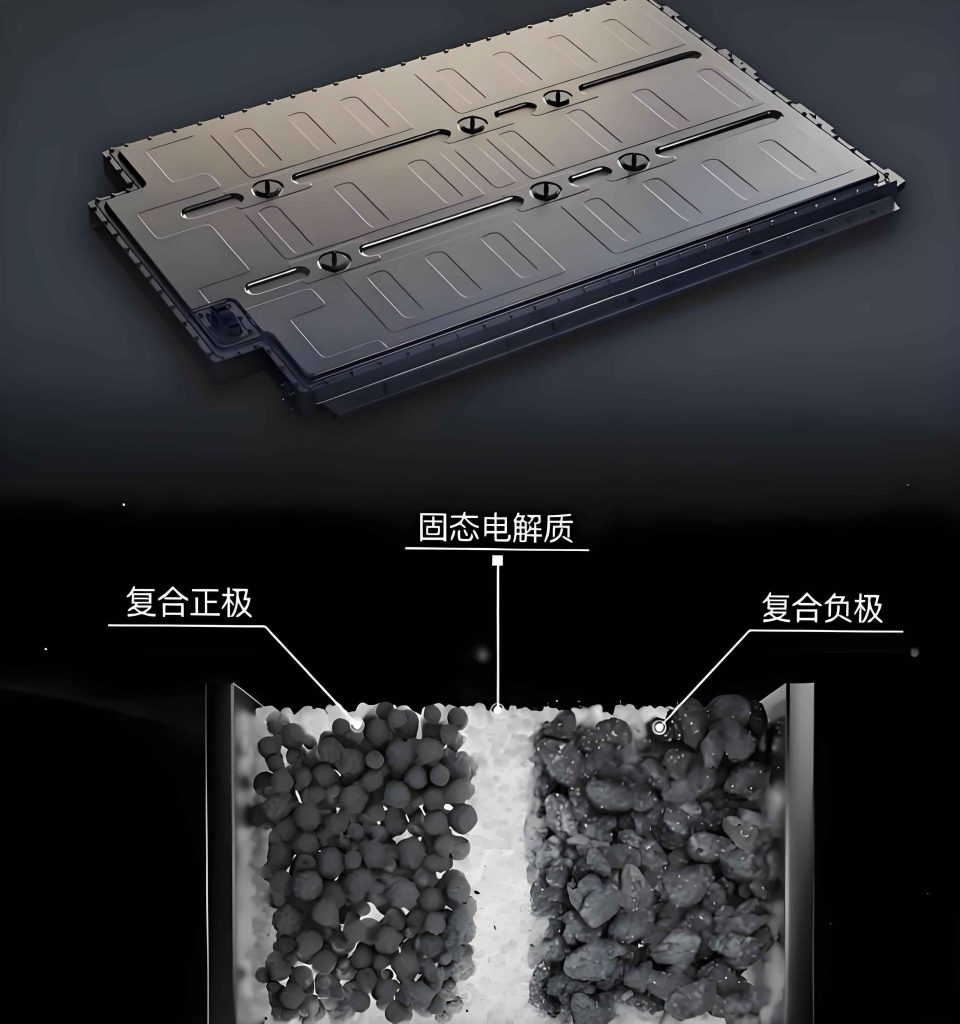
The relentless pursuit of higher energy density and enhanced safety in electrochemical energy storage has propelled the development of advanced battery technologies. Conventional liquid lithium-ion batteries, while dominant, carry inherent safety risks such as electrolyte leakage, thermal runaway, and potential combustion or explosion when subjected to abusive conditions like overcharge, over-discharge, or internal short circuits. In stark contrast, solid-state battery technology, which replaces the flammable liquid organic electrolyte with a solid ion-conducting medium, offers a fundamentally safer alternative. Beyond safety, solid-state battery architectures unlock the potential for using lithium metal anodes and high-voltage cathodes, paving the way for significantly higher specific energy.
However, the transition from laboratory promise to reliable engineering application necessitates robust and standardized evaluation protocols. Existing test methods for liquid lithium-ion batteries are often inadequate or inappropriate for characterizing solid-state battery cells, particularly those of the high-specific-energy type. Their distinct electrochemical interfaces, temperature-dependent ionic conductivity, and mechanical properties demand tailored assessment procedures. There is a critical gap in standardized methodologies for verifying key electrical performance parameters of high-specific-energy solid-state battery cells. This work aims to bridge this gap by conducting comprehensive experimental verification on representative cells and subsequently developing a coherent set of test methods and performance requirements to meet the rigorous demands of practical engineering applications.
Performance Characteristics of High-Specific-Energy Solid-State Batteries
The defining characteristic of a high-specific-energy solid-state battery is its exceptional gravimetric energy density. Current-generation cells can achieve weight-specific energies exceeding 450 Wh/kg, which is a substantial improvement over both long-cycle-life solid-state battery variants (typically around 350 Wh/kg) and state-of-the-art conventional liquid lithium-ion batteries (capped at approximately 400 Wh/kg for practical cells). This leap is primarily enabled by the use of lithium metal anodes and advanced cathode materials within the solid-state battery framework.
Furthermore, the operational envelope of a solid-state battery often differs markedly from its liquid-based counterparts. Key performance parameters exhibit unique profiles:
- Rate Capability: The power delivery capability, often indicated by the capacity retention at a 1C discharge rate relative to a low-rate (e.g., 0.2C) discharge, is a critical metric. The solid electrolyte’s ionic conductivity can influence this.
- Cycle Life: The longevity of a solid-state battery, especially when coupled with a lithium metal anode, is governed by different degradation mechanisms (e.g., interfacial stability, dendrite suppression) compared to liquid systems.
- Low-Temperature Performance: Ionic transport in solid electrolytes can be thermally activated. Therefore, the discharge capacity at low temperatures (e.g., -20°C) relative to room temperature is a vital indicator of cold-climate usability.
- High-Temperature Performance: This is a domain where solid-state battery technology shines. The absence of volatile, reactive liquid electrolytes allows for safer operation at elevated temperatures. While a liquid lithium-ion battery may suffer from severe side reactions and hazardous failure above 55°C, a solid-state battery can often operate reliably at 80°C or higher.
The substantial differences in these key parameters underscore the necessity for bespoke test methods. The following table summarizes a comparative analysis:
| Performance Parameter | High-Specific-Energy Solid-State Battery | Conventional Liquid Li-ion Battery |
|---|---|---|
| Target Weight-Specific Energy | > 450 Wh/kg | ~300-400 Wh/kg |
| 1C/0.2C Capacity Retention | Subject to cell design & electrolyte | Typically high (>90%) |
| Cycle Life (to 80% capacity) | May be lower initially, focuses on energy | Often >500-1000 cycles |
| Low-Temp (-20°C) Performance | ~70-85% of RT capacity | ~60-80% of RT capacity |
| High-Temp (80°C) Performance | Stable, >80% of RT capacity | Unsafe, severe degradation |
Experimental Research on Electrical Performance Parameters
Test Samples and Equipment
The experimental foundation of this study was built upon testing representative high-specific-energy solid-state battery pouch cells. These cells were designed with a lithium metal anode, a proprietary inorganic solid electrolyte, and a high-capacity cathode. All tests were conducted using calibrated equipment: a climate chamber (ET-1000L-C2) for temperature control, a battery test system (BTS-5V200A16CH) for applying electrical profiles, and a high-precision balance (BT300). Measurement accuracies were ensured to be within ±0.5% for voltage/current and ±0.1% for mass and dimensions.
Weight-Specific Energy Test
Objective & Principle: To determine the gravimetric energy density, which is the fundamental metric for a high-specific-energy solid-state battery. The cell is fully charged and then discharged at a low rate to measure the total extractable energy, which is then normalized by the cell’s mass.
Procedure:
- Condition the cell at (25 ± 3)°C.
- Charge with a constant current of 0.1C until the voltage reaches 4.35 V.
- Allow a rest period of 15 minutes.
- Discharge with a constant current of 0.1C until the voltage reaches the cutoff of 3.0 V.
- Record the discharge capacity \(C_{dis}\) (in Ah) and the average discharge voltage \(V_{avg}\) (in V), or directly record the total discharge energy \(E_{dis}\) (in Wh) from the tester.
- Measure the cell mass \(m\) (in kg).
Calculation:
The weight-specific energy \(E_w\) is calculated as:
$$E_w = \frac{E_{dis}}{m} = \frac{C_{dis} \times V_{avg}}{m}$$
where \(E_w\) is in Wh/kg.
Experimental Result & Requirement: For the tested solid-state battery cell, the discharge energy was 57.12 Wh (14.6 Ah × 3.912 V), and the mass was 0.1259 kg. Thus:
$$E_w = \frac{57.12 \text{ Wh}}{0.1259 \text{ kg}} \approx 453.6 \text{ Wh/kg}$$
Based on this and similar results, a requirement is established: \(E_w \geq 450 \text{ Wh/kg}\).
1C Discharge Capacity Retention Rate Test
Objective & Principle: To evaluate the power capability of the solid-state battery by assessing the capacity delivered under a moderately high discharge rate (1C) relative to a reference low-rate capacity.
Procedure:
- At (25 ± 3)°C, discharge the cell to 3.0 V at 0.2C.
- After a 30-minute rest, charge at 0.2C constant current to 4.35 V.
- Rest for 15 minutes.
- Discharge at 0.2C to 3.0 V to obtain the reference capacity \(C_{0.2C}\).
- Re-charge the cell following steps 2-3.
- Discharge at 1C constant current to 3.0 V to obtain the high-rate capacity \(C_{1C}\).
Calculation:
The 1C capacity retention rate \(R_{1C}\) is:
$$R_{1C} = \frac{C_{1C}}{C_{0.2C}} \times 100\%$$
Experimental Result & Requirement: For the test cell, \(C_{0.2C} = 14.28 \text{ Ah}\) and \(C_{1C} = 13.62 \text{ Ah}\). Therefore:
$$R_{1C} = \frac{13.62}{14.28} \times 100\% \approx 95.4\%$$
A requirement of \(R_{1C} \geq 80\%\) is deemed appropriate for this class of solid-state battery.
Cycle Life Test
Objective & Principle: To assess the longevity of the solid-state battery under a defined charge-discharge protocol, monitoring the decay of discharge capacity over repeated cycles. This test probes interfacial stability within the cell.
Procedure:
- At (25 ± 3)°C, perform a cycle as follows:
- Charge: 0.2C constant current to 4.35 V.
- Rest: 15 minutes.
- Discharge: 0.5C constant current to 3.0 V.
- Rest: 30 minutes.
- Repeat this cycle 200 times, recording the discharge capacity for each cycle (\(C_{cycle,n}\)).
Calculation:
The capacity retention after N cycles \(R_{cycle}(N)\) is:
$$R_{cycle}(N) = \frac{C_{cycle,N}}{C_{cycle,1}} \times 100\%$$
Experimental Result & Requirement: The initial cycle capacity \(C_{cycle,1}\) was 14.5 Ah. After 200 cycles, \(C_{cycle,200}\) was 11.75 Ah.
$$R_{cycle}(200) = \frac{11.75}{14.5} \times 100\% \approx 81.03\%$$
A requirement of \(R_{cycle}(200) \geq 80\%\) is established for initial qualification of high-specific-energy solid-state battery cells, acknowledging that cycle life is an active area for improvement.
Low-Temperature Discharge Capacity Test
Objective & Principle: To characterize the performance of the solid-state battery in cold environments, where ionic conductivity in the solid electrolyte decreases according to an Arrhenius-type relationship.
Procedure:
- At (25 ± 3)°C, establish the reference capacity \(C_{RT}\) using the 0.2C charge/discharge protocol (as in the 1C test).
- Fully charge the cell again using the standard protocol.
- Place the fully charged cell in a temperature chamber set to (-20 ± 2)°C and soak for 8 hours to thermally stabilize.
- While still at -20°C, immediately perform a 0.2C constant current discharge to 3.0 V. Record the low-temperature capacity \(C_{LT}\).
Calculation:
The low-temperature capacity retention \(R_{LT}\) is:
$$R_{LT} = \frac{C_{LT}}{C_{RT}} \times 100\%$$
Experimental Result & Requirement: With \(C_{RT} = 13.98 \text{ Ah}\) and \(C_{LT} = 11.48 \text{ Ah}\):
$$R_{LT} = \frac{11.48}{13.98} \times 100\% \approx 82.1\%$$
A requirement of \(R_{LT} \geq 70\%\) is set, which is competitive with and often exceeds the performance of liquid electrolytes at this temperature.
High-Temperature Discharge Capacity Test
Objective & Principle: To verify the safe and efficient operation of the solid-state battery at elevated temperatures, a key advantage stemming from the non-volatile electrolyte.
Procedure:
- At (25 ± 3)°C, establish the reference capacity \(C_{RT}\).
- Fully charge the cell again using the standard protocol.
- Place the fully charged cell in a temperature chamber set to (80 ± 2)°C and soak for 8 hours.
- While still at 80°C, immediately perform a 0.2C constant current discharge to 3.0 V. Record the high-temperature capacity \(C_{HT}\).
Calculation:
The high-temperature capacity retention \(R_{HT}\) is:
$$R_{HT} = \frac{C_{HT}}{C_{RT}} \times 100\%$$
Experimental Result & Requirement: With \(C_{RT} = 13.98 \text{ Ah}\) and \(C_{HT} = 14.50 \text{ Ah}\):
$$R_{HT} = \frac{14.50}{13.98} \times 100\% \approx 103.7\%$$
The capacity can be slightly higher due to increased ionic conductivity. A conservative requirement of \(R_{HT} \geq 80\%\) is established, which is easily met and highlights the thermal robustness of the solid-state battery.
Proposed Standardized Test Method Framework
Based on the experimental research and analysis, a comprehensive and standardized test method for high-specific-energy solid-state battery cells is proposed below. This framework is designed to be clear, repeatable, and directly applicable in specification sheets and quality control protocols.
1. Standard Environmental Conditions
Unless otherwise specified, all tests shall be conducted under the following ambient conditions:
- Temperature: 15°C to 35°C
- Relative Humidity: 20% to 80%
- Atmospheric Pressure: 86 kPa to 106 kPa
All tests requiring temperature control (low/high temperature) specify the test-specific conditions.
2. Standard Charging Procedure (Baseline)
Prior to most performance tests, the following charging procedure shall be used to establish a consistent initial state of charge (SOC):
- At (25 ± 3)°C, discharge the cell to 3.0 V at a 0.2C constant current.
- Allow the cell to rest for 30 minutes.
- Charge the cell with a 0.2C constant current until the voltage reaches 4.35 V.
- Terminate charge and allow the cell to rest for 15 minutes.
This is denoted as the “Standard Charge.”
3. Tabulated Test Methods and Requirements
The following table consolidates the key electrical performance tests, their detailed procedures derived from the experimental work, and the corresponding pass/fail criteria for a high-specific-energy solid-state battery.
| Test Parameter | Test Method Summary | Key Calculation / Output | Requirement |
|---|---|---|---|
| Weight-Specific Energy | 1. Perform “Standard Charge.” 2. At (25±3)°C, discharge at 0.1C to 3.0V. 3. Record discharge energy \(E_{dis}\) (Wh). 4. Measure cell mass \(m\) (kg). |
$$E_w = \frac{E_{dis}}{m}$$ | \(E_w \geq 450 \text{ Wh/kg}\) |
| 1C Capacity Retention | 1. Perform “Standard Charge.” 2. Discharge at 0.2C to 3.0V → \(C_{0.2C}\). 3. Re-charge (“Standard Charge”). 4. Discharge at 1C to 3.0V → \(C_{1C}\). |
$$R_{1C} = \frac{C_{1C}}{C_{0.2C}} \times 100\%$$ | \(R_{1C} \geq 80\%\) |
| Cycle Life (200 cycles) | 1. At (25±3)°C, repeat for 200 cycles: – Charge: 0.2C CC to 4.35V. – Rest 15 min. – Discharge: 0.5C CC to 3.0V. – Rest 30 min. Record \(C_{cycle,n}\). |
$$R_{cycle}(200) = \frac{C_{cycle,200}}{C_{cycle,1}} \times 100\%$$ | \(R_{cycle}(200) \geq 80\%\) |
| Low-Temp (-20°C) Capacity | 1. Establish reference \(C_{RT}\) at 0.2C. 2. Perform “Standard Charge.” 3. Soak at (-20±2)°C for 8 hrs. 4. Discharge at 0.2C to 3.0V at -20°C → \(C_{LT}\). |
$$R_{LT} = \frac{C_{LT}}{C_{RT}} \times 100\%$$ | \(R_{LT} \geq 70\%\) |
| High-Temp (80°C) Capacity | 1. Establish reference \(C_{RT}\) at 0.2C. 2. Perform “Standard Charge.” 3. Soak at (80±2)°C for 8 hrs. 4. Discharge at 0.2C to 3.0V at 80°C → \(C_{HT}\). |
$$R_{HT} = \frac{C_{HT}}{C_{RT}} \times 100\%$$ | \(R_{HT} \geq 80\%\) |
Application and Significance of the Developed Test Methods
The test methods formulated in this research have immediate practical utility. They provide a structured, quantitative framework for developers, manufacturers, and end-users of high-specific-energy solid-state battery technology. These methods enable:
- Product Specification and Datasheet Generation: Clear, standardized parameters (e.g., “Weight-Specific Energy: ≥450 Wh/kg”, “Cycle Life: ≥80% retention after 200 cycles”) can now be defined and verified.
- Quality Assurance and Batch Testing: Manufacturers can implement these tests for incoming quality control (IQC) and outgoing quality control (OQC) to ensure cell performance consistency.
- Objective Performance Benchmarking: Different solid-state battery designs and chemistries can be compared fairly using this common set of evaluation protocols.
- Guidance for R&D: The methods highlight key performance frontiers (like low-temperature rate capability or cycle life) that researchers can target for improvement.
The methodology has already been adopted as the foundation for drafting internal product specifications within major research institutes and has been referenced in test reports provided to academic and industrial partners. This underscores its role in bridging the gap between laboratory innovation and industrial application for the solid-state battery sector.
Conclusion and Future Perspectives
This work systematically addressed the critical lack of standardized test methods for evaluating the electrical performance of high-specific-energy solid-state battery cells. Through targeted experimental investigation of key parameters—weight-specific energy, rate capability, cycle life, and low/high-temperature performance—a coherent and practical set of test procedures and associated minimum performance requirements were developed. These methods are tailored to the unique characteristics of solid-state battery technology, differentiating them from legacy standards designed for liquid electrolyte systems.
The proposed framework fills a vital standardization gap, providing the necessary tools to rigorously characterize, specify, and qualify high-specific-energy solid-state battery cells. This is an essential step towards building confidence in the technology, facilitating supply chain development, and accelerating its integration into demanding applications such as electric aviation, next-generation electric vehicles, and advanced portable electronics. Future work will expand this methodology to include tests for fast-charging capability, internal resistance under various conditions, and more sophisticated safety and abuse tolerance assessments specific to the solid-state battery architecture.