
As a researcher deeply immersed in the fields of materials science and energy storage, I have witnessed a paradigm shift toward safer and more efficient battery systems. Among these, the solid-state battery stands out as a revolutionary technology, promising to overcome the limitations of traditional liquid electrolyte batteries. My perspective on this evolution is shaped by ongoing innovations across multiple disciplines, from nanotechnology to diagnostic tools, all converging to enhance energy storage solutions. In this article, I will explore key advancements, with a focus on solid-state battery developments, while integrating insights from related research areas. I aim to provide a comprehensive analysis, enriched with tables and formulas to summarize critical data and principles.
The journey toward advanced energy storage begins with understanding fundamental material interactions. One fascinating area is the control of surface and interface chemical reactions to construct nanomaterial patterns. This approach leverages self-assembled structures, such as DNA nanostructures, to guide the precise growth of metals and metal oxides. By programming DNA with addressable sites, like thiol groups, we can selectively adsorb metal precursors and initiate redox reactions, leading to patterned growth. This methodology not only enables the creation of complex nanoarchitectures but also offers a platform for designing components relevant to solid-state battery systems, such as tailored electrodes or solid electrolyte interfaces.
For instance, consider the growth of palladium, cobalt, nickel, silver, gold, or iron oxide nanoclusters on DNA scaffolds. The process involves coordination chemistry, where thiol groups exhibit strong binding with metal ions. The general reaction can be represented as:
$$ \text{DNA-SH} + M^{n+} \rightarrow \text{DNA-S-M}^{(n-1)+} + H^+ $$
followed by reduction or oxidation to form metallic or oxide deposits. This level of control is crucial for fabricating nanostructured materials that can enhance ion transport in solid-state battery components. To illustrate, I have summarized key metal growth parameters in Table 1.
| Metal/Metal Oxide | Precursor Ion | Binding Affinity with Thiol | Typical Growth Size (nm) | Potential Application in Solid-State Battery |
|---|---|---|---|---|
| Palladium (Pd) | Pd²⁺ | High | 5-10 | Catalytic electrodes for enhanced reactions |
| Cobalt (Co) | Co²⁺ | Moderate | 10-20 | Magnetic components or alloy anodes |
| Nickel (Ni) | Ni²⁺ | Moderate | 10-15 | Current collectors or conductive additives |
| Silver (Ag) | Ag⁺ | Very High | 5-15 | Conductive networks in composite electrolytes |
| Gold (Au) | Au³⁺ | Very High | 5-10 | Stable interlayers for interface engineering |
| Iron Oxide (Fe₂O₃) | Fe³⁺ | High | 20-30 | Anode materials for lithium or sodium storage |
The ability to pattern these materials at the nanoscale aligns with the needs of solid-state battery design, where controlled interfaces can mitigate issues like dendrite growth or poor contact. In fact, the principles of surface chemistry modulation are directly applicable to developing solid electrolytes with optimized ion pathways. As we delve deeper into solid-state battery technologies, it becomes evident that such interdisciplinary approaches are vital for breakthroughs.
Moving to the core of energy storage innovations, the development of sulfide-based solid electrolytes represents a milestone in solid-state battery research. These materials offer ionic conductivities rivaling liquid electrolytes, often exceeding \(10^{-2} \, \text{S/cm}\), which is essential for high-performance batteries. The crystal structure of sulfide electrolytes, such as those containing germanium (Ge), facilitates one-dimensional lithium-ion conduction along the c-axis, as described by the Arrhenius equation for ionic conductivity:
$$ \sigma = A \exp\left(-\frac{E_a}{kT}\right) $$
where \(\sigma\) is the ionic conductivity, \(A\) is the pre-exponential factor, \(E_a\) is the activation energy, \(k\) is Boltzmann’s constant, and \(T\) is the temperature. For Ge-based sulfides, low \(E_a\) values enable rapid ion transport, making them ideal for solid-state battery applications.
Recent advancements have led to multi-system sulfide solid electrolytes, including germanium and halogen-based variants, which have been scaled up to pilot production. These electrolytes are integral to constructing solid-state battery cells that exhibit exceptional cycle life and rate capability. For example, tests show that solid-state battery cells can retain 70.05% capacity after 1000 cycles at 0.5C and maintain 79.28% capacity at a 5C charging rate. Such performance underscores the potential of solid-state battery systems to replace conventional lithium-ion batteries in electric vehicles and grid storage.
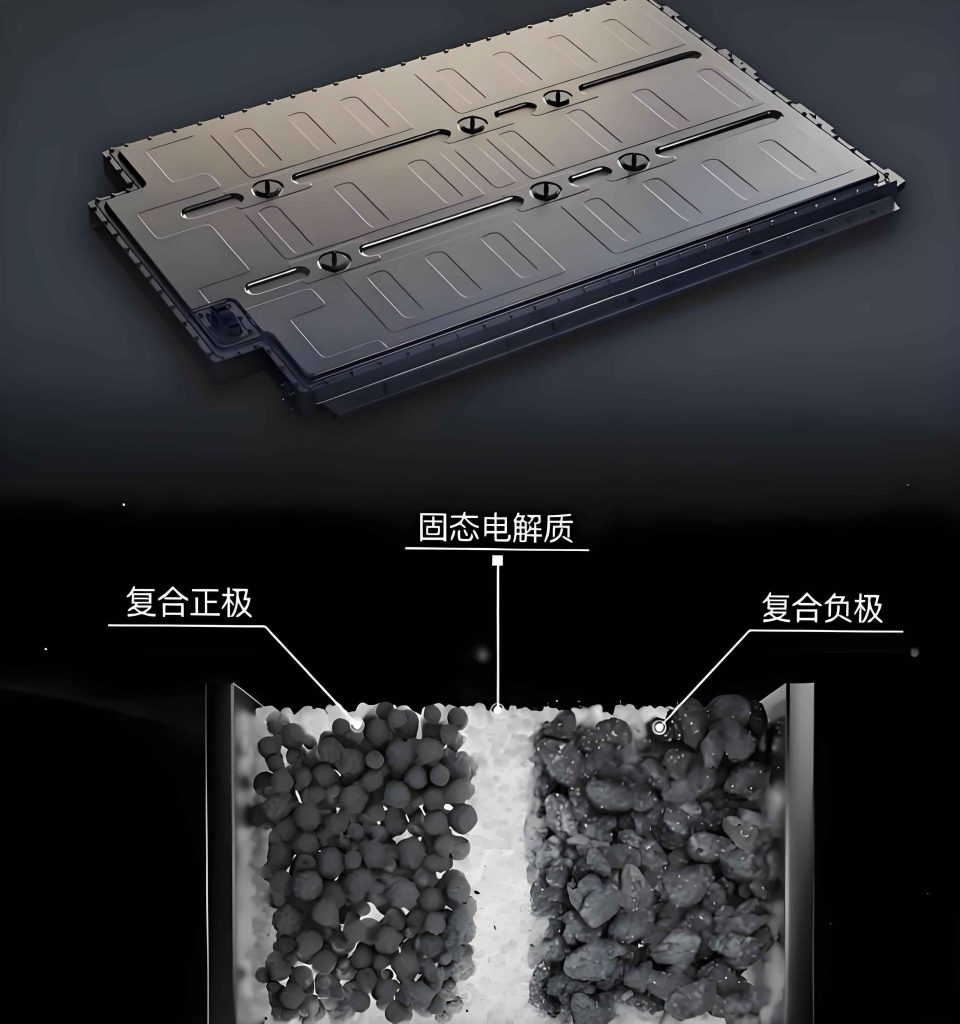
The image above illustrates a typical solid-state battery configuration, highlighting the dense electrolyte layer that prevents leakage and enhances safety. In my analysis, the key to advancing solid-state battery technology lies in optimizing these electrolytes for wider voltage windows and better compatibility with electrodes. To compare different electrolyte systems, I have compiled Table 2, which outlines their properties and implications for solid-state battery design.
| Electrolyte Type | Example Composition | Ionic Conductivity (S/cm) | Voltage Window (V) | Advantages for Solid-State Battery | Challenges |
|---|---|---|---|---|---|
| Sulfide (Ge-based) | Li10GeP2S12 | ~10-2 | 0-5 | High conductivity, good sinterability | Moisture sensitivity, cost of Ge |
| Sulfide (Halogen-based) | Li6PS5Cl | ~10-3 | 0-5 | Lower cost, stable interface | Moderate conductivity |
| Oxide | LLZO (Li7La3Zr2O12) | ~10-4 | 0-6 | High stability, wide voltage range | Brittleness, high processing temperature |
| Polymer | PEO-LiTFSI | ~10-5 | 0-4 | Flexibility, ease of fabrication | Low conductivity at room temperature |
From this table, it is clear that sulfide electrolytes offer a balance of high conductivity and processability, driving their adoption in next-generation solid-state battery systems. However, challenges like moisture stability necessitate protective coatings or hybrid designs. In my view, the future of solid-state battery development will involve combinatorial approaches, integrating nanostructured materials from DNA-based methods with these electrolytes to create hierarchical architectures.
Beyond material science, diagnostic tools play a crucial role in advancing battery technologies. For instance, fluorescence probes designed for disease diagnosis can inspire methods for monitoring battery health. A recent innovation involves small-molecule fluorescent probes for detecting nitric oxide (NO) in pulmonary fibrosis. The probe, denoted as PNO1, exhibits enhanced fluorescence in fibrotic tissues due to NO upregulation. This principle can be adapted for solid-state battery applications by developing probes that sense degradation products or interface changes within the battery.
The fluorescence intensity \(I\) can be modeled using the Stern-Volmer equation:
$$ \frac{I_0}{I} = 1 + K_{SV}[Q] $$
where \(I_0\) is the initial intensity, \(I\) is the quenched intensity, \(K_{SV}\) is the Stern-Volmer constant, and \([Q]\) is the quencher concentration (e.g., NO or battery by-products). By functionalizing surfaces with such probes, we could potentially visualize ion distribution or dendrite formation in a solid-state battery, enabling non-invasive diagnostics. This interdisciplinary crossover highlights how tools from biomedicine can enrich energy storage research, ultimately contributing to more reliable solid-state battery systems.
Another promising avenue is aqueous sodium-ion batteries, which complement solid-state battery efforts by offering inherent safety and resource abundance. While aqueous systems face limitations like narrow voltage windows due to water electrolysis, advances in electrolyte engineering are expanding their potential. The voltage window \(V_{window}\) of an aqueous electrolyte is governed by the decomposition potentials of water:
$$ V_{window} = E_{O_2} – E_{H_2} $$
where \(E_{O_2}\) is the oxygen evolution potential and \(E_{H_2}\) is the hydrogen evolution potential. By using “water-in-salt” electrolytes or additives, researchers have pushed \(V_{window}\) beyond 2.5 V, making aqueous sodium-ion batteries viable for grid storage. In comparison, solid-state battery systems typically operate at higher voltages (3-5 V) but require careful interface management.
I see synergistic opportunities between aqueous and solid-state battery technologies. For example, hybrid systems could combine solid electrolytes for high-voltage segments with aqueous ones for safer, cost-effective modules. Table 3 contrasts key parameters of these battery types, emphasizing the role of solid-state battery designs in high-energy applications.
| Parameter | Aqueous Sodium-Ion Battery | Solid-State Battery |
|---|---|---|
| Electrolyte Type | Water-based with salts | Solid sulfide, oxide, or polymer |
| Typical Voltage Window | 1.5-2.5 V | 3.0-5.0 V |
| Ionic Conductivity (S/cm) | ~10-1 (high due to aqueous medium) | 10-4 to 10-2 (varies with material) |
| Safety | High (non-flammable) | High (no liquid leakage) |
| Energy Density (Wh/kg) | 50-100 | 200-400 (projected for advanced solid-state battery) |
| Cost | Low (abundant sodium) | Moderate to high (processing challenges) |
| Primary Applications | Grid storage, low-power devices | Electric vehicles, portable electronics |
This comparison underscores that while aqueous batteries excel in safety and cost, solid-state battery systems offer superior energy density and voltage, making them indispensable for demanding applications. My research perspective suggests that future innovations will focus on bridging these gaps, perhaps through solid-state battery designs that incorporate aqueous-like interfaces for improved ion kinetics.
To delve deeper into the material science of solid-state battery components, let’s consider the diffusion kinetics of ions in solid electrolytes. The Nernst-Einstein equation relates ionic conductivity to diffusivity:
$$ \sigma = \frac{n q^2 D}{kT} $$
where \(n\) is the charge carrier density, \(q\) is the charge, \(D\) is the diffusion coefficient, \(k\) is Boltzmann’s constant, and \(T\) is temperature. For a solid-state battery, enhancing \(D\) through structural design—such as creating nanochannels via DNA templating—can boost performance. Moreover, the interfacial resistance between solid electrolyte and electrode is a critical factor, often modeled by the equation:
$$ R_{interface} = \frac{\delta}{\sigma_{interface}} $$
where \(\delta\) is the interface thickness and \(\sigma_{interface}\) is the interfacial conductivity. Reducing \(R_{interface}\) is key to realizing high-power solid-state battery cells.
In practice, the development of solid-state battery systems involves iterative testing and optimization. For example, cycling stability can be assessed using capacity retention formulas. If \(C_0\) is the initial capacity and \(C_n\) is the capacity after \(n\) cycles, the retention percentage \(R\) is:
$$ R = \frac{C_n}{C_0} \times 100\% $$
For the aforementioned solid-state battery with 70.05% retention after 1000 cycles, this implies minimal degradation, likely due to stable electrode-electrolyte interfaces. Such metrics are vital for commercializing solid-state battery technologies, and they drive research into novel materials like sulfide electrolytes.
Looking ahead, I envision a cohesive research ecosystem where advancements in nanotechnology, diagnostics, and electrolyte chemistry converge to accelerate solid-state battery adoption. For instance, the DNA-based patterning methods could be used to create three-dimensional electrode architectures that maximize surface area and reduce ion diffusion paths. Similarly, fluorescence probes might be integrated into solid-state battery modules for real-time health monitoring, detecting issues like hot spots or mechanical stresses.
Furthermore, the exploration of multi-valent ions (e.g., Mg²⁺, Ca²⁺) in solid-state battery systems presents new opportunities. The conductivity for such ions can be expressed as:
$$ \sigma = \sum_i n_i q_i \mu_i $$
where \(n_i\) is the concentration, \(q_i\) is the charge, and \(\mu_i\) is the mobility of ion species \(i\). Designing solid electrolytes with high mobility for multi-valent ions could enable next-generation solid-state battery with higher energy densities.
In conclusion, the journey toward advanced energy storage is multifaceted, with the solid-state battery at its core. From controlled nanomaterial growth to high-performance sulfide electrolytes and innovative diagnostic tools, each contribution pushes the boundaries of what’s possible. As a researcher, I am excited by the interdisciplinary synergy that fuels progress in solid-state battery technology. By leveraging insights from chemistry, physics, and engineering, we can overcome existing challenges and unlock the full potential of solid-state battery systems for a sustainable energy future. The tables and formulas presented here summarize key aspects, but the real innovation lies in continuous exploration and integration across fields. Solid-state battery development is not just about replacing liquids with solids; it’s about reimagining energy storage from the ground up, and I am confident that ongoing efforts will yield transformative outcomes.