
As an observer of the energy storage landscape, I find the current frenzy surrounding solid-state batteries both exhilarating and indicative of a profound industrial shift. The term “solid-state battery” has evolved from a niche research topic to a central pillar in the strategic plans of automotive giants and battery manufacturers worldwide. The fundamental question driving billions in investment is simple: what is the unique promise of this technology that compels such a fierce competitive race?
The answer lies in the inherent limitations of the incumbent technology. For over three decades, lithium-ion batteries with liquid electrolytes have powered our portable electronics and, more recently, the electric vehicle revolution. Yet, as I examine their fundamental chemistry, two critical constraints emerge: safety and energy density.
The safety issue stems primarily from the organic liquid electrolyte. This electrolyte is intrinsically flammable and volatile. During a thermal runaway event—triggered by internal short circuits, overcharging, or mechanical damage—the temperature rise causes the electrolyte to decompose exothermically, releasing oxygen and combustible gases. The polymer separator, with a melting point around $$T_{sep} \approx 160^\circ \text{C}$$, collapses, leading to a direct short circuit and potentially catastrophic fire or explosion. Statistically, the risk is non-trivial, with electric vehicle fire incidents showing a concerning upward trend year-over-year.
Concurrently, the energy density of liquid lithium-ion batteries is approaching its theoretical ceiling. The practical limits can be summarized as follows:
| Battery Chemistry | Practical Energy Density Range (Wh/kg) | Theoretical Limit (Approx.) |
|---|---|---|
| Lithium Iron Phosphate (LFP) | < 200 | ~220 Wh/kg |
| Nickel Manganese Cobalt (NMC) | 200 – 300 | ~350 Wh/kg |
| State-of-the-Art Liquid Li-ion | ~300-350 | ~350-400 Wh/kg |
The energy density $$\rho_E$$ is defined as the energy stored per unit mass:
$$\rho_E = \frac{E}{m}$$
where $$E$$ is the total energy capacity and $$m$$ is the mass of the cell. Breaking the 400 Wh/kg barrier with conventional liquid chemistry involves significant trade-offs with cycle life and safety.
This is where the “magic” of the solid-state battery becomes clear. By replacing the liquid electrolyte with a solid ion conductor, the technology addresses both core flaws simultaneously.
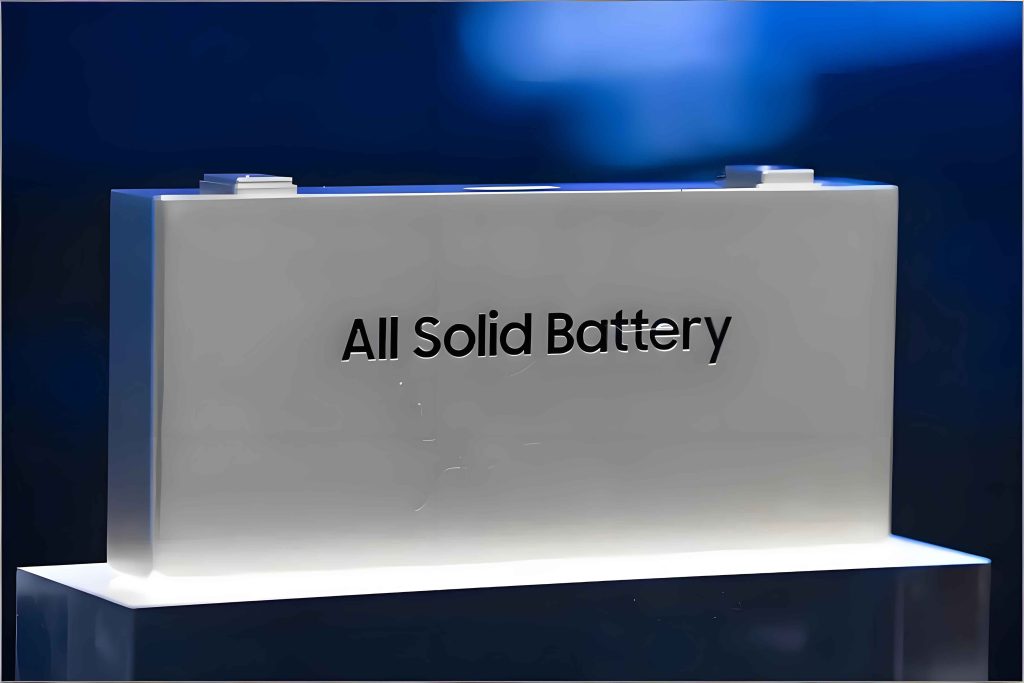
1. Intrinsic Safety: Solid electrolytes are typically non-flammable, non-volatile, and thermally stable up to much higher temperatures. Their mechanical rigidity also resists dendrite penetration (metallic lithium growth), a primary cause of internal shorts. The risk of thermal runaway is drastically reduced because the key propagator—the liquid electrolyte—is removed.
2. High Energy Density Potential: The solid-state battery architecture unlocks new material choices. Most notably, it enables the use of a pure lithium metal anode. The theoretical specific capacity of a lithium metal anode is about 3,860 mAh/g, compared to 372 mAh/g for conventional graphite. This alone is a game-changer. The overall energy density potential can be modeled as a function of electrode capacities and cell voltage:
$$\rho_E \approx \frac{ V_{cell} \times Q_{cathode} }{ w_{cathode} + w_{anode} + w_{electrolyte} + w_{inactive} }$$
where $$V_{cell}$$ is the average discharge voltage, $$Q$$ are the specific capacities, and $$w$$ are the weight fractions. With a lithium metal anode (high $$Q_{anode}$$, low $$w_{anode}$$) and high-voltage cathodes, projections suggest solid-state batteries can achieve 500 Wh/kg and beyond, as demonstrated by research institutions like NASA.
The allure of this potential has triggered a global gold rush. The investment landscape is monumental. I have seen valuations for dedicated solid-state battery startups soar into the billions within a few years, backed by consortiums of major automakers. The strategic moves are accelerating:
- Automakers are forming deep alliances, investing directly in solid-state battery developers, and announcing ambitious roadmaps for prototype and production vehicles, with 2025 frequently cited as a critical milestone.
- Established lithium-ion battery giants are dedicating substantial R&D resources to both solid-state and intermediate semi-solid-state solutions to defend their market position.
- Governments, recognizing the strategic importance of next-generation battery technology, are launching national research initiatives and funding programs worth tens of billions of dollars to secure domestic supply chains and intellectual property.
However, from my analysis, the path to commercialization is littered with formidable technical hurdles. The core challenge lies in the solid electrolyte itself. The ideal solid electrolyte must possess high ionic conductivity (approaching that of liquid electrolytes, ~10⁻² S/cm), excellent chemical/electrochemical stability against both electrodes, and mechanical robustness. The primary material families each have significant trade-offs:
| Electrolyte Type | Ionic Conductivity | Stability | Interface Contact | Key Challenge |
|---|---|---|---|---|
| Polymer | Low (~10⁻⁵ S/cm at RT) | Poor (Oxidative) | Good | Low conductivity at room temperature |
| Oxide | Moderate (~10⁻⁴ to 10⁻³ S/cm) | Very Good | Poor (Rigid) | Brittle, high interfacial resistance |
| Sulfide | High (~10⁻³ to 10⁻² S/cm) | Poor (Moisture-sensitive) | Good (Softer) | Extreme sensitivity to air, cost of raw materials |
The interfacial problem is particularly vexing. In a liquid system, the electrolyte flows and maintains intimate contact with the rough electrode surfaces. In a solid-state battery, maintaining a stable, low-resistance contact point between two solid materials (electrolyte and electrode) during repeated charge/discharge cycles, which cause volume changes, is extremely difficult. The interfacial resistance $$R_{interface}$$ can dominate total cell impedance:
$$R_{total} = R_{bulk} + R_{interface}$$
High $$R_{interface}$$ leads to poor power performance and rapid degradation.
Furthermore, manufacturing costs are currently prohibitive. Many solid electrolytes require expensive elements (e.g., germanium in sulfides). The production processes, such as thin-film deposition for oxide electrolytes or handling in inert atmospheres for sulfides, are complex and capital-intensive, deviating significantly from the established roll-to-roll manufacturing of liquid lithium-ion batteries.
Faced with these challenges, the industry has largely converged on a pragmatic intermediate step: the semi-solid-state battery. This design reduces the liquid electrolyte content significantly, replacing it with a solid electrolyte layer or matrix, but retains a small amount of liquid or gel to “wet” the interfaces and improve ion transport. It offers a tangible improvement in safety and a moderate boost in energy density (e.g., to 360-400 Wh/kg) while leveraging existing manufacturing infrastructure. Several vehicle models featuring semi-solid-state battery packs have already entered the market, serving as a crucial testbed for supply chains and consumer acceptance.
Yet, I view this as a transitional technology. While it mitigates risk, it does not fully realize the ultimate promise of the solid-state battery. The search for the ultimate solid electrolyte and scalable cell architecture continues. Some researchers are exploring novel paradigms like “condensed state” or polymer-gel hybrids that claim to bridge the performance gap differently.
Despite the obstacles, my conviction in the long-term trajectory remains firm. The solid-state battery represents a fundamental materials science breakthrough, not merely an incremental improvement. The exponential growth in scholarly publications and patents is a clear indicator of intense global focus. As one leading academic aptly summarized, the technology is on the cusp of commercialization. While an “overnight revolution” is impossible in such a complex field, the convergence of massive investment, relentless R&D, and clear market demand is steadily pulling the future of the solid-state battery from the laboratory into our everyday lives. The race is not about if, but when and by whom the key bottlenecks will be solved, heralding a new era for energy storage.