
Electrochemical energy storage devices, which primarily store and release electrical energy through chemical reactions, serve as the power source for portable devices and electric vehicles (EVs), and are key components of grids based on renewable energy. Batteries, due to their stable energy storage, convenient power supply, and diverse forms, capacities, and power densities, are among the most important and widely used electrical energy devices. Rechargeable lithium-ion batteries (LIBs) have been extensively used to power devices like mobile phones, laptops, and EVs, and as energy storage for renewable sources such as solar and wind. With the explosive development of technology, there is a higher demand for energy storage. The low theoretical capacity of commercial graphite anodes has limited the energy density improvement of the conventional LIB system, failing to meet modern society’s demand for high-specific-energy batteries.
In recent years, with the rapid development of the new energy vehicle industry, it has become increasingly recognized that traditional liquid LIBs are approaching their limits. Issues include a low upper limit for energy density (the theoretical limit for conventional liquid LIBs is around 350 Wh/kg), contributing to range anxiety; heavy overall battery mass; poor low-temperature performance; and safety hazards in high-temperature environments. To address the limitations of liquid LIBs, policy support is inclined towards the research, development, and industrial development of solid-state battery technology. According to the medium- and long-term development plan for lithium batteries by China’s Ministry of Industry and Information Technology, the target for 2025 is to achieve a single-cell energy density of 350 Wh/kg (the “Made in China 2025” target is 400 Wh/kg), and 500 Wh/kg by 2030. The safety of liquid batteries becomes very poor at high energy densities, for instance, above 300 Wh/kg. Therefore, the solid-state battery route is considered an excellent solution to ensure both high safety and high energy density, making its development seemingly inevitable.
Compared to liquid LIBs, solid-state battery technology promises to significantly exceed the energy density limits of existing liquid LIBs. It is particularly noteworthy that the lithium metal anode can increase the energy density of a battery by more than 70%, representing a step-change in performance. Theoretically, their energy density can reach 400–500 Wh/kg, which is 2–3 times that of liquid LIBs. Solid-state battery systems offer advantages such as increased driving range, significantly reduced thermal runaway risk, shorter charging time, extended cycle life, and reduced size. Consequently, an increasing number of companies, including leading power battery manufacturers and automakers, are doubling down on the R&D and production of solid-state battery technology.
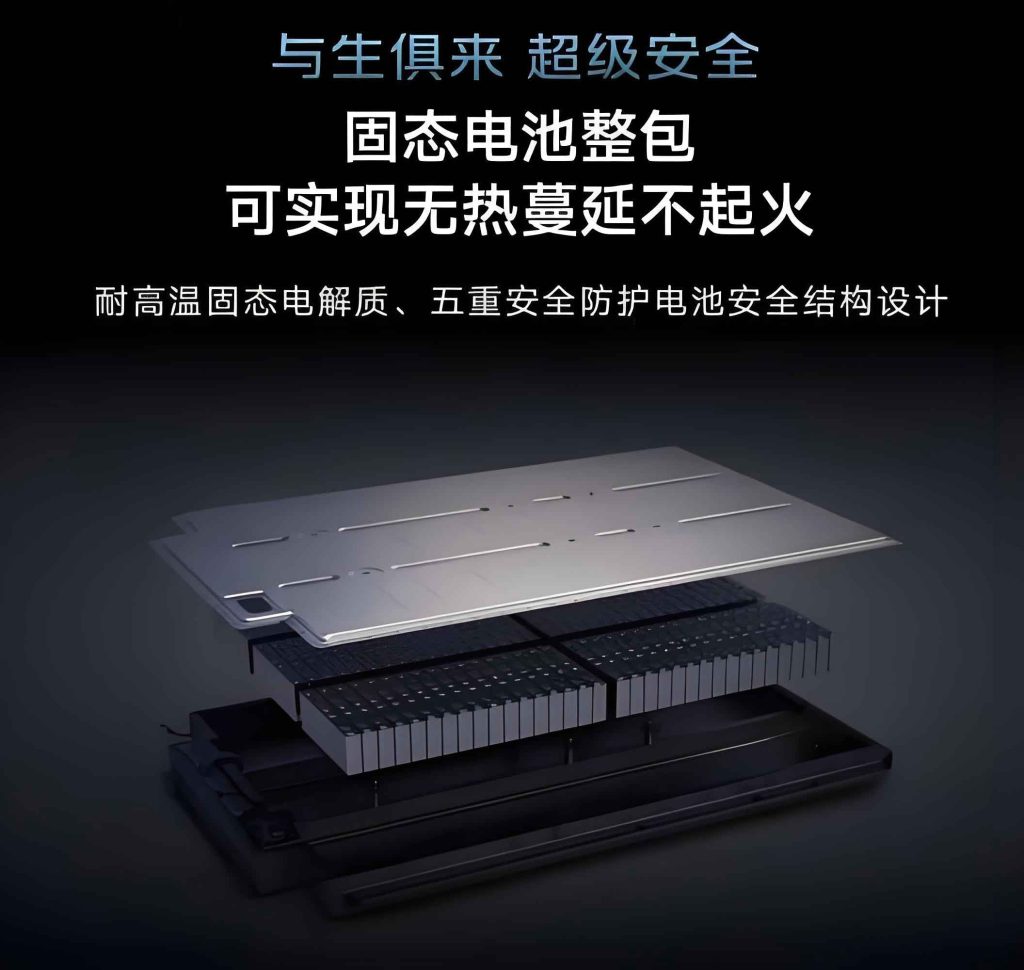
Classification of Solid-State Batteries
An all-solid-state battery replaces the liquid electrolyte, electrolyte salt, and separator in a traditional lithium-ion battery with a solid-state electrolyte. Given that solid-state electrolytes are non-flammable, non-corrosive, non-volatile, and leakage-free, all-solid-state battery systems are expected to completely resolve battery safety issues. Furthermore, the potential difference between the cathode and anode in an all-solid-state battery can exceed 5V, higher than that of traditional LIBs (4.2V), allowing for the use of high-energy cathode materials and enabling the use of lithium metal as the anode material, with a theoretical energy density as high as 700 Wh/kg. As the core component, the solid-state electrolyte largely determines the battery’s energy density, power density, cycle stability, safety performance, and service life. Based on the electrolyte material, common solid-state electrolytes can be classified into three main systems: polymer-based, oxide-based, and sulfide-based.
Polymer solid-state electrolytes primarily use poly(ethylene oxide) (PEO) and its derivatives. They offer low density and interfacial impedance, and are easy to process into thin layers. As early as 2011, the French company Bolloré launched an EV powered by a solid-state battery, with polymer-based systems being the first to achieve commercialization. However, polymer electrolytes suffer from low ionic conductivity at room temperature, limiting the energy ceiling. While heating significantly improves lithium-ion conductivity, it consumes energy and increases costs. The ionic conductivity ($\sigma$) often follows an Arrhenius-type relationship:
$$\sigma = A \exp\left(-\frac{E_a}{k_B T}\right)$$
where $E_a$ is the activation energy, $k_B$ is Boltzmann’s constant, and $T$ is the temperature.
Oxide solid-state electrolytes mainly include lithium lanthanum titanium oxide (LLTO), garnet-type lithium lanthanum zirconium oxide (LLZO), and other fast ion conductors. They possess high mechanical strength, strong pressure resistance, high physicochemical stability, and relatively simple manufacturing. Thin-film all-solid-state battery systems like LiPON have been produced in small batches, while non-film types have attempted to enter the consumer electronics market. However, the high interfacial impedance between oxide electrolytes and electrodes often leads to insufficient effective capacity utilization of the electrodes and rapid battery life decay. Fabricating thin layers is also challenging.
Sulfide solid-state electrolytes primarily use lithium sulfide combined with sulfides of elements like germanium, phosphorus, silicon, titanium, aluminum, and tin. They offer large ion transport channels, suitable electronegativity, and the highest ionic conductivity among the three types. Representative sulfide electrolytes include Li$_6$PS$_5$Cl (LPSCl), Li$_3$PS$_4$, Li$_7$P$_3$S$_{11}$, and Li$_{10}$GeP$_2$S$_{12}$ (LGPS). However, due to sulfur’s lower electronegativity compared to oxygen, pairing with high-voltage cathodes can lead to lithium depletion at the electrolyte interface, increasing interfacial resistance. Pairing with a lithium metal anode can generate a high-impedance solid electrolyte interphase (SEI). Furthermore, these material systems are highly sensitive to water and oxygen, can still be flammable in accidents, and face difficulties in thin-layer fabrication, requiring extremely high manufacturing process standards.
Sulfide solid electrolytes are considered one of the most promising materials for achieving high-energy-density all-solid-state battery systems due to their excellent mechanical ductility and ionic conductivity rivaling liquid electrolytes (up to 25 mS/cm). Key challenges include (electro)chemical decomposition, mechanical degradation at interfaces, lithium dendrite formation, and slow Li$^+$ diffusion in active materials. Air stability is another critical research area. Strategies to develop air-stable sulfide electrolytes include using H$_2$S absorbers, elemental substitution, novel material design, surface engineering, and sulfide-polymer composite electrolytes. Overcoming these challenges is crucial for transferring air-stable sulfide solid electrolytes from laboratory research to large-scale application in vehicle-specification all-solid-state battery packs.
| Electrolyte Type | Example Materials | Ionic Conductivity (at RT) | Key Advantages | Key Challenges | Compatibility with Li Metal |
|---|---|---|---|---|---|
| Polymer | PEO, PEO-based blends | ~10$^{-4}$ – 10$^{-3}$ S/cm (at 60-80°C) | Good flexibility, easy processing, low interfacial resistance | Low RT conductivity, narrow electrochemical window, thermal stability | Moderate |
| Oxide | LLZO, LLTO, LATP | ~10$^{-4}$ – 10$^{-3}$ S/cm | High mechanical/chemical stability, wide electrochemical window | High interfacial resistance, brittleness, thin-film processing difficulty | Good (with surface modification) |
| Sulfide | LPSCl, LGPS, Li$_3$PS$_4$ | ~10$^{-3}$ – 10$^{-2}$ S/cm (highest) | Highest ionic conductivity, good mechanical ductility | Poor air/chemical stability, interfacial reactions, H$_2$S generation | Challenging (interface instability) |
Research and Development Progress in the Automotive Industry
Despite a lack of industry-wide consensus on the most fundamental technological roadmap, major corporations are entering the solid-state battery arena, attracted by the superior material properties. Globally, Japan is betting on the sulfide route, with the earliest R&D layout and leading global technology and patents. It has established a collaborative R&D system between automakers and battery manufacturers, supported by government funding exceeding 200 billion yen (approximately 10 billion RMB), aiming for commercialization of all-solid-state battery technology by 2030 with an energy density target of 500 Wh/kg. South Korea is pursuing both oxide and sulfide routes in parallel, with government tax credit support and collaboration among major battery giants. The target is to develop commercial technology with an energy density of 400 Wh/kg between 2025-2028, with vehicle integration by 2030. Europe primarily focuses on the polymer route while also developing sulfide-based systems, with Germany making the largest R&D investment. The United States is pursuing all routes, with funding from the Department of Energy, led by startups collaborating with numerous automakers, targeting 500 Wh/kg by 2030. Domestic Chinese automakers are also actively partnering with solid-state battery startups, such as Nio with WeLion (Weilan New Energy), and BAIC, SAIC, GAC investing in QingTao Energy.
The involvement of automakers provides solid-state battery enterprises with financial, technical, and customer guarantees, accelerating the commercialization process. The table below summarizes key players and their status.
| Company / Entity | Region | Primary Technology Focus | Current Stage / Notable Achievement | Automaker Partners / Investors |
|---|---|---|---|---|
| Toyota | Japan | Sulfide | Prototype testing; largest patent holder; target commercialization ~2027-2030 | Subaru, others |
| Nissan | Japan | Sulfide | Pilot plant construction; aiming for launch in mid-2020s | – |
| QuantumScape | USA | Oxide (ceramic separator) | Delivered prototype cells to automotive partners for testing | Volkswagen, others |
| Solid Power | USA | Sulfide | Pilot production; delivering prototype cells to partners | BMW, Ford |
| WeLion (Weilan New Energy) | China | Polymer-Oxide Composite (Semi-solid) | Semi-solid cells in production; supplied to Nio for ET7 (~150 kWh pack, 360 Wh/kg cell) | Nio, Xiaomi, Huawei, Geely |
| QingTao Energy | China | Oxide-Polymer Composite (Semi-solid) | Mass production of semi-solid cells; first semi-solid battery EV (IM L7) launched with SAIC | SAIC, BAIC, GAC, Neta |
| Ganfeng Lithium | China | Oxide (Thick film, Semi-solid) | First-gen semi-solid cells (>260 Wh/kg); second-gen target >360 Wh/kg | Volkswagen, Dongfeng, Seres |
| ProLogium | Taiwan, China | Oxide (Semi-solid to Solid) | Pilot line; >94% yield for multi-layer cells; current energy density >270 Wh/kg | Mercedes-Benz, VinFast |
| SK On / Samsung SDI | South Korea | Sulfide / Oxide | Aggressive R&D prototype development; target mid-2020s for pilot production | Hyundai, Ford |
From disclosed information, Chinese solid-state battery enterprises primarily follow two R&D paths: semi-solid batteries based on solid-liquid hybrid electrolytes and sulfide-based all-solid-state battery systems. While adding liquid electrolyte may slightly reduce thermal stability, the manufacturing process for semi-solid batteries with hybrid electrolytes is more compatible with existing liquid LIB manufacturing technology and equipment. Considering factors like materials and equipment, semi-solid batteries appear more feasible in the short term and are on the verge of mass production. Thus, China seems to be leading in the industrialization of semi-solid batteries. For the industrialization of all-solid-state battery systems, there is still a gap compared to leading global companies like Samsung SDI, Toyota, Solid Power, and QuantumScape. In the long term, sulfide-based batteries are considered the most promising next-generation all-solid-state battery technology, favored by Japanese and Korean companies for their superior performance.
Major Existing Challenges
The first major challenge is production cost. Current estimates place the material cost of all-solid-state battery cells at approximately 2–3 RMB/Wh, significantly higher than current liquid LIBs. Furthermore, production line equipment for all-solid-state battery systems requires customized R&D, and initial manufacturing yields may be low, further increasing overall costs. High raw material prices and an immature supply chain contribute to the high cost. With technological progress and industrial development, costs are expected to decrease through material performance improvements, simplified production processes, and innovative cell design. The long-term cost target is around 1 RMB/Wh. A simplified cost model can be represented as:
$$C_{total} = C_{mat}(E) + C_{proc}(V) + C_{capex}/Y$$
where $C_{mat}$ is material cost dependent on energy (E), $C_{proc}$ is processing cost dependent on volume (V), $C_{capex}$ is capital expenditure, and $Y$ is yield.
The second challenge lies in materials science. Electrolyte selection is the primary consideration in all-solid-state battery R&D. Balancing ionic conductivity, processability, stability, and manufacturing cost, the two electrolyte technology paths closest to industrialization are sulfide and oxide-based systems. To further increase energy density, advancements in electrode materials are crucial. Cathode materials will evolve towards ultra-high nickel or lithium-rich manganese-based materials, while anode materials will move towards silicon-based or lithium metal. However, integrating these materials with solid-state electrolytes presents scientific challenges such as poor structural stability, large volume expansion, unstable interfacial contact, mechanical failure at interfaces, and lithium dendrite growth, all impacting cycle life and rate capability. Interfacial stability is governed by complex electrochemical and mechanical interactions. For instance, the stress ($\sigma$) generated at the interface due to volume change of an active particle can be approximated by:
$$\sigma \propto \frac{E \cdot \Delta V}{V_0}$$
where $E$ is the Young’s modulus of the electrolyte, $\Delta V$ is the volume change, and $V_0$ is the original volume.
| Component | Target Material | Key Scientific Challenges | Impact on Performance |
|---|---|---|---|
| Cathode | NMC 811, NCA, LMRO | Interfacial degradation, chemical/electrochemical instability with sulfide electrolytes, space-charge layer effects. | Capacity fade, increased impedance, reduced cycle life. |
| Anode | Lithium Metal, Silicon (Si/C) | Dendrite growth/penetration, infinite volume change, unstable SEI/CEI formation, poor interfacial contact. | Short circuits, rapid capacity loss, low Coulombic efficiency. |
| Electrolyte | Sulfides (LGPS, LPSCl), Oxides (LLZO) | Air/chemical instability (sulfides), brittleness & high interfacial resistance (oxides), low ionic conductivity at RT (polymers). | Manufacturing difficulty, safety hazards, poor rate performance. |
| Interface | N/A | High resistance, mechanical stress due to volume changes, side reactions, lithium filament propagation. | High polarization, power loss, premature failure. |
The third challenge involves manufacturing processes. For cell production, all-solid-state battery systems require higher consistency at material interfaces, necessitating innovation and upgrades in production processes, especially in coating and stacking equipment. The choice of manufacturing process must fully consider factors like cell performance in mass production, manufacturing yield, and cost. Currently, all-solid-state battery production can partially adopt wet processes, with compatibility with the existing supply chain around 50-60%; dry processes have even lower compatibility. Some equipment requires custom development, particularly for producing cathodes, anodes, and solid electrolyte membranes. For vehicle design, integrating and installing all-solid-state battery packs requires collaborative design between automakers and battery companies regarding material selection, cell structure, and system integration. Without liquid electrolyte wetting, all-solid-state battery cells often require external pressure to ensure stable electrochemical reactions at the solid-solid interfaces. Additionally, the performance of all-solid-state battery systems at low temperatures is worse than at room temperature, including increased polarization resistance, reduced cycle life, and degraded rate performance. Thermal management must focus more on system insulation and precise temperature control.
| Process Step | Conventional Liquid LIB | All-Solid-State Battery (Challenges) | Potential Solutions / Developments |
|---|---|---|---|
| Electrode Fabrication | Slurry casting (wet), drying, calendering. | Incorporating solid electrolyte particles; achieving intimate contact; preventing cracks. | Dry powder processes, hybrid slurry casting, optimized binder systems. |
| Electrolyte Integration | Separator winding/stacking, liquid electrolyte injection. | Forming dense, thin, defect-free solid electrolyte layers (separator or coating). | Thin-film deposition (PVD, ALD), tape-casting, lamination of freestanding electrolyte films. |
| Cell Stacking/Assembly | Winding or Z-stacking of electrodes with separator. | Maintaining uniform pressure and contact in solid-solid stack; precise alignment. | Modified stacking equipment with pressure application, monolithic designs. |
| Formation & Aging | Charge-discharge cycles to form SEI; degassing. | Forming stable solid-solid interfaces; possibly requiring high temperature/pressure. | Thermal compression during formation, pressure fixtures, extended conditioning protocols. |
The final challenge concerns safety standards. Although solid electrolytes offer intrinsic safety, significantly improving the safety of all-solid-state battery systems compared to liquid batteries—potentially saving on safety components and costs—battery system safety still requires attention, especially when using lithium metal anodes. An all-solid-state battery is not equivalent to absolute safety. Risks of thermal runaway and thermal propagation still exist. Safety and protection measures must be optimized for different stages of thermal propagation, enhancing thermal runaway warning capabilities at the cell level and thermal propagation protection at the system level, ultimately achieving both high energy density and safety for solid-state battery technology.
Conclusion and Outlook
From the preceding discussion, it is evident that the true deployment of all-solid-state battery systems in vehicles depends on breakthroughs in scientific issues and the maturation of the industrial ecosystem. To achieve genuine mass production and vehicle integration, two prerequisites must be met: (1) Key scientific problems at the material level must be resolved to meet the six core metrics—energy density, cycle life, rate capability, safety performance, temperature adaptability, and production cost—making the all-solid-state battery a true all-round performer; and (2) The entire ecosystem chain, including manufacturing process improvements, vehicle协同 design, and testing standard systems, must be perfected.
The all-solid-state battery is recognized as a crucial future direction for power battery technology. However, several technological and manufacturing hurdles must be overcome before large-scale mass production. Based on some automakers’ announced production plans, the time frame for the true large-scale commercial application of all-solid-state battery systems appears to be between 2025 and 2030. It must be strongly emphasized that the actual timeline for mass vehicle integration of all-solid-state battery systems depends on real-world R&D progress. If key scientific problems at the material level and efficient production processes/low-cost manufacturing at the industrial level cannot be effectively resolved, the timeline for mass production may still fall short of expectations. The transition can be conceptualized as a function of overcoming bottlenecks:
$$T_{commercial} = f(R_{mat}, R_{process}, R_{cost}, I_{ecosystem})$$
where $T_{commercial}$ is the time to commercialization, $R_{mat}$ represents material-level research progress, $R_{process}$ represents process development, $R_{cost}$ represents cost reduction efforts, and $I_{ecosystem}$ represents ecosystem integration. The future of EVs hinges on accelerating progress across all these variables for the solid-state battery.