
As I delve into the realm of advanced energy storage, the solid-state battery emerges as a pivotal innovation that promises to revolutionize various industries, from electric vehicles to portable electronics. The recent gathering of experts and researchers in the field has underscored the rapid progress and lingering challenges associated with this technology. In this article, I will explore the key scientific and technical issues discussed, using tables and formulas to summarize the insights gained, while emphasizing the critical role of solid-state batteries in our energy future.
The conference highlighted several critical areas of focus for solid-state battery development. To provide a clear overview, I have compiled the primary topics into a table that encapsulates the core themes driving research and innovation in solid-state batteries.
| Topic Area | Key Focus |
|---|---|
| Solid Electrolyte Materials | Fundamentals, new systems, manufacturing, and applications |
| Solid Electrolyte Separators | Composite membranes, supported membranes, coating films |
| Electrode Materials | Basics, novel systems, preparation, and application |
| Interface Engineering | Observation, control, manufacturing, and dynamic evolution during cycling |
| Hybrid Solid-Liquid Electrolyte Batteries | Power batteries, energy storage batteries, flexible batteries |
| All-Solid-State Batteries | All-solid-state lithium batteries, lithium-sulfur, lithium-air, sodium batteries |
| Theoretical and Computational Methods | High-throughput theory, design, and computational approaches |
| Industrialization Technology | Scaling up production and commercial applications |
One of the core aspects of solid-state battery research is the solid electrolyte material. The ionic conductivity, denoted by $\sigma$, is a critical parameter that determines the performance of the solid-state battery. It can be expressed using the Nernst-Einstein relation:
$$\sigma = n q \mu$$
where $n$ is the charge carrier concentration, $q$ is the charge, and $\mu$ is the mobility. For solid electrolytes, the conductivity often follows an Arrhenius behavior:
$$\sigma = \sigma_0 \exp\left(-\frac{E_a}{k_B T}\right)$$
Here, $\sigma_0$ is the pre-exponential factor, $E_a$ is the activation energy, $k_B$ is Boltzmann’s constant, and $T$ is the temperature. Improving $\sigma$ is essential for enhancing the solid-state battery’s efficiency, as higher conductivity reduces internal resistance and improves power delivery. The ion transport in solid electrolytes for solid-state batteries often involves hopping mechanisms. The diffusion coefficient, $D$, can be related to the jump distance, $a$, and attempt frequency, $\nu_0$, through:
$$D = \frac{1}{6} a^2 \nu_0 \exp\left(-\frac{E_a}{k_B T}\right)$$
This equation highlights how structural design can enhance ion mobility in solid-state batteries, enabling faster charging and discharging cycles.
To illustrate the progress in solid-state battery materials, I present a table summarizing common solid electrolytes and their properties, which are crucial for advancing solid-state battery technology.
| Material Type | Example | Ionic Conductivity (S/cm) | Advantages | Challenges |
|---|---|---|---|---|
| Oxide-based | LLZO (Li7La3Zr2O12) | ~10^{-4} to 10^{-3} | High stability | Brittleness, processing issues |
| Sulfide-based | LGPS (Li10GeP2S12) | ~10^{-2} | High conductivity | Moisture sensitivity |
| Polymer-based | PEO-LiTFSI | ~10^{-5} to 10^{-4} | Flexibility, ease of fabrication | Low conductivity at room temperature |
| Hybrid | Composite electrolytes | Varies | Balanced properties | Interface control |
Another key area is interface engineering. The interface between the solid electrolyte and electrodes in a solid-state battery can lead to high impedance and degradation. The interfacial resistance, $R_{int}$, can be modeled as:
$$R_{int} = \frac{\delta}{\kappa}$$
where $\delta$ is the interface thickness and $\kappa$ is the interfacial conductivity. Strategies to minimize $R_{int}$ include using buffer layers or composite materials. Interface stability is critical for long-cycle life in solid-state batteries. The chemical potential difference at the interface, $\Delta \mu$, can drive reactions. For a lithium metal anode and solid electrolyte, the reaction free energy, $\Delta G$, can be calculated as:
$$\Delta G = -n F E_{cell}$$
where $E_{cell}$ is the cell potential. Minimizing $\Delta G$ through material selection is key to stable interfaces in solid-state batteries. The dynamic evolution during cycling is a complex phenomenon. In-situ techniques like electrochemical impedance spectroscopy (EIS) can monitor interface changes. The impedance spectrum often includes contributions from bulk, grain boundary, and electrode-electrolyte interfaces. A common equivalent circuit model for a solid-state battery is:
$$Z(\omega) = R_b + \frac{R_{gb}}{1 + j \omega R_{gb} C_{gb}} + \frac{R_{int}}{1 + j \omega R_{int} C_{int}}$$
where $R_b$ is bulk resistance, $R_{gb}$ is grain boundary resistance, $C_{gb}$ is grain boundary capacitance, $R_{int}$ is interfacial resistance, $C_{int}$ is interfacial capacitance, and $\omega$ is angular frequency. Analyzing $Z(\omega)$ helps diagnose issues in solid-state battery performance, enabling better design and optimization.
The development of all-solid-state batteries is driven by the need for safer and higher-energy-density storage systems. The energy density, $E_d$, of a solid-state battery can be calculated as:
$$E_d = \frac{Q V}{m}$$
where $Q$ is the capacity, $V$ is the voltage, and $m$ is the mass. Compared to conventional lithium-ion batteries, solid-state batteries offer potential for higher $E_d$ due to the use of lithium metal anodes. Further exploration into all-solid-state lithium-sulfur batteries reveals their high theoretical energy density. The reaction in a lithium-sulfur solid-state battery can be represented as:
$$16 Li + S_8 \rightarrow 8 Li_2S$$
with a theoretical specific energy of about 2600 Wh/kg. However, issues like polysulfide shuttle and volume changes must be addressed in solid-state configurations. The use of solid electrolytes can confine polysulfides, enhancing cycle life. Similarly, all-solid-state sodium batteries are gaining attention due to the abundance of sodium. The ionic conductivity of sodium solid electrolytes, such as NASICON-type materials, follows similar principles to lithium-based systems. The conductivity can be expressed as:
$$\sigma_{Na} = \sigma_{0,Na} \exp\left(-\frac{E_{a,Na}}{k_B T}\right)$$
where the subscript Na denotes sodium-related parameters. Developing high-conductivity sodium solid electrolytes is crucial for affordable energy storage, expanding the applications of solid-state battery technology.
In the context of hybrid solid-liquid electrolyte batteries, these systems combine the benefits of both solid and liquid components. The overall conductivity, $\sigma_{total}$, can be approximated by a parallel model:
$$\frac{1}{\sigma_{total}} = \frac{\phi_s}{\sigma_s} + \frac{\phi_l}{\sigma_l}$$
where $\phi_s$ and $\phi_l$ are the volume fractions of solid and liquid phases, and $\sigma_s$ and $\sigma_l$ are their respective conductivities. This approach allows for tailored properties in solid-state battery designs, balancing safety and performance. Hybrid solid-liquid electrolyte batteries offer a pragmatic approach by combining the safety of solids with the conductivity of liquids. The performance of such batteries can be optimized by tuning the composition. For example, the conductivity of a composite electrolyte with ceramic fillers in a polymer matrix can be modeled using the Maxwell-Garnett equation:
$$\frac{\sigma_c – \sigma_m}{\sigma_c + 2\sigma_m} = f \frac{\sigma_f – \sigma_m}{\sigma_f + 2\sigma_m}$$
where $\sigma_c$ is the composite conductivity, $\sigma_m$ is the matrix conductivity, $\sigma_f$ is the filler conductivity, and $f$ is the volume fraction of filler. This allows for designing materials with tailored properties for solid-state batteries, enabling innovations in flexible and high-power applications.
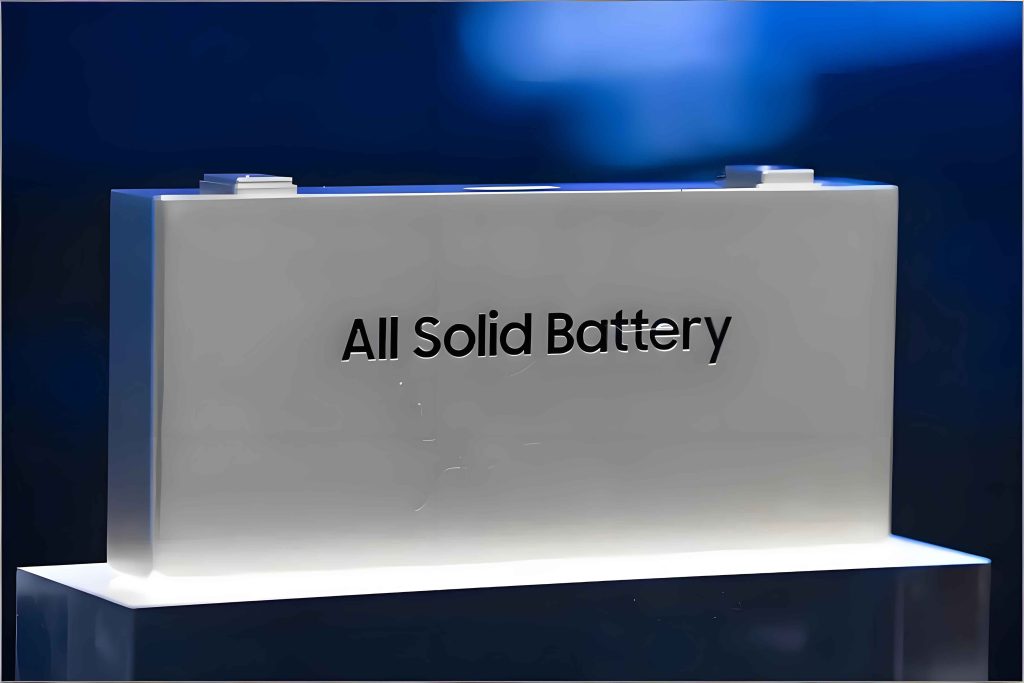
The image shows the compact and safe design of a solid-state battery, which eliminates flammable liquid electrolytes. This is one of the main advantages driving research in solid-state batteries, as safety concerns are paramount in large-scale energy storage and electric vehicles. The layered structure depicted underscores the importance of precise engineering in solid-state battery assemblies to ensure efficient ion transport and minimal interfacial resistance.
Theoretical and computational methods play a crucial role in accelerating solid-state battery development. High-throughput screening can identify promising materials based on descriptors such as ionic radius, electronegativity, and crystal structure. Density functional theory (DFT) calculations help predict properties like migration barriers for ions in solid electrolytes. For example, the migration energy, $E_m$, can be computed using:
$$E_m = E_{saddle} – E_{initial}$$
where $E_{saddle}$ and $E_{initial}$ are the energies at the saddle point and initial site, respectively. Lower $E_m$ values indicate faster ion diffusion, which is vital for solid-state battery performance. Looking ahead, the integration of artificial intelligence and machine learning in solid-state battery research can accelerate discovery. Predictive models can identify novel solid electrolyte compositions based on historical data. A simple linear regression for predicting conductivity might be:
$$\log(\sigma) = \beta_0 + \beta_1 x_1 + \beta_2 x_2 + \cdots + \epsilon$$
where $x_i$ are material descriptors and $\beta_i$ are coefficients. Such approaches can streamline the development of next-generation solid-state batteries, reducing trial-and-error in the lab.
Industrialization of solid-state batteries requires addressing scalability and cost. The manufacturing process involves steps like powder synthesis, film casting, and assembly. A simplified cost model for a solid-state battery production line might include:
$$C_{total} = C_{materials} + C_{processing} + C_{equipment}$$
Reducing $C_{total}$ is essential for commercial viability. Advances in roll-to-roll processing and automated assembly can help lower costs. The conference also emphasized the importance of scalability in solid electrolyte manufacturing. For oxide-based solid electrolytes, tape casting and sintering are common methods. The density of the sintered pellet, $\rho_{pellet}$, affects conductivity and is given by:
$$\rho_{pellet} = \frac{m}{V}$$
where $m$ is mass and $V$ is volume. Achieving high $\rho_{pellet}$ with minimal pores is essential for optimal ion transport in solid-state batteries. For polymer-based solid electrolytes, the degree of crystallinity influences conductivity. The amorphous fraction, $\chi_a$, can be related to conductivity through the Vogel-Tammann-Fulcher equation:
$$\sigma = A \exp\left(-\frac{B}{T – T_0}\right)$$
where $A$, $B$, and $T_0$ are constants. Increasing $\chi_a$ by blending or cross-linking can enhance conductivity in solid-state battery applications, making them more competitive with traditional batteries.
As I consider the future of solid-state batteries, the integration of new materials and interfaces will be key. For instance, the use of lithium metal anodes in solid-state batteries can significantly boost energy density, but it introduces challenges like dendrite formation. The growth rate of dendrites, $v_d$, can be described by:
$$v_d = \frac{J}{z F \rho}$$
where $J$ is the current density, $z$ is the charge number, $F$ is Faraday’s constant, and $\rho$ is the density. Strategies to suppress $v_d$ include using mechanically robust solid electrolytes or surface modifications. Additionally, solid-state battery designs must account for thermal management, as heat generation during operation can affect performance. The heat flux, $q$, can be estimated using:
$$q = I^2 R_{internal}$$
where $I$ is the current and $R_{internal}$ is the internal resistance. Efficient thermal design is crucial for maintaining the stability and longevity of solid-state batteries in real-world applications.
To summarize key points, I provide a table comparing different solid-state battery types based on their potential applications, highlighting how solid-state battery technology is diversifying to meet various needs.
| Battery Type | Energy Density (Wh/kg) | Safety | Cost | Primary Application |
|---|---|---|---|---|
| All-Solid-State Lithium | 300-500 | High | High | Electric vehicles |
| Hybrid Solid-Liquid | 200-400 | Moderate | Medium | Consumer electronics |
| Solid-State Lithium-Sulfur | 500-1000+ | High | Variable | Aviation, grid storage |
| Solid-State Sodium | 100-300 | High | Low | Stationary storage |
The journey towards widespread adoption of solid-state batteries is fraught with challenges, but the potential benefits in safety, energy density, and sustainability make it a worthwhile pursuit. As research continues, I am optimistic that solid-state batteries will become a cornerstone of modern energy systems. The collaborative efforts seen in conferences and research initiatives are accelerating progress, bringing us closer to a future where solid-state battery technology powers everything from smartphones to grid-scale storage. By leveraging advanced materials, computational tools, and innovative manufacturing, the solid-state battery field is poised to overcome current limitations and deliver transformative solutions for global energy needs.
In reflection, the solid-state battery represents not just an incremental improvement but a paradigm shift in energy storage. Its ability to enhance safety through non-flammable components, increase energy density via novel electrode materials, and enable flexible designs underscores its versatility. As I explore these facets, it becomes clear that continuous investment in fundamental science and engineering is essential to unlock the full potential of solid-state batteries. The equations and tables presented here serve as a foundation for understanding the complex interplay of factors that define solid-state battery performance, guiding future innovations in this exciting domain.