
The rapid expansion of electrochemical energy storage into electric vehicles and grid-scale applications has created an unprecedented demand for battery technologies that are safer and possess higher energy densities than current lithium-ion batteries. Conventional lithium-ion batteries, which employ liquid organic electrolytes, face intrinsic limitations including narrow electrochemical stability windows, flammability, leakage risks, and lithium dendrite growth. These issues collectively constrain the pursuit of higher energy densities and raise significant safety concerns. In this context, solid-state batteries (SSBs), which replace the liquid electrolyte and separator with a solid-state electrolyte (SSE), have emerged as a pivotal next-generation technology. The SSE offers the potential for improved safety, compatibility with high-voltage cathodes and lithium-metal anodes, and ultimately, a path towards higher energy density.
Significant progress has been made in recent years on several fronts critical to solid-state battery development. This includes the discovery of new solid-state electrolyte materials with high ionic conductivity, innovations for managing the challenging solid-solid interfaces, and the design of composite electrodes. However, the path to commercialization remains obstructed by persistent challenges. Ionic transport bottlenecks at phase boundaries within composite electrolytes, high and unstable interfacial impedance between electrodes and the electrolyte, and poor ionic transport within dense, high-loading electrodes continue to limit the achievable areal capacity, rate capability, and cycle life of solid-state battery cells.
Much research focuses on optimizing individual performance metrics, such as achieving superlative ionic conductivity in a bulk solid-state electrolyte or constructing a low-impedance artificial interphase layer. While these advances are essential, the overall cell performance is a complex interplay of multiple components and phenomena. Therefore, a holistic, system-level approach is required to translate material-level improvements into practical cell-level performance. To this end, our group proposed a comprehensive descriptor: Lithium-Ion Transport Throughput ($\Phi_{Li^+}$). This metric evaluates the integrated charge-discharge performance of a solid-state battery by quantifying the number of moles of lithium ions transported across the electrode/electrolyte interface per unit area per hour during operation. It is defined as:
$$
\Phi_{Li^+} = \frac{1000 \times C_{area}}{C_{Li} \cdot M_{Li} \cdot t}
$$
Where $C_{area}$ is the practical areal capacity (mA·h·cm$^{-2}$), $C_{Li}$ is the theoretical specific capacity of lithium metal (3860 mA·h·g$^{-1}$), $M_{Li}$ is the molar mass of lithium (6.941 g·mol$^{-1}$), and $t$ is the charge or discharge time (hours). The resulting unit is mol·m$^{-2}$·h$^{-1}$.
The $\Phi_{Li^+}$ descriptor inherently combines two critical cell-level performance indicators: areal capacity (directly linked to energy density) and current density/rate (linked to power density). Crucially, it uses the *practically delivered* areal capacity, which is the result of the convoluted effects of bulk ionic transport, interfacial charge transfer, and electrode-scale ionic/electronic transport. Therefore, $\Phi_{Li^+}$ provides a more accurate and integrated picture of the actual electrochemical processes within a solid-state battery compared to external circuit parameters like current density alone.
An analysis of literature data, including recent high-performance works, reveals the current landscape. Liquid electrolyte-based lithium-metal batteries still lead in achieving high $\Phi_{Li^+}$ values, often exceeding 2.5 mol·m$^{-2}$·h$^{-1}$, due to superior interfacial contact and high ionic conductivity. Among various solid-state battery systems, polymer-based SSBs show promise with their flexibility and good Li-metal compatibility, achieving $\Phi_{Li^+}$ values around 0.5 mol·m$^{-2}$·h$^{-1}$ at moderate rates. Sulfide-based solid-state batteries, boasting the highest ionic conductivities among SSEs, can achieve very high $\Phi_{Li^+}$ (>1.9 mol·m$^{-2}$·h$^{-1}$), though often when paired with alloy anodes like Li-In or composite Si anodes due to stability concerns with bare Li metal. Oxide and halide-based systems show significant potential but are still catching up in terms of demonstrated high-throughput performance. The data underscores that enhancing $\Phi_{Li^+}$ is a central challenge for solid-state battery development.
To elevate the lithium-ion transport throughput of a solid-state battery, a concerted effort must target three interconnected domains: (1) the bulk ionic transport within the solid-state electrolyte, (2) the ionic transport across electrode/electrolyte interfaces, and (3) the synergistic ionic and electronic transport within the composite electrode. We now review strategies and progress in each of these areas.
1. Enhancing Bulk Ionic Transport in Solid-State Electrolytes
The intrinsic ionic conductivity of the solid-state electrolyte sets the fundamental ceiling for lithium-ion transport throughput. Inorganic solid-state electrolytes (ISSEs) typically exhibit higher ionic conductivity (>10$^{-4}$ S·cm$^{-1}$) than polymer-based ones, yet most still lag behind liquid electrolytes (~10$^{-2}$ S·cm$^{-1}$). Ionic transport in crystalline ISSEs occurs via Li$^+$ hopping between adjacent lattice sites, governed by the energy landscape defined by the anion framework, cation arrangement, and Li-site occupancy.
A powerful strategy to enhance ionic conductivity is to introduce compositional disorder. The “high-entropy” design, involving multi-cation doping on a single crystallographic site, creates a distribution of local site energies. When these energy distributions overlap, the activation barrier for Li$^+$ hopping is reduced, especially if a percolating network of low-energy pathways forms. This approach has successfully boosted the conductivity of oxide, sulfide, and halide solid-state electrolytes by orders of magnitude. For instance, a high-entropy sulfide Li$_9.54$[Si$_{0.6}$Ge$_{0.4}$]$_{1.74}$P$_{1.44}$S$_{11.1}$Br$_{0.3}$O$_{0.6}$ achieved a record room-temperature ionic conductivity of 32 mS·cm$^{-1}$, enabling high-loading solid-state battery operation.
Extending disorder to the long-range leads to amorphous or glassy solid-state electrolytes. These materials lack grain boundaries and possess open, flexible structures that can facilitate high ionic mobility. Recent work on halide-based amorphous systems (e.g., Li–Ta–Cl) has shown promising conductivities up to ~7 mS·cm$^{-1}$. Characterizing their precise short-range order—using techniques like pair distribution function (PDF) analysis, solid-state NMR, and machine learning—is key to understanding and optimizing their transport properties.
For polymer-based solid-state electrolytescomposite polymer electrolytes (CPEs) by incorporating inorganic fillers (oxide, sulfide particles/nanowires). The enhancement mechanism can be dual: the inorganic phase can provide a high-conductivity percolation pathway, and the polymer/filler interface can create unique ion coordination environments that accelerate Li$^+$ transport. Advanced designs involve creating a three-phase percolating network where continuous pathways exist for ions in the polymer, the inorganic filler, and across their interfaces. Strategies like infiltrating a porous 3D inorganic scaffold with a polymer, or using dielectric fillers to mitigate space-charge layer effects at organic-inorganic interfaces, have yielded CPEs with conductivities approaching 10$^{-3}$ S·cm$^{-1}$ at room temperature.
2. Accelerating Ionic Transport Across Electrode/Electrolyte Interfaces
The solid-solid interface is arguably the most formidable challenge in solid-state battery technology. Poor physical contact, chemical/electrochemical instability, and space-charge layer effects collectively create a high-impedance barrier for Li$^+$ transfer, severely limiting $\Phi_{Li^+}$.
At the anode (Li metal)/SSE interface, strategies focus on improving wettability, stabilizing the interface, and homogenizing Li$^+$ flux. Designing porous or mixed ionic-electronic conducting (MIEC) interlayers on the SSE surface (e.g., on garnet-type oxides) can help distribute current evenly and accommodate volume changes, enabling stable cycling at high current densities. Another prevalent approach is to create an artificial alloy layer. This involves coating the SSE with a thin film of metals like Al, Si, Mg, or Bi. Upon contact with Li, these form Li-M alloys which are often ionically conductive, improve wettability, and act as a buffer to prevent reduction of the SSE. These alloy layers have been critical in enabling the use of sulfides and other reduction-sensitive SSEs with Li metal.
At the cathode/SSE interface, the challenges include interfacial reactions, poor contact, and Li$^+$ depletion due to space-charge effects. Applying a thin, conformal coating on cathode particles is standard. Ideal coating materials are ionically conductive, electrochemically stable across the operating voltage, and adhere well to both the cathode and the SSE. Common examples include LiNbO$_3$, Li$_2$ZrO$_3$, and Li$_3$PO$_4$-based coatings. For sulfides SSEs, halide-based coatings like LiI have shown effectiveness in suppressing interfacial decomposition while facilitating Li$^+$ transport.
Advanced characterization techniques, such as in situ scanning electron microscopy, time-of-flight secondary ion mass spectrometry (ToF-SIMS), and synchrotron-based X-ray tomography, are invaluable for probing the dynamic evolution of these buried interfaces during cycling, guiding the design of more robust interphases.
3. Constructing Efficient Transport Networks within Composite Electrodes
High energy density demands thick electrodes with high active material loading (>3 mA·h·cm$^{-2}$). In such electrodes, the tortuous pore structure and long transport distances create significant gradients in ionic and electronic potential, leading to underutilization of active material, especially at high rates. Therefore, engineering the electrode’s internal microstructure is vital for achieving high $\Phi_{Li^+}$.
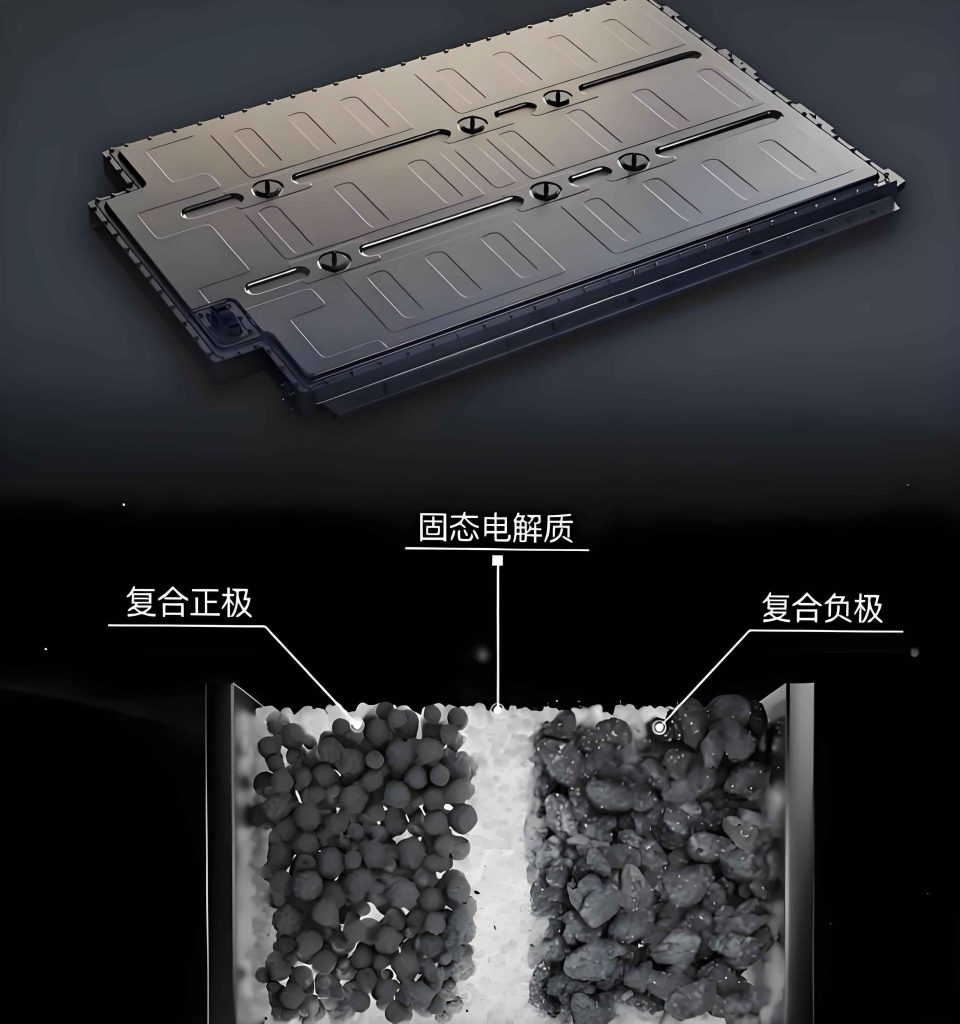
The traditional composite electrode is a random mixture of active material, solid-state electrolyte, and conductive carbon. This often leads to inefficient, tortuous ion transport paths. A paradigm shift involves structuring the electrode to create deliberate, low-tortuosity pathways. This can be achieved by aligning SSE-containing fibers or particles vertically using magnetic or electric fields, or by fabricating micro-pillar arrays of active material interspersed with electrolyte channels. These “vertical alignment” or “array” structures significantly reduce ionic transport resistance, enabling high-rate performance from high-loading electrodes.
Another key concept is building a dual percolating network for both ions and electrons. This ensures every active material particle is connected to both an ionic pathway (the SSE phase) and an electronic pathway (the conductive additive). Using 1D or 2D nanomaterials (e.g., SSE nanowires, graphene, CNTs) can efficiently create these interconnected networks at low additive contents. For example, integrating ion-conductive LLTO nanowires with electronic conductive CNTs into a cathode can create a “highway” system for rapid charge delivery to the reaction sites.
Pushing this concept further leads to integrated or “bicontinuous” electrode designs. Here, the solid-state electrolyte itself forms a continuous, porous scaffold into which the active material is infiltrated. Alternatively, the active material and SSE are co-sintered into a monolithic, dense composite. These designs minimize the number of distinct interfaces and ensure ultra-short transport lengths for both ions and electrons, dramatically improving the electrode’s power capability and active material utilization.
| Cathode | Anode | Electrolyte Type | Areal Capacity (mA·h·cm-2) | Rate (C) | $\Phi_{Li^+}$ (mol·m-2·h-1) |
|---|---|---|---|---|---|
| NMC622 | Li | Oxide | 1.85 | 1 | 0.69 |
| LiCoO2 | Li-In | Sulfide | 1.06 | 5 | 1.98 |
| NCM811 | Li | Polymer | 0.26 | 5 | 0.48 |
| LiCoO2 | Li | Liquid | 0.87 | 8 | 2.60 |
| NCM83 | Li | Nitride | 0.48 | 5 | 0.89 |
Summary and Outlook
The pursuit of high-performance solid-state batteries is a multi-dimensional optimization problem. The lithium-ion transport throughput ($\Phi_{Li^+}$) serves as a crucial integrator metric, linking fundamental material properties to practical cell-level performance in terms of energy and power density. As summarized, advancing $\Phi_{Li^+}$ requires synergistic progress across three fronts: developing solid-state electrolytes with higher and more stable ionic conductivity; engineering robust, low-impedance interfaces that maintain intimate contact during cycling; and architecting composite electrodes with efficient, low-tortuosity transport networks for both ions and electrons.
Future research must embrace a holistic, system-level perspective. Promising directions include:
- Material Innovation: Continued exploration of high-entropy, amorphous, and new structural families of solid-state electrolytes, guided by computation and advanced characterization.
- Interfacial Science: Developing dynamic, self-healing, or graded interphases that can adapt to volume changes and suppress deleterious reactions throughout the battery’s lifespan.
- Electrode Architecture: Moving beyond slurry-cast electrodes towards precision-engineered, 3D-structured electrodes fabricated via additive manufacturing or other advanced techniques.
- Integration & Manufacturing: Addressing scalability and cost, focusing on processes that can produce thin, defect-free SSE layers and well-controlled interfaces at high throughput.
By integrating insights and innovations from materials science, electrochemistry, and engineering, we can overcome the current barriers. Enhancing the lithium-ion transport throughput is not merely an academic exercise; it is the key to unlocking the full potential of solid-state batteries—enabling safer, longer-lasting, and more powerful energy storage solutions that will be critical for the future of transportation and renewable energy grids.