
With the accelerated transformation of the global energy structure, the development of energy storage technologies that are highly safe, low-cost, and sustainable has become an urgent need. Sodium-ion batteries are regarded as important candidates for the next-generation energy storage system due to advantages such as abundant sodium resources, low cost, and wide temperature range adaptability. However, they still face bottlenecks such as low volumetric energy density, insufficient cycle life, and sodium dendrite growth. Thin-film solid electrolytes, by replacing liquid electrolytes, can significantly enhance battery safety, inhibit dendrite growth, and increase energy density, thus becoming a key path to solve the above problems. In this review, we systematically discuss the latest research progress of thin-film solid electrolytes in sodium-ion solid-state batteries. Starting from the ion transport mechanism, we comparatively analyze the differences between solid electrolytes and traditional liquid systems. We deeply explore the characteristics of sodium ions, interface compatibility, and key challenges in material design. We classify and review the performance optimization strategies of oxides, sulfides, halides, and organic-inorganic composite electrolytes. The research results show that NASICON-type oxide electrolytes can significantly increase ionic conductivity through element doping, sulfides exhibit high room-temperature ionic conductivity, and organic-inorganic composites offer flexibility and low-cost advantages. However, the practical application of thin-film solid electrolytes is still limited by challenges such as low ion migration rate, high interface impedance, and complex preparation processes. Future efforts need to focus on element doping, interface engineering, development of new materials, and optimization of large-scale preparation processes to promote the commercial application of thin-film solid electrolytes in sodium-ion solid-state batteries, providing important support for achieving efficient, safe, and sustainable energy storage technologies.
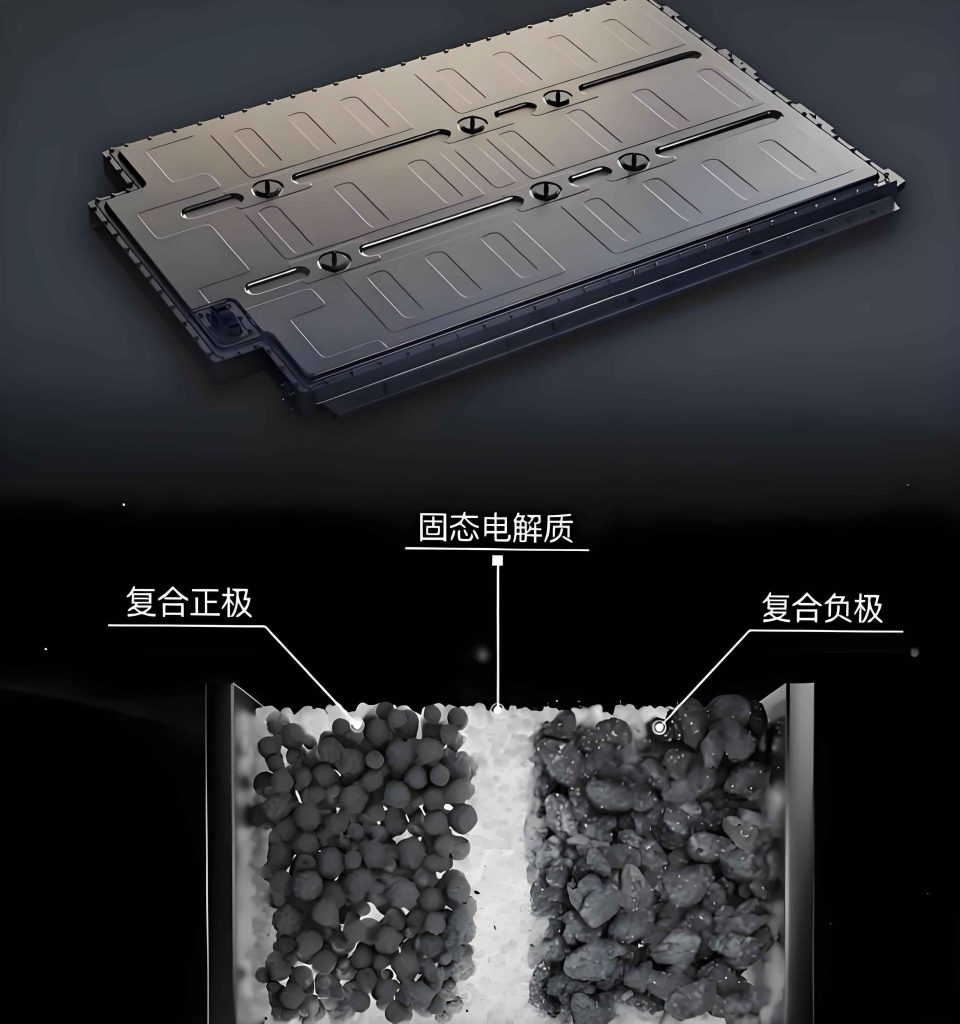
The operating principle of a solid-state battery is similar to that of traditional batteries, but with thin-film materials replacing the separator and liquid electrolyte. During charging, sodium ions de-intercalate from the cathode, migrate through the thin-film solid electrolyte, and embed into the anode; during discharging, the reverse process occurs. This mechanism not only suppresses dendrite growth but also enhances safety and energy density. The advantages of thin-film solid electrolytes include higher energy density, lower self-discharge rates, excellent flexibility, and compatibility with semiconductor manufacturing processes, enabling integration into electronic chips. However, key difficulties persist due to the larger radius of sodium ions leading to lower migration rates, volume energy density limitations, electrochemical potential mismatches increasing interface impedance, mechanical strain during cycling, and challenges in achieving uniform wetting of active materials. Additionally, film thickness affects discharge rates, and balancing feasibility with high-rate performance remains a hurdle for thin-film solid-state battery development.
The ionic conductivity of solid electrolytes is a critical parameter, often described by the Arrhenius equation: $$ \sigma = \sigma_0 \exp\left(-\frac{E_a}{kT}\right) $$ where \(\sigma\) is the ionic conductivity, \(\sigma_0\) is the pre-exponential factor, \(E_a\) is the activation energy, \(k\) is Boltzmann’s constant, and \(T\) is the temperature. For sodium-ion transport, the conductivity can also be expressed as: $$ \sigma = n e \mu $$ where \(n\) is the carrier concentration, \(e\) is the electron charge, and \(\mu\) is the mobility. Optimizing these factors is essential for improving the performance of solid-state batteries.
| Electrolyte Type | Example Material | Ionic Conductivity (mS/cm) | Key Features | Application in Solid-State Battery |
|---|---|---|---|---|
| Oxide | Na3.4Zr1.9Zn0.1Si2.2P0.8O12 | 5.27 | High stability, element doping enhances conductivity | Used in FeS2||PDA-Na3.4Zr1.9Zn0.1Si2.2P0.8O12||Na battery with 300 cycles at 0.5C |
| Sulfide | Na3PS4 | 32 | High room-temperature conductivity, good plasticity | Potential for high-performance sodium-sulfur solid-state batteries |
| Halide | NaTaCl6 | 4 | Good electrochemical stability, amorphous structure | Enables long cycling (1,500 cycles with 98% capacity retention at 0.5C) |
| Organic-Inorganic Composite | PEGDA-SCN-NaClO4-Na3Zr2Si2PO12 | 0.0338 | Flexibility, low cost, improved interface compatibility | Used in all-solid-state Na battery with 200 cycles at 0.1C and 77% capacity retention |
| Polymer | PEO/NaTFSI | 0.165 | Good flexibility, easy processing | Baseline for composite electrolytes in solid-state battery designs |
Inorganic solid electrolytes are categorized into oxides, sulfides, and halides. Oxide solid electrolytes, such as NASICON-type Na1+xZr2SixP3-xO12 (0 ≤ x ≤ 3) and Na-β”-Al2O3, offer high ionic conductivity and stability. For instance, doping strategies can enhance conductivity, as seen in Na3.5-xMn0.5V1.5-xZrx(PO4)3/C materials. The ionic conductivity often follows a doping-dependent relation: $$ \sigma \propto \exp(-\Delta G / kT) $$ where \(\Delta G\) is the Gibbs free energy change for ion migration. Sulfide solid electrolytes, like Na3PS4 and Na2.88Sb0.88W0.12S4, exhibit superior room-temperature conductivity but face challenges like polysulfide shuttle effects in sodium-sulfur solid-state batteries. Halide solid electrolytes, such as NaTaCl6, provide good oxidation stability but require further optimization for higher conductivity. The performance of these inorganic materials is crucial for advancing solid-state battery technology.
Organic materials include polymer electrolytes and organic-inorganic composites. Polymer electrolytes, based on poly(ethylene oxide) (PEO) or derivatives, rely on chain segment motion for ion transport: $$ D = D_0 \exp(-E_d / RT) $$ where \(D\) is the diffusion coefficient, \(D_0\) is a constant, \(E_d\) is the activation energy for diffusion, \(R\) is the gas constant, and \(T\) is the temperature. These materials offer flexibility and low-cost processing but typically have lower ionic conductivity. Organic-inorganic composites, such as PEO-based systems with Na3Zr2Si2PO12 fillers, combine the advantages of both, improving mechanical strength and conductivity. For example, a composite solid polymer electrolyte (CPE) with Na-β”-Al2O3 showed an ionic conductivity of 0.819 mS/cm at 80°C, higher than pure polymer electrolytes. Such composites are promising for enhancing the interface compatibility and cycle stability of sodium-ion solid-state batteries.
Other materials, such as metal-glass types, carbon-based materials, and ionic liquid-based systems, offer unique properties. Metal-glass materials, with amorphous structures, can provide abundant ion migration paths. Carbon-based materials, like carbon nanotubes and graphene, enhance conductivity and mechanical stability. Ionic liquid-based materials offer wide electrochemical windows and efficient ion transport. These alternatives expand the potential applications of thin-film solid electrolytes in solid-state batteries, but they require further research to address issues like low ion migration numbers and high interface resistance.
The key problems in thin-film solid electrolytes for sodium-ion solid-state batteries include: (1) insufficient ionic conductivity, especially in organic materials; (2) high interface impedance between electrolyte and electrodes; (3) high preparation costs for some materials; (4) issues like dendrite growth and interface degradation affecting battery life and safety; and (5) limited environmental adaptability under extreme temperatures. To solve these, we propose several approaches. For material optimization, element doping and structural design can enhance conductivity—for instance, doping in NASICON-type materials. Composite development balances properties, while new materials like metal-glass types offer innovation. Interface optimization involves introducing buffer layers or artificial interface layers to reduce impedance. For example, a SnO2-coated Na3.4Zr2Si2.4P0.6O12 electrolyte improved interface stability. Preparation process simplification, such as using solution casting or 3D printing, can lower costs. Battery structure optimization and system integration with smart management can enhance efficiency and longevity. Environmental adaptability can be improved through material modifications and advanced encapsulation techniques.
In conclusion, thin-film solid electrolytes play a pivotal role in advancing sodium-ion solid-state batteries by addressing safety and energy density concerns. Through material innovations, interface engineering, and process optimizations, significant progress has been made in oxides, sulfides, halides, and organic-inorganic composites. However, challenges remain in achieving high ionic conductivity, low interface resistance, and cost-effective large-scale production. Future research should focus on element doping strategies, novel material designs, and scalable manufacturing techniques to unlock the full potential of solid-state batteries. By overcoming these hurdles, thin-film solid electrolytes can enable the widespread adoption of sodium-ion solid-state batteries for efficient, safe, and sustainable energy storage solutions, contributing to the global energy transition. The continuous evolution of solid-state battery technology will rely on interdisciplinary efforts to optimize every component, from electrolytes to electrodes, ensuring robust performance in real-world applications.
| Challenge | Solution Strategy | Expected Outcome for Solid-State Battery | Mathematical Representation |
|---|---|---|---|
| Low ionic conductivity | Element doping, composite materials | Increased conductivity to >10 mS/cm for practical use | $$ \sigma_{\text{enhanced}} = \sigma_0 + \alpha C_{\text{dopant}} $$ where \(\alpha\) is a doping coefficient |
| High interface impedance | Interface layers, surface modification | Reduced impedance by 50-80%, improved cycle life | $$ R_{\text{interface}} = R_0 \exp(-\beta t) $$ with \(\beta\) as decay constant |
| Dendrite growth | Mechanical reinforcement, electrolyte design | Suppressed dendrites, enhanced safety of solid-state battery | Critical current density \(J_c \propto \sqrt{\frac{E}{\rho}} \) where \(E\) is Young’s modulus |
| High cost | Scalable processes, abundant materials | Cost reduction by 30-50% for commercialization | $$ \text{Cost} \approx \frac{C_{\text{material}} + C_{\text{process}}}{N_{\text{cycles}}} $$ |
| Temperature sensitivity | Material stabilization, encapsulation | Operation from -40°C to 100°C for solid-state battery | $$ \sigma(T) = \sigma_{\text{ref}} \exp\left[-\frac{E_a}{k}\left(\frac{1}{T} – \frac{1}{T_{\text{ref}}}\right)\right] $$ |
The development of thin-film solid electrolytes is integral to the success of sodium-ion solid-state batteries. By leveraging advanced materials science and engineering principles, we can overcome existing limitations and pave the way for next-generation energy storage. The integration of nanomaterials, for instance, can further enhance properties through effects like filling, nucleation, and electromagnetic modulation. As research progresses, the synergy between theoretical models and experimental validation will drive innovations, making solid-state batteries more competitive with traditional lithium-ion systems. Ultimately, the goal is to achieve a sustainable energy future where solid-state batteries provide reliable and efficient power for various applications, from electric vehicles to grid storage.