
As we look toward the future of urban mobility, the adoption of advanced electric drive systems has become a cornerstone for sustainable transportation. In our efforts to innovate and deliver efficient solutions, we have developed a central electric drive system that addresses the critical needs of modern buses and commercial vehicles. This article delves into the technical intricacies, design philosophy, and broad applications of our electric drive system, emphasizing how it enhances performance, reduces energy consumption, and integrates seamlessly into existing platforms. Throughout this discussion, the term “electric drive system” will be frequently highlighted to underscore its importance in transforming public transport.
The core of our approach lies in a plug-and-play design philosophy, which allows our electric drive system to be integrated into current vehicle platforms without significant modifications to the chassis, axles, or differentials. This flexibility enables manufacturers to transition from conventional to electrified models on the same platform, thereby reducing development time and costs. Our electric drive system is engineered for high lightweighting and energy efficiency, making it ideal for electric bus applications where weight and power consumption are paramount. By focusing on modularity, we ensure that our electric drive system can adapt to various vehicle architectures, promoting widespread adoption in the industry.
In large new energy commercial vehicles, the demand for high power and torque often leads to challenges with central direct-drive motors, which tend to be bulky and heavy, compromising vehicle lightweighting. Moreover, direct-drive systems exhibit lower efficiency at low-speed conditions, hindering energy savings and emission reductions. To overcome these issues, our electric drive system incorporates a deeply integrated design combining a mature planetary gear reduction mechanism with a permanent magnet synchronous motor. This integration allows for a reduction in motor size and cost while maintaining the same output torque, as expressed by the torque relationship: $$ T_{output} = T_{motor} \times i $$ where \( i \) is the gear reduction ratio. By optimizing this ratio, our electric drive system operates more frequently in high-efficiency zones, contributing to lower vehicle energy consumption. The efficiency of the entire electric drive system can be modeled as: $$ \eta_{system} = \eta_{motor} \times \eta_{gearbox} \times \eta_{controller} $$ where each component’s efficiency impacts overall performance. For instance, with typical values of \( \eta_{motor} = 0.95 \), \( \eta_{gearbox} = 0.98 \), and \( \eta_{controller} = 0.97 \), the system efficiency reaches approximately 0.90, demonstrating the advantages of our integrated approach.
| Parameter | Value | Unit |
|---|---|---|
| Maximum System Output Torque | 3200 | Nm |
| Application Range | 10m+ City Buses, Road Coaches, Trucks, Logistics Vehicles | – |
| Design Standard | ISO26262, ASIL C | – |
| Integration Type | Planetary Gear with Permanent Magnet Synchronous Motor | – |
| Efficiency at Peak Load | >90% | – |
| Weight Reduction Compared to Direct-Drive | Up to 15% | – |
Our electric drive system is developed in accordance with the ISO26262 functional safety standard, achieving ASIL C level, which ensures reliability and safety in diverse operating conditions. This commitment to safety is integral to our electric drive system, as it mitigates risks associated with high-torque applications in urban environments. The system is supplied as a complete package, including the central electric drive unit, motor controller, and drive force controller. This holistic solution provides manufacturers with optimal performance, efficiency, and longevity, further saving time and costs. The table above summarizes key specifications of our electric drive system, illustrating its capability to meet the demands of various vehicle types.
The advantages of our electric drive system extend beyond technical specifications. By enabling more efficient operation across speed ranges, it reduces overall energy consumption, which can be quantified using the energy equation: $$ E_{consumed} = \int P_{motor}(t) \, dt $$ where \( P_{motor}(t) \) is the power output of the motor over time. With our system, the power profile is optimized to minimize this integral, leading to extended range and lower operating costs. Additionally, the lightweight design contributes to reduced vehicle mass, enhancing acceleration and handling. The integration of the electric drive system into existing platforms is facilitated by standardized interfaces, as shown in the compatibility matrix below:
| Vehicle Platform Type | Integration Complexity | Estimated Modification Time |
|---|---|---|
| Low-Floor City Bus | Low | 2-3 weeks |
| High-Floor Coach | Medium | 4-5 weeks |
| Electric Truck | Low to Medium | 3-4 weeks |
| Logistics Delivery Vehicle | Low | 1-2 weeks |
This streamlined integration underscores the versatility of our electric drive system, making it a viable option for rapid fleet electrification. In urban public transport, where downtime must be minimized, such efficiency is crucial. Our electric drive system also incorporates advanced thermal management, which can be analyzed using the heat dissipation formula: $$ Q = h \cdot A \cdot \Delta T $$ where \( Q \) is the heat transfer rate, \( h \) is the convective heat transfer coefficient, \( A \) is the surface area, and \( \Delta T \) is the temperature difference. By optimizing these parameters, we ensure that the electric drive system maintains optimal temperature ranges, prolonging component life and maintaining performance under heavy loads.
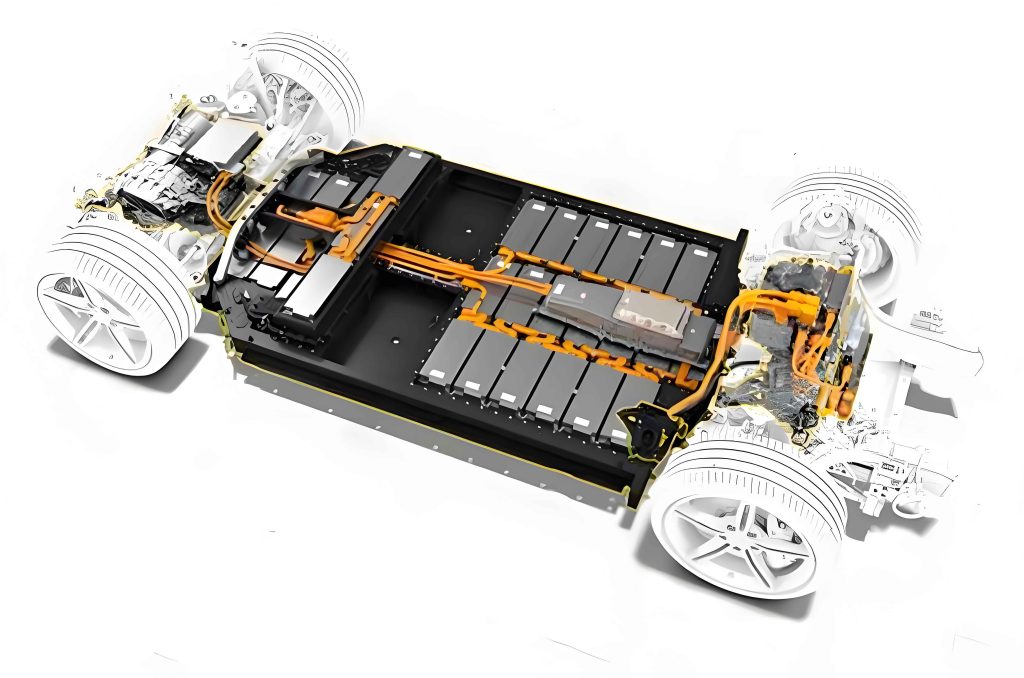
The visual representation above highlights the compact and integrated nature of our electric drive system, showcasing its potential for seamless installation in vehicle chassis. This design not only saves space but also enhances overall vehicle dynamics by lowering the center of gravity. As we continue to refine our electric drive system, we focus on scalability to accommodate different power requirements. For example, the torque-speed characteristics can be modeled using the equation: $$ T = k \cdot \Phi \cdot I $$ where \( k \) is a motor constant, \( \Phi \) is the magnetic flux, and \( I \) is the current. By adjusting these variables, our electric drive system can be tailored for specific applications, from light-duty vans to heavy-duty buses.
Looking ahead, the mass production of our electric drive system is poised to begin, with expectations to serve domestic and international markets. This rollout will further demonstrate the reliability and efficiency of our electric drive system in real-world conditions. We anticipate that widespread adoption will lead to significant reductions in greenhouse gas emissions, aligning with global sustainability goals. The economic benefits are also substantial, as the reduced energy consumption lowers operational costs for transport operators. For instance, the annual energy savings for a city bus fleet can be estimated using: $$ Savings = (E_{conventional} – E_{electric}) \cdot Price_{energy} \cdot Fleet_{size} $$ where \( E_{conventional} \) and \( E_{electric} \) are the energy consumptions per vehicle. With our electric drive system, \( E_{electric} \) is minimized, resulting in higher savings.
In conclusion, our electric drive system represents a significant leap forward in the electrification of public transport. By combining innovative design with rigorous safety standards, it offers a practical and efficient solution for modern vehicles. The repeated emphasis on the electric drive system throughout this article underscores its pivotal role in shaping the future of mobility. As technology evolves, we remain committed to enhancing our electric drive system, ensuring it meets the ever-growing demands for cleaner, smarter, and more reliable transportation. The journey toward full electrification is complex, but with advanced electric drive systems, it becomes an achievable and impactful reality.