
The continuous evolution of automotive electrification is driving a strong trend towards the integration of components. Among the various solutions emerging, the integrated “three-in-one” electric drive assembly has become a focal point of competition for manufacturers. Compared to earlier electric drive solutions, the integrated electric drive system offers significant advantages: a more compact structure and reduced volume, facilitating vehicle layout; lighter weight, contributing to lower driving energy consumption; direct three-phase connection, enhancing reliability and cost-effectiveness; a lower center of gravity, improving vehicle handling; high-speed transmission, enabling higher torque capacity and improved overall system efficiency; and a modular design philosophy that supports scalability, significantly shortening product development cycles and reducing development costs.
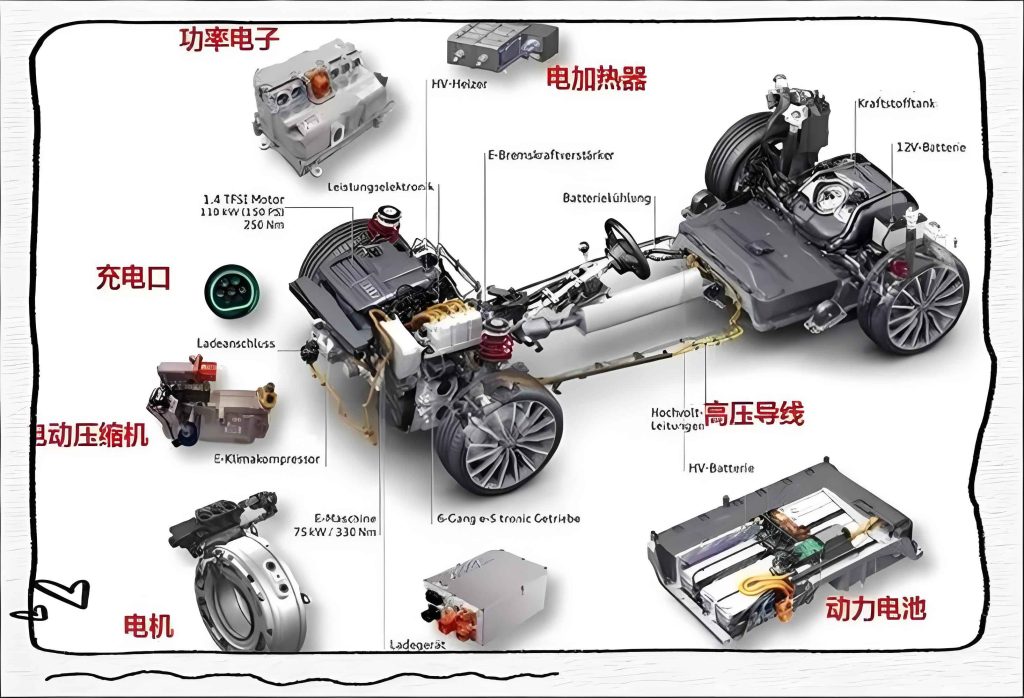
The integrated electric drive system discussed here is primarily composed of three core subsystems: the motor controller, the gear reducer, and the traction motor. This architecture represents a departure from the traditional approach of designing these units separately and then assembling them. Instead, it embodies a holistic, co-engineered design where the controller, motor, and gearbox are developed as a single, optimized entity. This integrated design offers the benefits of high torque density and compatibility with higher-speed motors. However, it concurrently imposes more stringent demands on the durability of gears and bearings, the strength of the housing, and the sealing performance of oil seals. Crucially, the operating environment for the motor controller changes fundamentally—it must function as an integral part of the motor assembly. This shift makes its reliability requirements even more critical than in conventional, decoupled designs. Therefore, establishing a robust and representative reliability validation methodology for the integrated electric drive system is of paramount importance.
An integrated electric drive system is a complex amalgamation of mechanical and electronic components. Its overall reliability depends not only on the inherent reliability of each sub-module but also on their combination, interfaces, and mutual compatibility. This article focuses on the methodology for validating the mechanical and electro-mechanical reliability of the integrated electric drive system, exploring the principles, selection of technical requirements, and application of tailored test cycles.
Theoretical Basis for Electric Drive System Reliability Research
In the automotive context, product reliability is defined as the ability or probability to perform a specified function without failure under stated conditions and for a specified period. For mechanical structures within an electric drive system, approximately 90% of failures originate from fatigue. Reliability can thus be closely aligned with durability. For non-repairable structural failures, reliability is essentially synonymous with durability until catastrophic failure. For repairable systems, reliability relates to the durability corresponding to major overhaul intervals, end-of-life, or retirement periods.
The integrated electric drive system is the heart of an electric vehicle. Its mean time between failures is a critical factor influencing customer satisfaction. Given the extended lifetime requirements (often several hundred thousand kilometers) and the impracticality of conducting full-duration tests, accelerated life testing (ALT) is universally adopted for mechanical systems. ALT aims to induce equivalent damage or failure mechanisms observed in field use within a significantly shorter laboratory timeframe by applying elevated stress levels (e.g., higher loads, temperatures, or duty cycles) in a controlled manner. The core principle is to establish a quantifiable relationship between the applied acceleration stress and the product’s lifetime, allowing for the reasonable extrapolation of field life from test data. The successful application of ALT for an electric drive system hinges on correctly identifying the dominant failure modes and selecting appropriate accelerating factors that do not introduce non-representative failure mechanisms.
Historically, when the motor, controller, and reducer were designed and validated as separate units, manufacturers in certain regions relied on established standards. For drive motor systems, standards such as GB/T 18488.1 (technical conditions) and GB/T 29307 (reliability test methods) were referenced. For gear reducers in pure electric passenger vehicles, QC/T 1022 was often applied. However, the integrated nature of the modern three-in-one system demands a more cohesive and system-level approach to reliability testing, moving beyond the simple concatenation of component-level tests.
Selection and Application of Key Technical Requirements for Reliability Testing
Selection of Mechanical Load Reliability Test Methods for Electronic/Electrical Components
Within the integrated electric drive system, the electronic control unit (ECU), sensors, and connectors are subjected to the same mechanical vibration environment as the mechanical parts. Validating their mechanical robustness is essential. For this purpose, the ISO 19453-3:2018 standard is selected over other general automotive environmental standards like ISO 16750 for several compelling reasons:
- It is specifically developed for the environmental conditions and testing of electrical and electronic equipment in the drive systems of electric propulsion vehicles.
- It provides a more detailed classification of mounting locations for electronic/electrical components, allowing for more precise test severity selection.
- The standard clearly correlates test severity levels with target vehicle mileage. This allows for straightforward adaptation of requirements if the target lifetime mileage changes, using the scaling methods provided in the standard.
- Compared to older standards, ISO 19453-3’s definition of “rough road” vibration profiles has been updated to reflect improvements in road infrastructure, making the test more representative of modern driving conditions.
- It maintains a sufficient number of stress cycles (on the order of 10^7) to provoke fatigue-related failures.
- It mandates that sinusoidal vibration tests cover at least one complete temperature cycle, ensuring the evaluation of thermal-mechanical interactions.
Based on ISO 19453-3, the derived mechanical load reliability requirements for the electronic/electrical components within our three-in-one electric drive system are summarized in the table below. These tests are to be conducted under high and low temperature cycling conditions to simulate real-world environmental stresses.
| Test Type | Frequency Range | Severity | Duration per Axis |
|---|---|---|---|
| Random Vibration | 10 – 100 Hz | 21.4 m/s² RMS (max) | 10 hours |
| Sine-on-Random (Sine) | 100 – 440 Hz | 50 m/s² (max) | 33 hours |
| Sine-on-Random (Random) | 500 – 2000 Hz | 68.7 m/s² RMS (max) | 33 hours |
Application of Mechanical Reliability Test Methods for Motor and Reducer
Analysis of Conventional Motor Reliability Test Methods
A widely referenced reliability test method for electric drive motor systems, similar to methodologies used for internal combustion engines, employs a fixed-speed, variable-torque operating profile across three different voltage levels. A single test cycle is characterized by sequences of constant torque, peak torque, and regenerative torque phases. The total test duration in such standards is often fixed (e.g., 402 hours), divided into segments at rated, maximum, and minimum voltages. While this method has been a mainstay, its direct application to an integrated electric drive system reveals several limitations:
- Unclear Mileage Representation: The fixed test duration (e.g., 402 hours) is not explicitly correlated to a target vehicle lifetime mileage, making it difficult to assess coverage.
- Lack of Reverse Operation: The typical cycle does not include operation in the reverse direction, which can produce distinct loading conditions on gears and bearings.
- Ambiguous Temperature Conditions: The standard often lacks precise specifications for coolant or ambient temperature during the test. The temperature delta between operating points and material limits is not explicitly managed, whereas temperature is a key accelerator for many failure modes.
- Vague Performance Degradation Criteria: Clear pass/fail criteria based on allowable performance decay (e.g., efficiency drop, torque output reduction) are usually not well-defined.
- Limited Speed Coverage: The test often runs at a single, relatively low speed (e.g., around 30% of peak motor speed). This approach, borrowed from engine testing, overlooks a fundamental difference: multi-speed transmissions allow engines to operate at varied output speeds even at peak power. A modern high-speed electric drive system operates across a much wider speed range, and high-speed conditions induce unique stresses (e.g., increased gear sliding velocity, higher bearing DN values, increased risk of gear scuffing, greater dynamic loads). A single low-speed cycle is insufficient to validate reliability across the entire operational envelope.
Developing a Tailored Reliability Test Cycle for the Integrated Electric Drive System
To address the limitations above, a tailored reliability validation methodology for the integrated system is developed. The core of this methodology is the derivation of a representative duty cycle that correlates lab test time to field mileage and covers critical operating conditions.
1. Cycle Development Based on Cumulative Damage Equivalence:
The goal is to define a laboratory test cycle that produces equivalent cumulative damage at the gearbox output shaft as the target vehicle would experience over its entire design life (e.g., 320,000 km). The process involves:
- Acquiring a representative vehicle drive cycle (e.g., a 202 km synthetic or real-world route profile).
- Using vehicle simulation software (e.g., AVL CRUISE, GT-SUITE) with detailed models of the vehicle and the integrated electric drive system to generate time-series data of output speed and torque (including regenerative braking) for the electric drive system.
- Applying the Palmgren-Miner linear damage accumulation rule to convert the complex operational profile into a quantifiable damage number. The damage $D_i$ from a stress block $i$ with torque $T_i$ and cycles $N_i$ is calculated relative to the material’s S-N curve. The total damage $D_{total}$ over the target mileage is the sum of damages from all stress blocks.
$$ D_i = \frac{N_i}{N_{f,i}} $$
Where $N_{f,i}$ is the number of cycles to failure at stress level $T_i$. For gear bending fatigue, $N_{f,i}$ is often related to $T_i$ by a power law (e.g., from standards like ISO 6336 or GB/T 3480). A simplified form of the damage calculation for a load spectrum can be expressed as:
$$ D_{total} = \sum_{i} \frac{n_i}{C \cdot T_i^{-m}} $$
where $n_i$ is the number of applied cycles at torque $T_i$, and $C$ and $m$ are material constants derived from the S-N curve. - Analyzing the distribution of damage contribution across different speed and torque bands. Empirical data from transmission testing suggests that a significant portion (e.g., 40-50%) of output shaft damage often occurs in lower speed ranges (<50 km/h equivalent), while high-speed operation (>100 km/h equivalent) may contribute 20-25%.
- Designing an accelerated laboratory cycle that replicates this damage distribution profile but with higher load factors and/or condensed timeframes to achieve the target $D_{total}$ in a practical test duration. The cycle time in the lab is compressed, but the applied loads are designed to produce an equivalent damage accumulation rate.
2. Integration of Temperature Management:
Temperature is a critical accelerating factor and a performance limiter. The test protocol must include active thermal management:
- The cooling system capacity must be representative of the vehicle application.
- The test cycle must ensure that critical component temperatures (e.g., magnet temperature in the motor, oil temperature in the gearbox, semiconductor junction temperature in the controller) remain below their specified maximum limits but are allowed to reach realistically high operational levels to accelerate relevant aging processes.
- Coolant inlet temperature is often cycled between high and low setpoints to induce thermal stresses on seals, housings, and electrical connections.
3. Definition of Performance Degradation Criteria:
Clear pass/fail criteria are established based on measurable performance parameters. After completing the reliability test sequence, performance is compared to baseline measurements. Failure is indicated if degradation exceeds thresholds such as:
- More than a 5-10% reduction in peak torque or power output.
- More than a 5% decrease in system efficiency at key operating points.
- Excessive increase in noise or vibration levels beyond specified limits.
- Any functional failure, leakage, or mechanical breakdown.
4. Inclusion of Extended High-Speed and Reverse Operation:
The derived test cycle explicitly includes sustained high-speed operating points to validate the performance of bearings, seals, and gears under high DN (bore diameter × speed) conditions and to assess the risk of gear scuffing. Furthermore, periodic reverse operation segments are incorporated to load components in the opposite direction.
By synthesizing these elements—damage equivalence, thermal management, clear degradation criteria, and extended operational coverage—a new, enhanced reliability test cycle is derived. This cycle moves beyond the simple fixed-speed profile. It is a variable-speed, variable-torque cycle that includes high-speed dwells, reverse operation, and regenerative braking phases, all while managing thermal conditions. This comprehensive cycle is executed for a laboratory duration that is calculated, via the accelerated damage model, to be equivalent to the vehicle’s target lifetime mileage. The relationship between lab test time $t_{lab}$ and field mileage $L_{field}$ can be conceptually framed using an acceleration factor $AF$:
$$ t_{lab} = \frac{L_{field}}{v_{eq} \cdot AF} $$
where $v_{eq}$ is an equivalent average speed for damage accumulation, and $AF$ aggregates the effects of increased load severity, focused duty cycle, and temperature in the lab compared to the field.
The mechanical reliability validation of the integrated electric drive system therefore rests on a dual-pillar approach: rigorous mechanical vibration testing for electronic components based on the latest specialized standard, and a tailored, damage-equivalent mechanical duty cycle test for the motor and gearbox assembly that addresses the gaps in conventional methods.
Conclusion
The pursuit of reliable integrated electric drive systems necessitates a sophisticated and system-level approach to validation. This research outlines a comprehensive methodology grounded in the principle of accelerated life testing.
Firstly, for the mechanical robustness of electronic and electrical sub-components, a critical analysis of existing standards led to the selection of ISO 19453-3. This standard is deemed superior due to its specificity for electric propulsion systems, detailed component classification, clear mileage correlation, updated environmental profiles, and integrated thermal-mechanical testing requirements. The technical specifications derived from it provide a relevant and rigorous benchmark for this aspect of the integrated electric drive system’s reliability.
Secondly, for the core mechanical reliability of the motor and gearbox assembly, a thorough examination of conventional test methods revealed significant limitations, including unclear mileage correlation, lack of reverse and high-speed operation, ambiguous temperature conditions, and vague failure criteria. To address these shortcomings, a tailored methodology was developed. This methodology is based on correlating laboratory test time to field mileage through cumulative damage equivalence calculations using vehicle drive cycles and simulation. It mandates explicit thermal management, defines clear performance degradation thresholds, and incorporates critical high-speed and reverse operating conditions into the derived test cycle. This results in a more representative and punishing validation profile that thoroughly exercises the integrated electric drive system across its entire intended operational envelope, ensuring that potential failure modes are precipitated and detected in a controlled laboratory environment within a reasonable timeframe.
In summary, the proposed framework—combining state-of-the-art environmental stress screening for electronics with a physics-based, damage-equivalent accelerated life test for the electro-mechanical powertrain—provides a more rational, comprehensive, and effective approach to verifying the long-term durability and reliability of integrated three-in-one electric drive systems. This methodology ensures that the final product is not only functionally integrated but also reliably validated as a cohesive system.