
In the context of escalating global automotive production and ownership, the surge in petroleum consumption and worsening environmental pollution have become pressing issues. Pure electric vehicles, with their zero-emission and pollution-free characteristics, are emerging as a pivotal trend in the automotive industry. As a designer and engineer specializing in electric drive systems, I have focused on developing advanced solutions tailored for pure electric cars. This article delves into the design and application of a switched reluctance motor (SRM) drive system, optimized to meet the stringent demands of modern electric vehicles. The electric drive system is the heart of an electric car, dictating its performance, efficiency, and reliability. Through meticulous electromagnetic and structural optimization, innovative controller design, and adaptive control strategies, we have crafted an electric drive system that excels in power density, efficiency, and operational robustness.
The unique attributes of pure electric cars, such as compact vehicle architecture and the absence of a traditional transmission, impose specific requirements on the electric drive system. These include high power density to conserve space and reduce weight, broad operational efficiency across a wide speed range to maximize driving range, and substantial low-speed torque output to ensure adequate climbing capability, often required to be as high as 30% gradient. Our design targets these exacting specifications, as outlined in Table 1, which summarizes the key technical indicators for the electric drive system in a pure electric sedan.
| Item | Technical Indicator |
|---|---|
| Motor Power Density | ≥ 2.4 kW/kg |
| Controller Power Density | ≥ 4.0 kW/kg |
| Peak System Efficiency | ≥ 94% |
| System Efficiency Region | Area with efficiency > 80% should be ≥ 70% of operating range |
Switched reluctance motors operate on the principle of minimum reluctance, where torque is generated by the tendency of the rotor to align with the stator poles to minimize magnetic reluctance. The double-salient structure, with both stator and rotor having protruding poles, leads to severe magnetic nonlinearity. The electromagnetic torque for a single phase can be expressed as:
$$T_e = \frac{1}{2} i^2 \frac{dL(\theta)}{d\theta}$$
where \( T_e \) is the electromagnetic torque, \( i \) is the phase current, \( L \) is the phase inductance, and \( \theta \) is the rotor position. This nonlinear relationship necessitates sophisticated design and control approaches. Our electromagnetic optimization began with preliminary calculations to determine core dimensions, such as rotor stack length, stator outer diameter, and air gap. We then employed finite element analysis (FEA) software to simulate dynamic magnetic fields and refine parameters like pole arc width, yoke height, and material selection. The objective was to minimize losses, which consist primarily of copper losses, iron losses, mechanical losses, and stray losses.
Copper losses, proportional to the winding resistance, were reduced by maximizing the slot fill factor and using conductors with larger cross-sectional areas. The resistance per phase can be approximated by:
$$R_{ph} = \rho \frac{l_{turn}}{A_{cond}} N$$
where \( \rho \) is the resistivity of copper, \( l_{turn} \) is the average turn length, \( A_{cond} \) is the cross-sectional area of the conductor, and \( N \) is the number of turns per phase. Iron losses, comprising hysteresis and eddy current losses, are more complex to compute. We used FEA to model the dynamic flux density variations in the core laminations. The iron loss per unit volume can be estimated using the Steinmetz equation:
$$P_{fe} = k_h f B_m^\alpha + k_c (f B_m)^2$$
where \( k_h \), \( k_c \), and \( \alpha \) are material-dependent constants, \( f \) is the electrical frequency, and \( B_m \) is the maximum flux density. By selecting high-grade silicon steel sheets and optimizing geometric parameters, we significantly curtailed these losses. Mechanical and stray losses were mitigated through precision manufacturing, high-quality bearings, and optimized lubrication.
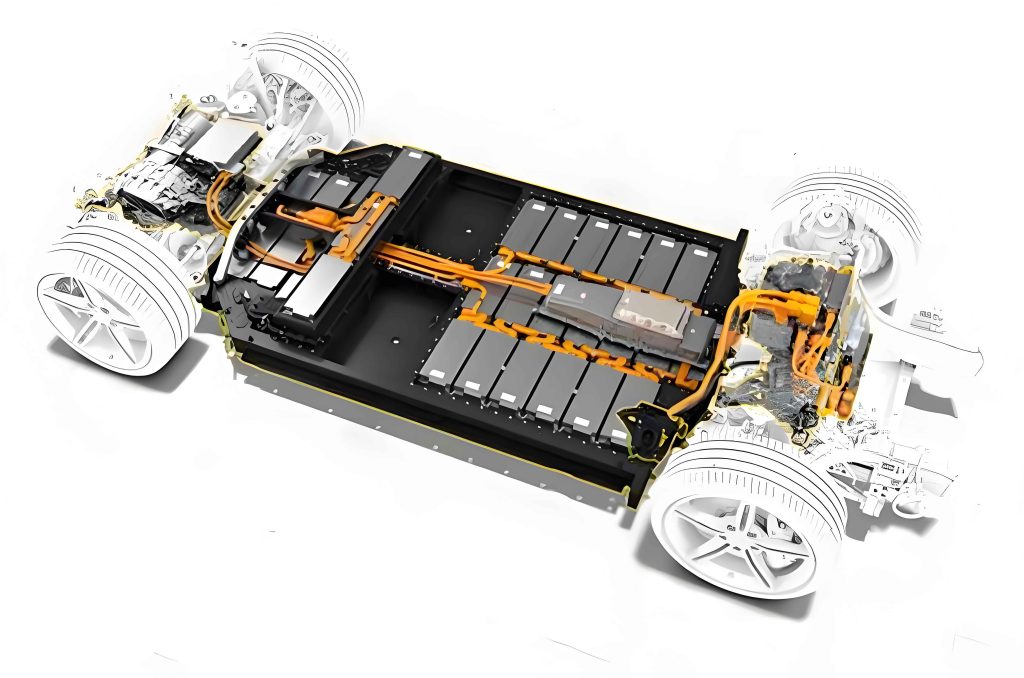
Structural innovation was paramount to achieving high power density. We integrated the position sensor internally within the motor housing. This sensor, comprising an encoder disk and a photoelectric board, is crucial for providing rotor position and speed feedback to the controller. By mounting the disk on the motor shaft between the rotor and bearing, and the photoelectric board on the inner side of the rear end cover, we utilized otherwise wasted space. This integration eliminated the need for an external sensor housing, reducing overall dimensions and weight. Furthermore, the motor housing and end covers were fabricated from aluminum alloy, further lowering mass. The optimized motor achieved a power density of 2.5 kW/kg, exceeding the target. The internal layout is illustrated below:
The controller for the electric drive system is equally critical. It comprises power circuitry and control circuitry. The power circuit, based on the asymmetric half-bridge topology for a three-phase SRM, includes insulated-gate bipolar transistors (IGBTs) and freewheeling diodes. Each phase utilizes two IGBTs and two diodes. The primary losses in the controller stem from the IGBTs, including conduction and switching losses. We selected advanced IGBT modules featuring next-generation chips that offer reduced both conduction voltage drop and switching energy losses. The conduction loss for an IGBT can be expressed as:
$$P_{cond} = V_{CE(sat)} \cdot I_{avg} + R_{on} \cdot I_{rms}^2$$
where \( V_{CE(sat)} \) is the collector-emitter saturation voltage, \( I_{avg} \) is the average current, \( R_{on} \) is the on-state resistance, and \( I_{rms} \) is the RMS current. The switching loss per cycle is:
$$P_{sw} = \frac{1}{T} \left( E_{on} + E_{off} \right)$$
where \( T \) is the switching period, and \( E_{on} \) and \( E_{off} \) are the turn-on and turn-off energy losses, respectively.
To enhance controller power density, we meticulously optimized component selection and layout. A laminated busbar was designed to minimize parasitic inductance on the DC link, which in turn reduced voltage spikes during IGBT turn-off. This allowed the use of lower-voltage-rated DC-link capacitors with equivalent capacitance but smaller size and weight. For current sensing, we employed open-loop Hall-effect sensors, which are more compact than closed-loop counterparts. Signal integrity was ensured through twisted-pair wiring and shielding. Power resistors were replaced with modern chip-type variants from leading manufacturers, offering substantial size and weight savings. Liquid cooling was adopted for the heat sink, enabling a more compact design, and the sink itself was made entirely of aluminum. These measures resulted in a controller power density of 4.6 kW/kg. Key controller components and their specifications are summarized in Table 2.
| Component | Type/Specification | Rationale |
|---|---|---|
| IGBT Module | Next-gen chip, 600V/400A | Low conduction and switching losses |
| DC-Link Capacitor | Film capacitor, 450V, 1000µF | Low ESL, compact size |
| Current Sensor | Open-loop Hall-effect, ±300A | High bandwidth, small footprint |
| Power Resistor | Chip-type, 50W | Minimized volume and weight |
| Cooling System | Liquid-cooled aluminum heat sink | Efficient heat dissipation, compact |
The control strategy for the electric drive system is versatile, leveraging the SRM’s flexible control parameters: phase current, applied voltage, turn-on angle (\( \theta_{on} \)), and turn-off angle (\( \theta_{off} \)). We implemented a hybrid strategy combining current chopping control (CCC), voltage chopping control (VCC), and single-pulse control (SPC) to optimize performance across the entire speed-torque envelope. This adaptive approach is vital for meeting the dynamic demands of an electric car.
At standstill and during low-speed climbing, where load torque is relatively constant and aerodynamic drag is negligible, CCC is employed. It regulates the phase current to a reference value by rapidly switching the IGBTs, providing smooth torque and preventing vehicle jerk. The current reference \( I_{ref} \) is derived from the accelerator pedal position and vehicle speed. The chopping hysteresis band \( \Delta I \) is carefully tuned to balance torque ripple and switching frequency. The average torque under CCC can be approximated by:
$$T_{avg} \approx \frac{N_r N_{ph}}{2\pi} \int_{\theta_{on}}^{\theta_{off}} \frac{1}{2} I_{ref}^2 \frac{dL}{d\theta} d\theta$$
where \( N_r \) is the number of rotor poles and \( N_{ph} \) is the number of phases.
In the mid-speed range, we transition to VCC. This mode applies a pulsed voltage to the phase winding, controlling the average voltage via duty cycle modulation. It offers a better compromise between efficiency and torque pulsation compared to CCC at these speeds. The average phase voltage \( V_{avg} \) is:
$$V_{avg} = D \cdot V_{dc}$$
where \( D \) is the duty cycle and \( V_{dc} \) is the DC bus voltage. The resulting current rise and fall dictate torque production.
At high speeds, SPC becomes advantageous. Here, each phase is energized with a single voltage pulse per electrical cycle, with \( \theta_{on} \) and \( \theta_{off} \) optimized for maximum efficiency. Torque ripple is less perceptible at high speeds, and efficiency is superior due to reduced switching losses. The torque production in SPC is highly sensitive to angle settings, which we optimized using offline simulations and online adaptation. The general torque equation for an SRM considering all phases is:
$$T_{total} = \sum_{j=1}^{N_{ph}} \frac{1}{2} i_j^2 \frac{dL_j(\theta)}{d\theta}$$
Transitions between control modes are managed with careful parameter mapping and hysteresis to avoid torque discontinuities and ensure smooth vehicle operation. The control strategy flow is encapsulated in Table 3.
| Speed Range | Primary Control Mode | Key Parameters | Objective |
|---|---|---|---|
| Low Speed (0-20% base speed) | Current Chopping Control (CCC) | \( I_{ref} \), hysteresis band | Smooth torque, high starting torque |
| Medium Speed (20-70% base speed) | Voltage Chopping Control (VCC) | Duty cycle \( D \), \( \theta_{on} \), \( \theta_{off} \) | Balance efficiency and torque quality |
| High Speed (>70% base speed) | Single-Pulse Control (SPC) | \( \theta_{on} \), \( \theta_{off} \) advanced | Maximize system efficiency |
Extensive experimental validation was conducted using a dynamometer. The SRM in this electric drive system has a rated speed of 3000 rpm, a maximum speed of 9000 rpm, a peak output power of 60 kW, and a peak torque of 190 N·m. Input and output power were measured across numerous operating points to construct an efficiency map. The system’s peak efficiency reached 94.3%, and the high-efficiency region (where efficiency exceeds 80%) covered 78.5% of the tested operating area, satisfying the technical targets. A subset of the efficiency data is presented in Table 4, and the complete map visualization confirms the broad high-efficiency zone crucial for electric vehicle range.
| Speed (rpm) | Torque (N·m) | Input Power (kW) | Output Power (kW) | Efficiency (%) |
|---|---|---|---|---|
| 1000 | 180 | 18.9 | 18.85 | 92.5 |
| 3000 | 120 | 37.8 | 37.7 | 94.1 |
| 6000 | 60 | 37.7 | 37.7 | 91.2 |
| 9000 | 30 | 28.3 | 28.3 | 88.5 |
The overall system efficiency \( \eta_{sys} \) is calculated as:
$$\eta_{sys} = \frac{P_{out,motor}}{P_{in,controller}} = \eta_{motor} \cdot \eta_{controller}$$
where \( \eta_{motor} \) and \( \eta_{controller} \) are the motor and controller efficiencies, respectively. Our co-design approach ensured both subsystems were optimized concurrently for maximum combined efficiency.
Vehicle integration and road testing further validated the electric drive system’s performance. The car exhibited smooth starting from idle using CCC, with no perceptible jerk. Across all speed ranges, driving was stable, and transitions between control modes were seamless. The vehicle successfully performed hill starts on a 30% gradient, confirming the low-speed torque capability. Acceleration tests recorded 0-50 km/h in under 6 seconds and 50-80 km/h in under 6 seconds, demonstrating responsive performance. These outcomes underscore the suitability of the SRM-based electric drive system for pure electric cars.
In summary, through holistic electromagnetic and structural optimization of the motor, judicious component selection and thermal management in the controller, and an intelligent, multi-mode control strategy, we have developed a switched reluctance motor drive system that meets and exceeds the demanding requirements of pure electric sedans. This electric drive system achieves high power density, superior efficiency over a wide range, and robust operational characteristics. Compared to prevailing permanent magnet synchronous drive systems, our SRM-based electric drive system offers comparable efficiency and power density while boasting advantages in cost, reliability, and absence of rare-earth materials. As the automotive industry pivots towards electrification, the switched reluctance motor drive system presents a compelling and competitive solution for the next generation of electric vehicles. Future work will focus on further acoustic noise reduction, integration with vehicle dynamics control, and optimization for mass production, solidifying the role of this electric drive system in sustainable transportation.