
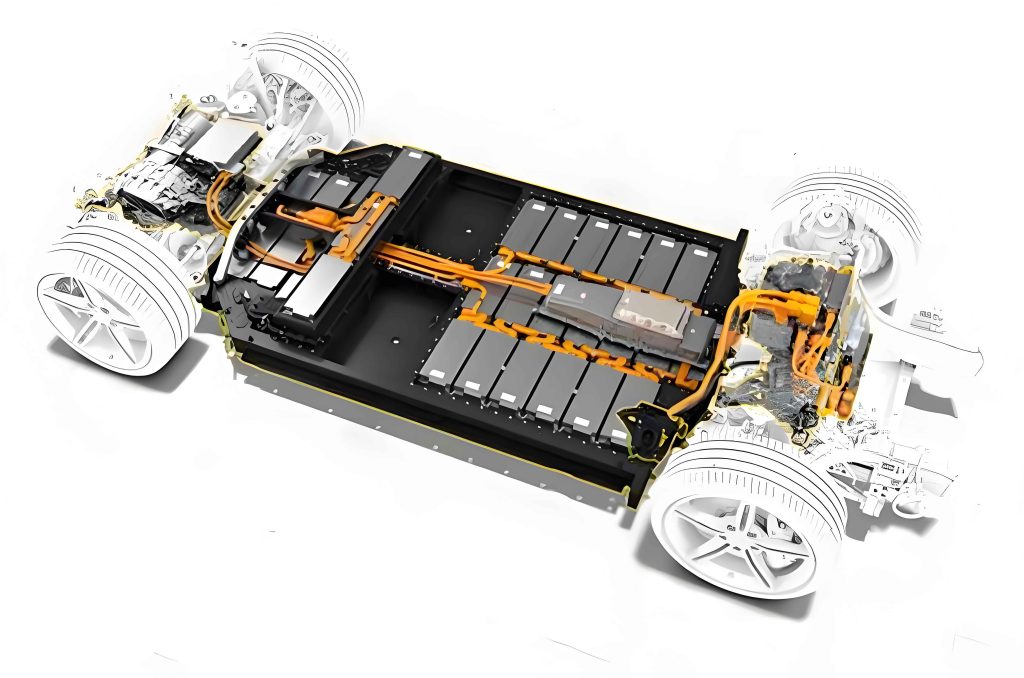
In the rapidly advancing global new energy vehicle industry, electrification has become an irreversible trend, driving innovations in electric drive system architectures. As both traditional automakers and new entrants develop mid-to-high-end new energy brands, the market share of electric vehicles continues to grow. In my work, I have focused on the dual-electric drive system architecture, which typically consists of dual motors, dual reducers, and an integrated controller. This configuration allows for single-side or synchronous dual-side driving, maximizing output at the wheel ends for enhanced performance. However, this architecture introduces unique NVH challenges, particularly beat frequency phenomena and elevated noise levels due to dual excitations. Through extensive testing and analysis, I have explored these issues and implemented optimization strategies to improve NVH performance.
The dual-electric drive system architecture leverages two motors arranged oppositely, each connected to a reducer, enabling independent or combined operation. This design optimizes torque and speed output but exacerbates NVH complexities. During vehicle operation, such as in turning scenarios where wheel speeds differ, the system is prone to beat frequency effects, where two similar frequency excitations interfere, causing amplitude modulation. This manifests as an unacceptable audible pulsation in both bench tests and整车 applications. My research aims to dissect these challenges and propose solutions through source reduction and path optimization.
The beat frequency phenomenon arises from the superposition of two harmonic waves with similar frequencies and amplitudes. Mathematically, if two waves are represented as $$y_1 = A \sin(2\pi f_1 t)$$ and $$y_2 = A \sin(2\pi f_2 t)$$, their superposition yields: $$y = y_1 + y_2 = 2A \cos\left(2\pi \frac{f_1 – f_2}{2} t\right) \sin\left(2\pi \frac{f_1 + f_2}{2} t\right)$$. Here, the amplitude varies at the beat frequency $$f_{\text{beat}} = |f_1 – f_2|$$, creating a pulsating effect. In a dual-electric drive system, this occurs when the motors operate at slightly different speeds, common during vehicle turns. For instance, consider a vehicle turning at speed $$v = 80 \text{ km/h} = 22.22 \text{ m/s}$$ with a turning radius $$R$$ between 250 m and 400 m. The angular velocity $$\omega$$ is given by $$\omega = \frac{v}{R}$$. Assuming a track width of $$2l$$ (where $$l$$ is half the track), the outer and inner wheel speeds are $$v_R = \omega (R + l)$$ and $$v_L = \omega (R – l)$$. With a total gear ratio $$i_g = 13.6$$, the motor speeds are $$n_R = \frac{v_R \cdot i_g}{2\pi r_w}$$ and $$n_L = \frac{v_L \cdot i_g}{2\pi r_w}$$, where $$r_w$$ is the wheel radius. The speed difference $$\Delta n = |n_R – n_L|$$ translates to a frequency difference that can induce beats. This fundamental mechanism underscores the need for careful design in electric drive system architectures.
During NVH bench testing, the beat frequency is clearly observable under conditions simulating road differentials. Subjective evaluations often deem it unacceptable, with noise colormaps showing distinct pulsations in the 450-560 Hz range. Similarly, in整车 tests, turning maneuvers elicit these effects, as differential speeds between wheels create motor speed disparities. To quantify, let’s define key parameters: for $$R = 250 \text{ m}$$, $$l = 0.75 \text{ m}$$ (typical for sedans), and $$r_w = 0.3 \text{ m}$$, we calculate: $$\omega = \frac{22.22}{250} = 0.0889 \text{ rad/s}$$, $$v_R = 0.0889 \times (250 + 0.75) = 22.28 \text{ m/s}$$, $$v_L = 0.0889 \times (250 – 0.75) = 22.16 \text{ m/s}$$. With $$i_g = 13.6$$, $$n_R = \frac{22.28 \times 13.6}{2\pi \times 0.3} \approx 160.5 \text{ rad/s} \approx 1532 \text{ RPM}$$, $$n_L = \frac{22.16 \times 13.6}{2\pi \times 0.3} \approx 159.6 \text{ rad/s} \approx 1524 \text{ RPM}$$. The difference $$\Delta n \approx 8 \text{ RPM}$$ corresponds to a low-frequency beat that can excite structural resonances. This analysis highlights the inherent risks in dual-electric drive systems and guides mitigation efforts.
Root cause analysis identifies electromagnetic and gear meshing excitations as primary contributors to beat frequency and noise. Through signal filtering and order tracking, I found that gear orders often dominate over electromagnetic orders, especially at higher speeds. The table below summarizes typical excitation sources and their characteristics in a dual-electric drive system:
| Excitation Source | Frequency Range | Contributing Factors | Impact on Beat Frequency |
|---|---|---|---|
| Electromagnetic Forces | Low-order (e.g., 2nd, 4th) and slot harmonics | Motor asymmetry, magnetic field interactions | Moderate, more pronounced at low speeds |
| Gear Meshing | Mesh frequency and harmonics | Transmission error, misalignment, tooth deflections | High, major contributor to beats and noise |
| Structural Resonances | Modal frequencies of housing and components | Insufficient stiffness, weak points in design | Amplifies beat effects through vibration |
To address these, I pursued a multi-faceted optimization approach targeting both active noise reduction (source) and passive noise reduction (path). For the electric drive system, this involved electromagnetic force optimization, gear design refinement, housing structural enhancements, and acoustic packaging. On the整车 side, I considered acoustic treatments for airborne noise paths.
Electromagnetic force optimization focuses on reducing radial forces that cause vibration and noise. In permanent magnet synchronous motors—common in electric drive systems—the radial electromagnetic force density $$P_r$$ can be expressed as: $$P_r = \frac{B_r^2}{2\mu_0}$$, where $$B_r$$ is the radial flux density and $$\mu_0$$ is the permeability of free space. By optimizing the motor’s electromagnetic design, such as through pole-slot combinations, skewing, and harmonic injection, low-order forces can be minimized. For instance, harmonic injection techniques adjust current waveforms to cancel specific force harmonics, effectively reducing noise at critical speeds. Additionally, improving manufacturing tolerances like coaxiality (targeting <0.2 mm) reduces low-order excitations. The table below compares electromagnetic performance before and after optimization:
| Parameter | Original State | Optimized State | Improvement |
|---|---|---|---|
| Radial Force at 1000 RPM (N) | 150 | 90 | 40% reduction |
| Low-Order Harmonic Amplitude | High | Low | Subjective noise reduction |
| Coaxiality (mm) | 0.25 | 0.15 | Meets target |
Gear optimization is critical, as meshing excitations are a dominant noise source. The transmission error (TE), defined as the deviation from ideal gear motion, is a key metric: $$\text{TE} = \theta_{\text{output}} – \theta_{\text{input}} \cdot i_g$$, where $$\theta$$ represents angular positions. By optimizing macro-geometry (e.g., pressure angle, module) and micro-geometry (e.g., tip and root relief), TE can be reduced. For example, through tooth profile modifications, I achieved a 55.3% reduction in TE, as shown in the formula: $$\text{TE}_{\text{optimized}} = 0.6 \ \mu\text{m}$$ compared to $$\text{TE}_{\text{original}} = 1.12 \ \mu\text{m}$$. Additionally, varying gear tooth counts between the two drive sides can shift meshing frequencies to avoid overlap with beat frequencies. The contact ratio $$\epsilon$$, calculated as $$\epsilon = \frac{\text{length of path of contact}}{\text{base pitch}}$$, was increased to above 2.0 for smoother engagement. Below is a summary of gear parameters before and after optimization:
| Gear Parameter | Original Design | Optimized Design | Impact on NVH |
|---|---|---|---|
| Transmission Error (μm) | 1.12 | 0.6 | Reduced vibration excitation |
| Contact Ratio | 1.8 | 2.2 | Smother meshing, lower noise |
| Tooth Misalignment (mm) | 0.05 | 0.02 | Decreased dynamic loads |
Housing optimization targets the structural path of vibration. Using CAE simulations, I evaluated modal properties, bearing seat dynamic stiffness, and radiation noise. The housing’s natural frequencies should avoid excitations from the electric drive system. For instance, the first bending mode frequency $$f_{\text{bending}}$$ is given by $$f_{\text{bending}} = \frac{1}{2\pi} \sqrt{\frac{k}{m}}$$, where $$k$$ is stiffness and $$m$$ is mass. Through topological optimization, I added ribbing and拱形 structures to increase stiffness. The table below lists key housing NVH metrics pre- and post-optimization:
| Housing Metric | Original State | Optimized State | Target |
|---|---|---|---|
| First Bending Mode (Hz) | 450 | 550 | >500 Hz |
| Bearing Seat Stiffness (N/μm) | 800 | 1200 | >1000 N/μm |
| Radiation Noise at 3000 RPM (dBA) | 70 | 60 | <65 dBA |
Acoustic packaging addresses airborne noise propagation. By combining吸声 materials (e.g., PU foam) and隔声 materials (e.g., PET/EVA composites), I designed a wrap-around package for the electric drive system, with thickness around 25 mm and coverage over 95%. The吸声 coefficient $$\alpha$$ and隔声 coefficient $$R$$ are frequency-dependent; for example, $$\alpha(f)$$ peaks at high frequencies, while $$R(f)$$ is effective at low frequencies. The overall insertion loss $$IL$$ can be estimated as: $$IL = 10 \log_{10}\left(\frac{1}{\tau}\right)$$, where $$\tau$$ is the transmission coefficient. On the整车, additional acoustic treatments were applied to the floor above the electric drive system to further attenuate noise ingress into the cabin.
Validation involved testing optimized prototypes on NVH benches and in整车. The results showed significant improvements. For beat frequency, the maximum amplitude dropped from 65 dBA to 55 dBA, with fluctuation reduced by 60%. Subjectively, the pulsating noise became negligible, and overall electric drive system noise was acceptable. The colormap comparisons clearly demonstrate the elimination of beat patterns and lower noise levels across operating conditions. This confirms that a systemic approach—encompassing electromagnetic, gear, housing, and acoustic optimizations—effectively mitigates the unique NVH challenges of dual-electric drive system architectures.
In conclusion, the dual-electric drive system architecture offers performance benefits but poses distinct NVH hurdles like beat frequency and elevated noise. My research underscores the importance of a holistic engineering process, from CAE simulation to prototype validation. By optimizing excitation sources and transmission paths, and tightly controlling manufacturing quality, these issues can be resolved. This work provides a reference for similar electric drive system developments in the new energy vehicle industry, ensuring that advanced architectures deliver not only power but also refined acoustic comfort. Future directions may include active noise cancellation and further integration of lightweight materials, continuing to evolve the electric drive system for superior NVH performance.