
In modern industrial applications, electric drive systems are increasingly deployed in scenarios requiring long cable connections, such as oil drilling, mining, and renewable energy installations. These long-cable-fed electric drive systems often face a critical challenge: overvoltage oscillations at the motor terminals due to impedance mismatches between the cable and motor. This phenomenon can accelerate insulation aging and even lead to motor failure, posing significant reliability concerns. Traditional mitigation methods, like passive filters, introduce drawbacks such as increased volume, losses, and cost. Therefore, in this article, I present a novel active suppression scheme based on quasi 2N+1 level modulation for cascaded H-bridge (CHB) inverters in electric drive systems. This approach eliminates reflected waves on the cable without additional components, enhancing system efficiency and flexibility. I will delve into the theoretical foundations, implementation details, and validation through simulations and experiments, emphasizing the importance of addressing overvoltage in electric drive systems.
The core issue stems from the propagation of high-frequency PWM pulses along long cables in electric drive systems. When the motor’s surge impedance differs from the cable’s characteristic impedance, voltage reflections occur, causing damped oscillations with peaks that can exceed the inverter output voltage. For electric drive systems operating at medium voltages, this is exacerbated by the use of CHB inverters, which are favored for their modularity and scalability. However, existing solutions for such electric drive systems often rely on bulky filters or complex active circuits. My work focuses on leveraging the inherent capabilities of CHB inverters through modulation techniques to suppress overvoltage oscillations, thereby improving the robustness of electric drive systems in long-cable applications.
To understand the problem, consider the basic model of a long-cable-fed electric drive system. The system comprises an inverter, a transmission cable, and a motor. The cable can be modeled as a uniform transmission line with distributed parameters. Let $Z_s$ be the inverter output impedance, $Z_0$ the cable characteristic impedance, and $Z_m$ the motor surge impedance. The voltage at any point $x$ along the cable, at time $t$, can be expressed using transmission line theory. For a lossless cable, the characteristic impedance and propagation velocity are given by:
$$Z_0 = \sqrt{\frac{L_0}{C_0}}$$
$$v_p = \frac{1}{\sqrt{L_0 C_0}}$$
where $L_0$ and $C_0$ are the inductance and capacitance per unit length, respectively. The propagation time $\tau$ for a cable of length $l$ is:
$$\tau = l \sqrt{L_0 C_0}$$
When a PWM pulse from the inverter travels down the cable, it reflects at the motor terminal if $Z_m \neq Z_0$. Assuming $Z_m \gg Z_0$ and $Z_s \ll Z_0$, the reflection coefficients at the motor ($\Gamma_m$) and inverter ($\Gamma_s$) ends are approximately:
$$\Gamma_m \approx 1, \quad \Gamma_s \approx -1$$
The motor terminal voltage $V(l, s)$ in the Laplace domain, considering multiple reflections, is:
$$V(l, s) = \frac{(1 + \Gamma_m) e^{-s\tau}}{1 – \Gamma_s \Gamma_m e^{-2s\tau}} V(s)$$
where $V(s)$ is the inverter output voltage. In the time domain, this leads to overvoltage oscillations with a peak that can approach twice the inverter voltage under certain conditions. The oscillation frequency $f_r$ is related to the cable parameters:
$$f_r = \frac{1}{4\tau} = \frac{1}{4l \sqrt{L_0 C_0}}$$
Several factors influence the overvoltage peak in electric drive systems. These include cable length, PWM rise time, and cable distributed parameters. For instance, the critical cable length $l_c$ beyond which the overvoltage peak saturates is:
$$l_c = \frac{v_p t_r}{2} = \frac{t_r}{2 \sqrt{L_0 C_0}}$$
where $t_r$ is the PWM rise time. The normalized overvoltage peak $P_m$ can be expressed as:
$$P_m = \begin{cases}
(1 + \Gamma_m) \frac{l}{l_c/2}, & \text{for } l \leq l_c/2 \\
1 + \Gamma_m, & \text{for } l > l_c/2
\end{cases}$$
This relationship highlights the sensitivity of electric drive systems to cable dimensions. To quantify the impact, I summarize key parameters in Table 1, which are typical for medium-voltage electric drive systems.
| Parameter | Symbol | Typical Value |
|---|---|---|
| Cable Length | $l$ | 0.1 to 2 km |
| Distributed Inductance | $L_0$ | 0.39 μH/m |
| Distributed Capacitance | $C_0$ | 0.254 nF/m |
| Characteristic Impedance | $Z_0$ | 39 Ω |
| PWM Rise Time | $t_r$ | 0.1 to 1 μs |
| Motor Surge Impedance | $Z_m$ | 1000 Ω |
To address this, I propose a quasi 2N+1 level modulation scheme for CHB inverters in electric drive systems. The core idea is to insert a fixed-duration quasi-level at each rising and falling edge of the inverter output voltage, effectively canceling reflected waves. For a CHB inverter with $N$ submodules, each submodule produces multiple voltage levels. By adjusting the modulation, a quasi-level of height $V_{dc}/2$ (where $V_{dc}$ is the submodule DC voltage) and duration $t_d = 2\tau$ is inserted. This duration ensures that the reflected wave from the first edge cancels with the incident wave from the second edge.
The implementation involves carrier-based modulation with phase shifts. For each H-bridge submodule, two carriers with a phase difference $\delta$ are used:
$$\delta = \pi + \theta_d, \quad \theta_d = 2\pi \frac{t_d}{T_s}$$
where $T_s$ is the switching period. Additionally, carriers across submodules are phase-shifted by $\theta = 2\pi/N$. This arrangement generates the desired quasi-levels. The output phase voltage $v_{\text{QL-PWM}}(t)$ for the CHB inverter can be derived using double Fourier analysis. The expression is:
$$v_{\text{QL-PWM}}(t) = NV_{dc} M \cos(\omega_0 t) + \sum_{m=1}^{\infty} \sum_{n=-\infty}^{\infty} \frac{4V_{dc}}{m\pi} J_n \left( \frac{Nm\pi M}{2} \right) \sin \left( \frac{Nm\pi}{2} \right) \cos \left( \frac{Nm\theta_d}{2} \right) \cos \left( Nm\omega_c t + n\omega_0 t \right)$$
where $M$ is the modulation index, $\omega_0$ is the fundamental frequency, $\omega_c$ is the carrier frequency, and $J_n$ is the Bessel function. The base fundamental component remains unchanged, ensuring normal operation of the electric drive system. Importantly, the harmonic distribution is altered, with cancellation at frequencies given by $f = k/(4\tau)$ for odd $k$, which aligns with the cable’s resonant frequency, thereby reducing excitation of overvoltage oscillations.
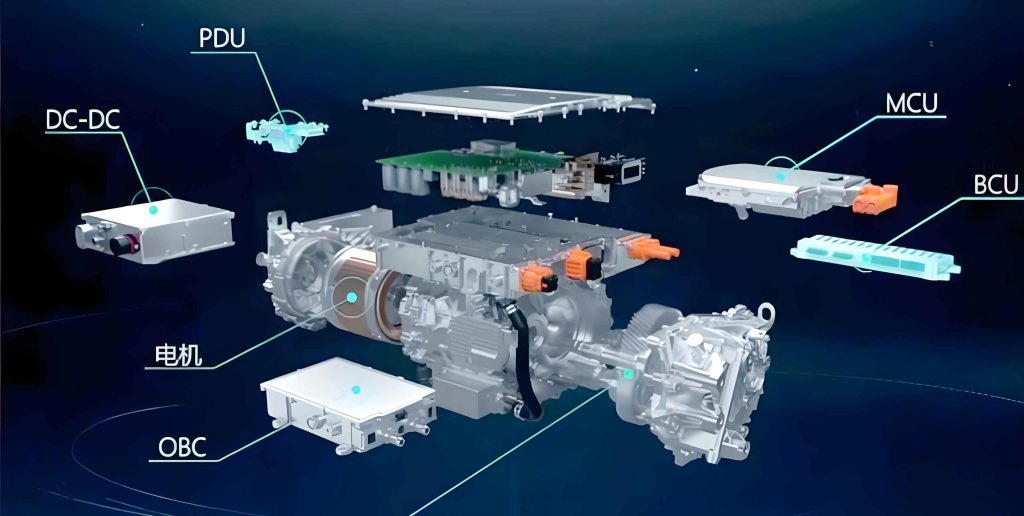
The effectiveness of this modulation scheme in electric drive systems was verified through simulations. I modeled a CHB-based electric drive system with parameters as in Table 2, using PLECS software. The system included a 3-submodule CHB inverter, a long cable, and an induction motor. Simulations compared traditional phase-shifted carrier (PSC) modulation with the proposed quasi 2N+1 level modulation under various cable lengths and switching frequencies.
| Parameter | Value |
|---|---|
| Submodule DC Voltage ($V_{dc}$) | 1500 V |
| Number of Submodules ($N$) | 3 |
| Fundamental Frequency ($f_0$) | 50 Hz |
| Switching Frequency ($f_s$) | 2 kHz |
| Cable Length ($l$) | 0.02 to 2 km |
| Cable $L_0$ | 0.39 μH/m |
| Cable $C_0$ | 0.254 nF/m |
| Quasi-level Duration ($t_d$) | $2\tau$ (calculated per $l$) |
For a cable length of 0.02 km, the overvoltage peak with traditional modulation was 91.55% of $V_{dc}$, while with quasi 2N+1 level modulation, it reduced to 3.80%. Similar improvements were observed across different lengths, as summarized in Table 3. This demonstrates the robustness of the approach for electric drive systems with varying installation distances.
| Cable Length (km) | Overvoltage Peak (Traditional) | Overvoltage Peak (Proposed) | Reduction |
|---|---|---|---|
| 0.02 | 91.55% | 3.80% | 95.8% |
| 0.1 | 107.13% | 4.67% | 95.6% |
| 0.5 | 151.23% | 6.69% | 95.6% |
| 1 | 273.03% | 9.19% | 96.6% |
| 2 | 575.01% | 20.04% | 96.5% |
The scheme also maintains system efficiency. I compared the overall efficiency of the electric drive system using different suppression methods: RLC filter, RC filter, active reflected wave canceller (ARWC), and the proposed modulation. The efficiency $\eta_{\text{total}}$ is calculated as:
$$\eta_{\text{total}} = 1 – \frac{P_{\text{CHB}} + P_{\text{device}} + P_{\text{cable}} + P_{\text{motor}}}{P_{\text{in}}}$$
where $P_{\text{device}}$ is the loss from suppression devices. For the proposed method, $P_{\text{device}} = 0$ since no additional components are used. As shown in Table 4, the quasi 2N+1 level modulation achieves higher efficiency across load conditions, making it advantageous for energy-sensitive electric drive systems.
| Suppression Scheme | Efficiency at Light Load | Efficiency at Full Load | Additional Components |
|---|---|---|---|
| RLC Filter | 85.2% | 89.1% | Yes |
| RC Filter | 84.8% | 88.7% | Yes |
| ARWC | 86.5% | 90.3% | Yes |
| Quasi 2N+1 Level Modulation | 88.9% | 92.1% | No |
Experimental validation was conducted on a scaled-down electric drive system with a 2-submodule CHB inverter and 100 m cable. The parameters included $V_{dc} = 50$ V, $f_s = 2$ kHz, and $t_d = 1.2$ μs (calculated for $\tau = 0.6$ μs). With traditional modulation, the motor terminal voltage showed overvoltage peaks of up to 100% above $V_{dc}$, while with the proposed modulation, the peaks were suppressed to less than 5%. This confirms the practical feasibility of the approach for real-world electric drive systems.
Furthermore, the modulation scheme integrates seamlessly with vector control strategies commonly used in electric drive systems. The control block diagram includes a speed controller, current controllers, and coordinate transformations, with the modulator generating the quasi-levels based on cable length. The dynamic performance was tested under variable torque and speed conditions. In simulations, the electric drive system maintained stable operation with fast torque response and minimal overvoltage, as evidenced by metrics like settling time and overshoot. For instance, during a step load change from 5 kN·m to 10 kN·m, the speed deviation was less than 2%, and overvoltage remained below 10% of $V_{dc}$. This highlights the compatibility of the scheme with high-performance electric drive systems.
In conclusion, the quasi 2N+1 level modulation scheme effectively suppresses overvoltage oscillations in long-cable-fed electric drive systems. By inserting fixed-duration quasi-levels, it cancels reflected waves without extra hardware, enhancing efficiency and reliability. The method is particularly suited for CHB-based electric drive systems, offering a scalable solution for medium-voltage applications. Future work could explore adaptation to varying cable lengths online or integration with other multilevel topologies. Overall, this advancement contributes to the robustness and cost-effectiveness of electric drive systems in industrial settings.
From a broader perspective, the importance of addressing overvoltage in electric drive systems cannot be overstated. As industries adopt longer cables for flexibility, such innovations ensure the longevity and safety of motor installations. The proposed modulation aligns with trends toward smarter, more efficient electric drive systems, paving the way for enhanced performance in challenging environments. I believe that continued research in this area will further optimize electric drive systems for diverse applications, from renewable energy to heavy machinery.