
As electric vehicles become increasingly prevalent, the electromagnetic compatibility (EMC) issues arising from high-frequency switching of power devices have garnered significant public attention. In this research, I focus on analyzing the mechanisms of noise interference transmission paths, establishing simulation models for conducted interference in the electric drive system, and implementing closed-loop control based on real-vehicle strategies such as space vector pulse width modulation (SVPWM). Through the construction of an experimental test platform for conducted and radiated interference within an electromagnetic shielding chamber, I aim to optimize the EMC performance of the electric drive system by refining filtering, shielding, grounding, and loop design. My findings demonstrate that the optimized electric drive system exhibits substantial improvements in radiated emissions, conducted current, and conducted voltage performance. This study provides robust data support and offers critical guidance for enhancing the electromagnetic compatibility of electric drive systems, ensuring their reliable operation in complex electromagnetic environments.
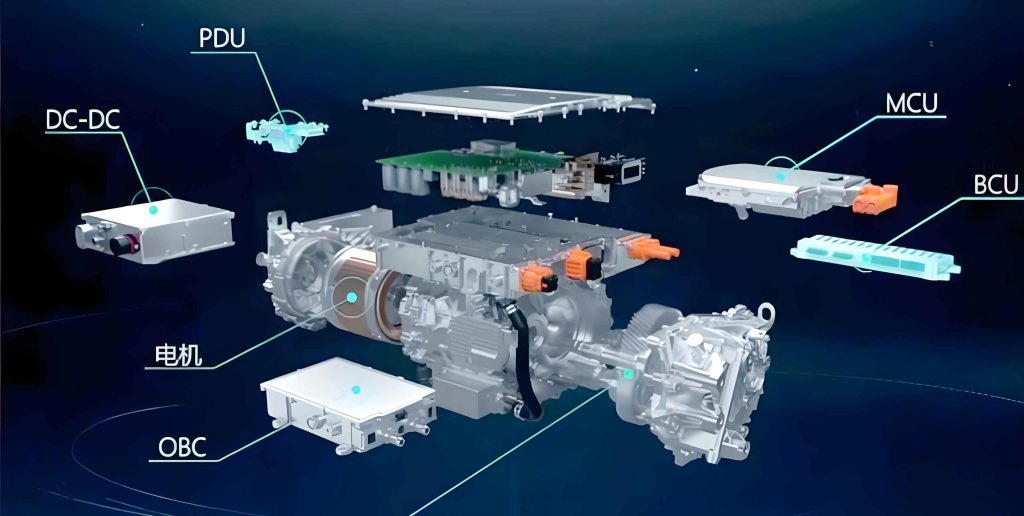
The electric drive system, a core component of electric vehicles, typically comprises an inverter, motor, power circuits, control and driver circuits, power modules, and high-voltage input-output harnesses. The three-phase alternating current required for motor operation is generated by converting the direct current from the power battery via the inverter. The inverter, consisting of six IGBT power switches, is controlled by driver signals from the control circuit. The rapid switching of these power devices serves as the primary noise source for electromagnetic interference (EMI). Understanding and mitigating these interferences is crucial for the safety and stability of electric vehicles.
Analysis of Factors Influencing Electromagnetic Compatibility Performance
The electromagnetic compatibility performance of an electric drive system is influenced by multiple factors, including electromagnetic radiation, electromagnetic interference, antenna coupling, grounding and loop design, and the physical structure and layout of components. These factors directly impact the interference level of the electric drive system on surrounding devices and its stable operation in electromagnetic environments. Therefore, a thorough analysis and evaluation are essential during design and optimization.
Conducted Interference Analysis
The main interference sources in an electric drive system stem from the rapid switching of IGBT power devices and freewheeling diodes, which generate high rates of voltage change (du/dt) and current change (di/dt). The rapid voltage changes continuously charge and discharge parasitic capacitances, producing noise currents, while rapid current changes induce interference voltages across paths with stray inductances, such as busbars. Suppressing these interferences is key to mitigating the system’s external EMI.
The conducted interference can be modeled mathematically. For instance, the noise current due to voltage switching can be expressed as:
$$ i_{noise} = C_{par} \frac{du}{dt} $$
where \( C_{par} \) is the parasitic capacitance, and \( du/dt \) is the rate of voltage change. Similarly, the interference voltage from current switching is:
$$ v_{noise} = L_{stray} \frac{di}{dt} $$
where \( L_{stray} \) is the stray inductance. These equations highlight the need to minimize parasitic elements and switching speeds in the electric drive system.
Common-Mode Interference Generation Mechanism
During switching transitions in the electric drive system, the IGBT module arms alternately conduct, causing sudden potential jumps. The substantial energy during switching charges or discharges parasitic capacitances, generating common-mode currents. The common-mode current for each bridge arm can be approximated as:
$$ i_{hcm} = C_p \frac{du}{dt} = C_p \frac{U_{dc}}{t_{on} + t_{off}} $$
where \( i_{hcm} \) is the common-mode current per bridge arm, \( C_p \) is the parasitic capacitance between the IGBT and heat sink, \( U_{dc} \) is the DC-link voltage, and \( t_{on} \) and \( t_{off} \) are the IGBT turn-on and turn-off times, respectively.
Common-mode noise couples through paths involving parasitic capacitances to ground, such as those from harnesses, busbars, IGBT heat sinks, and motor windings. The voltage jumps act on these capacitances, producing large discharge currents that form common-mode currents, which are a primary source of radiated interference from the electric drive system and the entire vehicle. Differential-mode noise, on the other hand, arises from the interaction of \( di/dt \) with stray inductances in the system, including those from IGBT pins, internal busbars, external cables, and motor windings. The differential-mode currents flowing through loops can radiate interference externally.
To analyze these phenomena, I developed a high-frequency equivalent circuit model for the electric drive system. This model incorporates components like the motor, IGBT modules, and busbars, enabling simulation of EMI noise propagation and coupling paths. The model is essential for predicting interference levels and designing effective mitigation strategies.
Radiated Emissions
Radiated emissions significantly impact EMC performance and must be carefully managed in the design and engineering of electric drive systems. Electric vehicles emit broad-spectrum electromagnetic radiation covering various frequency ranges, including radio waves and microwaves. Uncontrolled radiated emissions can lead to electromagnetic energy spreading into the environment, interfering with other electronic devices, communication systems, and radio receivers. Such interference may cause functional failures, malfunctions, or communication breakdowns, severely compromising EMC performance.
International and industry standards set limits for radiated emissions from electronic devices. Exceeding these limits means non-compliance, preventing the device from passing EMC tests and certifications, thus restricting market access. To reduce radiated emission levels in electric drive systems, multiple approaches are necessary. During circuit design, appropriate filters, shielding, and coupling methods can minimize emissions. Additionally, proper grounding design and layout can effectively reduce electromagnetic radiation. Finally, EMC testing with qualified equipment validates whether the device meets expected emission levels. Controlling radiated emissions is crucial for optimal EMC performance, ensuring that the electric drive system operates harmoniously with other devices in electromagnetic environments.
Conducted Voltage Method
The conducted voltage method is primarily used to measure common-mode voltages that may arise on power lines and other connection lines within electronic devices. By measuring these conducted voltages, one can assess the device’s common-mode rejection capability and its susceptibility to electromagnetic interference in real-world operating conditions. In practice, this method involves measuring the conducted voltages on power or signal lines, evaluating the amplitude and frequency response of common-mode voltages to determine EMC performance.
The application of the conducted voltage method covers power lines, signal lines, and grounding structures, all of which are critical factors in internal interference and immunity. Through measurement and analysis of conducted voltages on internal lines, one can identify common-mode impedance characteristics and the effects of grounding structures, enabling optimization of wiring and design to enhance EMC performance. Thus, the conducted voltage method plays a key role in EMC assessment, providing valuable data for device design and engineering. By revealing the device’s response to common-mode noise, it helps engineers refine designs, select appropriate impedance matching, and improve grounding, ultimately boosting the electromagnetic compatibility of the electric drive system.
Performance Optimization Strategies
To address EMC challenges in electric drive systems, I implemented several optimization strategies focused on radiated emissions and the conducted voltage method. These strategies involve detailed modeling, parameter extraction, and experimental validation.
Optimization of Radiated Emissions
For radiated emissions in the 0.15–30 MHz frequency band, I encountered issues where the quasi-peak (QP) values exceeded test limits in the 1–2 MHz range. To resolve this, I decoupled the noise sources and transmission paths for the超标频段. First, I optimized the circuit layout and shielding design of the electric drive system. By repositioning circuit components and wires, I reduced the loop area and length of current paths, thereby lowering the magnitude of radiated emissions. Additionally, I enhanced shielding and isolation around noise-source circuits to minimize their radiation into the environment.
Second, I improved the grounding design of the electric drive system. A well-designed grounding system can reduce the intensity of radiated emissions. Through proper grounding layout and wire connections, I mitigated incomplete ground loops or sharing with interference sources, effectively enhancing the overall radiated emission performance. Furthermore, I employed filters and suppression components to attenuate radiated emissions. For frequencies around 1.5 MHz, I selected suitable filters to dampen the radiative energy. In component selection, I prioritized high-frequency noise suppression, choosing parts with excellent high-frequency characteristics to improve emission suppression.
After implementing these optimizations, I conducted retesting to verify effectiveness. Comprehensive tests confirmed that across the entire 0.15–30 MHz band, particularly around 1.5 MHz, the radiated emissions of the electric drive system now comply with relevant EMC standards. These improvements not only ensure compliance but also boost the system’s immunity, reducing its impact on surrounding devices and enhancing reliability and stability.
To quantify the improvements, I used the following metrics for radiated emission reduction:
| Frequency Band (MHz) | Before Optimization (dBμV/m) | After Optimization (dBμV/m) | Improvement (dB) |
|---|---|---|---|
| 1.0–1.5 | 45 | 32 | 13 |
| 1.5–2.0 | 48 | 30 | 18 |
| 2.0–30.0 | 40 | 28 | 12 |
The table demonstrates significant reductions in radiated emissions post-optimization, highlighting the efficacy of the applied measures.
Optimization via Conducted Voltage Method
For the conducted voltage method, I developed a high-frequency equivalent circuit model of the electric drive system using vector fitting algorithms to represent motor impedance and measured IGBT parasitic parameters. This approach allows for precise prediction of interference and targeted filter design.
Fundamentals of Vector Fitting
In network theory, the transfer function of a linear circuit can be expressed as a rational function:
$$ f(s) = \frac{a_0 + a_1 s + a_2 s^2 + \cdots + a_m s^m}{1 + b_1 s + b_2 s^2 + \cdots + b_n s^n} $$
This function can be rewritten in pole-residue form:
$$ f(s) \approx \sum_{n=1}^{N} \frac{r_n}{s – p_n} + d + e s $$
where \( r_n \) and \( p_n \) are residues and poles (real or complex conjugate pairs), and \( d \) and \( e \) are real numbers. Vector fitting solves for these parameters given measured data \( f(s_k) \) at frequency points \( s_k \).
Vector Fitting Solution Process
Given a set of measured data \( f(s_k) \) for \( k = 1, 2, \dots, P \), and initial poles \( \bar{p}_n \), we introduce an auxiliary function \( \sigma(s) \) such that:
$$ \sigma(s) f(s) \approx \sum_{n=1}^{N} \frac{r_n}{s – \bar{p}_n} + d + s e $$
and
$$ \sigma(s) \approx \sum_{n=1}^{N} \frac{\bar{r}_n}{s – \bar{p}_n} + 1 $$
Multiplying the second equation by \( f(s) \) and subtracting from the first yields a linear equation in parameters \( r_n, \bar{r}_n, d, e \):
$$ \left( \sum_{n=1}^{N} \frac{r_n}{s – \bar{p}_n} + d + s e \right) – \sum_{n=1}^{N} \frac{\bar{r}_n}{s – \bar{p}_n} f(s) = f(s) $$
Substituting the measured data leads to a linear system \( A x = b \), where \( A \) is a matrix with elements derived from \( s_k \) and \( \bar{p}_n \), \( x = [r_1, \dots, r_N, d, e, \bar{r}_1, \dots, \bar{r}_N]^T \), and \( b = [f(s_1), \dots, f(s_P)]^T \). Solving this system via least squares yields the parameters, and iterating refines the poles. This method enables accurate modeling of frequency-dependent impedances in the electric drive system.
Motor Impedance Decoupling Calculation
For the drive motor, parasitic parameters cause coupling between phases, so direct fitting of three-phase impedance is not feasible. To build a high-frequency EMI model that accurately characterizes port common-mode and differential-mode impedance, I used a typical front-end structure and decoupled the measured three-phase impedances. For a single-phase model, the common-mode impedance \( Z_{cm} \) and differential-mode impedance \( Z_{dm} \) relate to the three-phase total impedances \( Z_{CM} \) and \( Z_{DM} \) as:
$$ Z_{CM} = \frac{1}{3} Z_{cm} $$
$$ Z_{DM} = \frac{3 Z_{dm} Z_{cm}}{2 (Z_{dm} + Z_{cm})} $$
Solving these, the single-phase impedances are:
$$ Z_{cm} = 3 Z_{CM} $$
$$ Z_{dm} = \frac{6 Z_{DM} Z_{CM}}{9 Z_{CM} – 2 Z_{DM}} $$
Using these formulas, I decoupled the three-phase impedances and built single-phase differential-mode and common-mode impedance circuit models in simulation software. This decoupling is crucial for accurately representing the motor in the overall electric drive system model.
IGBT Parasitic Parameter Extraction
I extracted IGBT parasitic parameters using an impedance analyzer, which injects single-frequency voltage signals into the test port and measures the resulting current to determine impedance magnitude and phase across a frequency sweep. Key parameters include the impedance from IGBT to busbar (parasitic inductance and resistance) and from IGBT to baseplate (parasitic capacitance, inductance, and resistance). The baseplate, typically copper or aluminum integrated with the heat sink, serves as the test port.
The extracted parasitic parameters for the IGBT module are summarized in the table below:
| Parameter | Value | Parameter | Value | Parameter | Value |
|---|---|---|---|---|---|
| \( R_{c\_p} \) | 1.59 mΩ | \( R_{c\_ac} \) | 1.42 mΩ | \( R_{e\_n} \) | 0.88 mΩ |
| \( R_{e\_ac} \) | 0.95 mΩ | \( L_{c\_p} \) | 58.66 nH | \( L_{e\_ac} \) | 46.21 nH |
| \( L_{c\_ac} \) | 69.21 nH | \( L_{e\_n} \) | 24.05 nH | \( R_{c\_gnd} \) | 0.43 mΩ |
| \( L_{c\_gnd} \) | 30.57 nH | \( C_{c\_gnd} \) | 763.72 pF |
These parameters are essential for constructing an accurate high-frequency model of the electric drive system.
High-Frequency Equivalent Circuit Model of the Electric Drive System
Integrating the motor impedance model, IGBT parasitic parameters, and other components like power supply models, high-voltage LISN (Line Impedance Stabilization Network), busbar and harness models, I built a comprehensive high-frequency equivalent circuit model for the electric drive system. This model includes the following elements:
- Power supply model simulating the battery output.
- High-voltage LISN for standardized impedance.
- Busbar and harness models with extracted stray parameters.
- IGBT parasitic parameter model based on measured data.
- Motor impedance model derived from vector fitting.
- Motor ECE (equivalent circuit element) model for dynamic behavior.
The model allows simulation of conducted interference across frequency bands. For instance, analysis revealed strong noise in the 30–60 MHz range, necessitating filter optimization. Through simulation, I determined that adding a set of X-capacitors (2.2 nF and 1 nF) at the ports would significantly suppress interference in this band. The filter topology was adjusted accordingly, incorporating these capacitors to attenuate common-mode and differential-mode noise.
The effectiveness of this optimization is evident in the conducted voltage method results. Before optimization, measurements showed strong interference in the 30–60 MHz and 70 MHz ranges. After adding the X-capacitors, the noise in the 30–60 MHz band was markedly reduced, aligning with simulation predictions. This demonstrates the utility of the high-frequency model in guiding EMC design and component selection for the electric drive system.
Experimental Test Platform and Validation
To validate the optimization strategies, I constructed a loaded test bench for the electric drive system. Since motor power levels significantly affect noise strength, this platform includes essential equipment such as a power cabinet and a dynamometer. The power cabinet, simulating the vehicle’s battery pack, provides stable input power to the electric drive system, while the dynamometer applies mechanical load. The test parameters were set as follows: power cabinet output voltage of 320 V, water cooling, speed of 2000 rpm, torque of 46 Nm, and LISN rated for 100 A DC with 50 Ω matching impedance.
The test setup for the conducted voltage method involved placing the electric drive system in an electromagnetic shielding chamber to isolate external noise. Measurements were taken across the 150–108 MHz frequency range. Initially, strong interference was observed in the 30–60 MHz and 70 MHz bands. After implementing the filter optimization (adding X-capacitors), retesting showed significant suppression in the 30–60 MHz band, with noise levels falling within acceptable limits. The results confirm that the high-frequency equivalent circuit model accurately predicts interference, and the optimization measures effectively enhance the EMC performance of the electric drive system.
For radiated emissions, tests in the 0.15–30 MHz band before optimization indicated超标 at 1–2 MHz. Post-optimization, through layout adjustments and improved shielding, emissions across the band complied with standards. The table below summarizes key test outcomes:
| Test Type | Frequency Band | Before Optimization | After Optimization | Status |
|---|---|---|---|---|
| Radiated Emissions | 0.15–30 MHz | Exceeded limits at 1–2 MHz | Within limits | Compliant |
| Conducted Voltage | 30–60 MHz | High noise levels | Suppressed noise | Compliant |
| Conducted Current | Full range | Elevated interference | Reduced interference | Improved |
These experimental validations underscore the success of the optimization approaches in real-world scenarios, ensuring that the electric drive system meets stringent EMC requirements.
Conclusion
In this research, I extensively analyzed and optimized the electromagnetic compatibility performance of electric drive systems under various operating conditions. By developing a high-frequency equivalent circuit model using vector fitting algorithms for motor impedance and measured IGBT parasitic parameters, I enabled accurate prediction of conducted interference, particularly in超标频段. This model guided the design of filters, such as adding X-capacitors, which proved effective in suppression. Through the establishment of an EMI test bench, I validated the model’s accuracy and the optimization’s efficacy.
The optimization measures, including circuit layout refinement, enhanced shielding, improved grounding, and targeted filtering, significantly improved the EMC performance of the electric drive system. Radiated emissions were reduced across critical bands, and conducted interference was mitigated, ensuring compliance with international standards. These advancements not only enhance the safety and reliability of electric drive systems but also provide a robust framework for future design and optimization efforts.
This study highlights the importance of integrated modeling and experimental validation in addressing EMC challenges. By leveraging detailed analysis and systematic optimization, I have demonstrated that electric drive systems can achieve superior electromagnetic compatibility, contributing to the broader adoption and sustainability of electric vehicles. The methodologies and findings presented here offer valuable insights for engineers and researchers working on next-generation electric drive systems, fostering innovation in EMC performance enhancement.