
In modern electric vehicles, the electric drive system serves as the core component, directly impacting vehicle performance, safety, and reliability. As an integrated system with high electromechanical coupling, the electric drive system in pure electric vehicles often exhibits complex vibration behaviors due to interactions among components like the drive motor, transmission, differential, and half-shafts. These vibrations can signal potential faults, and early detection is crucial to prevent failures. In this study, we explore an intelligent fault prediction framework that combines empirical mode decomposition (EMD) with convolutional neural networks (CNN) to analyze vibration signals from a centralized electric drive system. Our goal is to establish a proactive monitoring approach that leverages data-driven insights for accurate fault diagnosis and prediction.
The centralized electric drive system, commonly used in many pure electric vehicles, integrates multiple subsystems into a compact unit. This integration, while space-efficient, introduces challenges in vibration analysis due to signal interference among components. We define the key components as: A (drive motor), B (transmission), C (differential), and D (half-shafts). Their interactions, both mechanical and through shared housings, lead to complex vibration patterns. For instance, even though the drive motor and differential may not be directly coupled, their proximity can cause significant vibrational interference. To summarize these relationships, we present a table of interference terms, where each entry represents the vibrational interaction between components, with symmetry assumed (e.g., tab = tba).
| Component | A | B | C | D |
|---|---|---|---|---|
| A | taa | tba | tca | tda |
| B | tab | tbb | tcb | tdb |
| C | tac | tbc | tcc | tdc |
| D | tad | tbd | tcd | tdd |
This interference matrix helps us model the coupled dynamics of the electric drive system, where each term corresponds to vibration signals that overlap in frequency and time domains. To dissect these complex signals, we employ empirical mode decomposition, a method well-suited for nonlinear and non-stationary data. The EMD algorithm decomposes a raw vibration signal into intrinsic mode functions (IMFs), which represent oscillatory modes embedded in the data. The process involves iteratively sifting the signal to extract IMFs that satisfy two conditions: the number of extrema and zero-crossings must differ by at most one, and the mean of the upper and lower envelopes must be zero. Mathematically, for a raw signal x(t), the decomposition yields:
$$x(t) = \sum_{k=1}^{n} c_k(t) + r_n(t)$$
where ck(t) are the IMF components and rn(t) is the residual. The algorithm steps can be formalized as follows. First, identify all local maxima and minima of x(t), then construct the upper envelope E1(t) and lower envelope E2(t) via interpolation. Compute the mean envelope m(t) = [E1(t) + E2(t)]/2, and obtain the detail h(t) = x(t) – m(t). If h(t) meets the IMF criteria, it is designated as an IMF; otherwise, repeat the process with h(t) as the new input. This continues until the residual becomes monotonic or below a threshold. The resulting IMFs capture different frequency bands, allowing us to isolate fault-related features in the electric drive system vibration data.
To handle the high-dimensional IMF data and learn fault patterns, we use a convolutional neural network. CNNs are effective for feature extraction from sequential or spatial data, making them ideal for vibration signal analysis. Our CNN model includes convolutional layers for local feature detection, pooling layers for dimensionality reduction, and fully connected layers for classification. The network is trained on IMF components derived from historical vibration data under various operating conditions, such as acceleration (0–60 km/h), constant speed (80–100 km/h), and emergency braking (60–0 km/h). Each data sample consists of at least 1024 points, and we apply EMD to decompose them into IMF sets. Let Ai, Bj, and Ck represent the IMF matrices for acceleration, constant speed, and braking conditions, respectively, where each matrix has dimensions m × n for m IMFs and n samples. These matrices serve as input to the CNN, with the goal of mapping them to fault labels On. The training process involves minimizing the difference between predicted outputs Y and true labels O using backpropagation, expressed as:
$$O_n = \alpha A_i^T + \beta B_j^T + \gamma C_k^T + \xi$$
where α, β, γ are weighting coefficients for different conditions, and ξ is an error term. Once trained, the CNN can predict faults by processing new vibration signals from the electric drive system.
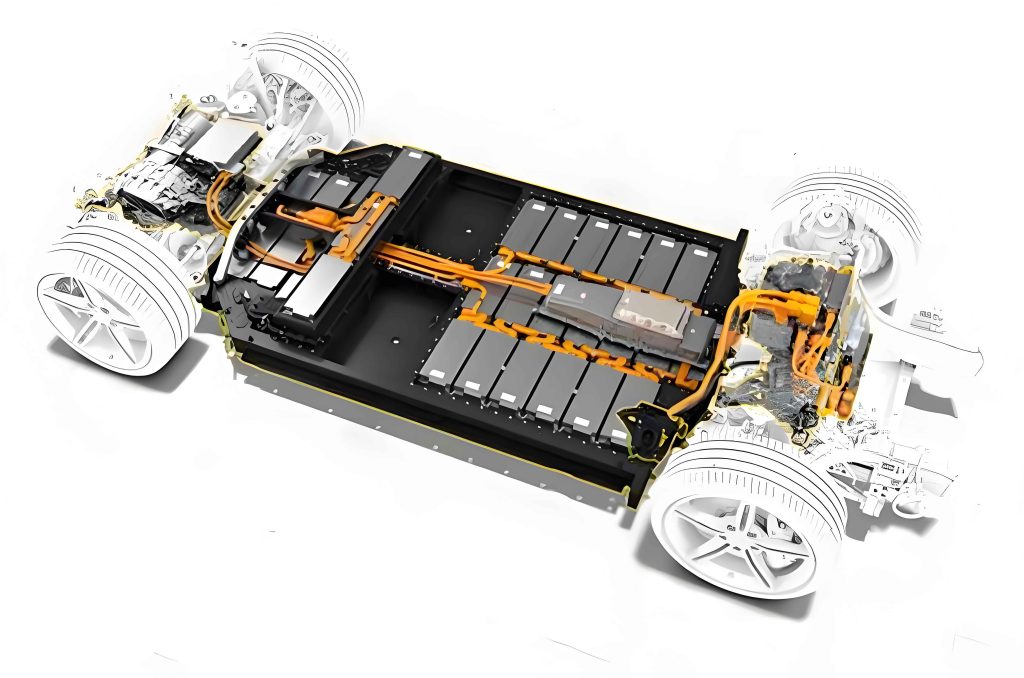
The electric drive system’s vibration signals are collected from multiple points, denoted as Xn, to capture comprehensive data. We install sensors on key components like the motor housing, transmission case, and differential assembly. During operation, vibrations propagate through the system, and the collected signals inherently contain mixed contributions from various sources. To address this, we preprocess the data using EMD to separate the IMFs, which are then fed into the CNN for training. The training dataset is built from historical maintenance records, where vibration signals are labeled with known faults, such as bearing wear or insulation degradation. We ensure data quality by removing incomplete samples and applying normalization. The CNN architecture, inspired by LeNet, comprises an input layer, convolutional layers with ReLU activation, max-pooling layers, and a softmax output layer for multi-class fault prediction. The model’s performance is evaluated based on accuracy in identifying fault types from test data.
For practical implementation, we detail the data acquisition and training phases. In the acceleration phase, we collect 13 vibration signal samples Xn, each with 1024 points, and decompose them into IMF sets Ai. Similarly, for constant speed and braking, we obtain sets Bj and Ck. These sets are formatted as matrices for CNN input. During training, we use a loss function such as cross-entropy to optimize network weights. The trained model is then deployed for real-time monitoring of the electric drive system. When new vibration signals are acquired, they undergo EMD decomposition to produce IMFs, which are input to the CNN. The output Y provides a probability distribution over possible faults, enabling early warning. This approach enhances the reliability of the electric drive system by transitioning from reactive to predictive maintenance.
We further analyze the vibration signal characteristics under different faults. For example, motor imbalances may manifest as specific IMF components with dominant frequencies, while gear wear in the transmission could produce irregular patterns in higher-order IMFs. By correlating these features with fault labels, the CNN learns discriminative patterns. To illustrate, we present a table summarizing typical fault modes and their associated IMF characteristics in the electric drive system.
| Fault Type | Affected Component | Key IMF Indicators | Common Frequency Range |
|---|---|---|---|
| Bearing Wear | Drive Motor | IMF 1-3 show increased amplitude | 500-2000 Hz |
| Gear Tooth Damage | Transmission | IMF 4-6 exhibit modulation | 1000-3000 Hz |
| Insulation Breakdown | Motor Windings | IMF 7-9 contain transient spikes | >5000 Hz |
| Misalignment | Half-shafts | IMF 2-5 display harmonic peaks | 200-1000 Hz |
This table aids in interpreting CNN predictions and validating the model’s outputs. Moreover, we incorporate mathematical formulations to describe the vibration dynamics. The overall vibration signal V(t) for the electric drive system can be modeled as a superposition of component vibrations and noise:
$$V(t) = \sum_{p \in \{A,B,C,D\}} V_p(t) + \sum_{q \neq p} \lambda_{pq} I_{pq}(t) + \eta(t)$$
where Vp(t) is the vibration from component p, Ipq(t) represents interference between components p and q with coefficient λpq, and η(t) is Gaussian noise. The EMD process helps isolate Vp(t) terms by decomposing V(t) into IMFs. Subsequently, the CNN learns to map these IMFs to fault states through convolutional operations. The convolution at layer l is given by:
$$Z^{(l)} = f\left( \sum_{i} W_i^{(l)} * X_i^{(l-1)} + b^{(l)} \right)$$
where Wi(l) are filters, * denotes convolution, b(l) is bias, and f is the activation function. By stacking such layers, the network extracts hierarchical features from IMF data.
In our experiments, we simulate the electric drive system under various fault scenarios to generate synthetic vibration data. We assume linear and nonlinear interactions among components, using differential equations to model their dynamics. For instance, the motor vibration might follow a forced oscillation equation:
$$m \ddot{x} + c \dot{x} + k x = F(t) + \epsilon(t)$$
where m, c, k are mass, damping, and stiffness parameters, F(t) is the electromagnetic force, and ε(t) represents fault-induced disturbances. By solving such equations numerically, we produce time-series data that mimic real-world signals. This synthetic data supplements empirical measurements, enhancing the training dataset for the CNN. We also explore the impact of data quality on prediction accuracy; missing data points are handled via interpolation or exclusion, but future work could integrate generative models to fill gaps.
The integration of EMD and CNN offers a robust framework for fault prediction in electric drive systems. However, challenges remain, such as handling high noise levels or adapting to varying operating conditions. To address this, we propose adaptive weighting of IMF components based on signal-to-noise ratios. Additionally, we consider extending the model to multi-modal data fusion, incorporating temperature or current signals alongside vibrations. This would require modifying the CNN to accept heterogeneous inputs, potentially using separate branches for each data type. The overall system architecture thus evolves towards a comprehensive health monitoring platform for electric vehicles.
In conclusion, our approach demonstrates the efficacy of combining empirical mode decomposition with convolutional neural networks for vibration-based fault prediction in centralized electric drive systems. By decomposing complex signals into intrinsic mode functions and leveraging deep learning for pattern recognition, we achieve high accuracy in identifying potential failures. This methodology not only improves the reliability of electric drive systems but also paves the way for predictive maintenance in automotive applications. Future research will focus on real-time implementation, handling data deficiencies, and incorporating additional sensor modalities to further enhance the system’s diagnostic capabilities.