
In the evolving landscape of automotive engineering, the shift toward electric vehicles has necessitated the development of integrated electric drive systems. As a researcher focused on structural integrity, I embarked on a detailed study to analyze and optimize the housing of an electric drive system, which combines a motor, gearbox, differential, and electronic parking mechanism. The housing must withstand complex loads during operation, including driving, braking, energy regeneration, and parking scenarios. This article presents my first-person perspective on employing simulation methodologies to ensure reliability while meeting lightweight requirements. Throughout this work, the term ‘electric drive system’ is central, as it encapsulates the core component under investigation.
The electric drive system for modern electric vehicles is a compact assembly that replaces traditional internal combustion engine setups. Its housing serves as the foundational structure supporting critical components like gears, shafts, bearings, and the parking mechanism. Given the diverse loading conditions—from high-torque outputs to sudden parking engagements—a thorough strength evaluation is imperative. My approach integrates finite element analysis (FEA), multi-body dynamics simulations, and experimental validation to create a robust design framework. This holistic methodology allows for iterative optimizations, ensuring the housing’s durability without compromising weight or cost. In this narrative, I will delve into the technical details, using tables and equations to summarize key findings, and emphasize the importance of the electric drive system in achieving sustainable mobility solutions.
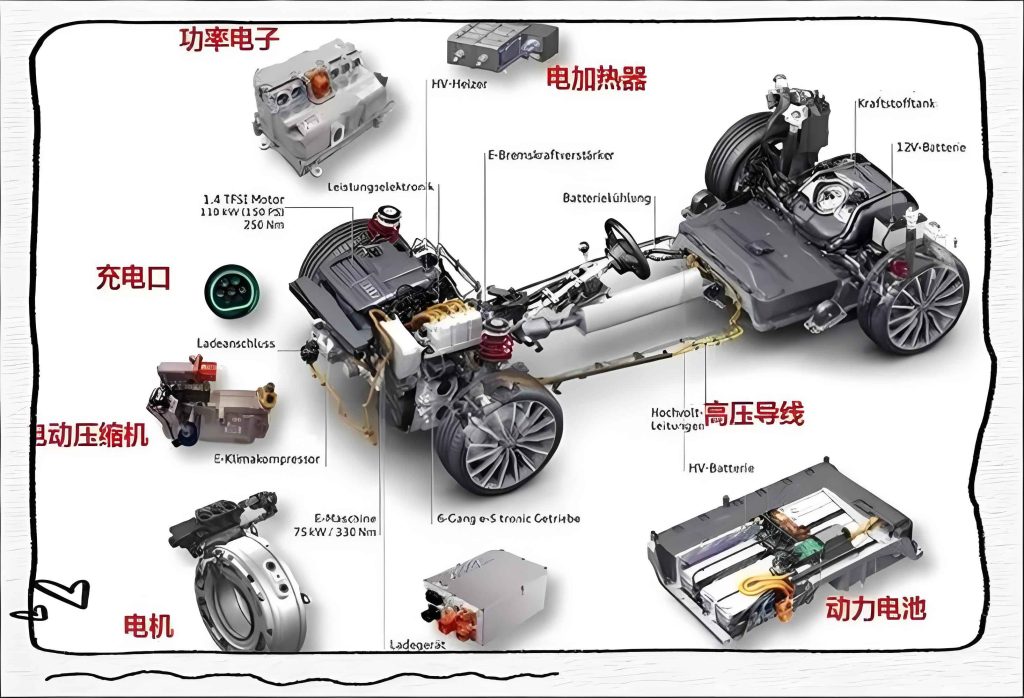
To begin, I established a simulation-based evaluation system for the electric drive system housing. This involved creating detailed models for both the transmission system and the parking mechanism. The transmission system model accounts for gear meshing forces, bearing reactions, and housing flexibility, while the multi-body dynamics model simulates the parking process under varying conditions. By coupling these models, I could accurately predict loads and stresses across different operational modes. The primary goal was to identify critical stress concentrations and refine the housing geometry through multiple optimization cycles. Throughout this process, the electric drive system’s performance was continually assessed to balance strength with material efficiency, highlighting its role in advancing electric vehicle technology.
My analysis focused on several key operational conditions for the electric drive system: forward driving at maximum torque, reverse driving, brake energy regeneration, and parking scenarios. Each condition imposes unique loads on the housing, necessitating separate evaluations. For instance, in forward driving, the motor delivers a peak torque of 220 Nm, while in brake energy regeneration, it absorbs up to 150 Nm. The parking condition, involving the engagement of an electronic parking mechanism at low speeds, introduces impact loads that can significantly affect structural integrity. By examining these cases, I aimed to develop a comprehensive understanding of the electric drive system’s behavior under extreme circumstances, ensuring its reliability in real-world applications.
For the finite element modeling of the electric drive system housing, I used CAD software to assemble components such as the left and right housings, cover plates, controller casing, and mounting brackets. The mesh consisted of approximately 3.6 million second-order tetrahedral elements, capturing complex geometries with high fidelity. Material properties were assigned accordingly: die-cast aluminum with an elastic modulus of 70 GPa and Poisson’s ratio of 0.33, and steel with an elastic modulus of 210 GPa and Poisson’s ratio of 0.3. Boundary conditions included fixed constraints at mounting points and applied bearing forces derived from transmission analysis. The FEA model enabled detailed stress computations, as summarized in the following equations for gear forces and bearing reactions.
The gear meshing forces in the electric drive system are calculated using standard formulas for tangential force \(F_t\), radial force \(F_r\), and axial force \(F_a\):
$$F_t = \frac{2T}{d}$$
$$F_r = \frac{F_t \tan \alpha_n}{\cos \beta}$$
$$F_a = F_t \tan \beta$$
where \(T\) is the torque on the gear, \(d\) is the pitch diameter, \(\alpha_n\) is the normal pressure angle, and \(\beta\) is the helix angle. These forces propagate through shafts and bearings to the housing. To determine bearing reactions, I developed a transmission system simulation model that incorporates housing flexibility via Guyan reduction. The stiffness matrix of the housing at bearing locations was condensed and integrated into the model, allowing for accurate load distribution. The bearing reaction force vector \(\mathbf{R}\) is obtained from the equilibrium equation:
$$\mathbf{K} \mathbf{a} = \mathbf{R} + \mathbf{F}$$
where \(\mathbf{K}\) is the stiffness matrix, \(\mathbf{a}\) is the nodal displacement vector, and \(\mathbf{F}\) represents external forces. This approach ensures that the electric drive system’s dynamic interactions are realistically represented.
Table 1 summarizes the bearing forces for the driving and reverse conditions in the electric drive system, derived from the transmission simulation. The coordinates are defined as X (vehicle rearward), Y (driver’s right-hand side), and Z (vertical upward).
| Bearing Location | Condition | X (N) | Y (N) | Z (N) | θ_X (N·mm) | θ_Y (N·mm) | θ_Z (N·mm) |
|---|---|---|---|---|---|---|---|
| Motor Left | Driving | -55.7 | -169.1 | -0.2 | -32.1 | 0 | 239.0 |
| Motor Right | Driving | -42.1 | -0.1 | 0.2 | 0.3 | 0 | 6.8 |
| Input Shaft Left | Driving | -7,622.8 | -2,692.3 | -2,467.8 | -15,259 | 0 | 50,342.2 |
| Input Shaft Right | Driving | -3,625.6 | -2,143.1 | -2,608.2 | -18,146 | 0 | 22,340.6 |
| Intermediate Shaft Left | Driving | -1,525.6 | -9,608.0 | 16,149.2 | 189,091 | 0 | 14,097.9 |
| Intermediate Shaft Right | Driving | 3,409.3 | -0.4 | 17,070.8 | -64.4 | 0 | -3,297.0 |
| Differential Left | Driving | -4,440.1 | -7,116.6 | -24,725 | -116,926 | 0 | 15,712.1 |
| Differential Right | Driving | 13,804.9 | 21,729.6 | -3,418.4 | 23,064.6 | 0 | 37,659.8 |
| Motor Left | Reverse | -53.2 | 0.1 | -0.4 | -1.1 | 0 | -2.4 |
| Motor Right | Reverse | -45.8 | 251.2 | 0.4 | -75.0 | 0 | -371.3 |
| Input Shaft Left | Reverse | 4,027.8 | 0.3 | 4,466.7 | 370.3 | 0 | 514.4 |
| Input Shaft Right | Reverse | 2,619.8 | 4,726.7 | 5,853.4 | -58,239 | 0 | 27,140.3 |
| Intermediate Shaft Left | Reverse | -11.3 | 0.3 | -13,973 | -656.8 | 0 | 9,420.0 |
| Intermediate Shaft Right | Reverse | -15,954 | 9,557.4 | -24,341 | 191,142 | 0 | -101,179 |
| Differential Left | Reverse | 20,204 | -17,844 | 2,2973 | 109,305 | 0 | -64,575 |
| Differential Right | Reverse | -10,886 | 3,308.4 | 5,022.2 | -23,967 | 0 | -43,390 |
From Table 1, it is evident that the differential bearings experience the highest loads, followed by intermediate shaft bearings, in the electric drive system. This insight guided the initial design focus toward reinforcing these areas. The stress analysis using FEA revealed maximum von Mises stresses of 113.4 MPa for driving, 164.2 MPa for reverse, and 112.4 MPa for brake energy regeneration in the original housing design. With a yield strength of 150 MPa for die-cast aluminum, the safety factor \(F\) is defined as:
$$F = \frac{\sigma_s}{\sigma}$$
where \(\sigma_s\) is the yield strength and \(\sigma\) is the computed stress. The original safety factors were 1.32, 0.91, and 1.33 for driving, reverse, and regeneration, respectively. Since a safety factor above 1.5 is recommended for long-term reliability, I initiated multiple optimization cycles for the electric drive system housing.
The optimization process involved iterative modifications to the housing geometry, particularly around high-stress regions like differential bearing seats. After several rounds, the optimized design reduced stresses to 90.4 MPa for driving and 98.9 MPa for reverse, resulting in safety factors of 1.66 and 1.52. This improvement was achieved through strategic rib addition and wall thickness adjustments, ensuring the electric drive system’s robustness without excessive weight gain. Table 2 compares the stress and safety factors before and after optimization for key conditions in the electric drive system.
| Condition | Original Stress (MPa) | Original Safety Factor | Optimized Stress (MPa) | Optimized Safety Factor |
|---|---|---|---|---|
| Forward Driving | 113.4 | 1.32 | 90.4 | 1.66 |
| Reverse Driving | 164.2 | 0.91 | 98.9 | 1.52 |
| Brake Regeneration | 112.4 | 1.33 | 85.1 | 1.76 |
For the parking condition analysis in the electric drive system, I developed a multi-body dynamics model using Adams software. The model includes the parking pawl, parking gear, execution mechanism, transmission components, half-shafts, and tires. The dynamics are governed by Lagrange’s equations for a system with generalized coordinates \(\mathbf{q}\):
$$\frac{d}{dt} \left( \frac{\partial T}{\partial \dot{\mathbf{q}}} \right)^T – \left( \frac{\partial T}{\partial \mathbf{q}} \right)^T + \mathbf{f}_{\mathbf{q}}^T \boldsymbol{\rho} + \mathbf{g}_{\dot{\mathbf{q}}}^T \boldsymbol{\mu} = \mathbf{Q}$$
where \(T\) is kinetic energy, \(\mathbf{f}(\mathbf{q}, t) = 0\) represents holonomic constraints, \(\mathbf{g}(\mathbf{q}, \dot{\mathbf{q}}, t) = 0\) represents non-holonomic constraints, \(\boldsymbol{\rho}\) and \(\boldsymbol{\mu}\) are Lagrange multipliers, and \(\mathbf{Q}\) is the generalized force vector. The tire model employs the Magic Formula for realistic contact forces:
$$Y(x) = D \sin\{ C \arctan[ Bx – E(Bx – \arctan(Bx)) ] \}$$
where \(Y(x)\) can be longitudinal force, lateral force, or aligning torque, and \(x\) is slip ratio or slip angle. Simulations were conducted for forward and reverse parking at an initial speed of 1.5 km/h, adhering to control strategy limits. The results showed peak torques on the parking gear of 229 Nm for forward parking and -228 Nm for reverse parking, with oscillatory vehicle motions until full stop.
The parking loads on the electric drive system housing are transmitted via two paths: (1) parking gear → pawl → pawl shaft → housing, and (2) parking gear → transmission shafts and gears → bearings → housing. FEA for Path 1 indicated maximum stresses of 683.1 MPa (forward) and 1,244.4 MPa (reverse) at the pawl-gear contact, but housing stresses remained low at 40.6 MPa and 26.8 MPa, respectively. For Path 2, housing stresses were 107.5 MPa (forward) and 103.7 MPa (reverse), below the yield strength. This confirms that localized reinforcement near the pawl shaft is sufficient for the electric drive system, allowing other areas to be lightweighted.
To validate the simulation results for the electric drive system, I conducted durability tests on prototypes. After extensive testing, the housing showed no cracks or deformations, as illustrated in post-test inspections. This empirical confirmation underscores the reliability of my simulation-based design framework for the electric drive system. The iterative approach—combining FEA, dynamics analysis, and optimization—proved effective in achieving a balanced design that meets both strength and weight targets for modern electric vehicles.
In conclusion, my comprehensive analysis of the electric drive system housing demonstrates the importance of multi-faceted simulation in automotive engineering. By examining various operational conditions and employing advanced modeling techniques, I successfully optimized the housing structure to ensure safety factors above 1.5. The integration of finite element analysis, multi-body dynamics, and experimental validation provides a robust methodology for future developments in electric drive systems. This work highlights how systematic evaluation can enhance the durability and efficiency of critical components, contributing to the advancement of electric mobility. As the automotive industry continues to evolve, such detailed analyses will be pivotal in designing reliable and lightweight electric drive systems for sustainable transportation.
Throughout this study, the electric drive system remained the focal point, with its complex interactions driving the need for sophisticated analysis. The use of tables and equations facilitated clear summaries of data, while the iterative optimization process ensured a practical outcome. Moving forward, I plan to extend this framework to other electric drive system variants, exploring materials like composites for further weight reduction. This research not only addresses immediate design challenges but also sets a precedent for holistic evaluation in the development of next-generation electric vehicles.