
The pursuit of optimal performance in Formula Student Electric China (FSEC) competitions hinges on a meticulously designed electric drive system. This system, encompassing the traction motor, motor controller, and high-voltage battery pack, forms the core of the vehicle’s powertrain. Its matching design directly dictates critical performance metrics such as acceleration, top speed, and endurance. This article details a comprehensive methodology for the matching design of an FSEC racing car’s electric drive system, integrating theoretical calculations with advanced vehicle dynamics simulation to achieve predetermined performance targets.
The design process begins by establishing clear vehicle performance objectives based on the competition’s dynamic events: the 0-75 meter straight-line acceleration, the 22 km endurance race, and high-speed handling. Key vehicle parameters are defined, forming the foundation for all subsequent calculations and simulations.
| Performance Target | Goal Value |
|---|---|
| Maximum Speed, \( u_{max} \) | 100 km/h |
| 0-75 m Acceleration Time, \( t_{acc} \) | ≤ 5.5 s |
| Endurance Race Distance | 22 km |
| 50-80 km/h Acceleration Time | ≤ 4 s |
| Vehicle Parameter | Design Value |
|---|---|
| Total Mass (including driver), \( m \) | 360 kg |
| Tire Radius, \( r \) | 255 mm |
| Drag Coefficient, \( C_D \) | 0.49 |
| Frontal Area, \( A \) | 1.575 m² |
| Rolling Resistance Coefficient, \( f \) | 0.018 |
| Transmission Efficiency, \( \eta_T \) | 0.94 |
| Rotational Mass Factor, \( \delta \) | 1.05 |
The cornerstone of the electric drive system matching is the vehicle power balance equation, which ensures the motor’s power output equals the sum of power required to overcome all driving resistances and losses at any given moment:
$$ P_e = \frac{1}{\eta_T} \left( \frac{G f u_a}{3600} + \frac{C_D A u_a^3}{76140} + \frac{\delta m u_a}{3600} \frac{du}{dt} + \frac{G i u_a}{3600} \right) $$
where \( P_e \) is the motor power (kW), \( G \) is the vehicle weight (N), \( u_a \) is the vehicle speed (km/h), \( i \) is the road grade, and \( du/dt \) is the acceleration (m/s²). For initial sizing on level ground (\(i=0\)), the equation simplifies.
Motor and Controller Sizing via Theoretical Calculation
1. Motor Power Requirements: The target performance metrics are analyzed to determine the minimum required motor power.
For the maximum speed target (\(u_{max} = 100\) km/h, \(du/dt=0\), \(i=0\)), the required power \(P_1\) is calculated:
$$ P_1 = \frac{1}{\eta_T} \left( \frac{G f u_{max}}{3600} + \frac{C_D A u_{max}^3}{76140} \right) $$
Substituting the parameters yields \(P_1 \approx 12.66\) kW. This defines the minimum continuous or rated power requirement for the electric drive system’s motor.
For the 0-75m acceleration target (time \(t \leq 5.5\) s), the average speed \(\bar{u}\) and acceleration \(\bar{a}\) are first derived from kinematics (\(\bar{u} \approx 49.10\) km/h, \(\bar{a} \approx 4.96\) m/s²). The peak power required during this event, \(P_2\), is:
$$ P_2 = \frac{1}{\eta_T} \left( \frac{G f \bar{u}}{3600} + \frac{C_D A \bar{u}^3}{76140} + \frac{\delta m \bar{u}}{3600} \bar{a} \right) \approx 29.4 \text{ kW} $$
For the 50-80 km/h acceleration target (time \(t’ \leq 4\) s), the average speed \(\bar{u}’ \approx 65\) km/h and acceleration \(\bar{a}’ \approx 7.5\) m/s² lead to a peak power requirement \(P_3\):
$$ P_3 = \frac{1}{\eta_T} \left( \frac{G f \bar{u}’}{3600} + \frac{C_D A \bar{u}’^3}{76140} + \frac{\delta m \bar{u}’}{3600} \bar{a}’ \right) \approx 58.64 \text{ kW} $$
Therefore, to meet all targets, the motor for the electric drive system must have a peak power \(P_{e,max} \geq \max(P_2, P_3) = 58.64\) kW and a rated power \(P_{e,r} \geq P_1 = 12.66\) kW.
2. Motor Speed and Torque: Assuming an initial fixed transmission ratio \(i_g = 4\), the motor’s maximum speed \(n_{max}\) and peak torque \(T_{tq,max}\) can be estimated:
$$ n_{max} = \frac{0.377 \cdot i_g \cdot u_{max}}{r} \approx 4160.8 \text{ rpm} $$
$$ T_{tq, max} = 9550 \times \frac{P_{e,max}}{n_{max}} \approx 137.7 \text{ Nm} $$
Based on these requirements and considering power density, weight, and structural simplicity, a permanent magnet synchronous motor (PMSM) and its paired controller were selected.
| Motor Parameter | Value |
|---|---|
| Rated / Peak Power | 30 kW / 60 kW |
| Rated / Peak Torque | 80 Nm / 200 Nm |
| Rated / Peak Speed | 3600 rpm / 9000 rpm |
| Controller Parameter | Value |
|---|---|
| Operating Voltage Range | 250 – 410 V DC |
| Peak Current | 260 A |
High-Voltage Battery Pack Design for the Electric Drive System
The battery pack must supply sufficient energy for the 22 km endurance race and deliver the peak power demanded by the motor. High energy and power density cells are essential. The Samsung INR21700-40T cylindrical cell was chosen.
| Cell Parameter | Value |
|---|---|
| Nominal Voltage / Capacity | 3.6 V / 4.0 Ah |
| Peak Discharge Current | 34.4 A |
| Energy Density | 573 Wh/L |
1. Series Count (S): Determined by the motor controller’s operating voltage. The number of cells in series \(n_s\) must satisfy:
$$ n_s \geq \frac{U_{ctrl, nom}}{V_{cell, nom}} = \frac{336V}{3.6V} \approx 93.33 $$
A configuration of 96S (6 modules of 16S) was selected, giving a nominal pack voltage of 345.6 V and a maximum voltage of 403.2 V, fitting well within the controller’s 250-410 V range.
2. Pack Energy & Parallel Count (P): The total energy \(W\) required for the 22 km endurance race is calculated. Assuming an average race speed \(u_{a,end} = 45\) km/h and average acceleration \(a_{end} = 2.5\) m/s², the average motor power \(P_{ea}\) is found using the power balance equation. The total energy is then:
$$ W = \int_0^t P_{ea} \, dt \cdot \frac{1}{\eta_d \eta_s \eta_e} $$
where \(\eta_d\) (battery discharge efficiency) \(\approx 0.96\), \(\eta_s\) (cell depth of discharge) \(\approx 0.9\), and \(\eta_e\) (motor average efficiency) \(\approx 0.96\). The result is \(W \approx 7.92\) kWh. The required pack capacity \(C\) is:
$$ C = \frac{W}{U_{max}} = \frac{7.92 \text{ kWh}}{403.2 \text{ V}} \approx 19.64 \text{ Ah} $$
To achieve this, 5 cells are connected in parallel (5P). The final battery pack configuration for the electric drive system is 96S5P, with a total capacity of 20 Ah and nominal energy of 7.92 kWh.
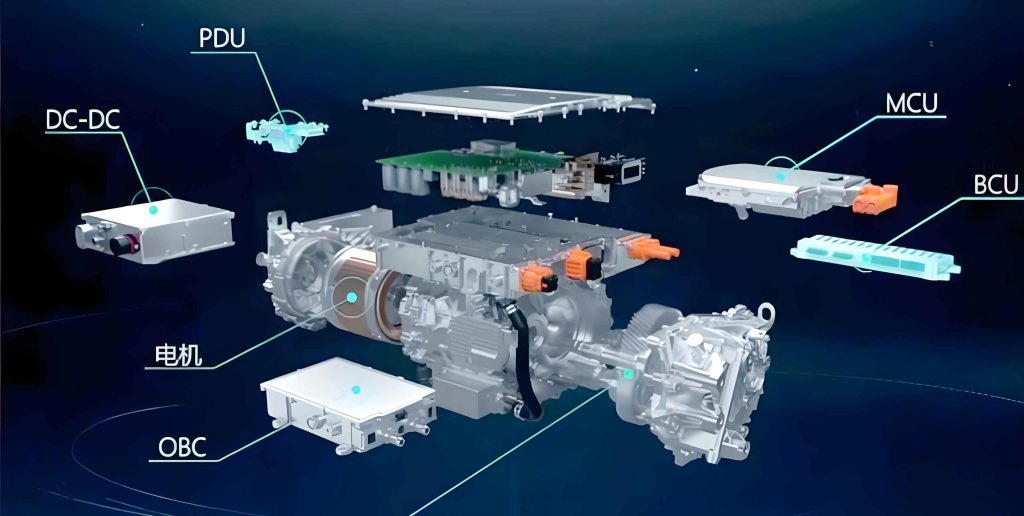
Transmission Ratio Optimization
With a single-speed reduction gear, finding the optimal fixed ratio is crucial. Theoretical limits are first established. The minimum ratio \(i_{min}\) is dictated by the maximum speed and the motor’s peak torque \(T_{max}\):
$$ i_{min} = \frac{r}{\eta_T T_{max}} \left( Gf + \frac{C_D A u_{max}^2}{21.15} \right) \approx 0.58 $$
The maximum ratio \(i_{max}\) is limited by the motor’s peak speed \(n_{max}\):
$$ i_{max} = \frac{0.377 \cdot r \cdot n_{max}}{u_{max}} \approx 8.65 $$
Thus, the feasible range is \(0.58 \leq i_g \leq 8.65\). To find the optimal value within this range for lap time performance, a specialized lap time simulation software, OptimumLap, was employed. A detailed vehicle model (incorporating mass, aerodynamics, tire data, and the selected motor’s torque curve) and a precise model of the FSEC competition track were built. Simulations were run iteratively across the feasible ratio range.
The results clearly indicated that a final drive ratio of \(i_g = 3.95\) produced the fastest simulated lap time. This ratio provides the best compromise between acceleration out of corners and maximum top speed on the straights for this specific electric drive system and track layout.
Vehicle Dynamics Simulation for Performance Verification
To validate the entire electric drive system matching design, a full vehicle dynamics model was created in CarSim software. All parameters derived from the theoretical calculations—vehicle mass, inertia, tire properties, aerodynamic coefficients, the precisely modeled 96S5P battery pack, the motor’s efficiency map and torque curve, the motor controller’s limits, and the optimized 3.95 final drive ratio—were integrated into the model. The official FSEC endurance track was also accurately modeled.
1. Straight-Line Acceleration (0-75 m): The simulation was configured for a full-power launch from standstill over 75 meters. The results verified the capability of the matched electric drive system.
| Simulation Result | Value |
|---|---|
| 0-75 m Acceleration Time | 5.24 s |
This comfortably meets the target of ≤ 5.5 s. The plots of distance vs. time, velocity vs. time, and acceleration vs. time confirm robust performance.
2. Endurance Race (22 km): The primary goal was to verify the energy capacity of the battery pack. The simulation was set to run 20 laps on the ~1.1 km track model, totaling 22 km. The key metric was the State of Charge (SOC) depletion.
| Simulation Result | Value |
|---|---|
| Initial SOC | 95% |
| Final SOC after 22 km | 22% |
The SOC vs. distance plot shows a consistent decline, finishing with a safe margin above 0%. This conclusively proves that the designed battery pack, as a core component of the electric drive system, possesses sufficient energy to complete the endurance race under competitive driving conditions.
Conclusion
This work presents a systematic and verified methodology for the matching design of an FSEC racing car’s electric drive system. The process begins with defining performance targets and proceeds through theoretical power-based calculations to size the motor, controller, and battery pack. An optimal fixed transmission ratio was determined using specialized lap time simulation software. Finally, comprehensive vehicle dynamics simulations were conducted to rigorously validate the system’s performance against the original acceleration and endurance targets.
The simulation results confirm that the matched electric drive system—comprising a 60 kW peak PMSM, a compatible high-voltage controller, a 96S5P battery pack with 7.92 kWh of energy, and a 3.95 final drive ratio—enables the vehicle to achieve a 0-75 m acceleration time of 5.24 seconds and successfully complete the 22 km endurance race with adequate energy reserve. This integrated approach, combining foundational theory with modern simulation tools, provides a robust framework for designing high-performance electric drive systems in the competitive context of Formula Student.