
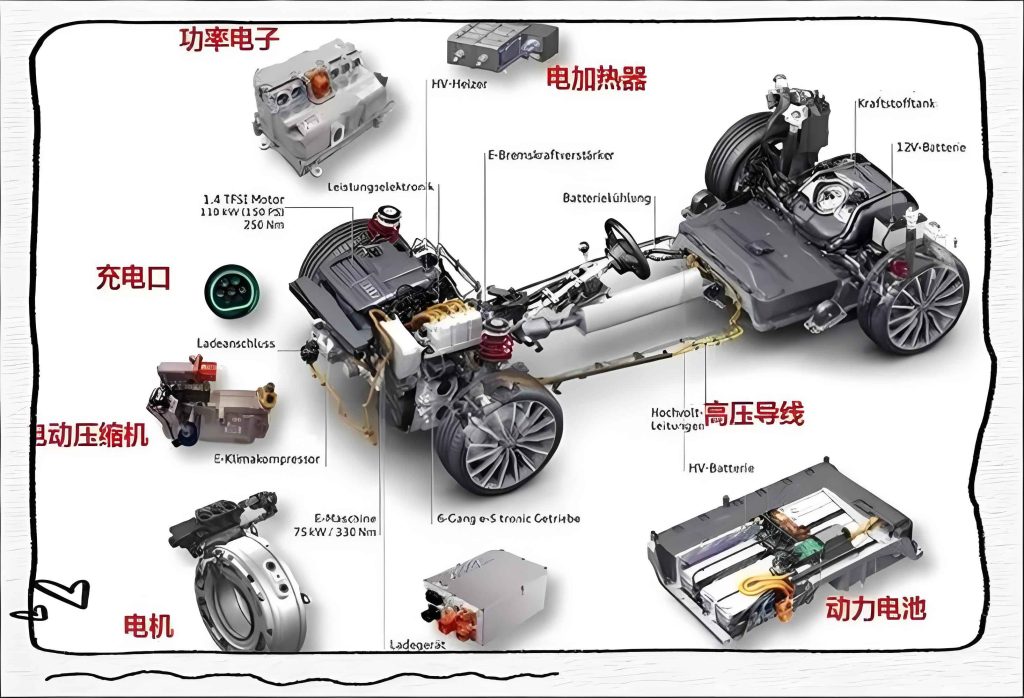
The rapid advancement of the electric vehicle (EV) industry has brought electromagnetic compatibility (EMC) issues to the forefront of consumer and regulatory concerns. The electric drive system, constituting the motor and its controller, is a primary source of powerful electromagnetic interference (EMI) within an EV. The high-frequency switching operations of power semiconductors in the inverter generate significant conducted and radiated emissions, which can severely disrupt the function of on-board electronic devices and potentially affect other road infrastructure. Ensuring the electromagnetic safety and compatibility of EVs is therefore paramount, leading to the establishment of stringent standards such as GB/T 18655, CISPR 25, and UN ECE Regulation No. 10, which define limits and measurement methods for both components and whole vehicles.
Compliance testing for the electric drive system, as a critical subsystem, is essential for vehicle homologation. However, the complexity of its architecture and the multitude of noise coupling paths introduce significant challenges in obtaining accurate and repeatable EMC test results. A particularly confounding issue that has not been sufficiently addressed in standard testing methodologies is the phenomenon of axle current. During operation, a potential difference, known as shaft or axle voltage, can develop between the rotor shaft and the motor housing. If this voltage exceeds the dielectric strength of the bearing lubricant, it can discharge through the bearings, creating circulating currents. This axle current phenomenon is detrimental for two primary reasons: it causes premature bearing failure through electrical discharge machining (EDM), and it acts as an unintended but potent radiating antenna, corrupting radiated emission measurements.
In a typical component-level EMC test setup for an electric drive system, the unit is mounted on a test bench and connected to a dynamometer via a custom-made, metallic drive shaft (tooling shaft). This configuration often disrupts the axle current mitigation strategies (e.g., insulated bearings, shaft grounding brushes) designed into the electric drive system for vehicle integration. Consequently, the test setup itself can become a dominant source of electromagnetic radiation, leading to results that do not reflect the true EMI performance of the electric drive system as it would behave in the actual vehicle environment. This discrepancy creates a significant gap between component-level test results and whole-vehicle test results, undermining the reliability of the compliance process.
This paper investigates the impact of axle current on the electromagnetic compatibility testing of electric drive systems. We analyze the root causes of axle current generation within the test context, evaluate its distorting effect on standard radiated emission measurements, and propose an optimized system-level testing methodology. This methodology aims to restore the integrity of the electric drive system’s native mitigation strategies during testing, thereby yielding results that are more representative of real-world road conditions. The insights and methods presented herein are intended to inform future revisions of EMC standards and provide crucial guidance for the electromagnetic design and validation of electric drive systems.
1. Axle Current Phenomenon in Electric Drive Systems: Mechanisms and Test Context
The generation of axle voltage and subsequent current in an electric drive system is a well-documented parasitic effect. Fundamentally, it stems from the high dv/dt and di/dt outputs of the pulse-width modulated (PWM) inverter. The primary mechanisms can be categorized based on their origin, which is crucial for understanding their impact on testing.
The high-frequency common-mode voltage (Vcm) generated by the inverter is the principal driver. This Vcm is present between the neutral point of the motor windings (star point) and the ground (motor frame). Through parasitic capacitive couplings within the motor—between the stator windings and the rotor (Cwr), and between the rotor and the stator frame (Crg)—this Vcm induces a voltage on the rotor shaft relative to ground. This potential is the axle voltage (Vshaft). A simplified model illustrates this:
$$ V_{shaft} = V_{cm} \cdot \frac{C_{wr}}{C_{wr} + C_{rg}} $$
Where Cwr is the winding-to-rotor capacitance and Crg is the rotor-to-ground capacitance. This voltage seeks a path to ground. In a complete circuit, which includes the bearings, shaft, and housing, it drives a circulating axle current.
For the context of EMC testing, it is critical to distinguish between two classes of axle current phenomena, as their implications differ significantly.
| Category | Root Cause | Characteristics & Impact on Testing |
|---|---|---|
| Inherent Design & Manufacturing | Magnetic asymmetries due to stator core lamination, rotor eccentricity, slotting effects, or material imperfections. These create an inherent flux linkage with the shaft. | This phenomenon is intrinsic to the electric drive system unit and is present regardless of the test or vehicle environment. EMC tests should capture emissions resulting from this, as they reflect the unit’s true performance. The resulting axle voltage is typically sinusoidal at the fundamental or harmonic frequencies of the drive. |
| Test Setup & Tooling Induced | Disruption of native mitigation paths by the test bench setup. Specifically, the replacement of the vehicle’s half-shafts with solid metallic tooling shafts that lack proper grounding/isolation features, and the absence of a vehicle chassis ground path. | This is an artifact of the test methodology. It introduces an uncontrolled, highly resonant radiating structure (the tooling shaft) and often prevents designed-in mitigation (e.g., grounding brushes from making contact). It generates significant high-frequency noise that dominates measurements, masking the true emissions of the electric drive system itself. This is the primary source of discrepancy between component and vehicle-level tests. |
The focus of this research is squarely on the second category: Test Setup & Tooling Induced axle current. This is an extraneous variable that compromises the validity of the component-level EMC test for the electric drive system. The standard test setup, while practical, fails to replicate the integrated electrical environment of the vehicle, where the half-shafts, wheel hubs, and tires form a complex impedance network that differs drastically from a low-impedance, well-grounded metal tooling shaft connected directly to a dynamometer.
2. Axle Current Suppression Strategies and Their Relevance to Testing
Modern electric drive systems incorporate various design strategies to mitigate axle current and its effects. Understanding these is key to developing a representative test method.
| Strategy Category | Specific Methods | Mechanism & Effect | Challenge in Standard Component Test |
|---|---|---|---|
| Circuit & Topology Design | Use of 3-Level Neutral Point Clamped (NPC) inverters; Optimized PCB layout with reduced parasitic loops; Integration of common-mode chokes on DC-link or output. | Reduces the amplitude of the source common-mode voltage (Vcm) or impedes its propagation. | Effective if implemented. However, testing with a tooling shaft can bypass filtering effects or create new coupling paths. |
| Filtering & Isolation | DC-link filters (LC, LCL); Motor-side dV/dt or sinus filters; Isolation transformers. | Attenuates high-frequency common-mode noise before it reaches the motor terminals. | Standard practice. The effectiveness is part of the Device Under Test (DUT) evaluation. |
| Bearing & Shaft Treatment | Insulated bearings (typically on non-drive end); Conductive grease; Shaft grounding rings (electrical brushes). | Blocks the current path through bearings (insulation) or provides a low-impedance, controlled shunt path to ground (brushes). | Most critical. Tooling shafts often lack the surface for brushes to contact, rendering this primary mitigation inactive. Insulated bearings remain effective. |
| System Integration Measures | Use of specific half-shafts with non-conductive coatings or joints; Reliance on the impedance of the vehicle’s driveline and tires. | The vehicle’s driveline acts as a distributed, lossy network that attenuates high-frequency axle currents. | Completely absent in a bench test with solid metal tooling shafts, which are highly conductive and resonant. |
The table reveals a fundamental issue: the most vehicle-specific mitigation strategies—particularly shaft grounding brushes and the RF characteristics of the half-shafts—are neutered in a standard component test setup. Therefore, to assess the true electromagnetic compatibility of the electric drive system, the test method must aim to preserve or faithfully replicate the functionality of these integrated mitigation features. Simply adding an external shield to the tooling shaft is insufficient, as it can reflect emissions and alter the measurement geometry. A more holistic approach is required.
3. Impact of Tooling-Induced Axle Current on Standard EMC Test Results
To quantify the problem, we conducted experiments on a representative electric drive system (rated power: 47 kW). The unit was tested according to the component-level method for radiated emissions, specifically the Absorber Lined Shielded Enclosure (ALSE) method outlined in standards like GB/T 18655/CISPR 25. The setup used a standard metallic tooling shaft to connect the electric drive system to the dynamometer.
Prior to the full radiated emission scan, a time-domain analysis was performed to confirm the presence of significant axle voltage. An oscilloscope probe measured the voltage between the tooling shaft and the ground reference of the test bench. Under a typical test load condition (50% of rated speed and torque), high-frequency voltage pulses with peak-to-peak amplitudes exceeding 380 mV were observed on the shaft. This confirmed the presence of a strong high-frequency potential, indicative of a severe common-mode excitation and a likely axle current path.
The subsequent radiated emission test in the frequency range of 150 kHz to 30 MHz (using a monopole antenna) yielded the problematic results. The measured spectrum showed excessive noise levels exceeding the standard limits (e.g., Class 3/5). More importantly, the spectrum was characterized by:
- Numerous Broadband Peaks: Distinct, high-amplitude resonances not typical of a well-behaved electric drive system.
- High Instability: Significant amplitude “jitter” and wandering of peak frequencies, indicating a noisy, non-stationary source.
This profile is classic for a structure (the tooling shaft) acting as an excited, poorly-matched antenna. The emissions were not primarily from the electric drive system’s enclosure or cables, but from the test fixture itself.
To directly confirm the axle current, a current probe was clamped around the tooling shaft. The measured axle current spectrum showed strong correlated peaks at the same frequencies as the dominant radiated emission peaks. The current magnitude reached levels as high as 30-40 dBμA at specific resonances (e.g., around 15 MHz and 41 MHz). The relationship between the common-mode voltage (Vcm), the impedance of the shaft-to-ground path (Zpath), and the axle current (Iaxle) is given by:
$$ I_{axle} = \frac{V_{cm}}{Z_{path}} $$
In the bench setup, Zpath is largely determined by the capacitive coupling of the long, unshielded tooling shaft, resulting in a low impedance at its resonant frequencies, hence high current. This high Iaxle flowing on an unshielded conductor of significant length makes it an efficient radiator, invalidating the test.
4. Proposed System-Level EMC Test Methodology for Electric Drive Systems
To obtain results representative of real vehicle conditions, we propose an enhanced, system-level test methodology. The core principle is to test the electric drive system in a configuration that maintains the integrity of its vehicle-grade axle current mitigation features and approximates the RF characteristics of the vehicle’s driveline.
4.1 Test Setup Description
The key innovation is the use of a dual-axis dynamometer within a shielded chamber (ALSE) and, most critically, the replacement of solid metal tooling shafts with the original vehicle half-shafts. The setup comprises:
- Electric Drive System Under Test (DUT): Mounted on a grounded fixture.
- Original Vehicle Half-Shafts: Connected between the DUT’s output flanges and the input flanges of the dual-axis dynamometer. This restores the connection for any shaft grounding brushes and introduces the real-world impedance of the half-shafts (which may include damped joints or composite materials).
- Dual-Axis Dynamometer: Capable of applying independent load and speed profiles to each output of the electric drive system, simulating real driving conditions.
- Vehicle-Rated HV Battery Simulator & LVS: To power the system.
- Interconnecting Cables & Harnesses: As used in the vehicle or their close equivalents.
This configuration effectively creates a “chassis-less vehicle driveline” inside the chamber. The half-shafts are connected to the dynamometer, which presents a different RF ground impedance compared to the vehicle’s wheels on the road, but it is a defined and consistent termination that is far more representative than a solid metal shaft.
4.2 Test Execution and Rationale
The test procedure follows standard radiated emission measurement guidelines (antenna positions, scanning, etc.). The operational profile for the electric drive system should include various speed and torque points, including high dv/dt conditions. The use of original half-shafts ensures that:
- Shaft grounding brushes (if present) make proper electrical contact with the shaft surface, providing the intended low-impedance path for axle current to bypass the bearings.
- The RF impedance and resonance behavior of the radiating structure (the half-shaft) are much closer to the in-vehicle state than a solid metal rod.
- The electromagnetic coupling between the electric drive system’s housing and the driveline is more accurately represented.
This method shifts the test philosophy from a “component in isolation” to a “system in a representative integration state.” It evaluates the electric drive system’s performance including its designed-in mitigation strategies, which is the actual performance delivered to the vehicle manufacturer.
5. Comparative Analysis of Test Results and Discussion
Applying the proposed system-level method to the same electric drive system tested earlier yielded profoundly different and more credible results. The radiated emission spectrum showed a marked improvement:
- Reduced Overall Amplitude: Emission levels dropped significantly, now complying with standard limits.
- Cleaner Spectral Signature: The numerous, unstable resonant peaks vanished. The remaining emissions were smoother, more predictable, and characteristic of noise from converter switching and its harmonics, coupled via cables and the enclosure.
- Improved Stability: The signal showed minimal jitter, indicating a stable and well-behaved source, which is the electric drive system itself, not the test fixture.
A quantitative comparison of peak emission values at key frequency points between the two methods demonstrates the scale of the tooling shaft’s distorting effect.
| Frequency of Interest | Emission Level (Standard Method with Tooling Shaft) | Emission Level (Proposed System-Level Method) | Difference (Δ) | Interpretation |
|---|---|---|---|---|
| ~2.1 MHz | 48 dBμV/m | 32 dBμV/m | -16 dB | Tooling shaft resonance amplified switching noise. |
| ~15.7 MHz | 42 dBμV/m | 28 dBμV/m | -14 dB | Dominant resonance from tooling shaft current, largely eliminated. |
| ~41.5 MHz | 39 dBμV/m | 24 dBμV/m | -15 dB | Another strong tooling shaft resonance removed. |
| Broadband region (20-30 MHz) | High, erratic peaks | Low, smooth baseline | > 10 dB avg. | General reduction of fixture-related noise. |
The data conclusively shows that the standard method introduced errors exceeding 10-15 dB at specific frequencies—an enormous margin in EMC engineering. The proposed method filters out this test-fixture artifact, revealing the genuine emission profile of the electric drive system. The resulting data aligns much more closely with emissions measured on complete vehicle-level tests, providing a reliable bridge between component design validation and final vehicle homologation.
The effectiveness of this method can be conceptually modeled. The impedance of the path for common-mode current, Zpath_system, in the system-level test is higher and more lossy than that of the tooling shaft, Zpath_tooling, due to the characteristics of the half-shaft and restored grounding.
$$ Z_{path\_system} > Z_{path\_tooling} $$
Since $I_{axle} \propto 1/Z_{path}$, the axle current is reduced:
$$ I_{axle\_system} < I_{axle\_tooling} $$
Consequently, the radiated field strength E, which is proportional to the current on the radiating structure, is also reduced:
$$ E \propto I_{axle} \cdot L_{eff} $$
Where Leff is the effective length. The system-level test reduces both Iaxle and potentially Leff (due to better grounding), leading to the observed drop in emissions.
6. Conclusion and Implications
This research has identified and addressed a critical source of inaccuracy in the electromagnetic compatibility assessment of electric drive systems for vehicles: the tooling-induced axle current phenomenon in standard component-level test setups. By replacing custom metallic tooling shafts with original vehicle half-shafts and employing a dual-dynamometer system, we propose a system-level EMC test methodology that preserves the integrity of the electric drive system’s native axle current mitigation strategies.
The key findings are:
- The standard test setup often creates a dominant, resonant radiating structure (the tooling shaft) that can distort radiated emission measurements by more than 10-15 dB, rendering the results non-representative of in-vehicle performance.
- The proposed system-level method effectively suppresses this test artifact, yielding a cleaner, more stable, and compliant emission spectrum that truly reflects the electromagnetic performance of the electric drive system as an integrated unit.
- This approach bridges the gap between component and vehicle-level testing, providing automakers and suppliers with more reliable and predictive data during the development phase.
The implications of this work are significant for both industry practice and standardization. We recommend that future revisions of EMC standards for vehicle components, particularly those governing high-voltage powertrain systems like the electric drive system, consider incorporating guidelines for system-level or “integration-representative” testing. This could involve specifications for using representative driveline components or defining the maximum allowable parasitic impedance of test shafts. Furthermore, this research underscores the necessity for deeper investigation into the physics of axle current generation and propagation within complex driveline networks. A more sophisticated understanding will enable the creation of even more robust and economical test models, ultimately leading to more electromagnetic compatible, reliable, and safe electric vehicles.