
The evolution of the new energy vehicle market has driven a clear trend towards the integration and lightweight design of electric drive systems. Highly integrated systems have become a focal point of research, with oil-cooled electric drive systems, exemplified by powertrains like the Tesla Model 3, emerging as a crucial direction for high-end new energy vehicles. In these systems, the lubricating oil used for the gears, shafts, and bearings of the gearbox is also tasked with cooling the electric motor. Determining the optimal oil volume must simultaneously address the mechanical lubrication of the gearbox, the thermal management of the motor, and the overall system efficiency. Compared to traditional gearboxes, defining the oil volume for an oil-cooled electric drive system presents a significant technical challenge, often lacking established practical guidelines. This analysis examines the mechanisms influencing cooling and lubrication within oil-cooled electric drive systems. By holistically considering the requirements for cooling, lubrication, and peak efficiency, a set of design principles for determining the optimal system oil volume is established. Based on these principles, the oil volume design process for a specific 160 kW oil-cooled three-in-one electric drive system is detailed, and the feasibility of the proposed volume is verified through experimental testing. The proposed optimal oil volume design principles offer valuable engineering guidance for the development of oil-cooled electric drive systems.
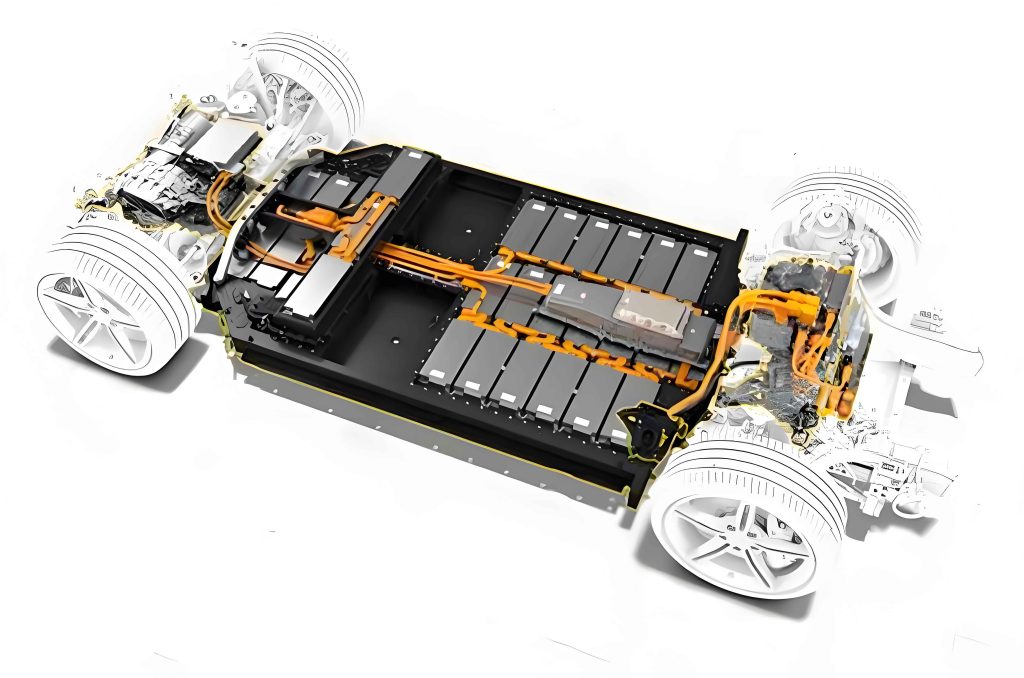
The integrated oil-cooled electric drive system typically comprises the drive motor, motor controller, and transmission (gearbox). The cooling performance of the electric drive system directly impacts its service life and operational reliability. Adequate lubrication in the gearbox effectively prevents or mitigates gear surface pitting and scuffing. Similarly, the lubrication condition of bearings is a primary factor influencing their lifespan. During operation of a permanent magnet synchronous motor, exceeding certain temperature limits can damage the winding insulation—the component often with the lowest thermal class. This can accelerate insulation aging, shorten motor life, or in severe cases, lead to insulation carbonization and functional failure. Excessive temperature rise not only compromises winding insulation but can also degrade stator and rotor core materials and cause thermal demagnetization of permanent magnets, ultimately reducing the motor’s operational life. Therefore, the oil circuit and volume design for an oil-cooled electric drive system must fully account for the lubrication needs of gears and bearings, while also addressing the cooling requirements of critical motor components, ensuring the entire system operates safely and efficiently within an optimal temperature range.
System Overview and Power Loss Sources
The oil-cooled electric drive system discussed here is distinct from traditional water-cooled systems. It features a shared cavity for the drive motor and gearbox, utilizing a unified cooling and lubrication circuit. Consequently, oil volume determination must integrate factors influencing both the motor and the gearbox.
Power losses within the drive motor primarily consist of iron losses, winding (copper) losses, mechanical losses (e.g., bearing friction, windage), and stray load losses. Power losses in the gearbox mainly originate from gear meshing losses, bearing losses, oil pump power consumption, and seal drag losses. The vast majority of these losses convert into thermal energy, manifesting as a temperature increase in the electric drive system assembly.
Within the motor, mechanical losses, iron losses, and a portion of stray losses are relatively constant, independent of load. Other losses, such as winding losses and the remaining stray losses, vary with motor load and current. Therefore, the oil volume must guarantee sufficient cooling for the motor under all operating conditions. The oil pump loss is a unique addition in an actively lubricated oil-cooled electric drive system. While the gearbox has less stringent temperature requirements than the motor, its power losses are predominantly mechanical. Effective lubrication can significantly reduce these mechanical losses, thereby improving overall system efficiency. Thus, the oil volume must satisfy the gearbox’s lubrication needs. The design process must concurrently address motor cooling and gearbox lubrication.
Cooling and Lubrication Principles
The analysis focuses on a three-in-one oil-cooled electric drive system. Its lubrication and cooling system is designed to cool the motor while lubricating the gears and bearings. The final oil volume is determined through a comprehensive evaluation of cooling performance, lubrication adequacy, and system efficiency.
The cooling system is powered by a mechanical pump, with the oil circuit formed by the housing, end covers, rotating shaft, oil collection rings, and oil pipes. The pump delivers oil to designated locations to cool the motor’s stator core, winding end-turns, rotor core, and motor bearings, as well as to lubricate the gearbox’s input and intermediate shaft bearings. The cycle begins at the pump inlet. Oil passes through a filter and an oil-to-coolant heat exchanger (oil cooler). The flow then splits: one path directs oil into dedicated channels within the motor’s stator laminations to cool the stator core and the outer sections of the winding end-turns. The other path is further divided; a portion lubricates the rear bearings of the gearbox input and intermediate shafts, while the remainder flows through the hollow motor shaft to cool the rotor core and the inner sections of the winding end-turns, simultaneously lubricating the front bearings of the gearbox shafts. Finally, gravity returns the oil to the lowest point in the housing—the pump inlet—completing the cycle.
This analysis reveals that, unlike a traditional gearbox, the system’s oil volume must satisfy both the lubrication demands of the gearbox components and the cooling requirements of the motor. Excessive oil volume can lead to significant churning and windage losses, particularly at high rotational speeds, detrimentally affecting the system’s efficiency. Insufficient oil volume risks inadequate lubrication and cooling, jeopardizing system durability and lifespan. This work provides a methodological framework for determining the optimal oil volume in such actively lubricated, oil-cooled electric drive systems.
Design Principles for Oil Volume in Electric Drive Systems
Based on the operational principles of the cooling and lubrication system, the oil volume design follows a two-stage approach: first, establishing a baseline volume that meets fundamental cooling and lubrication needs, and second, optimizing this volume for peak system efficiency.
Defining Performance Test Conditions
To objectively evaluate electric drive system performance, standardized test conditions must be defined. A comprehensive assessment considers both transient and steady-state behavior. Transient performance is typically evaluated using vehicle durability test cycles, such as the New European Driving Cycle (NEDC) and the Worldwide Harmonized Light Vehicles Test Cycle (WLTC). While NEDC emphasizes steady-state conditions, WLTC places greater emphasis on transient and transitional phases, making it more representative of real-world driving dynamics for evaluating thermal management under variable loads. Therefore, the WLTC cycle is selected as the primary transient evaluation benchmark.
For steady-state extremes, two critical operating points are defined:
- High-Speed Condition: At this point, the electric drive system operates at its rated power and maximum input speed for an extended period (e.g., 2 hours). This condition maximizes churning losses in the gearbox while also maximizing the effectiveness of splash lubrication and external housing convective heat transfer. It tests the system’s ability to manage losses and散热 under high-RPM operation.
- High-Torque Condition: Here, the system operates at its rated power and maximum input torque for an extended period. This condition generates significant heat from both the motor and mechanical components, while the external散热 conditions and splash lubrication effectiveness are less favorable than at high speed. It primarily tests the极限 cooling capacity of the electric drive system.
Thus, the oil volume design should be validated against these three core scenarios: the WLTC cycle (transient), the high-speed steady-state condition, and the high-torque steady-state condition.
Theoretical Baseline Oil Volume Calculation
The studied electric drive system employs a shared oil circuit for the motor and gearbox, with a separate cooling system for the controller. Therefore, oil volume design focuses solely on the motor-gearbox unit. The motor is the most temperature-sensitive component, while the gearbox has the highest demand for effective lubrication. Although the motor contains mechanical parts (bearings), the active cooling system ensures their basic lubrication is maintained. The gearbox generates considerable heat from gear meshing and bearing friction, but its materials have a higher temperature tolerance than motor insulation. Consequently, the cooling requirement can be primarily attributed to the motor, and the lubrication requirement to the gearbox.
The system’s cooling need is simplified to the motor’s cooling need. Given the complexity of motor thermal analysis, a top-down approach is used. The total power loss of the motor, which converts to heat, is estimated. The required heat dissipation is then derived based on the motor’s designed equilibrium temperature and the cooling oil’s heat absorption capacity.
Motor losses (Ploss_motor) include iron loss, winding loss, mechanical loss, and stray loss. For an oil-cooled system, heat transfer is predominantly conductive, supplemented by convection and radiation. Using Finite Element Analysis (FEA), the temperature field within the motor can be simulated. For the subject 160 kW system operating at peak power, the temperature distribution of the critical winding end-turns can be obtained. The maximum allowable temperature at this point serves as the cooling target for baseline oil volume calculation.
The motor’s heat generation power (Pheat) can be estimated from its design efficiency (ηmotor). Assuming all generated heat is removed by the circulating oil (an idealization for baseline calculation), and that the oil passages are fully primed during pump operation, the required oil flow rate (Q) from the pump can be calculated. This flow must carry away the heat with a permissible temperature rise (ΔT) in the oil.
$$Q = \frac{P_{heat}}{\rho \cdot c \cdot \Delta T \cdot \eta_{thermal}}$$
Where:
- ρ is the density of the oil.
- c is the specific heat capacity of the oil.
- ΔT is the designed temperature rise of the oil across the motor.
- ηthermal is a factor accounting for the efficiency of heat transfer from components to the oil (less than 1).
A more practical formula often used links pump flow directly to the motor’s electrical input power (Pin) and losses:
$$Q \approx \frac{P_{in} \cdot (1 – \eta_{motor})}{\rho \cdot c \cdot \Delta T}$$
Considering the length (L) of the oil circulation path and accounting for oil drain-back time via a drain-back coefficient (CL, typically ~1.1), the baseline oil volume required for motor cooling (V1) is estimated as the volume of oil in active circulation within the cooling circuit:
$$V_1 = Q \cdot t_{circuit} \approx Q \cdot \frac{L}{v_{avg}} \quad \text{or more simply as:} \quad V_1 = A_{flow} \cdot L \cdot C_L$$
Where Aflow is the aggregate cross-sectional area of the primary oil passages. For initial design, V1 is often derived from fluid simulation or empirical rules related to the motor’s power rating and cooling scheme.
The lubrication requirement is simplified to the gearbox’s need. For systems relying partly on splash lubrication, a traditional rule states that the static oil level should at least reach the lowest point on the tooth tip circle of the most submerged gear in the vertical plane. The oil volume (V2) to achieve this level can be determined from the system’s 3D CAD model or through Computational Fluid Dynamics (CFD) software like nanoFluidX, simulating the static oil fill.
Therefore, the theoretical baseline oil volume (V0) is the sum of the volumes needed for motor cooling and gearbox lubrication:
$$V_0 = V_1 + V_2$$
Once the structural design of the electric drive system is finalized, its peak efficiency is largely determined. Optimizing the oil volume presents a significant opportunity to enhance overall system efficiency and control costs, moving beyond merely meeting basic functional needs.
| Component | Loss Sources | Dependence | Impact of Oil Volume |
|---|---|---|---|
| Drive Motor | Iron Losses | Mainly speed | Adequate volume ensures cooling, preventing excessive temperature rise which can increase winding resistance and losses. Indirectly affects viscous drag on rotor. |
| Winding (Copper) Losses | Load (current squared) | ||
| Mechanical Losses (Bearings, Windage) | Speed | ||
| Stray Load Losses | Load and speed | ||
| Gearbox | Gear Meshing Losses | Load, speed, lubrication | Adequate volume ensures proper film formation, reducing friction. Excessive volume increases churning losses, especially at high speed. |
| Bearing Losses | Load, speed, lubrication | ||
| Oil Pump Loss | Pump design, flow rate | Pump power increases with required flow/pressure, which is influenced by system design and oil viscosity. | |
| Churning & Windage Losses | Speed, oil level, geometry | Directly and significantly increased by excessive oil volume. |
Methodology and Application: Case Study on a 160 kW System
The theoretical baseline oil volume (V0) for the subject 160 kW oil-cooled three-in-one electric drive system was calculated to be 2.3 liters. This value was derived from the combined assessment of motor cooling needs (based on thermal FEA simulating peak load conditions) and gearbox lubrication needs (based on static oil level simulation).
To optimize this volume for system efficiency, experimental testing was conducted. Since system efficiency results from the complex interplay of motor heating, gearbox lubrication, and churning losses—factors that are challenging to model precisely with CFD for quantitative final optimization—a empirical test-based approach was adopted.
Experimental Verification and Optimal Volume Determination
Testing was performed on a three-in-one comprehensive test bench. The methodology followed industry standards such as QC/T 1022-2015 and relevant enterprise test specifications for electric drive system transmission efficiency. The key parameters of the unit under test are summarized below.
System Specifications: Peak Power: 160 kW; Maximum Input Speed: 17,000 rpm; Maximum Input Torque: 240 Nm; Gear Ratio: 11.762.
Employing a controlled variable method, five separate system efficiency tests were executed. The sole variable was the total oil fill volume in the system. The tested volumes were 2.3 L (the theoretical baseline), 2.4 L, 2.5 L, 2.6 L, and 2.7 L. Each test sequence included the WLTC cycle, the high-speed steady-state condition, and the high-torque steady-state condition. The average combined efficiency (weighted or averaged across these cycles) was calculated for each oil volume. The results clearly indicate an optimum.
| Oil Volume (Liters) | 2.3 | 2.4 | 2.5 | 2.6 | 2.7 |
|---|---|---|---|---|---|
| Average Combined Efficiency (%) | 90.253 | 90.255 | 90.262 | 90.258 | 90.252 |
The data shows that system efficiency initially improves as oil volume increases from the baseline 2.3 L, peaking at 2.5 L with an average combined efficiency of 90.262%. Further increases to 2.6 L and 2.7 L result in a decline in efficiency. This creates a classic efficiency vs. volume curve. The increase from 2.3L to 2.5L suggests the baseline volume was marginally insufficient, likely leading to slightly elevated operating temperatures in the motor or sub-optimal lubrication in the gearbox under certain test conditions, causing efficiency penalties that outweighed any churning losses. The volume of 2.5 L represents the best compromise: it provides sufficient oil to ensure excellent cooling and lubrication, minimizing losses from those sources, without introducing excessive churning and windage losses that become dominant at 2.6 L and 2.7 L, particularly during the high-speed test phase. Therefore, for this specific 160 kW oil-cooled electric drive system, the optimal oil volume is determined to be 2.5 liters.
Discussion and Future Directions
This analysis and case study establish a practical, two-stage methodology for designing oil volume in integrated oil-cooled electric drive systems. The process begins with a analytical/simulation phase to determine a theoretical baseline volume (V0) that meets the fundamental cooling and lubrication requirements:
$$V_0 = V_{cooling} + V_{lubrication}$$
This is followed by an empirical optimization phase, where system efficiency is measured under representative duty cycles (like WLTC, high-speed, high-torque) across a range of oil volumes centered on V0. The volume yielding the highest average combined efficiency is identified as the optimal operating fill quantity.
The principles underscore that the optimal oil volume is not merely the sum of individual component needs but is a system-level compromise. It balances the reduction of electrical and mechanical losses through adequate cooling and lubrication against the increase in hydraulic losses (churning, pump work) associated with higher oil quantities. The proposed use of WLTC, high-speed, and high-torque conditions provides a robust validation framework that covers the critical operational extremes and transient behaviors of an electric drive system in a vehicle application.
Future work should focus on refining the first-stage theoretical model to improve its predictive accuracy for V0, potentially reducing the experimental optimization range required. Furthermore, detailed investigation into the design of the oil pump itself—its flow rate, pressure characteristics, and efficiency map—is crucial. The pump’s operational parameters are intrinsically linked to the system’s pressure drop, which is influenced by the oil circuit design and the oil’s viscosity-temperature characteristics. Optimizing the pump for the specific optimal oil volume and system flow requirements presents a significant opportunity for further gains in overall electric drive system efficiency. Research into advanced lubrication strategies, such as targeted minimal quantity lubrication (MQL) or more efficient oil jet designs, could also help decouple lubrication from churning losses, pushing the efficiency frontier further.