
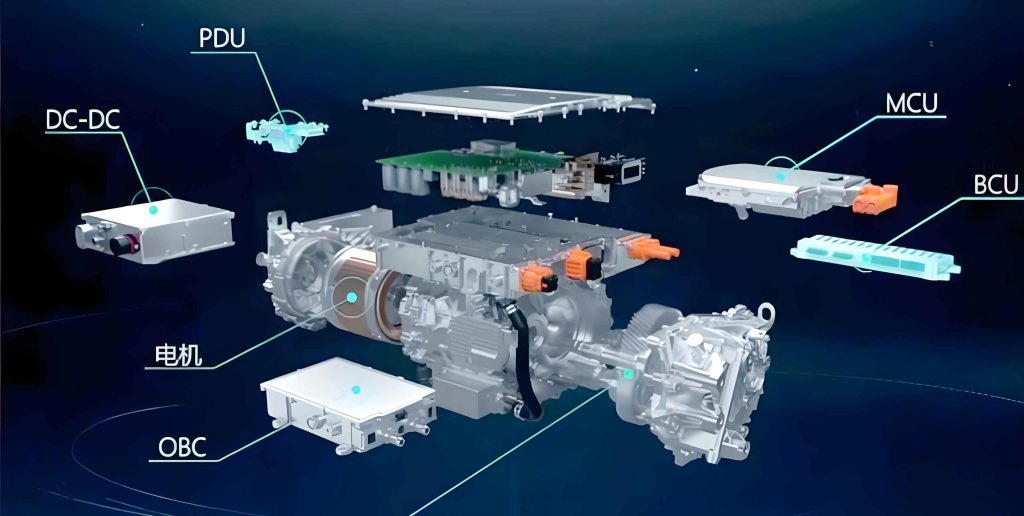
In the context of modern industrial applications, the demand for high-capacity electric drive systems has surged, particularly for synchronous motors that serve as critical components in large-scale machinery. As part of our research and development efforts, we focus on designing and analyzing a synchronous motor tailored for a high-capacity electric drive system. This motor is rated at 51.2 MW, with a voltage of 10.5 kV and a frequency of 50 Hz, aiming to fill a gap in the domestic market where such high-power units are often dominated by foreign manufacturers. The development of this motor not only supports import substitution but also enables integrated solutions combining motors and inverters, thereby enhancing system efficiency and sustainability. In this paper, we present a comprehensive electromagnetic analysis using finite element numerical methods, covering no-load and load conditions, as well as rotor surface loss under inverter supply. Our goal is to validate the electromagnetic design and ensure its reliability for practical deployment in high-capacity electric drive systems.
The core of our analysis revolves around the finite element method (FEM), which allows for detailed simulation of electromagnetic fields within the motor. We begin by establishing a two-dimensional transient model, which simplifies the complex three-dimensional geometry while maintaining accuracy for key performance metrics. This approach is essential for optimizing the design of high-capacity electric drive systems, where factors like torque ripple and harmonic distortion can significantly impact operational efficiency. Below, we outline the fundamental assumptions and equations governing our FEM model.
We make the following assumptions to facilitate the analysis: (1) The magnetic field is modeled in two dimensions using a Cartesian coordinate system, ignoring end effects and assuming axial uniformity. (2) Eddy current reactions in conductive materials are neglected, treating the field as a nonlinear static magnetic field. (3) The magnetic permeability in the iron core is isotropic. (4) The external magnetic field is negligible, with the stator outer surface set as a zero vector potential boundary. Based on these, the electromagnetic field in the motor is described by the vector magnetic potential \( A_Z \), satisfying the following boundary value problem:
$$ \Omega: \frac{\partial}{\partial x} \left( \frac{1}{\mu} \frac{\partial A_Z(t)}{\partial x} \right) + \frac{\partial}{\partial y} \left( \frac{1}{\mu} \frac{\partial A_Z(t)}{\partial y} \right) = -J_Z(t) + \sigma \frac{\partial A}{\partial t} $$
$$ S_1: A_Z = 0 $$
where \( \Omega \) is the solution domain, \( S_1 \) is the stator outer diameter boundary, \( J_Z \) is the current density, \( \mu \) is the permeability, and \( \sigma \) is the electrical conductivity. This equation is discretized using FEM to solve for \( A_Z \), enabling us to determine the magnetic field distribution. For computational efficiency, we model a unit motor segment, leveraging symmetry to reduce mesh complexity. The model includes key components such as the stator core, windings, rotor slots, and damping bars, each assigned material properties as summarized in Table 1.
| Component | Material | Conductivity (S/m) |
|---|---|---|
| Stator Core | 50W350 | — |
| Stator Winding | Oxygen-Free Copper | 43.3 |
| Rotor Slot Wedge | Beryllium Cobalt Zirconium Copper | 26.1 |
| Rotor Damping Bar | Zirconium Copper | 49.3 |
| Rotor Core | 34CrMo1A | 2 |
After defining materials, we apply boundary conditions and excitations, followed by meshing the entire domain with refinement near the air gap to capture field variations accurately. The meshed model consists of thousands of elements, ensuring precise calculations for the high-capacity electric drive system motor. This setup forms the basis for our subsequent no-load and load analyses.
Under no-load conditions, the stator windings are open-circuited, and the rotor excitation winding provides the magnetic field with a current of 246.87 A, corresponding to a speed of 3000 r/min. We analyze the magnetic flux lines, flux density distribution, core losses, damping losses, back EMF, and cogging torque. The magnetic flux lines, as shown in the simulation, form closed loops through the rotor yoke, teeth, air gap, stator teeth, and yoke, with some leakage flux at the interpolar regions. The flux density cloud plot indicates uniform distribution, with peak values below the saturation knee of the iron core, avoiding local saturation. This is critical for the efficiency of the electric drive system.
The rotor slot wedges, made of beryllium cobalt zirconium copper, and damping bars on the rotor teeth act as a damping winding due to their good conductivity. In no-load operation, the harmonic-induced eddy losses in these components are minimal. We compute the damping loss distribution, which primarily concentrates on the surfaces of slot wedges and damping bars due to skin effect, with a total value of 57.68 W. Similarly, the stator core loss is evaluated at 124.34 kW, with higher density in regions opposite rotor teeth and yoke. These losses are summarized in Table 2 for clarity.
| Parameter | Value | Unit |
|---|---|---|
| Excitation Current | 246.87 | A |
| Back EMF (Line-to-Line, Fundamental) | 10.42 | kV |
| Back EMF THD | 0.24 | % |
| Stator Core Loss | 124.34 | kW |
| Rotor Damping Loss | 57.68 | W |
| Peak Cogging Torque | 85.2 | N·m |
| Cogging Torque to Rated Torque Ratio | 0.01 | % |
The back EMF waveform under no-load is nearly sinusoidal, with symmetric three-phase line voltages. Harmonic analysis reveals minor 5th and 7th harmonics, resulting in a total harmonic distortion (THD) of 0.24%. This low distortion is beneficial for reducing losses and improving power quality in the electric drive system. The cogging torque, arising from slot harmonics, exhibits periodic oscillations with a peak of 85.2 N·m, which is negligible compared to the rated torque. These results validate the design’s effectiveness under no-load scenarios.
For load analysis, we simulate rated operation with the stator supplied by a three-phase sinusoidal voltage source of 10.5 kV and the rotor excitation current set to 545 A. The electromagnetic torque is calculated, showing an average value of 165.428 kN·m, closely matching the design target of 162.987 kN·m. The torque ripple, defined as the ratio of peak-to-peak variation to average torque, is 2.23%, indicating stable performance for the high-capacity electric drive system. The torque waveform and its frequency spectrum are analyzed to identify harmonic contributions, which are minimal due to the optimized winding design.
To further assess the motor’s robustness, we investigate rotor surface losses under inverter supply, which introduces voltage harmonics. The inverter output spectrum includes multiple harmonics, leading to distorted current waveforms and increased rotor eddy losses. We apply a harmonic voltage source based on typical inverter characteristics and simulate the transient response. The stator current waveform shows distortion, and the rotor surface loss distribution is computed, revealing concentrated eddy currents on the rotor surface and slot openings. The steady-state rotor eddy loss under inverter supply is approximately 29.52 kW, higher than in sinusoidal supply due to harmonic effects. This analysis underscores the importance of considering inverter interactions in electric drive system designs.
The mathematical formulation for rotor eddy loss under harmonic conditions can be expressed as:
$$ P_{eddy} = \int_V \sigma |E|^2 \, dV $$
where \( E \) is the electric field intensity induced by time-varying magnetic fields. For harmonic analysis, we decompose the voltage into Fourier series:
$$ V(t) = V_0 + \sum_{n=1}^{\infty} V_n \sin(n\omega t + \phi_n) $$
This leads to corresponding current harmonics that exacerbate rotor losses. Our FEM model incorporates these harmonics to provide accurate loss predictions. The results are summarized in Table 3, comparing key parameters under different operating conditions for the electric drive system motor.
| Condition | Average Torque (kN·m) | Torque Ripple (%) | Rotor Eddy Loss (kW) | Back EMF THD (%) |
|---|---|---|---|---|
| No-Load (Sinusoidal) | — | — | 0.058 | 0.24 |
| Rated Load (Sinusoidal) | 165.428 | 2.23 | — | — |
| Inverter Supply (Rated Load) | ~165.4 | ~2.5 | 29.52 | — |
In addition to torque and losses, we evaluate other performance metrics such as efficiency and power factor. The motor’s efficiency under rated load is estimated using loss components: stator copper loss, core loss, rotor damping loss, and additional stray losses. The total losses are calculated as:
$$ P_{total} = P_{cu} + P_{core} + P_{damping} + P_{stray} $$
where \( P_{cu} \) is the stator copper loss, derived from the current and resistance. For our design, the efficiency exceeds 98%, making it suitable for energy-intensive applications in high-capacity electric drive systems. The power factor is maintained above 0.9 lagging through proper excitation control, ensuring grid compatibility.
We also analyze the magnetic saturation effects under load. The flux density in critical regions, such as tooth roots and yoke, is monitored to prevent overheating and ensure thermal stability. The maximum flux density remains below 1.8 T, which is within safe limits for the core material. This is verified through iterative simulations adjusting the excitation current. The relationship between flux density \( B \) and field intensity \( H \) is modeled using the nonlinear B-H curve of the core material:
$$ B = \mu(H) \cdot H $$
where \( \mu(H) \) is the permeability function. Our FEM solver handles this nonlinearity efficiently, providing realistic field distributions.
Furthermore, we examine the impact of manufacturing tolerances on performance. Variations in air gap length or winding asymmetry can affect harmonic content and torque ripple. Through sensitivity analysis, we determine that a ±5% change in air gap results in less than 1% variation in back EMF THD, demonstrating the design’s robustness for the electric drive system. This is crucial for mass production and field deployment.
The damping system, comprising slot wedges and damping bars, plays a vital role in suppressing oscillations and enhancing stability. We model its effectiveness by analyzing the transient response to sudden load changes. The motor exhibits rapid damping of rotor oscillations, with a settling time of less than 0.1 seconds, ensuring smooth operation in dynamic electric drive system applications. The damping torque component is expressed as:
$$ T_d = K_d \cdot \frac{d\theta}{dt} $$
where \( K_d \) is the damping coefficient and \( \theta \) is the rotor angle. Our simulations confirm adequate damping for all operational scenarios.
In terms of thermal management, we estimate temperature rises based on loss distributions. The rotor surface losses under inverter supply are particularly concerning, as they can lead to hot spots. Using thermal coupling in FEM, we predict a temperature rise of about 30°C on the rotor surface, which is manageable with forced air cooling. This aligns with industry standards for high-capacity electric drive systems.
To summarize, our electromagnetic analysis validates the design of the synchronous motor for high-capacity electric drive systems. The no-load and load simulations confirm low harmonic distortion, acceptable torque ripple, and manageable losses. The inverter supply analysis highlights the need for careful harmonic mitigation, but overall, the motor meets performance targets. This work demonstrates the effectiveness of FEM in optimizing motor designs, reducing development risks, and enhancing economic benefits. Future work will focus on prototype testing and integration with inverters for complete system validation.
The successful development of this motor contributes to technological advancement in domestic industries, reducing reliance on imports and promoting green solutions. By leveraging finite element analysis, we have ensured a reliable and efficient design for high-capacity electric drive systems, paving the way for broader applications in sectors like metallurgy, mining, and energy. This research underscores the importance of detailed electromagnetic computation in modern motor engineering.